Sri Gadadhara Dasa Goswami
Companion of Mahaprabhu, Chief Preacher Under Nityananda Prabhu
The complete life, on one page: The main biography and every pastime page, in order, in one place
Introduction
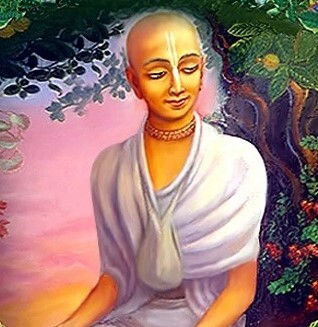
Sri Gadadhara Dasa Goswami was a direct associate of Sri Chaitanya Mahaprabhu in Navadwipa and, later, one of the closest companions Nityananda Prabhu had at his side when the Lord sent him to preach the sankirtana movement across Bengal. He is remembered above all for one thing: turning a hostile Kazi (a Muslim magistrate) into a chanter of the Hare Krishna maha-mantra, an episode Krishnadasa Kaviraja Goswami singles out in Sri Chaitanya-charitamrita as his defining achievement.
Scriptural evidence for the introduction (2)
sri-gadadhara dasa sakha sarvopari
kaji-ganera mukhe yeriha bolaila hari
Word for word
sri-gadadhara dasa: Sri Gadadhara dasa; sakha: another branch; sarva-upari: above all; kaji-ganera: of the Kazis (Muslim magistrates); mukhe: in the mouth; yeriha: one who; bolaila: caused to speak; hari: the holy name of Hari.
Sri Gadadhara dasa, the twenty-third branch, was understood to be the topmost, for he induced all the Muslim Kazis to chant the holy name of Lord Hari.
From the purport: Purport excerpt: "He is stated to be the luster of the body of Srimati Radharani, just as Srila Gadadhara Pandita Gosvami is an incarnation of Srimati Radharani Herself."
The verse and purport that most directly establish Gadadhara Dasa's identity and its explicit theological distinction from Gadadhara Pandit.
राधाविभूतिरूपा या चन्द्रकान्तिः पुरा स्थिता ।
साद्य गौराङ्ग निकटे दासवंशगदाधरः ॥१५४॥
पूर्णानन्दा व्रजे यासीद्बलदेव प्रियाग्रणीः ।
सापि कार्यवशादेव प्राविशतं गदाधरम् ॥१५५॥
rādhā-vibhūti-rūpā yā candrakāntiḥ purā sthitā |
sādya gaurāṅga nikaṭe dāsa-vaṁśa-gadādharaḥ ||154||
pūrṇānandā vraje yāsīd baladeva priyāgraṇīḥ |
sāpi kārya-vaśād eva prāviśataṁ gadādharam ||155||
Śrīla Gadādhara dāsa is considered to be a united form of Candrakānti, who is the effulgence of Śrīmatī Rādhārāṇī, and Pūrṇānandā, who is the foremost of Lord Balarāma’s very dear girlfriends.
Kavi Karnapura's two verses identifying Gadadhara Dasa as Chandrakanti, the effulgence of Srimati Radharani, joined by Purnananda, Balarama's dearest gopi friend. Sanskrit: diacritic edition of the Gaura-ganoddesha-dipika; translation: Srila Prabhupada, Chaitanya-charitamrita Adi 10.53 purport.
Chapter 1
Companion of Mahaprabhu in Navadwipa and Puri
His early years with Chaitanya Mahaprabhu, and the Vraja identity that explains his place in two households at once.
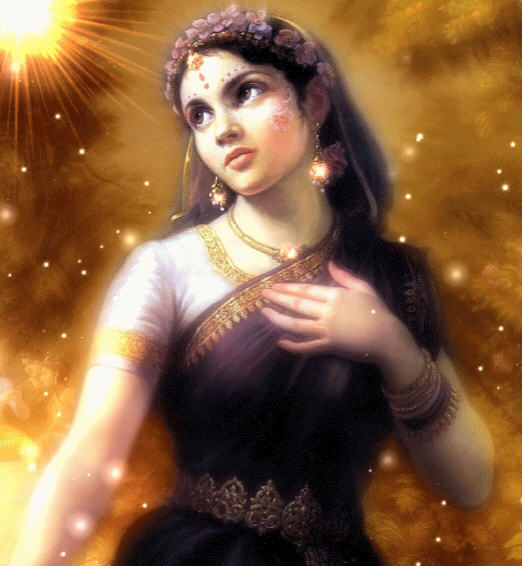
Long before he became known as Nityananda Prabhu's right hand in Bengal, Gadadhara Dasa was simply one of the devotees who stayed close to Sri Chaitanya Mahaprabhu in Navadwipa. When the Lord accepted sannyasa at Katwa and moved to Nilachala, Jagannatha Puri, Gadadhara Dasa was among those who went with Him rather than stay behind.
Among the Devotees at Puri #
Sri Chaitanya-charitamrita places Gadadhara Dasa in the company of the devotees who gathered around Mahaprabhu once He had settled at Puri. He is named there alongside Vasudeva Datta and Murari Gupta, together with devotees from Kulina-grama and Khanda who were not brahmanas by caste but who served the Lord with equal devotion. Their service was very practical. They would buy food that had first been offered to Lord Jagannatha and then invite Mahaprabhu to accept it as prasadam in their own homes. It is a small detail, but it tells us about the group Gadadhara Dasa belonged to. These men came from very different backgrounds. Only their attachment to the Lord and their eagerness to feed Him brought them together.
The Blessing at Raghava Pandit's House #
One of the few events from this period that is told in detail took place at the home of Raghava Pandit in Bengal, where Mahaprabhu stopped while travelling toward Vrindavana. Gadadhara Dasa came there to see Him. Chaitanya Mahaprabhu was so moved by this meeting that He placed His own foot on Gadadhara Dasa's head. The tradition has never forgotten this act of personal blessing. It is one of the clearest signs of how dear this servant was to the Lord, quite apart from anything he would later do under Nityananda Prabhu.
Chandrakanti and Purnananda in Vraja #
Gaudiya Vaishnava tradition does not see Mahaprabhu's associates only as historical people of sixteenth-century Bengal. It also asks who they were in the eternal Vraja pastimes, before Krishna appeared as Chaitanya Mahaprabhu and drew them back into His company. For Gadadhara Dasa the answer comes from the Gaura-ganoddesha-dipika, and it is unusually specific. He is described as two personalities joined together. One is Chandrakanti, a gopi who is herself an expansion (vibhuti) of Srimati Radharani's own beauty and radiance. The other is Purnananda, described as the foremost of the gopis dear to Lord Balarama. The verses explain that Purnananda entered into Chandrakanti "for the sake of her service," and it was this combined form that appeared in Gaura-lila as Gadadhara Dasa.
This is also where the tradition takes the most care to keep him separate from Sri Gadadhara Pandit. Gadadhara Pandit is identified as Radharani Herself, appearing alongside Krishna in His own incarnation as Chaitanya Mahaprabhu. Gadadhara Dasa is related to Her, but clearly different. He is not Radharani. He is the dyuti, the bodily luster or radiance, that shines from Her. Krishnadasa Kaviraja Goswami describes Mahaprabhu as radha-bhava-dyuti-suvalita, "endowed with the emotions and the very luster of Radharani's body," and Srila Prabhupada's purport explains that this description points to exactly this idea. Gadadhara Dasa is that dyuti in personal form. So the difference between them is a matter of theology, not just two people sharing a name. It also explains why Gadadhara Dasa could serve two seemingly different divine personalities, Chaitanya Mahaprabhu and Nityananda Prabhu, without any contradiction. He is an expansion of Radha's radiance, and also of one of Balarama's own dear associates. So, in a sense, he belonged to both households from the start.
Named Among the Devotees at Panihati #
Chaitanya-charitamrita's Antya-lila also names Gadadhara Dasa in a larger group of devotees who sat with Nityananda Prabhu on a raised platform at the Panihati festival (Antya-lila 6.61). Ramadasa, Sundarananda, Murari, Kamalakara, Sadasiva and Purandara are named with him. It is only a plain list, with no story or conversation attached to it.
Toward the Bengal Mission #
Gadadhara Dasa's belonging to both households became an outward fact once Mahaprabhu began sending Nityananda Prabhu out to preach across Bengal. How Gadadhara Dasa came to be chosen as one of Nityananda's own companions for that mission, and what he did once he arrived, is told on Nityananda's Chief Assistant and the Kazi. From his years in Navadwipa and Puri alone, one simple point remains. Long before the famous story of the Kazi, the Lord Himself had already blessed Gadadhara Dasa by His touch. And the tradition already understood him to be inseparable from Radharani's own radiance.
Scriptural evidence for this chapter (3)
radha-vibhuti-rupa ya
candrakantih pura vraje
sa sri-gauranga-nikate
dasa-vamsyo gadadharah
purnananda vraje yasid
baladeva-priyagrani
sapi karya-vasad eva
pravisat tam gadadharam
The gopi named Chandrakanti, who was an expansion of Sri Radha's own beauty in Vraja, appeared near Sri Gauranga in the servant's line as Gadadhara. Purnananda, who was the foremost of the gopis dear to Lord Baladeva in Vraja, also entered into that same Gadadhara for the sake of her service.
Cited in Srila Prabhupada's purport to Chaitanya-charitamrita Adi 10.53 as the textual basis for Gadadhara Dasa's dual Vraja identity as Chandrakanti and Purnananda.
ramadasa, sundarananda, dasa-gadadhara
murari, kamalakara, sadasiva, purandara
Word for word
ramadasa: Ramadasa; sundarananda: Sundarananda; dasa-gadadhara: Gadadhara dasa; murari: Murari; kamalakara: Kamalakara; sadasiva: Sadasiva; purandara: Purandara.
Among them were Ramadasa, Sundarananda, Gadadhara dasa, Murari, Kamalakara, Sadasiva and Purandara.
One of several plain devotee-lists in Chaitanya-charitamrita's Antya-lila that place Gadadhara Dasa among the regular company of devotees who came to see Mahaprabhu at Puri.
Word for word
vasudeva: Vasudeva; gadadhara-dasa: Gadadhara dasa; gupta-murari: Murari Gupta; kulina-grami: the inhabitants of Kulina-grama; khanda-vasi: the inhabitants of Khanda; jagannathera prasada: remnants of the food of Jagannatha.
They would extend invitations to the Lord. Vasudeva Datta, Gadadhara dasa, Murari Gupta, the inhabitants of Kulina-grama and Khanda and many other devotees who were not brahmanas by caste would purchase food offered to Lord Jagannatha and then extend invitations to Sri Chaitanya Mahaprabhu.
Places Gadadhara Dasa among the named devotees who personally served and invited Mahaprabhu during His years at Jagannatha Puri.
Chapter 2
Nityananda's Chief Assistant and the Kazi
How Gadadhara Dasa became one of Nityananda Prabhu's closest companions in Bengal, and the night he delivered a hostile Kazi through the holy name.
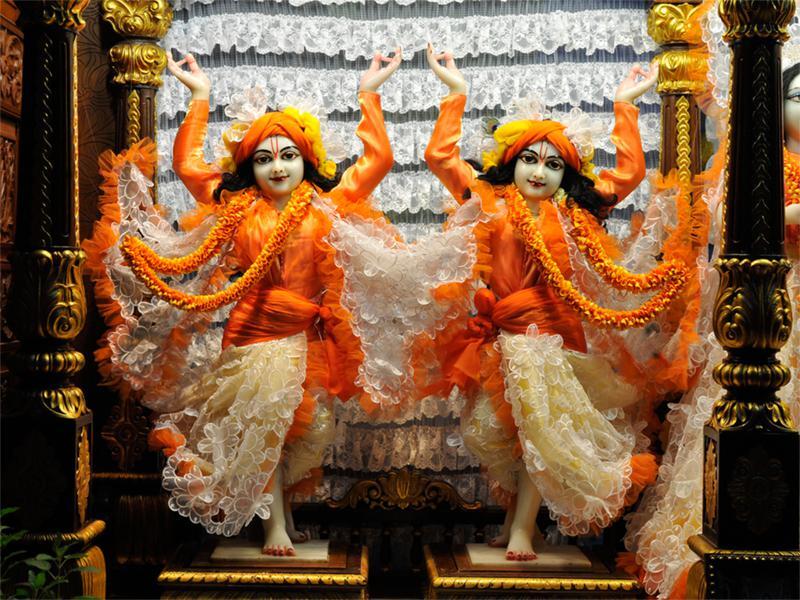
When Sri Chaitanya Mahaprabhu set out from Puri toward Vrindavana and reached Bengal, He made a decision that would shape the rest of Gadadhara Dasa's life. He did not let Nityananda Prabhu continue on with Him. He sent Nityananda back to preach the sankirtana movement across Bengal, and gave him companions for the task. Sri Chaitanya-charitamrita records that Mahaprabhu told Nityananda, in short, that He was giving him Ramadasa, Gadadhara Dasa and others as assistants to help him in the work. Ramadasa is the same devotee later known as Abhirama Gopala Thakura. Chaitanya-charitamrita notes elsewhere that he and Gadadhara Dasa always stayed together throughout this period, close to Nityananda's son Virabhadra Gosani.
Gopi-Bhava on the Road #
Most of Nityananda's other close assistants, the twelve gopalas, served him as friends, in sakhya-rasa. Gadadhara Dasa did not. The tradition says he remained absorbed in madhurya-rasa, the conjugal mood of the gopis of Vraja, and this could be seen in his behaviour. Travelling with Nityananda Prabhu, he would sometimes forget himself entirely. He would talk loudly the way a Vraja gopi would, or put a clay pot of Ganges water on his head and call out through the streets as if he were selling milk and yogurt: "Who wants to buy milk? Who wants to buy yogurt?" By every account, this was half serious and half pure ecstatic play. Nityananda Prabhu understood exactly what was happening and simply let it be. At some point during this Bengal period, Nityananda Prabhu and Madhava Ghosh together performed Dana-keli-lila in Gadadhara Dasa's own house. This drama shows Krishna's pastime of collecting toll from the gopis of Vraja. It was a remarkable thing to perform in the home of a man whom the tradition already understood to be one of those very gopis himself.
The Night at the Kazi's Door #
The episode that made Gadadhara Dasa famous, though, is the one Sri Chaitanya-charitamrita puts at the very top of the list. It is his meeting with a Kazi who opposed the sankirtana movement. Gadadhara Dasa was one of Nityananda's chief preachers, and his method was very simple. He asked everyone, whatever their caste, religion or social position, to chant the Hare Krishna maha-mantra. Not everyone welcomed it. One Kazi, a Muslim magistrate responsible for keeping order, was openly hostile to the sankirtana that had begun spreading quickly through the villages.
One night Gadadhara Dasa went to the Kazi's house anyway. Overwhelmed in Krishna-prema, he danced and chanted loudly outside the Kazi's door. The Kazi came storming out, ready to scold him for disturbing the peace, and then stopped short. The tradition describes Gadadhara Dasa's presence as the very luster of Radharani made visible. Something in that presence stopped the Kazi's anger before he could speak. Gadadhara Dasa embraced him warmly. The Kazi, startled, asked what he wanted. "Gaura-Nityananda have appeared on this earth to deliver everyone through divine love, by distributing the sweet nectar of the Holy Name of Hari," Gadadhara Dasa told him. "Why don't you chant this name yourself?" The Kazi, half mocking and half truly shaken, answered that he would chant it tomorrow. This was the chance Gadadhara Dasa had been waiting for. He began to dance on the spot. "Why tomorrow?" he said. "You have already chanted the Hare Krishna mantra, so simply continue." In the retelling, the Kazi had indeed said the name Hari during their conversation, and Gadadhara Dasa would not let him take back what he had already said. According to the tradition, that one utterance of the holy name purified the Kazi, and he took shelter at Gadadhara Dasa's feet.
The Twenty-Third Branch, and the Topmost #
Krishnadasa Kaviraja Goswami lists the many "branches" that grew from Chaitanya Mahaprabhu's tree of devotional service. He names Gadadhara Dasa as the twenty-third. Then he adds that Gadadhara Dasa was understood to be the topmost of them all, because he alone succeeded in making Kazis, as a group, into chanters of Krishna's name. Srila Prabhupada, commenting on this verse, held up Gadadhara Dasa's method as something anyone could still copy. It needed no elaborate philosophy. It was just a sincere servant of Nityananda Prabhu going door to door and asking people to chant. This is a very modest description for a devotee whom the tradition elsewhere identifies with Radharani's own radiance. The method was simple, but the one using it was a devotee of great depth. That contrast is the real point.
What became of Gadadhara Dasa once his years of active preaching in Bengal gave way to settled life is told on Final Years at Endiyadaha and Disappearance.
Scriptural evidence for this chapter (2)
rama-dasa, gadadhara adi kata jane
tomara sahaya lagi' dilu tomara sane
Word for word
rama-dasa: Ramadasa; gadadhara: Gadadhara dasa; adi: and others; kata jane: some people; tomara: Your; sahaya: assistants; lagi': as; dilu: I give; tomara sane: with You.
Nityananda Prabhu was given assistants like Ramadasa, Gadadhara dasa and several others. Sri Chaitanya Mahaprabhu said, "I give them to You to assist You."
Records Chaitanya Mahaprabhu personally assigning Gadadhara Dasa to Nityananda Prabhu as an assistant for the Bengal preaching mission.
gadadhara dasa gopibhave purnananda
yanra ghare danakeli kaila nityananda
Word for word
gadadhara dasa: Gadadhara dasa; gopi-bhave: in the ecstasy of the gopis; purna-ananda: fully in transcendental bliss; yanra ghare: in whose house; dana-keli: performance of dana-keli-lila; kaila: did; nityananda: Lord Nityananda Prabhu.
Srila Gadadhara dasa was always fully absorbed in ecstasy as a gopi. In his house Lord Nityananda enacted the drama Dana-keli.
Confirms that Nityananda Prabhu staged the Dana-keli-lila drama specifically in Gadadhara Dasa's own house, and describes his constant gopi-bhava.
Chapter 3
Final Years at Endiyadaha and Disappearance
His settled years at Katwa and Endiyadaha, his disappearance, and the temple his line built there over the following centuries.
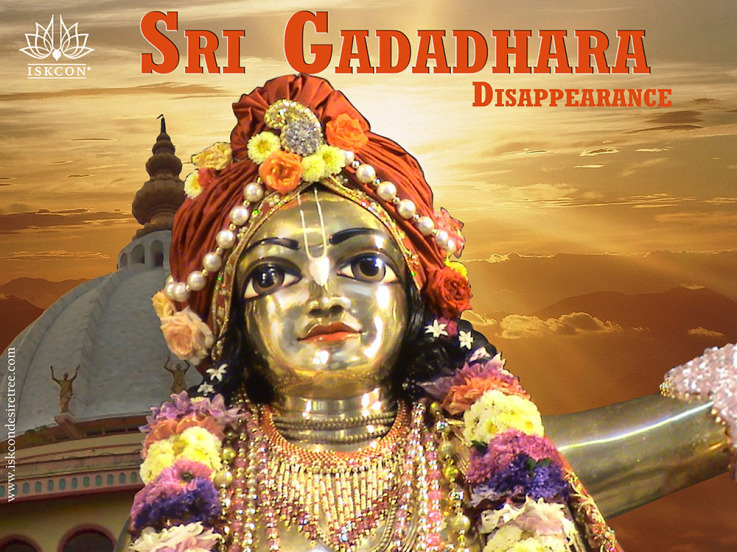
In time, Nityananda Prabhu's sankirtana campaign in Bengal settled into a quieter, more established stage. Gadadhara Dasa's own life changed in a similar way. He moved from the road to a fixed home, and from active preaching to founding temples that would outlast him by centuries.
From Katwa to Endiyadaha #
Gadadhara Dasa's first settled home was Katwa, the town where Chaitanya Mahaprabhu Himself had accepted sannyasa from Keshava Bharati. There he established a temple to Sri Gaurasundara. In time he also took a disciple, Yadunandana Chakravarti, the only disciple of his recorded in the available sources. Some accounts also say that for a time he cared for Sachi Mata and Vishnupriya Devi, Mahaprabhu's mother and wife, in Navadwipa before their own disappearances. But this detail rests on a single source, so it should be read with care.
Eventually Gadadhara Dasa moved on once more, this time to Endiyadaha-grama. This village on the banks of the Ganges, some eight or ten miles from Calcutta, became his final and best-remembered home. There he installed a Bala Gopala deity for worship. Sri Chaitanya-charitamrita, quoting the Bhakti-ratnakara, traces this whole sequence plainly: Navadwipa, then Katwa after Mahaprabhu's disappearance, then Endiyadaha, where Gadadhara Dasa made his last home. When they speak of this settled, later part of his life, the sources most often add a title of respect and call him Gadadhara Dasa Thakura, not simply Gadadhara Dasa. The change in title marks a change in his life. He was no longer a travelling preacher, a wandering companion passing through with Nityananda Prabhu. He had become an established local acharya, a householder who founded a temple, whom the people of Endiyadaha would have known directly.
His Disappearance in Kartika #
Gadadhara Dasa disappeared on Kartika-shukla-ashtami, the eighth day of the bright fortnight of the month of Kartika. The available sources give no year for this, and no year for his birth either. This is a real gap in a life that is otherwise unusually well recorded. We report the gap here and do not fill it with a guess.
The Temple That Outlived Him #
What happened at Endiyadaha after Gadadhara Dasa's disappearance is, in its own way, as remarkable as anything in his life. His tomb there passed first into the care of the Satyogi Vaishnavas, a Vaishnava community, and later came under the direction of Siddha Bhagavan Dasa Babaji of Kalna. This pattern repeats again and again in later Gaudiya Vaishnava history. A devotee's samadhi becomes the seed of a living temple, and a line of babajis and their followers look after it for generations. Readers will recognize it from the samadhi traditions of acharyas like Gaura Kishora Dasa Babaji as well. At Endiyadaha, on Siddha Bhagavan Dasa Babaji's order, Madhusudana Mullik built a small monastery on the site in the Bengali year 1256 (roughly the mid-nineteenth century). He was a member of the well-known Mullik family of Narikeladanga, Calcutta. He also arranged worship there for a Deity named Radhakanta. His son, Balaichandra Mullik, went further. In the Bengali year 1312 (roughly the early twentieth century) he installed Gaura-Nitai Deities alongside the existing ones. Ever since, the same altar at Endiyadaha has held both Gaura-Nityananda and Radha-Krishna together.
Why the Confusion with Gadadhara Pandit Still Matters #
As these pages said at the start, Gadadhara Dasa is not Gadadhara Pandit. They lived in the same generation, served the same Lord, and share the same first name. But the tradition is careful never to mix them up. Gadadhara Pandit is Radharani Herself in the Panca-tattva. Gadadhara Dasa is the luster of Her body. He served both Chaitanya Mahaprabhu and Nityananda Prabhu, and spent his later years quietly building a temple on the banks of the Ganges. Srila Prabhupada's own Chaitanya-charitamrita purports keep this difference exact, even while telling both of their stories with equal reverence. The same care has been kept here. For his years with Mahaprabhu before he ever came to Endiyadaha, see Companion of Mahaprabhu in Navadwipa and Puri. For the Bengal preaching years and the story of the Kazi, see Nityananda's Chief Assistant and the Kazi.
Closing
Not the Same Person as Gadadhara Pandit #
Because his name is Gadadhara, he is very easily and very often confused with Sri Gadadhara Pandit, the fourth member of the Panca-tattva. They are not the same person. Srila Prabhupada's purport to Chaitanya-charitamrita (Adi 10.53) makes the difference clear. It describes Gadadhara Pandit as an incarnation of Srimati Radharani Herself. But it describes Gadadhara Dasa as the luster, or dyuti, of Radharani's own body. He is an expansion, not the source. Krishnadasa Kaviraja calls Mahaprabhu radha-bhava-dyuti-suvalita, "endowed with the emotions and the bodily luster of Radharani," and the same purport explains that Gadadhara Dasa is that dyuti. The Gaura-ganoddesha-dipika is an earlier work that lists the Vraja identities of Mahaprabhu's associates. It is even more specific. It says that in Krishna-lila he was the gopi Chandrakanti, an expansion of Radha's own radiance, joined with Purnananda, a dear friend of Balarama in Vraja. This is also why he could serve comfortably in the households of both Chaitanya Mahaprabhu and Nityananda Prabhu at once.
| Detail | Description |
|---|---|
| Role | Servant (dasa) of Chaitanya Mahaprabhu, chief assistant to Nityananda Prabhu in Bengal |
| Birth | Not recorded; earliest known residence was Navadwipa |
| Later residence | Katwa, then Endiyadaha-grama on the Ganges, Bengal |
| Disappearance | Ashtami (eighth day), bright fortnight of Kartika (year not recorded) |
| Identity | Chandrakanti, Radharani's effulgence, joined by Purnananda, Balarama's gopi friend (Gaura-ganoddesha-dipika 154-155; Chaitanya-charitamrita Adi 10.53 purport) |
| Known disciple | Yadunandana Chakravarti of Katwa |
| Chief episode | Delivered a Kazi of Bengal by inducing him to chant Hare Krishna |
- Sri Chaitanya-charitamrita, Adi-lila 10.53 (verse, synonyms, translation and purport)
- Sri Chaitanya-charitamrita, Adi-lila 11.13
- Sri Chaitanya-charitamrita, Adi-lila 11.17
- Sri Chaitanya-charitamrita, Madhya-lila 15.43
- Sri Chaitanya-charitamrita, Antya-lila 6.61
- Sri Chaitanya-charitamrita, Antya-lila 10.140-141
- Gadadhara Dasa Thakura - Biography, Gaudiya History (ISKCON Desire Tree)
- Gadadhara Dasa Goswami, Gaudiya History (ISKCON Desire Tree)
- Sri Gadadhara Dasa Goswami, ISKCON Bangalore blog
- Gadadhara Dasa, Vedic Library (ISVARA.org)
- Sri Gadadhara Dasa Gosvami - Disappearance, Vaisnava Calendar Reminder Service
- Srila Gadadhara Dasa Gosvami, ISKCON Desire Tree
