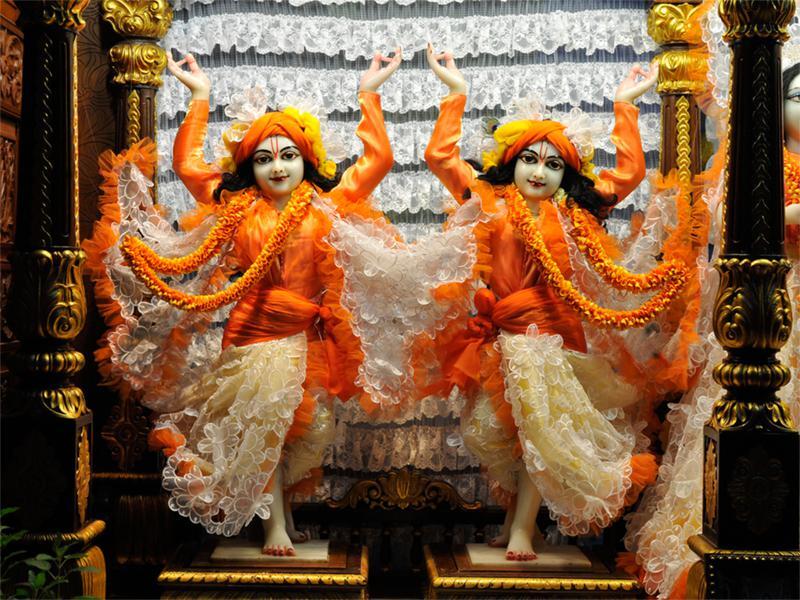
When Sri Chaitanya Mahaprabhu set out from Puri toward Vrindavana and reached Bengal, He made a decision that would shape the rest of Gadadhara Dasa's life. He did not let Nityananda Prabhu continue on with Him. He sent Nityananda back to preach the sankirtana movement across Bengal, and gave him companions for the task. Sri Chaitanya-charitamrita records that Mahaprabhu told Nityananda, in short, that He was giving him Ramadasa, Gadadhara Dasa and others as assistants to help him in the work. Ramadasa is the same devotee later known as Abhirama Gopala Thakura. Chaitanya-charitamrita notes elsewhere that he and Gadadhara Dasa always stayed together throughout this period, close to Nityananda's son Virabhadra Gosani.
Gopi-Bhava on the Road #
Most of Nityananda's other close assistants, the twelve gopalas, served him as friends, in sakhya-rasa. Gadadhara Dasa did not. The tradition says he remained absorbed in madhurya-rasa, the conjugal mood of the gopis of Vraja, and this could be seen in his behaviour. Travelling with Nityananda Prabhu, he would sometimes forget himself entirely. He would talk loudly the way a Vraja gopi would, or put a clay pot of Ganges water on his head and call out through the streets as if he were selling milk and yogurt: "Who wants to buy milk? Who wants to buy yogurt?" By every account, this was half serious and half pure ecstatic play. Nityananda Prabhu understood exactly what was happening and simply let it be. At some point during this Bengal period, Nityananda Prabhu and Madhava Ghosh together performed Dana-keli-lila in Gadadhara Dasa's own house. This drama shows Krishna's pastime of collecting toll from the gopis of Vraja. It was a remarkable thing to perform in the home of a man whom the tradition already understood to be one of those very gopis himself.
The Night at the Kazi's Door #
The episode that made Gadadhara Dasa famous, though, is the one Sri Chaitanya-charitamrita puts at the very top of the list. It is his meeting with a Kazi who opposed the sankirtana movement. Gadadhara Dasa was one of Nityananda's chief preachers, and his method was very simple. He asked everyone, whatever their caste, religion or social position, to chant the Hare Krishna maha-mantra. Not everyone welcomed it. One Kazi, a Muslim magistrate responsible for keeping order, was openly hostile to the sankirtana that had begun spreading quickly through the villages.
One night Gadadhara Dasa went to the Kazi's house anyway. Overwhelmed in Krishna-prema, he danced and chanted loudly outside the Kazi's door. The Kazi came storming out, ready to scold him for disturbing the peace, and then stopped short. The tradition describes Gadadhara Dasa's presence as the very luster of Radharani made visible. Something in that presence stopped the Kazi's anger before he could speak. Gadadhara Dasa embraced him warmly. The Kazi, startled, asked what he wanted. "Gaura-Nityananda have appeared on this earth to deliver everyone through divine love, by distributing the sweet nectar of the Holy Name of Hari," Gadadhara Dasa told him. "Why don't you chant this name yourself?" The Kazi, half mocking and half truly shaken, answered that he would chant it tomorrow. This was the chance Gadadhara Dasa had been waiting for. He began to dance on the spot. "Why tomorrow?" he said. "You have already chanted the Hare Krishna mantra, so simply continue." In the retelling, the Kazi had indeed said the name Hari during their conversation, and Gadadhara Dasa would not let him take back what he had already said. According to the tradition, that one utterance of the holy name purified the Kazi, and he took shelter at Gadadhara Dasa's feet.
The Twenty-Third Branch, and the Topmost #
Krishnadasa Kaviraja Goswami lists the many "branches" that grew from Chaitanya Mahaprabhu's tree of devotional service. He names Gadadhara Dasa as the twenty-third. Then he adds that Gadadhara Dasa was understood to be the topmost of them all, because he alone succeeded in making Kazis, as a group, into chanters of Krishna's name. Srila Prabhupada, commenting on this verse, held up Gadadhara Dasa's method as something anyone could still copy. It needed no elaborate philosophy. It was just a sincere servant of Nityananda Prabhu going door to door and asking people to chant. This is a very modest description for a devotee whom the tradition elsewhere identifies with Radharani's own radiance. The method was simple, but the one using it was a devotee of great depth. That contrast is the real point.
What became of Gadadhara Dasa once his years of active preaching in Bengal gave way to settled life is told on Final Years at Endiyadaha and Disappearance.
