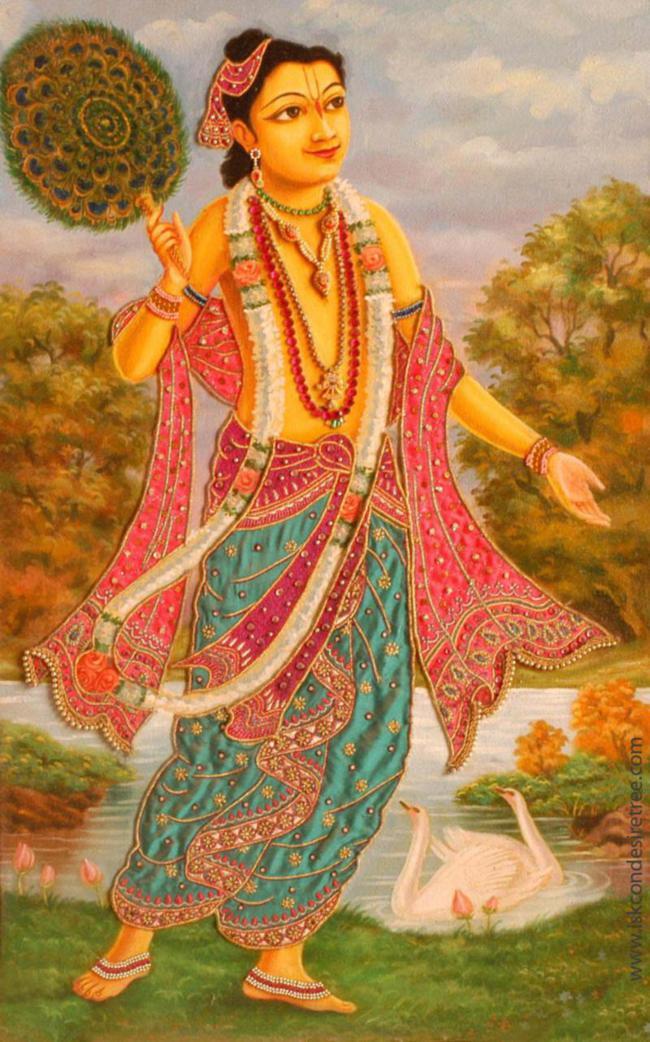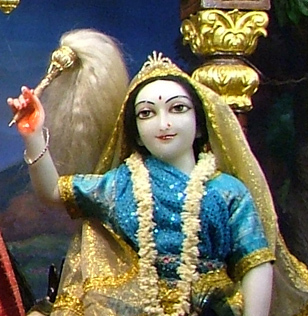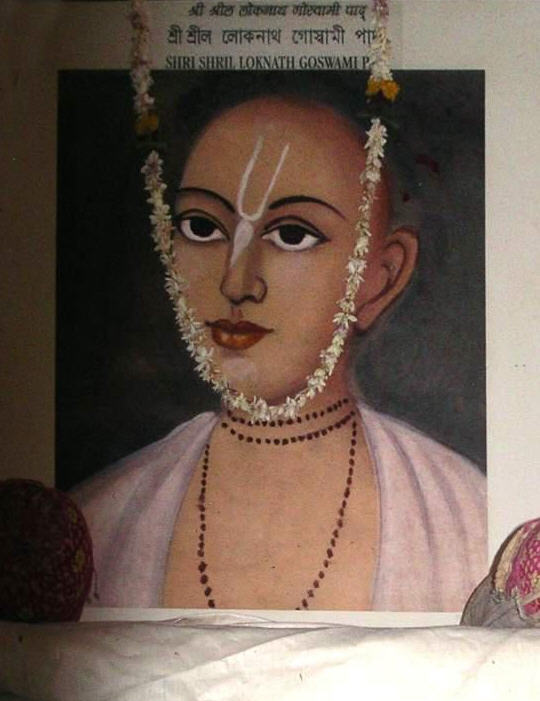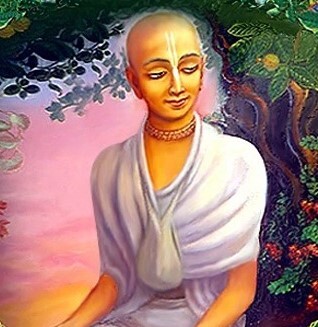
Sri Gadadhara Dasa Goswami
Companion of Mahaprabhu, Chief Preacher Under Nityananda Prabhu
Also known as Gadadhara Dasa Thakura, Dasa Gadadhara, Sri Gadadhara Dasa Gosvami, Endiyadaha-vasi Gadadhara Dasa
“Why tomorrow? You have already chanted the Hare Krishna mantra, so simply continue.”
Said to the Kazi of Bengal who had promised to chant the holy name "tomorrow"; recorded in Srila Prabhupada's purport to Sri Chaitanya-charitamrita, Adi-lila 10.53
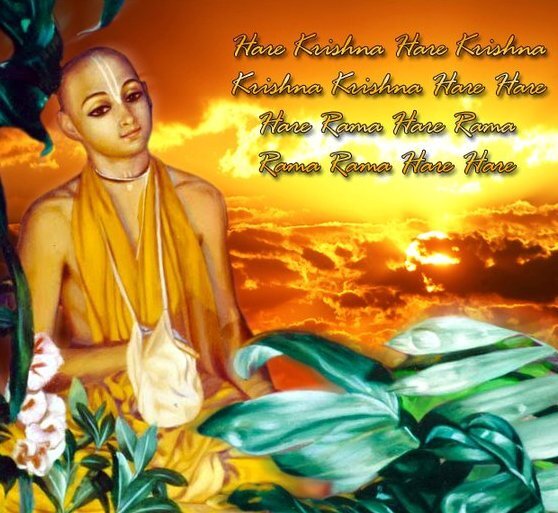
Sri Gadadhara Dasa Goswami was a direct associate of Sri Chaitanya Mahaprabhu in Navadwipa and, later, one of the closest companions Nityananda Prabhu had at his side when the Lord sent him to preach the sankirtana movement across Bengal. He is remembered above all for one thing: turning a hostile Kazi (a Muslim magistrate) into a chanter of the Hare Krishna maha-mantra, an episode Krishnadasa Kaviraja Goswami singles out in Sri Chaitanya-charitamrita as his defining achievement.
Not the Same Person as Gadadhara Pandit #
Because his name is Gadadhara, he is very easily and very often confused with Sri Gadadhara Pandit, the fourth member of the Panca-tattva. They are not the same person. Srila Prabhupada's purport to Chaitanya-charitamrita (Adi 10.53) makes the difference clear. It describes Gadadhara Pandit as an incarnation of Srimati Radharani Herself. But it describes Gadadhara Dasa as the luster, or dyuti, of Radharani's own body. He is an expansion, not the source. Krishnadasa Kaviraja calls Mahaprabhu radha-bhava-dyuti-suvalita, "endowed with the emotions and the bodily luster of Radharani," and the same purport explains that Gadadhara Dasa is that dyuti. The Gaura-ganoddesha-dipika is an earlier work that lists the Vraja identities of Mahaprabhu's associates. It is even more specific. It says that in Krishna-lila he was the gopi Chandrakanti, an expansion of Radha's own radiance, joined with Purnananda, a dear friend of Balarama in Vraja. This is also why he could serve comfortably in the households of both Chaitanya Mahaprabhu and Nityananda Prabhu at once.
| Detail | Description |
|---|---|
| Role | Servant (dasa) of Chaitanya Mahaprabhu, chief assistant to Nityananda Prabhu in Bengal |
| Birth | Not recorded; earliest known residence was Navadwipa |
| Later residence | Katwa, then Endiyadaha-grama on the Ganges, Bengal |
| Disappearance | Ashtami (eighth day), bright fortnight of Kartika (year not recorded) |
| Identity | Chandrakanti, Radharani's effulgence, joined by Purnananda, Balarama's gopi friend (Gaura-ganoddesha-dipika 154-155; Chaitanya-charitamrita Adi 10.53 purport) |
| Known disciple | Yadunandana Chakravarti of Katwa |
| Chief episode | Delivered a Kazi of Bengal by inducing him to chant Hare Krishna |
A Navadwipa Companion Who Followed the Lord #
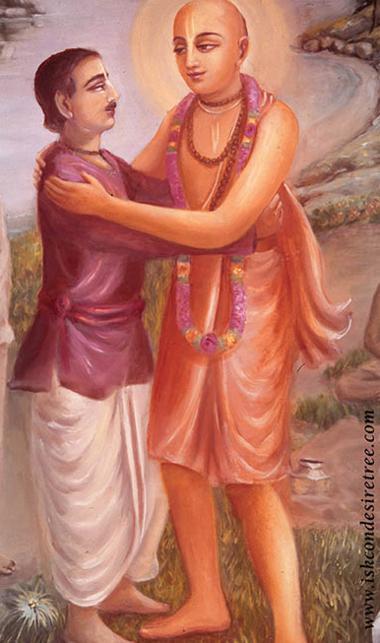
Gadadhara Dasa is counted among the devotees who lived close to Mahaprabhu in His Navadwipa days and who later followed Him to Nilachala, Jagannatha Puri, after His sannyasa. Chaitanya-charitamrita lists him among the devotees present with the Lord at Puri, alongside Vasudeva Datta and Murari Gupta. Together with the devotees of Kulina-grama and Khanda, these devotees would bring remnants of Jagannatha's own food to invite Mahaprabhu to eat. Once, Mahaprabhu was passing through Bengal on His way toward Vrindavana and stopped at the house of Raghava Pandit. Gadadhara Dasa came to see Him there. Mahaprabhu was overjoyed and placed His own foot on Gadadhara Dasa's head. The tradition still remembers this sign of the Lord's personal affection. More about this period in Navadwipa and Puri, and a fuller account of his Vraja identity, are given on Companion of Mahaprabhu in Navadwipa and Puri.
Sent to Bengal with Nityananda Prabhu #
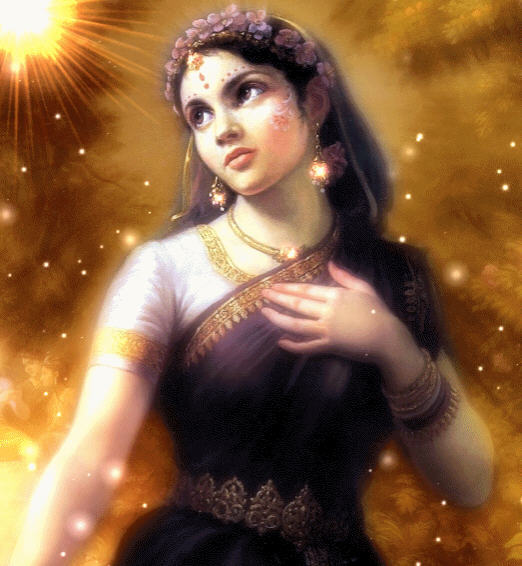
Chaitanya Mahaprabhu did not let Nityananda Prabhu continue on to Vrindavana. He turned him back toward Bengal to preach, and He sent two companions with him: Sri Ramadasa (later known as Abhirama Gopala Thakura) and Sri Gadadhara Dasa. Most of Nityananda's other assistants, the twelve gopalas, served him in sakhya-rasa, the mood of friendship. But Gadadhara Dasa, as Chaitanya-charitamrita puts it, remained always merged in madhurya-rasa, the conjugal mood of the gopis of Vraja. Some of the most lively and human stories recorded about him come from this mood. Absorbed in gopi-bhava, he would put a clay pot of Ganges water on his head and call out, as if he were selling milk and yogurt in the lanes of a Bengali village, "Who wants to buy milk? Who wants to buy yogurt?" Nityananda Prabhu, together with Madhava Ghosh, also once performed the drama Dana-keli-lila in Gadadhara Dasa's own house. As one of Nityananda's chief preachers, Gadadhara Dasa carried out the sankirtana campaign that made him famous. He went door to door and asked everyone, whatever their caste or position, simply to chant Hare Krishna. For this reason Krishnadasa Kaviraja calls him the "twenty-third branch" of the tree of Chaitanya Mahaprabhu's devotional service, and the topmost of all the branches, because he alone turned the Kazis into chanters of the holy name. The Kazis were the Muslim magistrates who often stood against the sankirtana movement. The full story of that night at the Kazi's door is told on Nityananda's Chief Assistant and the Kazi.
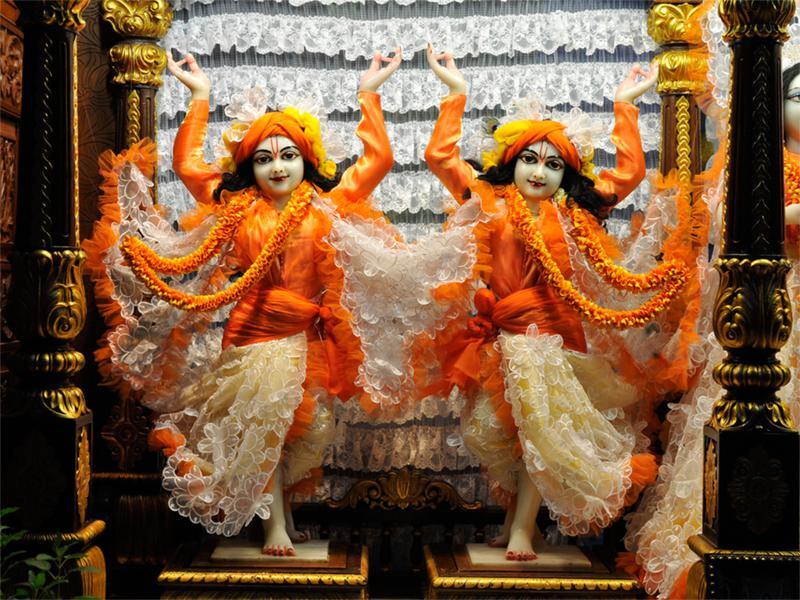
His gopi mood matches the identity that Srila Kavi Karnapura's Gaura-ganoddesha-dipika (verses 154-155) gives him:
rādhā-vibhūti-rūpā yā candrakāntiḥ purā sthitā
sādya gaurāṅga nikaṭe dāsa-vaṁśa-gadādharaḥ
pūrṇānandā vraje yāsīd baladeva priyāgraṇīḥ
sāpi kārya-vaśād eva prāviśataṁ gadādharam
"Śrīla Gadādhara dāsa is considered to be a united form of Candrakānti, who is the effulgence of Śrīmatī Rādhārāṇī, and Pūrṇānandā, who is the foremost of Lord Balarāma’s very dear girlfriends." (Gaura-ganoddesha-dipika 154-155, as explained by Srila Prabhupada in his purport to Chaitanya-charitamrita Adi 10.53)
Endiyadaha and What Remains Today #
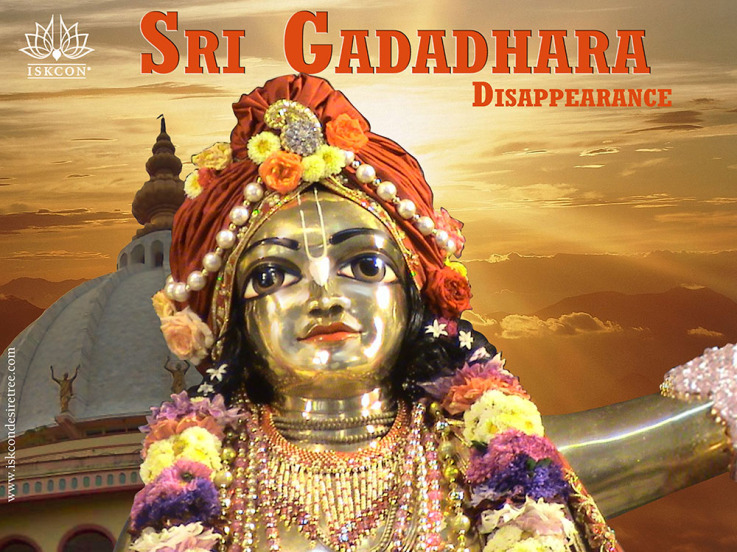
In his later years Gadadhara Dasa settled at Katwa, where Mahaprabhu had taken sannyasa, and established a temple there to Sri Gaurasundara. He then moved on to a village on the Ganges called Endiyadaha-grama, roughly eight or ten miles from Calcutta. This became his final residence, and there he installed a Bala Gopala deity. He disappeared there on Kartika-shukla-ashtami. The available sources give no year for either his birth or his disappearance, though much else about his life is well documented. His samadhi at Endiyadaha remained a living center of worship long after his time. Generations later, in the mid-nineteenth century, Madhusudana Mullik of Calcutta's Mullik family built a math there on the order of Siddha Bhagavan Dasa Babaji of Kalna. Madhusudana Mullik also installed a Deity of Radhakanta there. Early in the twentieth century, his son Balaichandra Mullik added Gaura-Nitai Deities. So Gaura-Nityananda and Radha-Krishna are worshipped together on the same altar to this day. This later history, and his one recorded disciple, Yadunandana Chakravarti of Katwa, are covered on Final Years at Endiyadaha and Disappearance.
No available source names a formal diksha guru for Gadadhara Dasa. Like several of Mahaprabhu's earliest Navadwipa associates, he is remembered simply as an eternal, direct companion of the Lord, and not through the usual account of an initiation. The fullest connected account of Gadadhara Dasa's life available in English is the Chaitanya-charitamrita commentary of Srila Prabhupada. Srila Prabhupada singled out Gadadhara Dasa's way of preaching, which was to ask everyone, without exception, simply to chant Hare Krishna. He pointed to it as a method any sincere servant of Nityananda Prabhu could still follow today.
Scriptural evidence
Quoted in the text above:
- Verses 154-155 Gaura-ganoddesha-dipika quoted above ↑
Further verses:
sri-gadadhara dasa sakha sarvopari
kaji-ganera mukhe yeriha bolaila hari
Word for word
sri-gadadhara dasa: Sri Gadadhara dasa; sakha: another branch; sarva-upari: above all; kaji-ganera: of the Kazis (Muslim magistrates); mukhe: in the mouth; yeriha: one who; bolaila: caused to speak; hari: the holy name of Hari.
Sri Gadadhara dasa, the twenty-third branch, was understood to be the topmost, for he induced all the Muslim Kazis to chant the holy name of Lord Hari.
From the purport: Purport excerpt: "He is stated to be the luster of the body of Srimati Radharani, just as Srila Gadadhara Pandita Gosvami is an incarnation of Srimati Radharani Herself."
The verse and purport that most directly establish Gadadhara Dasa's identity and its explicit theological distinction from Gadadhara Pandit.
- Sri Chaitanya-charitamrita, Adi-lila 10.53 (verse, synonyms, translation and purport)
- Sri Chaitanya-charitamrita, Adi-lila 11.13
- Sri Chaitanya-charitamrita, Adi-lila 11.17
- Sri Chaitanya-charitamrita, Madhya-lila 15.43
- Sri Chaitanya-charitamrita, Antya-lila 6.61
- Sri Chaitanya-charitamrita, Antya-lila 10.140-141
- Gadadhara Dasa Thakura - Biography, Gaudiya History (ISKCON Desire Tree)
- Gadadhara Dasa Goswami, Gaudiya History (ISKCON Desire Tree)
- Sri Gadadhara Dasa Goswami, ISKCON Bangalore blog
- Gadadhara Dasa, Vedic Library (ISVARA.org)
- Sri Gadadhara Dasa Gosvami - Disappearance, Vaisnava Calendar Reminder Service
- Srila Gadadhara Dasa Gosvami, ISKCON Desire Tree
Frequently asked
When was Sri Gadadhara Dasa Goswami born?
Sri Gadadhara Dasa Goswami appeared Not recorded in Not recorded (earliest known residence: Navadwipa).
When and where did Sri Gadadhara Dasa Goswami disappear?
Sri Gadadhara Dasa Goswami disappeared Kartika-shukla-ashtami (year not recorded) at Endiyadaha-grama, Bengal.
What are the main pastimes of Sri Gadadhara Dasa Goswami?
The pastimes covered here include: Companion of Mahaprabhu in Navadwipa and Puri, Nityananda's Chief Assistant and the Kazi, Final Years at Endiyadaha and Disappearance.