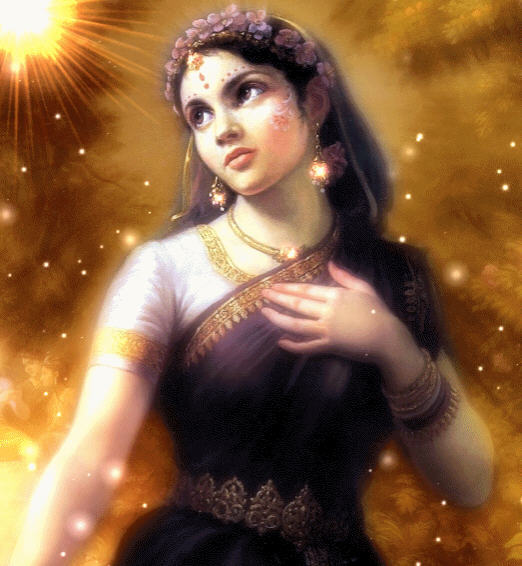
Long before he became known as Nityananda Prabhu's right hand in Bengal, Gadadhara Dasa was simply one of the devotees who stayed close to Sri Chaitanya Mahaprabhu in Navadwipa. When the Lord accepted sannyasa at Katwa and moved to Nilachala, Jagannatha Puri, Gadadhara Dasa was among those who went with Him rather than stay behind.
Among the Devotees at Puri #
Sri Chaitanya-charitamrita places Gadadhara Dasa in the company of the devotees who gathered around Mahaprabhu once He had settled at Puri. He is named there alongside Vasudeva Datta and Murari Gupta, together with devotees from Kulina-grama and Khanda who were not brahmanas by caste but who served the Lord with equal devotion. Their service was very practical. They would buy food that had first been offered to Lord Jagannatha and then invite Mahaprabhu to accept it as prasadam in their own homes. It is a small detail, but it tells us about the group Gadadhara Dasa belonged to. These men came from very different backgrounds. Only their attachment to the Lord and their eagerness to feed Him brought them together.
The Blessing at Raghava Pandit's House #
One of the few events from this period that is told in detail took place at the home of Raghava Pandit in Bengal, where Mahaprabhu stopped while travelling toward Vrindavana. Gadadhara Dasa came there to see Him. Chaitanya Mahaprabhu was so moved by this meeting that He placed His own foot on Gadadhara Dasa's head. The tradition has never forgotten this act of personal blessing. It is one of the clearest signs of how dear this servant was to the Lord, quite apart from anything he would later do under Nityananda Prabhu.
Chandrakanti and Purnananda in Vraja #
Gaudiya Vaishnava tradition does not see Mahaprabhu's associates only as historical people of sixteenth-century Bengal. It also asks who they were in the eternal Vraja pastimes, before Krishna appeared as Chaitanya Mahaprabhu and drew them back into His company. For Gadadhara Dasa the answer comes from the Gaura-ganoddesha-dipika, and it is unusually specific. He is described as two personalities joined together. One is Chandrakanti, a gopi who is herself an expansion (vibhuti) of Srimati Radharani's own beauty and radiance. The other is Purnananda, described as the foremost of the gopis dear to Lord Balarama. The verses explain that Purnananda entered into Chandrakanti "for the sake of her service," and it was this combined form that appeared in Gaura-lila as Gadadhara Dasa.
This is also where the tradition takes the most care to keep him separate from Sri Gadadhara Pandit. Gadadhara Pandit is identified as Radharani Herself, appearing alongside Krishna in His own incarnation as Chaitanya Mahaprabhu. Gadadhara Dasa is related to Her, but clearly different. He is not Radharani. He is the dyuti, the bodily luster or radiance, that shines from Her. Krishnadasa Kaviraja Goswami describes Mahaprabhu as radha-bhava-dyuti-suvalita, "endowed with the emotions and the very luster of Radharani's body," and Srila Prabhupada's purport explains that this description points to exactly this idea. Gadadhara Dasa is that dyuti in personal form. So the difference between them is a matter of theology, not just two people sharing a name. It also explains why Gadadhara Dasa could serve two seemingly different divine personalities, Chaitanya Mahaprabhu and Nityananda Prabhu, without any contradiction. He is an expansion of Radha's radiance, and also of one of Balarama's own dear associates. So, in a sense, he belonged to both households from the start.
Named Among the Devotees at Panihati #
Chaitanya-charitamrita's Antya-lila also names Gadadhara Dasa in a larger group of devotees who sat with Nityananda Prabhu on a raised platform at the Panihati festival (Antya-lila 6.61). Ramadasa, Sundarananda, Murari, Kamalakara, Sadasiva and Purandara are named with him. It is only a plain list, with no story or conversation attached to it.
Toward the Bengal Mission #
Gadadhara Dasa's belonging to both households became an outward fact once Mahaprabhu began sending Nityananda Prabhu out to preach across Bengal. How Gadadhara Dasa came to be chosen as one of Nityananda's own companions for that mission, and what he did once he arrived, is told on Nityananda's Chief Assistant and the Kazi. From his years in Navadwipa and Puri alone, one simple point remains. Long before the famous story of the Kazi, the Lord Himself had already blessed Gadadhara Dasa by His touch. And the tradition already understood him to be inseparable from Radharani's own radiance.
