Srila Govinda Dasa Kaviraja
Bengali Padavali Poet, Author of Bhajahu Re Mana
The complete life, on one page: The main biography and every pastime page, in order, in one place
Introduction
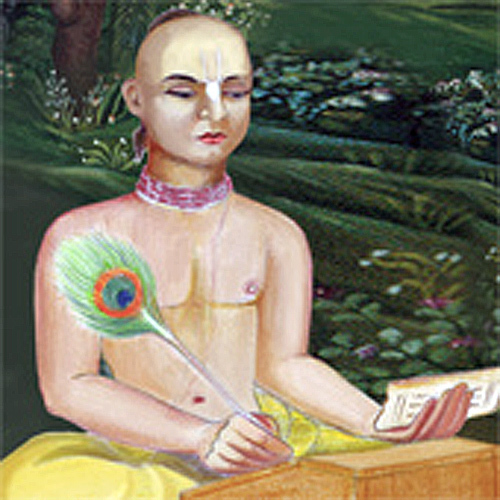
Srila Govinda Dasa Kaviraja was a Bengali Vaishnava poet of the generation after Sri Chaitanya Mahaprabhu's own associates. He is remembered chiefly for a body of devotional padas (songs) on Radha and Krishna and on Chaitanya Mahaprabhu Himself. Of everything he wrote, one song has outlasted the rest: Bhajahu Re Mana. It is still sung in Gaudiya Vaishnava kirtana today, and Srila Prabhupada explained it at length in more than one purport. Sri Chaitanya-charitamrita names him directly as "the famous Vaishnava poet," and he is remembered by the title Kaviraja. Srila Jiva Goswami gave him this title after reading his verse.
| Detail | Description |
|---|---|
| Traditional dates | c. 1535-c. 1613 (commonly repeated in secondary sources; Sri Chaitanya-charitamrita itself gives no dates) |
| Family home | Srikhanda, near Katwa, Bardhaman district, Bengal |
| Parents | Chiranjiva (father) and Sunanda (mother) |
| Guru | Shrinivasa Acharya |
| Elder brother | Ramachandra Kaviraja, also a disciple of Shrinivasa Acharya and a close associate of Narottama Dasa Thakura |
| Major works | Sangita-Madhava and Gitamrta |
| Title "Kaviraja" | Conferred by Srila Jiva Goswami in recognition of his poetry |
Chapter 2
The Song That Reached Jiva Goswami
A single pada sent to Vrindavana won Govinda Dasa Kaviraja his title, and a purport from Srila Prabhupada four centuries later.
Of all the songs Govinda Dasa Kaviraja wrote, one reached Vrindavana from Bengal in his own lifetime, and it has travelled far ever since. It begins bhajahu re mana, sri nanda-nandana abhaya-caranaravinda re, which means "O mind, just worship the lotus feet of the son of Nanda, which make one fearless." Sri Chaitanya-charitamrita records that after composing it, Govinda Dasa sent the song to Srila Jiva Goswami. By then Jiva Goswami was established in Vrindavana as one of the Six Goswamis who were setting Chaitanya Mahaprabhu's teaching in clear order. Jiva Goswami was so pleased with what he read that he wrote back. He urged Govinda Dasa to keep composing kirtanas of the same standard and to send them on to Vrindavana. Tradition holds that this exchange, and Jiva Goswami's clear regard for his poetic skill, earned Govinda Dasa the title Kaviraja, "king of poets."
What the Song Says #
Bhajahu Re Mana speaks, as its opening word suggests, to the poet's own mind, not directly to Krishna. This is unusual, and it gives the whole song a very personal feeling. Govinda Dasa pictures his mind worn out by years of chasing passing happiness. It has gone without sleep through cold and heat, wind and rain, wearing itself out in the service of "wicked and miserly men" for the smallest return. Again and again, he gives the tired mind one remedy. It should take shelter of the lotus feet of the son of Nanda. These feet are abhaya, fearless, because nothing that has once taken shelter there has anything left to fear. He also reminds his mind that it cannot do this training alone. It depends on durlabha manava-janama sat-sange, the rare human birth used in the association of saintly persons. The song closes on a personal note in the bhanita line, the line that names its author. There Govinda Dasa asks simply to hear Krishna's glories, chant them, remember them always, and offer his very self in service.
Srila Prabhupada's Two Purports #
Srila Prabhupada returned to this song more than once. In a purport recorded in San Francisco on 16 March 1967, he explained the wordplay in Govinda Dasa's own name, "Govinda, Krishna, and dasa means servant," and then went through the song's warning. The song warns that a human life spent chasing fear and passing pleasure, without the association of devotees, wastes the rarest chance a soul can be given. Five years later, in Los Angeles on 27 May 1972, he returned to the same pada. He explained why Govinda Dasa addresses Krishna as "Nanda-nandana" and not directly by name. Prabhupada explained that approaching the Lord through His relationship with a devotee pleases Him more than a plain, direct address. He then quoted a verse from Srimad-Bhagavatam. It describes how, for one who takes shelter of Krishna's lotus feet, every step in this material world is no longer dangerous. With that verse he made, in Sanskrit, the very same point that Govinda Dasa's Bengali pada had already made four centuries earlier: fix the mind at Krishna's feet, and there is nothing left to fear. Here an acharya giving purports came back to one sixteenth-century Bengali pada on two separate occasions, five years apart. This tells us something about how deeply this small song had settled into Gaudiya Vaishnava devotional life by the twentieth century.
An Honest Note on the Title Itself #
Kaviraja is not a title unique to Govinda Dasa. Krishnadasa Kaviraja Goswami, the author of Sri Chaitanya-charitamrita itself, carried the same title. In Bengali the word is also the ordinary term for a hereditary Ayurvedic physician. This fits, since some sources describe Govinda Dasa's own family as belonging to that profession (see Srikhanda, Family, and the Turn to Vaishnavism). Chaitanya-charitamrita itself uses the word in both senses in different places. Its account of Jiva Goswami's praise says that Govinda Dasa's title came from his poetry. But a separate verse elsewhere in the text uses "kavirajas" simply to mean physicians, when it counts members of his family circle among Nityananda Prabhu's followers. For Govinda Dasa Kaviraja himself, Chaitanya-charitamrita explains the title by his poetic excellence, as Jiva Goswami judged it. That explanation is followed here. But the word also carried a second meaning, linked to the family trade, and we have not tried to fully separate that meaning from the poetic one.
Scriptural evidence for this chapter (2)
kaṁsāri sena, rāmasena, rāmacandra kavirāja govinda, śrīraṅga, mukunda, tina kavirāja
Word for word
kaṁsāri sena: Kamsari Sena; rāmasena: Ramasena; rāmacandra kavirāja: Ramachandra Kaviraja; govinda: Govinda; śrīraṅga: Shriranga; mukunda: Mukunda; tina kavirāja: all three are Kavirajas, or physicians.
The fifty-eighth great devotee of Lord Nityananda Prabhu was Kamsari Sena, the fifty-ninth was Ramasena, the sixtieth was Ramachandra Kaviraja, and the sixty-first, sixty-second and sixty-third were Govinda, Shriranga and Mukunda, who were all physicians.
From the purport: Purport excerpt: "Since Govinda Kaviraja, the author of two books, Sangita-madhava and Gitamrta, was a great Vaishnava kavi, or poet, Srila Jiva Gosvami gave him the title Kaviraja."
The verse itself glosses kaviraja as physician, while the purport explains that Govinda Dasa personally received the title for his poetry from Jiva Goswami, the two-sided meaning discussed openly rather than resolved here.
bhajahū re mana śrī-nanda-nandana abhaya-caraṇāravinda re, durlabha mānava-janama sat-saṅge, tāroho e bhava-sindhu re
Word for word
bhaja: worship; hu: please; mana: O mind; śrī-nanda-nandana: the son of Nanda Maharaja; abhaya: fearless; caraṇa-aravinda: lotus feet; durlabha: rarely obtained; mānava-janama: this human birth; sat-saṅge: in the association of saintly persons; tāroho: cross over; e bhava-sindhu: this ocean of material existence.
O mind, just worship the lotus feet of the son of Nanda, which make one fearless. Having obtained this rare human birth, cross over this ocean of worldly existence by associating with saintly persons.
Govinda Dasa Kaviraja's own most famous pada, quoted here in the translation Srila Prabhupada used in his own purports on the song in 1967 and 1972.
Chapter 3
A Padavali Poet Among Giants
Where Govinda Dasa Kaviraja stands among Bengal's Vaishnava-pada poets, and why not every song signed Govinda Dasa is safely his.
Beyond Bhajahu Re Mana, Govinda Dasa Kaviraja is credited with two named collections, Sangita-Madhava and Gitamrta, and with a larger group of single padas that later collectors gathered under his name. Together these works place him in one clear literary movement, the Vaishnava padavali tradition. For centuries Bengal produced a great wealth of devotional lyric poems built around the love story of Radha and Krishna. This poetry grew most richly in the two centuries after Sri Chaitanya Mahaprabhu's own life. Historians of this poetry regularly name Govinda Dasa Kaviraja among its finest poets, together with Chandidasa, Jnanadasa Thakura, and the Maithili poet Vidyapati. Vidyapati's work came before the whole movement and strongly shaped it. These four poets are sometimes each linked with one main theme. Vidyapati is remembered for lyrics of separation, Chandidasa for love and union, and Jnanadasa for tender affection. Govinda Dasa Kaviraja is remembered above all for the lovers' secret meetings themselves, and the anxious feelings that surround them.
Writing in Vidyapati's Shadow #
Govinda Dasa Kaviraja composed mostly in Brajabuli. This was an artificial, courtly literary language that blended Bengali and Maithili. Vidyapati had made it popular among Vaishnava poets more than a century before him. Govinda Dasa is sometimes called Bengal's "second Vidyapati" because his verse took in that inheritance so fully. Some accounts hold that he traveled all the way to Bishphi, Vidyapati's own home village in the Madhubani region, to study and collect his work directly. Still, what he made from that inheritance was his own. Vidyapati's poetry dwells on separation, and Chandidasa's on union. But Govinda Dasa Kaviraja's padas are especially linked with the anxious, unsettled moments of the lovers' secret meetings, above all Radha's uneasiness at Krishna's restless, wandering ways. His influence lasted even longer than the padavali tradition itself. Centuries later, Rabindranath Tagore drew on this same Brajabuli style of Vaishnava padavali poetry, including Govinda Dasa Kaviraja's poems, when he composed his own early collection Bhanusimher Padavali.
Not Every "Govinda Dasa" Is This One #
There is a real difficulty in the old manuscripts of the padavali tradition. Several poets of this time signed their songs in the bhanita line with the name "Govinda Dasa" or a name close to it. Later compilers have not always agreed on which songs belong to which poet. The collection of devotional songs here shows the same difficulty openly, instead of hiding it. It keeps the songs that can be surely identified as Govinda Dasa Kaviraja's, Bhajahu Re Mana among them, as a small, separate set. A much larger group of songs about Chaitanya Mahaprabhu's own pastimes also carries a "Govinda Dasa" signature. But judging from their content, these songs seem to belong to a different poet with the same or a very similar name. Readers should also keep him separate from Krishnadasa Kaviraja Goswami, the author of Sri Chaitanya-charitamrita, and from Govinda Ghosh. Govinda Ghosh was one of the Ghosh brothers, hereditary kirtan singers who were personal associates of Chaitanya Mahaprabhu. These are three different men with three different bodies of work. Only variations of one common name join them.
A Song Still Sung #
Some things remain uncertain about which padas belong to him. But there is no serious doubt that Govinda Dasa Kaviraja wrote Bhajahu Re Mana. Sri Chaitanya-charitamrita names him directly. The song carries his own bhanita signature. And Srila Prabhupada treated the matter as settled when he gave purports on it in both 1967 and 1972 (see The Song That Reached Jiva Goswami). Four centuries ago, a household of Srikhanda poets sent a song to Vrindavana and received a title in return. Today, when Gaudiya Vaishnavas everywhere speak the name Govinda Dasa Kaviraja, that song is what they mean.
Closing
Songs in the Vaishnava Song Book #
The Vaishnava Song Book carries 2 songs attributed to Srila Govinda Dasa Kaviraja; see the full author page here.
- Sri Chaitanya-charitamrita, Adi-lila 10.78-79, purport
- Sri Chaitanya-charitamrita, Adi-lila 11.51, purport
- Govinda Dasa Kaviraja | Gaudiya History
- Govinda Das Kaviraj - Vaishnav Songs | ISKCON Desire Tree
- Purport to Bhajahu Re Mana, San Francisco, 16 March 1967
- Purport to Bhajahu Re Mana, Los Angeles, 27 May 1972
