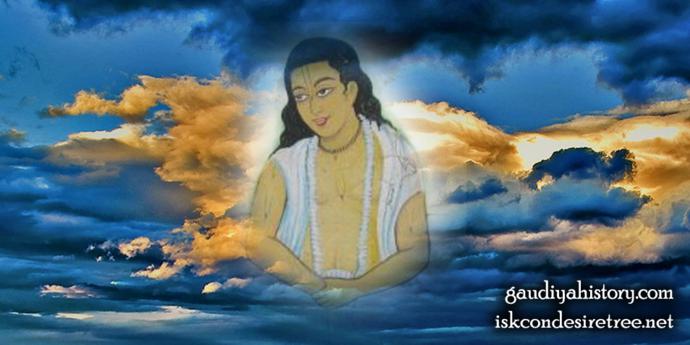
Some years after Hridaya Chaitanya received his new name, a boy arrived at Ambika Kalna. This boy's own life would carry that name far beyond Bengal. He was born to a family of milkmen belonging to the Six Gopa (Shata-gopa) community at Dharenda Bahadurpur. This village is now identified with Kalaikunda near Midnapur. He was named Duhkhi, meaning "sorrowful," and the name is sometimes spelled Dukhi or Dukhia. His father, Krishna Mandal, and mother, Durika, had lost several children before his birth. They are said to have named him Duhkhi to keep away further grief, and to have vowed that if this child survived they would offer him to Vishnu's service.
| Detail | Description |
|---|---|
| Birth name | Duhkhi (Dukhi, Dukhia) |
| Family | Milkmen (gopas) of the Six Gopa lineage; father Krishna Mandal, mother Durika |
| Birthplace | Dharenda Bahadurpur, near present-day Kalaikunda, Midnapur |
| Journey | Traveled with Ganga pilgrims to Ambika Kalna in Bengal |
| Name given by Hridaya Chaitanya | Krishnadasa (combined in tradition as Duhkhi Krishnadasa) |
A Boy Marked for Renunciation #
Even as a child, sources agree, Duhkhi showed signs that set him apart: an unusual seriousness once his basic schooling was done, and a growing pull toward the stories of Gaura and Nityananda that he heard from local devotees. When that pull became a wish to bathe in the Ganges, his father, himself a devotee, gave his blessing and let the boy join a group of pilgrims bound for Gauda-desh. He never returned home.
Two Accounts of How They Met #
Sources truly differ on whether this meeting was planned or happened by chance. Both versions are given here, without mixing them into one. One widely repeated account, on the Gaudiya History website's biography of Shyamananda Prabhu, describes the meeting as closer to chance. In this account, the boy simply traveled with the pilgrims to Ambika Kalna and, once there, "chanced to meet" Hridaya Chaitanya. A more detailed devotional account, compiled in a "Life of Shyamananda Pandit," tells it differently. In it, Duhkhi names Hridaya Chaitanya as his intended guru even before leaving home. He tells his father plainly, "Hriday Chaitanya Prabhu is my guru, he lives in Ambika Kalna. His guru is Gauridas Pandit... If you give the order, I will go to him." The available sources do not agree on this point. Perhaps Hridaya Chaitanya's reputation had already reached a milkman's household many days' journey away. Or perhaps the two simply found each other once the boy arrived.
What They Do Agree On #
Both versions agree on what happened at the meeting itself. When the boy arrived at Ambika Kalna, he paid his respects outside Gauridasa Pandit's household temple and found Hridaya Chaitanya there. When asked who he was, Duhkhi answered simply and honestly. He said that he had come a long way, that he was from a family of milkmen, and that his name was Duhkhi. Tradition says Hridaya Chaitanya was pleased by the plain sincerity of the boy's words. It says that he looked past the boy's non-brahmana birth and recognized in him what one account calls "the lotus of devotion blooming on the stem of renunciation." He gave the boy a new name on the spot, Krishnadasa. In time, on an auspicious day, he formally initiated him with the Krishna mantra.
A Choice That Echoes Through the Lineage #
This willingness to see real devotion first and social birth second was not an isolated kindness. Sri Chaitanya Mahaprabhu Himself is recorded as teaching this same principle to Ramananda Raya: that "whether one is a brahmana, a sannyasi or a shudra... he can become a spiritual master if he knows the science of Krishna" (Sri Chaitanya-charitamrita, Madhya 8.128). Later, when Krishnadasa had become Shyamananda Pandit, he handed down this very principle as an explicit order to his own chief disciple, Rasikananda Prabhu. He did this when he sent Rasikananda to initiate people across every caste line in Odisha. Hridaya Chaitanya's acceptance of a milkman's son at Ambika Kalna is where that three-generation thread begins. Training and Sending Him to Vrindavana tells what came next. It describes the training Hridaya Chaitanya gave this new disciple and the decision to send him to Vrindavana.
