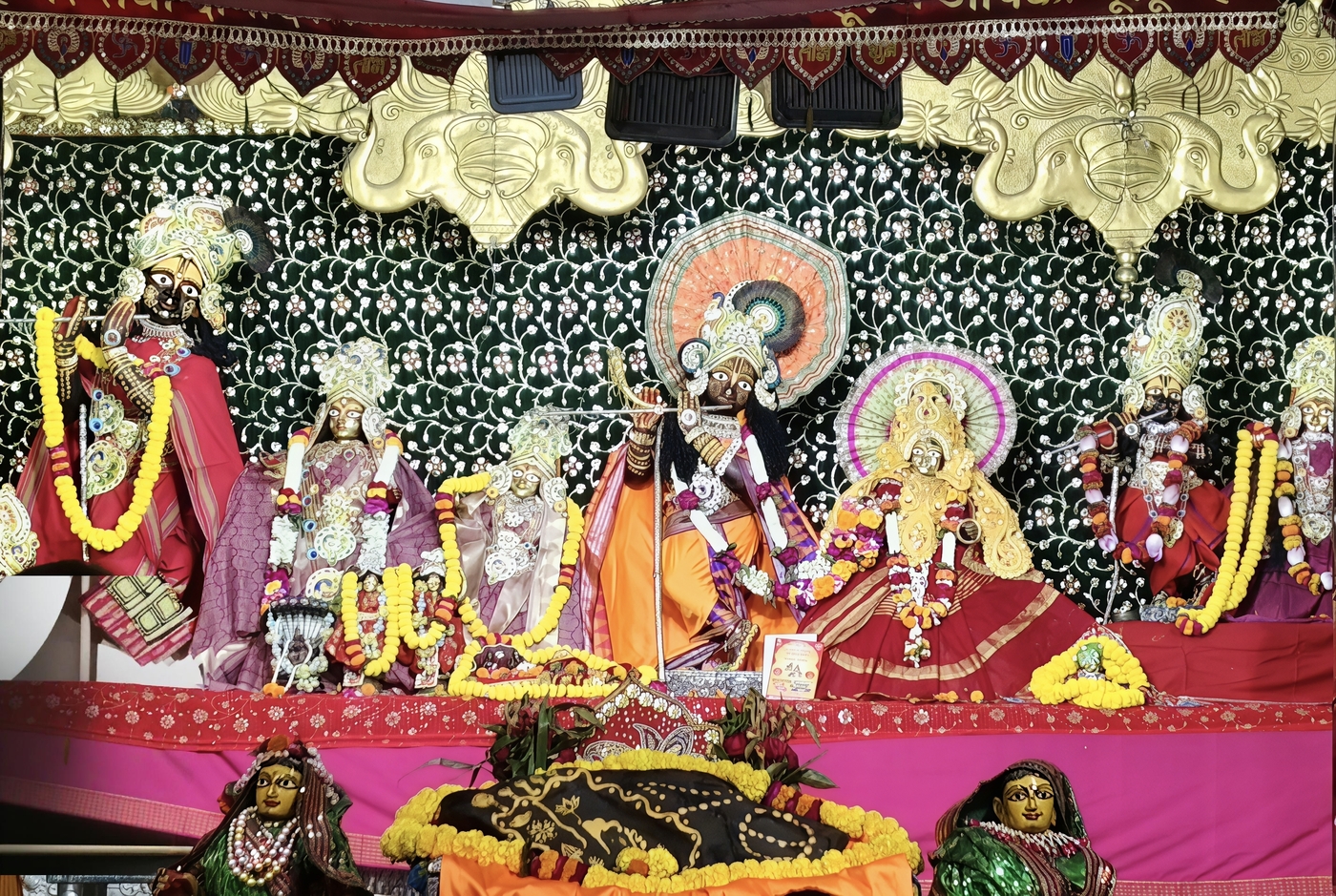
Once initiated, Krishnadasa gave himself completely to his guru's service. Hridaya Chaitanya watched that service closely. He is remembered as someone who trained his disciple with real personal attention, not one who simply accepted him and moved on. The available sources do not say exactly what the training was, beyond "assiduous service," meaning careful and hard-working service. This is a common description in this literature for a disciple's daily care of his guru's needs. But the same sources do describe in detail how wisely Hridaya Chaitanya recognized when his disciple's service had matured enough for him to be sent further. They also describe how he personally and deliberately made that happen.
| Detail | Description |
|---|---|
| New disciple's stated wish | To see the river Yamuna, having already bathed in the Ganges |
| Guru's response | "Yes, of course, you shall see it. You shall go to Braj-dhama." |
| Destination | Vrindavana, to study under Jiva Goswami |
| Traveling companions found there | Narottama Dasa Thakura and Shrinivasa Acharya |
| New name received in Vrindavana | Shyamananda |
"You Shall Go to Braj-Dhama" #
Tradition preserves a short but meaningful conversation between guru and disciple. After his bath in the Ganges, Krishnadasa's heart only grew more restless. "Now I shall see the Yamuna," he told his guru. Hridaya Chaitanya did not discourage this longing or treat it as youthful impatience. He understood it correctly as the pull of Vrindavana itself, and answered simply: "Yes, of course, you shall see it. You shall go to Braj-dhama." Some time later, when he judged that his disciple's service and devotion were firm enough, Hridaya Chaitanya gave Krishnadasa permission to travel to Vrindavana. Tradition says he sent with him his own messages of respect and dandavats to be delivered to the six Goswamis. According to the same account, he had also already written ahead to Jiva Goswami himself: "I have a disciple named Duhkhi Krishnadasa. I am offering him to you. Teach him well in Krishna consciousness... when his mind is fixed... you may send him back to me." The message may or may not have been delivered in exactly those words. But every version of the story makes the same point. This was a planned handing over between two gurus, not an abandonment.
The Journey to Vrindavana #
Krishnadasa's route to Vrindavana is remembered as a pilgrimage in itself. He went first through Navadwipa, where he paid respects at the old house of Jagannatha Mishra. Then he went to Gaya, where Chaitanya Mahaprabhu Himself had once taken initiation from Ishvara Puri. In Kashi (Benares) he met Tapana Mishra and Chandrashekhara Acharya. Finally he reached Mathura and Vrindavana, where he went looking for Jiva Goswami's own bhajana hut. There he found two other young students already studying under Jiva Goswami: Narottama Dasa Thakura and Shrinivasa Acharya. The three of them became close companions in scriptural study and in madhukari, the practice of begging just enough food for the day.
A Guru's Displeasure, and a Change of Heart #
This very human episode is, in one sense, as much about Hridaya Chaitanya as about his disciple. In Vrindavana, tradition holds, Krishnadasa received an unusual mark of tilaka and a new name, Shyamananda, in connection with a vision involving Srimati Radharani. Jiva Goswami himself was joyful about what had happened, though he asked that it not be spoken of publicly. Still, word of the change reached Ambika Kalna. Hridaya Chaitanya heard that his disciple had taken on a new name and tilaka without his permission. He was angry enough to travel to Vrindavana himself and scold Krishnadasa directly. Krishnadasa, tradition says, bore the rebuke without protest, certain in his own mind that he had never actually left his guru's service. That night, in a dream, Hridaya Chaitanya is said to have been rebuked in turn by Radharani herself. In the dream she told him plainly that she had given the boy his new name and mark, and asked why he had instructed his disciple otherwise. By morning Hridaya Chaitanya had accepted what had happened. He embraced Shyamananda warmly and returned to Ambika Kalna reconciled. The exact historical facts behind this episode are not certain. But the devotional sources consistently tell it as the moment when Hridaya Chaitanya's position as guru was, in a sense, corrected and confirmed at the same time.
Called Back, and Sent On Again #
Later, Shyamananda returned once to Ambika Kalna to report to his guru on his studies, before continuing eastward. It was from Ambika Kalna, some time afterward, that Hridaya Chaitanya gave the order that shaped the rest of Shyamananda's life. He saw that Chaitanya Mahaprabhu's own associates in Utkal desh were passing on one by one, and that the preaching there was fading. So he directed his disciple to go and revive it. That mission and what it built are the subject of Legacy.
