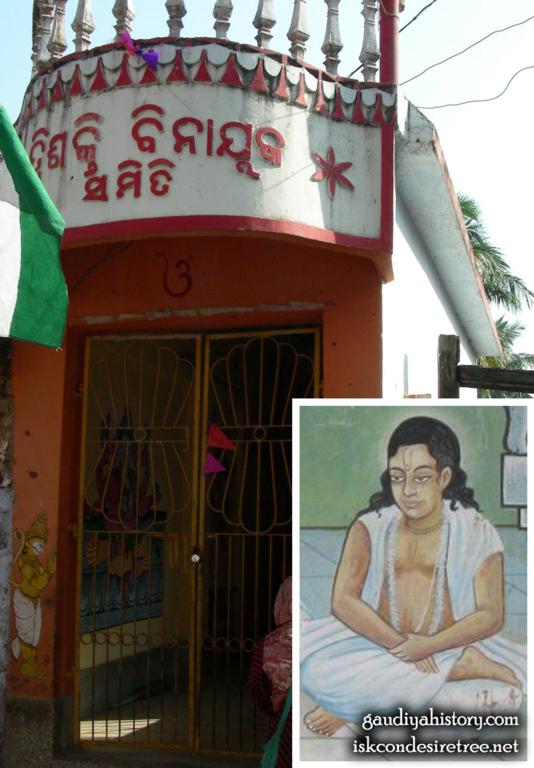
Shyamananda Pandit left Ambika Kalna carrying his guru's order on his head. By his own account, he felt real pain at leaving Hridaya Chaitanya behind. What he built afterward across Utkal is well recorded in the traditional life stories. Its outline is traced here, because every part of it grew, directly or indirectly, out of Hridaya Chaitanya's own original decision to recognize and train him.
| Detail | Description |
|---|---|
| Shyamananda's mission field | Dandeshwar, Rohini, Balarampur, Nrisimhapur, Gopiballabhpur, and wider Utkal |
| Chief disciple found in Utkal | Rasikananda Prabhu, met at Rohini |
| Later philosophical descendant | Baladeva Vidyabhusana |
| Hridaya Chaitanya's disappearance | Date and place not recorded; occurred while Shyamananda was preaching in Utkal |
| Shyamananda's own disappearance | 1552 Shaka era (1630 AD), by tradition |
Building a Mission in Utkal #
On his way to Utkal, Shyamananda passed through his own birth village and through Dandeshwar, where his father had once lived, preaching in both. At Rohini, on the Subarnarekha river, he met the young Rasikananda Prabhu, who quickly became his foremost disciple. Rasikananda's own page on discipleship under Shyamananda Pandit tells of this meeting in full. At Gopiballabhpur, Shyamananda installed Deities of Radha-Govinda that Rasikananda would later be entrusted to serve. From Nrisimhapur to Balarampur, Shyamananda is remembered for winning over wealthy householders, yogis, and even open skeptics through kirtana and plain explanation of the teachings of Gaura and Nityananda.
Word of a Guru's Passing #
At some point during these years of active preaching, Shyamananda received news that Hridaya Chaitanya had passed away. According to the fullest account of his life, he was at Gopiballabhpur at the time. Shyamananda is said to have fainted at the news, and then to have wept for a long time, until his guru appeared in a dream to comfort him and encourage him to continue his preaching. No available source gives a date, a place, or any further circumstance of Hridaya Chaitanya's own disappearance. We state this plainly instead of filling the gap with invented details. Shyamananda's birth, initiation, travels, and death are recorded in several independent accounts. But Hridaya Chaitanya himself simply disappears from the records, with no account of his last days.
A Line That Reaches Baladeva Vidyabhusana #
The lineage that his one act of recognition started is clearly remembered. From Shyamananda Pandit, the line of formal initiation runs through Rasikananda Prabhu. According to Gauridasa Pandit's own legacy page, it then continues through Nayanananda Goswami and Radha Damodara Goswami to Baladeva Vidyabhusana. Baladeva Vidyabhusana was the eighteenth-century scholar whose Govinda-bhashya secured the Gaudiya sampradaya's standing at Jaipur in 1718. In this way, a recorded chain of formal discipleship runs from Ambika Kalna, where a Bengali guru was willing to initiate a milkman's son, to one of the most important philosophical defenses the Gaudiya Vaishnava tradition ever made. That defense came nearly two centuries and several generations later.
The Same Principle, Handed Down Once More #
The thread that matters most in Hridaya Chaitanya's own story did not end with Baladeva Vidyabhusana's scholarship. It appeared again, more directly, in how Shyamananda himself passed on what he had received. When Shyamananda sent Rasikananda Prabhu to preach, he gave him an explicit charge to initiate people across every caste line in Utkal, "from the brahmanas up to the chandalas... without any discrimination." Shyamananda did not invent this idea on his own. It was the same principle his own guru had already put into practice by initiating him, a milkman's son, at Ambika Kalna. Gaudiya History's biographical entry on Hridaya Chaitanya notes that the family of disciples descending from this line came to be known as the "Shyamananda parivar," and that it is still remembered as prominent across Orissa and southern Bengal. Hridaya Chaitanya himself left behind no writings, no dated birth or death, and no independent monument of his own. Instead, he left a single act of recognition at Ambika Kalna, and a lineage that carried its effects forward for centuries.
