Sri Kholavecha Shridhara
The Khola-Seller of Navadwip
The complete life, on one page: The main biography and every pastime page, in order, in one place
Introduction
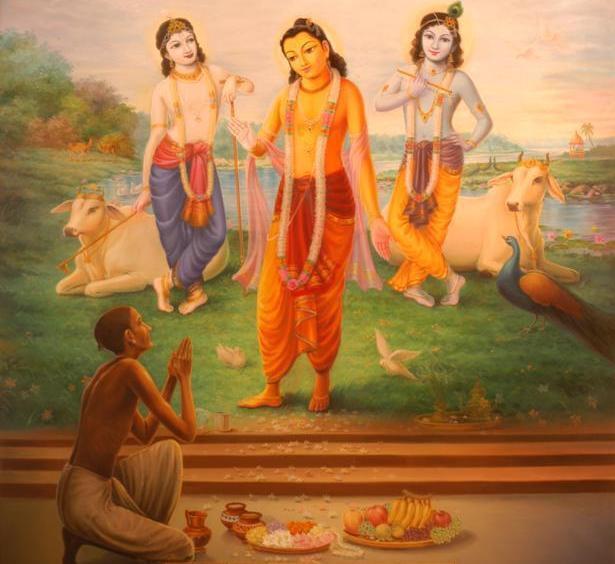
Kholavecha Shridhara, "Shridhara the khola-seller," was one of the poorest people in Navadwip during Sri Chaitanya Mahaprabhu's own householder years there, and one of the Lord's most cherished companions. He earned a bare living selling khola, strips of banana-tree bark used as disposable cups. He also sold banana flowers, stems and fruit from his own small orchard. He owned almost nothing. Even his metal water pot was cracked. Yet the young Nimai Pandit, not yet known to the world as Sri Chaitanya Mahaprabhu, made a daily habit of visiting his stall. He would bargain over the prices and drink from Shridhara's broken iron jug. Like Haridasa Thakura, Shridhara belongs to a small group of devotees whom the tradition remembers because they had no social standing to offer the Lord. They had only unbroken, one-pointed devotion, and that is what Sri Chaitanya Mahaprabhu turned out to value more than anything else.
| Detail | Description |
|---|---|
| Trade | Sold khola (banana-tree bark, used as disposable cups) and banana produce (flowers, stems, fruit) from his own orchard |
| Home | Navadwip, at the site later known as Shridhara Angan, near Mayapur |
| Other names | Sridhara Pandit, Kholaveca Sridhara, Kolavecha Sridhara |
| Daily practice | Gave half his day's earnings to the worship of Mother Ganga before spending anything on himself |
| Best-known pastime | Sri Chaitanya Mahaprabhu's daily bargaining over his goods and drinking from his broken iron pot, culminating in a revelation of His Krishna-Balarama form |
| Identity | Kusumasava, the cowherd friend who made Krishna laugh in Vraja (Gaura-ganoddesha-dipika 133; Chaitanya-charitamrita Adi 10.67 purport) |
| Legacy | A shrine at Shridhara Angan, built under Srila Bhaktisiddhanta Sarasvati Thakura's direction, still stands and is visited during Mayapur parikrama |
Scriptural evidence for the introduction (1)
खोलावेचतया ख्यातः पण्डितः श्रीधरो द्विजः ।
आसीद्व्रजे हास्यकारी यो नाम्ना कुसुमासवः ॥१३३॥
kholāvecatayā khyātaḥ paṇḍitaḥ śrīdharo dvijaḥ |
āsīd vraje hāsya-kārī yo nāmnā kusumāsavaḥ ||133||
The cowherd boy known as Kusumāsava in kṛṣṇa-līlā later became Kholāvecā Śrīdhara during Caitanya Mahāprabhu's līlā at Navadvīpa.
From the purport: According to Kavi-karṇapūra, Śrīdhara was a cowherd boy of Vṛndāvana whose name was Kusumāsava.
Identifies Kholavecha Shridhara as Kusumasava, the cowherd boy who made Krishna laugh in Vraja. Sanskrit: diacritic edition of the Gaura-ganoddesha-dipika; translation: Srila Prabhupada, Chaitanya-charitamrita Adi 10.67 purport.
Chapter 2
The Daily Vow to the Ganges
Why he gave away half his earnings before spending anything on himself, and what his neighbors got wrong about his sleepless nights.
However little Shridhara made in a day, he split it in two before he did anything else. Half went to the worship of Mother Ganga, and only the other half was his to live on. Srila Prabhupada records the practice simply in his purport to Sri Chaitanya-caritamrta Adi-lila 10.67: "he spent fifty percent of his income to worship the Ganges, and the balance he used for his subsistence." Think about what that meant for a man in Shridhara's position. This was not a wealthy householder giving away a part of what he could easily spare. This was a man who could not afford an unbroken water pot, yet he gave away half of an already small income before he let himself have any of it.
That order mattered. The vow was not "give something to the Ganges if there's anything left over." In his life there was rarely going to be anything left over. So, by his own design, the offering came first, every day, without exception. Only after it was kept did Shridhara turn to his own needs. His life had almost nothing fixed or settled in it. But this daily act of setting something aside was itself a kind of discipline. He repeated it so often that it became part of who he was, not just something he did.
Wealth Measured a Different Way #
Gaudiya Vaishnava retellings of his life describe how the Lord, in the guise of the young Nimai Pandit, once asked Shridhara directly why he stayed so poor when he worshiped Vishnu so faithfully. It was as if devotion should have bought him some relief from his circumstances. As the tradition remembers it, Shridhara answered by comparing himself to a bird that makes its nest from tree to tree and finds just enough food each day. Living like this, he was just as content as a king in his palace enjoying every comfort money could buy. In his telling, the difference between the two was not something to be measured in wealth at all. It was a small piece of Vaishnava philosophy from a man who sold banana bark for a living: whoever has love for Krishna is rich, and whoever does not, however much he owns, is poor.
Chanting Through the Night #
The same discipline continued after dark. Shridhara stayed up chanting the holy names long into the night, night after night. His neighbors noticed this habit, but they misunderstood it. They assumed, reasonably enough given how he lived, that hunger pains from his poverty were keeping him awake, not devotion. Nobody thought to ask if a poor banana-seller might simply be spending his nights in bhajana because that was what he wanted to do. It is a small detail in the sources, but it fits everything else known about him. His devotion was carried on so quietly and so steadily that the people around him mistook it for something else entirely. While Shridhara lived this life of steady, mostly hidden devotion, Sri Chaitanya Mahaprabhu began a daily habit of His own. He started visiting Shridhara's stall, as told in Mahaprabhu's Play for the Water Pot.
Scriptural evidence for this chapter (1)
khola-veca sridhara prabhura priya-dasa
yanha-sane prabhu kare nitya parihasa
The twenty-ninth branch was Sridhara, a trader in banana-tree bark. He was a very dear servant of the Lord. On many occasions, the Lord played jokes on him.
From the purport: Purport excerpt: "Sridhara was a poor brahmana who made a living by selling banana-tree bark to be made into cups. He spent fifty percent of his income to worship the Ganges, and the balance he used for his subsistence."
This is the same purport quoted on Shridhara's own life page; it is the direct source for the fifty-fifty vow described here, and for the poverty against which his daily discipline is measured.
Chapter 3
Mahaprabhu's Play for the Water Pot
The years-long daily bargain over banana leaves and a broken iron pot that neither man ever really wanted to settle.
Most people know Shridhara for a habit, not for a single dramatic scene. Sri Chaitanya Mahaprabhu did it nearly every day for years. As the young Nimai Pandit, He would come to Shridhara's stall and take whatever He wanted from the banana leaves, flowers and stems laid out for sale. He would pay Shridhara far less than the asking price, sometimes only a token amount, sometimes nothing at all. Then, before leaving, He would drink water straight from Shridhara's own jug. It was a battered, cracked iron pot, the only water vessel the poor brahmana owned. Sri Chaitanya-caritamrta records the habit in a single line: "Every day Lord Chaitanya Mahaprabhu jokingly snatched fruits, flowers and pulp from Sridhara and drank from his broken iron pot" (Adi 10.68). It is the kind of detail that gets only one line in a summary chapter, because everyone already knew the fuller story behind it.
Sri Chaitanya-Bhagavata tells that fuller story. It was not so much a single theft as a long-running, half-serious argument that neither man seemed to want to end. "Why are you taking the goods from My hands? Don't you know yet who I am?" the Lord would ask, teasing him. Shridhara was annoyed but never truly angry, and he would answer back in the same spirit. Sometimes he answered with mock humility ("Listen, O respected brahmana. Please forgive me, for I am Your dog"). Sometimes he simply told Him to go elsewhere ("Are there no other shops? Go there and buy leaves cheaper"). On other days the Lord pressed him directly about his poverty. He asked why Shridhara lived like an ascetic when, as the Lord saw it, he had so much wealth. Shridhara would offer to hand over a stem, a few bananas, a few leaves, and ask, "then am I still at fault?" And the argument would start again the next day as if it had never been settled. In a sense, it never was.
Why the Lord Would Not Simply Pay #
Sri Chaitanya-Bhagavata is direct about what was really going on beneath the teasing. The Lord values what His devotees offer with love, however small, above anything a non-devotee could offer at full price or more. Through most of these exchanges, Shridhara did not know who was arguing with him over banana leaves every day. He only knew that a restless young brahmana kept coming, kept taking more than He paid for, and kept drinking from his broken pot as if it were the finest water vessel in Navadwip. Yet, for all his loud protesting, Shridhara never once turned Him away.
One Pot, Several Retellings #
Later tellings of Shridhara's life sometimes turn this years-long habit into a single vivid scene. In it the Lord asks to buy the water pot itself, or simply takes it, in a moment often set at Shridhara's home in what is now called Shridhara Angan. That version is not really wrong. It is a short way of telling the story. In one picture, it shows what Sri Chaitanya-caritamrta and Sri Chaitanya-Bhagavata both describe as a regular, near-daily arrangement, not a single dramatic episode. All the versions agree about the object itself and its meaning. It was a cracked iron water pot, the only one Shridhara owned. The Lord drank from it not because He needed the water, but because it was Shridhara's, offered simply and honestly by a man who owned almost nothing else to give. The Lord drew on this same relationship when He finally showed Shridhara who had been arguing with him all along. It had been built out of years of teasing and an argument that neither of them would let go. That story is told in The Maha-Prakasha and Shridhara's Boon.
Scriptural evidence for this chapter (2)
Quoted in the text above:
- Adi 10.68 Sri Chaitanya-caritamrta
- Madhya-khanda 9.167 Sri Chaitanya-Bhagavata
Chapter 4
The Maha-Prakasha and Shridhara's Boon
The night Sri Chaitanya Mahaprabhu revealed His Krishna-Balarama form to Shridhara, and the one boon Shridhara asked for in return.
According to Sri Chaitanya-Bhagavata, what follows happened during a night of extraordinary ecstasy. The text itself describes that night as lasting twenty-one hours. In it, Sri Chaitanya Mahaprabhu revealed His divinity to one intimate devotee after another. Later accounts place the scene at Srivasa Thakura's house in Navadwip. Shridhara's turn came in the middle of it. The Lord told him plainly to look: "O Shridhara, look at My form. Today I will award you the eight mystic perfections." And He showed him a four-armed form holding an enchanting flute. Balarama stood at His right side, Ananta Sesha held His thousand hoods overhead like an umbrella, and sages including Sanaka, Narada and Sukadeva looked on. Kavi-karnapura's Gaura-ganoddesha-dipika had already identified Shridhara as the cowherd boy Kusumasava. This was the very form, Krishna and Balarama together, that Kusumasava had once served in Vrindavana. Now it was shown directly to the man who had spent years arguing with Him over banana leaves.
Shridhara did not take it calmly. He reeled and fell to the ground, struck with wonder. When the Lord asked him to offer prayers, he could only answer that he was too foolish to find the words. Sri Chaitanya-Bhagavata says that Sarasvati, the goddess of speech, appeared on his tongue by the Lord's own order. Through her, Shridhara began to speak. He praised the Lord as the source of the mystic perfections, of prosperity and yoga, of devotional service and liberation, and of Brahma and Shiva, all of them under Him. In the same breath he confessed that his own sinful heart had never once recognized who he had been arguing with. When the Lord pressed him afterward to ask for a boon, repeating "Ask, ask," Shridhara's first response was caution, not eagerness. "O Lord, will You again deceive Me? Stay peaceful, for this will not be possible again," he said. It was the reaction of a man who had spent years being teased and was not sure, even now, whether to trust what he was seeing.
A Single Request #
When Shridhara did ask, he did not ask for wealth, mystic power, or liberation, though the Lord had offered all of it. According to Sri Chaitanya-Bhagavata, Madhya-khanda 9.223-225, his request was this: "Let that brahmana who forcibly took away my banana leaves be my Lord birth after birth. Let me always engage in the service of the lotus feet of that brahmana who constantly quarreled with me." A separate translation of the same verses, published by Gaudiya History, gives the same sense: "May that Brahmin who used to pinch my banana leaves and bark be my Lord, lifetime after lifetime. May that Brahmin who used to argue with me be my master, and I serve His lotus feet." The two translations use different words, but both agree on what mattered. Shridhara had just been shown that the person bargaining with him every day was Krishna and Balarama combined. Yet the only thing he wanted was to keep being bargained with, birth after birth. As he spoke, his love overcame him, and he began crying loudly with his arms raised. The Vaishnavas gathered around him saw him weep, and they were overwhelmed and wept along with him.
What the Boon Says About Him #
Notice what Shridhara's request leaves out. He does not ask to understand the Lord's pastimes, to be freed from material life, or to be given the mystic powers he has just been offered outright. The Lord's revelation had opened the way to all of these. He asks only to remain, in every future life, the servant of the same brahmana who had underpaid him and teased him for years. This is the clearest statement the tradition preserves of what Shridhara's devotion really was. It was not admiration for a Lord he had just found to be extraordinary. It was loyalty to a person he already loved, no matter who that person turned out to be. That loyalty carried on well past this one extraordinary night, as told in Legacy and Remembrance.
Scriptural evidence for this chapter (2)
শ্রীধর বলেন,—“প্রভু, আরো ভাঙ্ডাইবা? থাকহ নিশ্চিন্তে তুমি, আর না পারিবা”
śrīdhara balena,—"prabhu, āro bhāṅḍāibā?
thākaha niścinte tumi, āra nā pāribā"
Shridhara replied, "O Lord, will You again deceive Me? Stay peaceful, for this will not be possible again."
Cited via Bhumipati Dasa's published English translation of Sri Chaitanya-Bhagavata (wisdomlib.org), not via a Prabhupada purport. Shridhara's wary response, right after the revelation, before he agrees to ask the Lord for a boon.
“মাগ মাগ” পুনঃ পুনঃ বলে বিশ্বম্ভর শ্রীধর বলযে,—“প্রভু, দেহ’ এই বর। যে ব্রাহ্মণ কাডি’ নিল মোর খোলা পাত সে ব্রাহ্মণ হৌক মোর জন্ম জন্ম নাথ। যে ব্রাহ্মণ মোর সঙ্গে করিল কন্দল মোর প্রভু হৌক তাঙ্র চরণ-যুগল”
"maga maga" punah punah bale visvambhara
sridhara balaye,—"prabhu, deha' ei vara
ye brahmana kadi' nila mora khola pata
se brahmana hauka mora janma janma natha
ye brahmana mora sange karila kandala
mora prabhu hauka tanra carana-yugala"
Vishvambhara repeatedly said, "Ask, ask," and Shridhara replied, "O Lord, then give me this benediction. Let that brahmana who forcibly took away my banana leaves be my Lord birth after birth. Let me always engage in the service of the lotus feet of that brahmana who constantly quarreled with me."
Cited via Bhumipati Dasa's published English translation of Sri Chaitanya-Bhagavata (wisdomlib.org), not via a Prabhupada purport, since Chaitanya-Bhagavata has no standalone corpus on vedabase.io. This is the central verse of Shridhara's story: offered any boon after the Lord's self-revelation, he asks only to remain His servant birth after birth. Gaudiya History's own translation of the same verses (cited as "Chaitanya Bhagavat 2.9.223-5") renders the sense the same way with different wording.
Chapter 5
Legacy and Remembrance
How a poor banana-seller's bond with Sri Chaitanya Mahaprabhu outlasted His years in Navadwip, and how it is still marked today.
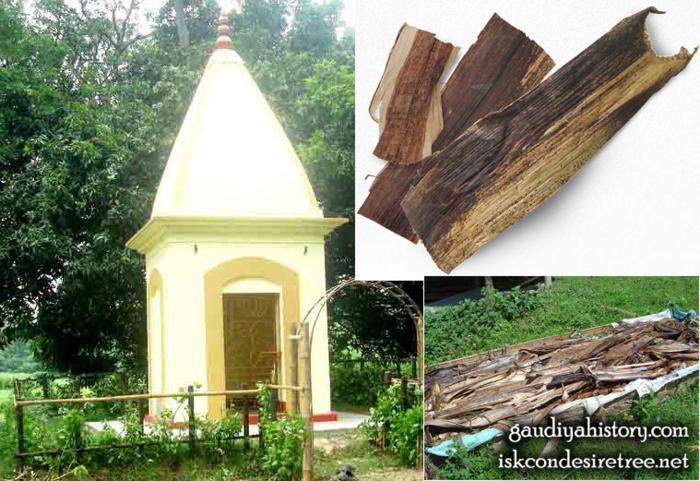
Shridhara's story does not end with the night his identity as Krishna's servant was revealed to him. Sri Chaitanya-caritamrta's purport to Adi-lila 10.67 records what happened later. Sri Chaitanya Mahaprabhu began His public campaign of sankirtana, openly going against the local qazi's ban on congregational chanting. Then Shridhara danced joyfully in the streets along with everyone else. Before the Lord took sannyasa and left His mother Sachi's household for good, Shridhara sent her a squash from his own garden to cook. It was a small, practical gift from a man who had almost nothing else to give. And after Sri Chaitanya Mahaprabhu left Bengal for Jagannatha Puri, Shridhara did not stay behind. Every year, the purport says, he made the journey to Puri simply to see Him again. For years this man had bargained with the Lord over banana leaves. Once he understood who he had been bargaining with, he kept the relationship going for the rest of his life, in his own way and at his own cost.
A Shrine Where His Home Once Stood #
Centuries later, Srila Bhaktisiddhanta Sarasvati Thakura had a small shrine built on the site of Shridhara's old home, on ground still known as Shridhara Angan. He was the guru of Srila Prabhupada, and he did more than anyone else to recover and mark the holy places of Sri Chaitanya Mahaprabhu's Navadwip pastimes. The shrine was not a grand monument. It was a marker, placed so that a poor banana-seller's part in the Lord's life would not be lost. Almost everything else about him was never recorded: his birth year, his family, and, in most tellings, even the year he died. The shrine stands there still, one stop among many on the parikrama routes that pilgrims walk through Mayapur and Navadwip today.
What Srila Prabhupada Preserved #
Srila Prabhupada's own purport to Sri Chaitanya-caritamrta Adi-lila 10.67 does not preach about Shridhara's poverty or draw a clear lesson from it. It simply states the facts as the tradition preserved them: the fifty-fifty split of his income, the daily joking, the broken iron pot, the squash for Sachi, the yearly trips to Puri, and his earlier identity as Krishna's cowherd friend Kusumasava. It lets them speak for themselves. This simple way of telling says something by itself. Everywhere else, the text explains the philosophy behind every pastime it records. But here Shridhara's story is left as it is. It is a plain account of one very poor man whom the Supreme Lord chose to visit every single day. The text does not tell us why.
A Devotee Whose Guru Is Not Recorded #
The sources we found do not name a diksha or siksha guru for Shridhara, and this page does not guess one. What the sources do record is his close, personal bond with Sri Chaitanya Mahaprabhu. In this he is much like Haridasa Thakura, another devotee the Lord loved dearly. The Lord loved Haridasa not for any social standing but for the plain, unbroken sincerity of his devotion. For both men, poverty and low standing were never obstacles in Sri Chaitanya Mahaprabhu's eyes. In fact, the tradition remembers both of them because they had nothing to offer Him except that sincerity.
Scriptural evidence for this chapter (1)
khola-veca sridhara prabhura priya-dasa
yanha-sane prabhu kare nitya parihasa
The twenty-ninth branch was Sridhara, a trader in banana-tree bark. He was a very dear servant of the Lord. On many occasions, the Lord played jokes on him.
From the purport: Purport excerpt: "Sridhara was a poor brahmana who made a living by selling banana-tree bark to be made into cups. He spent fifty percent of his income to worship the Ganges, and the balance he used for his subsistence."
This is the very purport this account is directly about: Srila Prabhupada records Shridhara's poverty, his Ganges vow, the daily jesting, and his earlier identity as Kusumasava without moralizing about any of it, letting the facts of a poor man's devotion speak for themselves.
- Sri Chaitanya-caritamrta, Adi-lila 10.67-68
- Sri Chaitanya-Bhagavata, Madhya-khanda, Chapter 9 (translated by Bhumipati Dasa)
- Gaudiya History: Kholavecha Shridhara - Biography
- Gaudiya History: Sri Kholaveca Sridhara
- ISKCON Bangalore: Kholavecha Sridhara - Dear Devotee of Lord Chaitanya Mahaprabhu
- ISKCON Desire Tree: Kolavecha Sridhara Angana
- Vine of Devotion: Mahaprabhu's Love for the Unseen Devotee (Part One)
