Srila Madhusudana Vachaspati
Brother of Sarvabhauma Bhattacharya, Host of Sri Chaitanya Mahaprabhu at Vidyanagara
The complete life, on one page: The main biography and every pastime page, in order, in one place
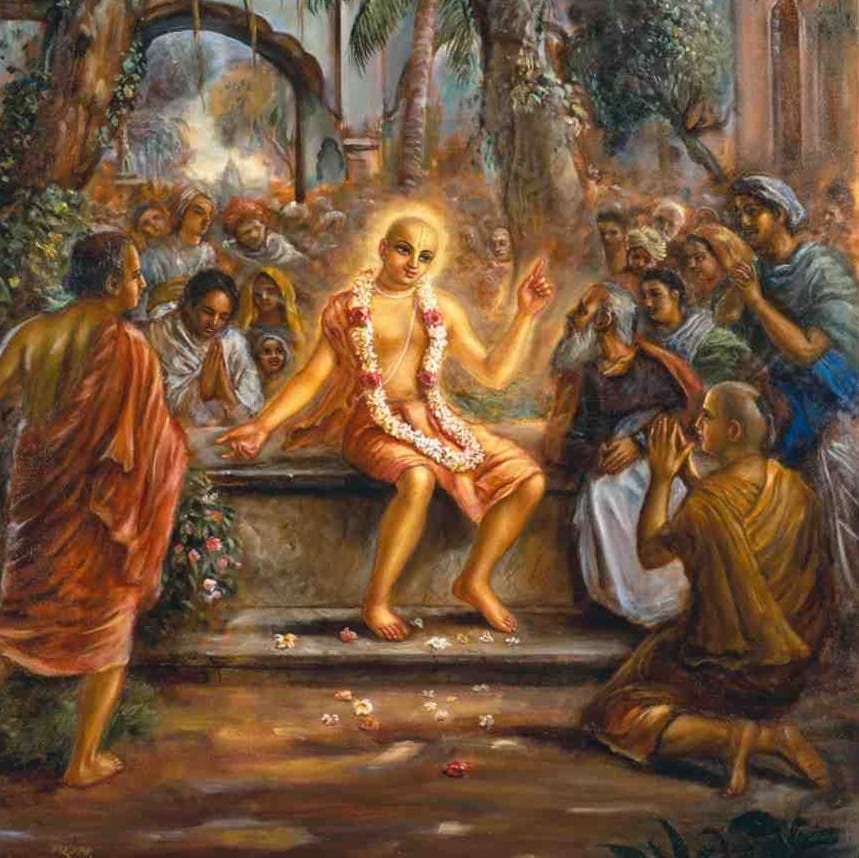
Introduction
Madhusudana Vachaspati is remembered in Sri Chaitanya Mahaprabhu's own biography as one of a remarkable pair of brothers. He was the quieter brother, who worshipped the Ganges. His brother was the far more famous Vasudeva Sarvabhauma, who as Sarvabhauma Bhattacharya became the greatest scholar converted in the entire Chaitanya movement. Sarvabhauma's story fills whole chapters of Krishnadasa Kaviraja Goswami's Sri Chaitanya-charitamrita. But Madhusudana's life appears only in scattered but specific glimpses. The Lord gave him a personal instruction at Jagannatha Puri. One night the Lord slipped quietly away from Madhusudana's crowded house near Nabadwip. And Srila Prabhupada records, almost in passing, that he later taught Sanskrit to Srila Jiva Goswami in Kashi.
| Detail | Description |
|---|---|
| Also known as | Vidya-Vacaspati, the title used for him through most of the Chaitanya-charitamrita |
| Family | Son of Mahesvara Vishrada, a scholar of Nadia; brother of Vasudeva Sarvabhauma, later Sarvabhauma Bhattacharya |
| Native place | Vidyanagara, a village in the Nadia district of Bengal, near Koladvipa (Kuliya) |
| Known for | Personally told by Sri Chaitanya Mahaprabhu to worship the Ganges; host of the Lord's stay at Vidyanagara; later, per tradition, Vedanta teacher of Jiva Goswami in Kashi |
| Primary sources | Sri Chaitanya-charitamrita, Madhya-lila 6.18, 15.133-136, 16.207 and Adi-lila 10.85 |
At a Glance
- Brother of Sarvabhauma Bhattacharya, sons of the Nadia scholar Mahesvara Vishrada
- Personally told by Mahaprabhu to worship mother Ganges, while Sarvabhauma was told to worship Lord Jagannatha
- Hosted Sri Chaitanya Mahaprabhu at his own house in Vidyanagara amid overwhelming crowds
- Remembered by Srila Prabhupada as the Kashi teacher under whom Jiva Goswami studied Sanskrit
Scriptural evidence for the introduction (1)
nadiya-nivasi, visaradera jamata
mahaprabhura bhakta tenho prabhu-tattva-jnata
Word for word
nadiya-nivasi: an inhabitant of Nadia; visaradera: of Visarada; jamata: the son-in-law; mahaprabhura bhakta: a devotee of Lord Caitanya Mahaprabhu; tenho: he; prabhu-tattva-jnata: a knower of the true identity of Sri Caitanya Mahaprabhu.
Gopinatha Acharya was a resident of Nadia, the son-in-law of Visarada and a devotee of Chaitanya Mahaprabhu. He knew the true identity of His Lordship.
From the purport: Purport excerpt: "He lived in the Nadia district in a village called Vidyanagara, and had two sons named Madhusudana Vacaspati and Vasudeva Sarvabhauma."
This purport is the primary source identifying Madhusudana Vachaspati as the son of Mahesvara Vishrada and the brother of Vasudeva Sarvabhauma (Sarvabhauma Bhattacharya).
Chapter 1
The Two Brothers of Vidyanagara
How the sons of a Nadia scholar became, in Sri Chaitanya Mahaprabhu's own words, worshippers of wood and water.
Long before either brother met Sri Chaitanya Mahaprabhu, they were simply the sons of Mahesvara Vishrada, a respected scholar who lived in Vidyanagara, a village in the Nadia district of Bengal not far from Nabadwip. Vishrada, the Chaitanya-charitamrita notes, had been a classmate of Nilambara Chakravarti, Sri Chaitanya Mahaprabhu's own maternal grandfather, which places the family within the same close circle of Nadia pandits that produced Mahaprabhu Himself. Of his two sons, one, Vasudeva, left home to study logic and Vedanta and eventually rose to become the chief pandit of the Jagannatha Puri royal court under Maharaja Prataparudra. The other, Madhusudana, appears to have stayed closer to Vidyanagara and earned the scholarly title Vachaspati, by which the Chaitanya-charitamrita most often calls him: Vidya-Vacaspati.
A Brother's Conversion #
Vasudeva Bhattacharya's story after leaving home is told at length elsewhere. He became famous as Sarvabhauma, "lord of the whole earth" of learning. Maharaja Prataparudra brought him to Puri. And one day in 1510, a young sannyasi in ecstasy was carried into his house, and that sannyasi turned out to be Krishna Himself. That whole account is one of the best-recorded conversions in Gaudiya Vaishnava history, and it is told on Sarvabhauma Bhattacharya's own page. Here we follow what came after it. Once Sarvabhauma had surrendered to Sri Chaitanya Mahaprabhu, his brother Vachaspati also appears in the record. He too was drawn into the Lord's company at Puri, alongside Sarvabhauma.
Worship Him As Wood, Worship Him As Water #
The Chaitanya-charitamrita describes a moment when Mahaprabhu, "out of His causeless mercy," gathered the two brothers together and gave each of them a personal instruction. Krishna, He explained, is manifest in this age in two accessible forms: as wood, in the Deity of Lord Jagannatha, and as water, in the river Ganges. Both are directly the Supreme, not symbols of Him. Sarvabhauma, already installed as a royal pandit at the temple, was told to worship Lord Jagannatha. Vachaspati, whose family home lay along the Ganges in Bengal, was told to worship mother Ganges herself. It is a brief exchange of only a handful of verses, but it shows something important. Mahaprabhu was not simply treating Vachaspati as a part of his brother's larger story. He gave him his own, specific service, suited to where he actually lived and what he could do.
This small instruction also carries a theological point, which Srila Prabhupada explains in his purport to this verse. The Vedic teaching "everything is Brahman" does not mean that everything, in a general way, is equally worthy of worship. It means that the Supreme Lord can and does manifest Himself directly through specific forms of wood and water, for the deliverance of conditioned souls in this age. "Lord Jagannatha is the Supreme Lord Himself in the form of wood, and the river Ganges is the Supreme Lord Himself in the form of water" (Sri Chaitanya-charitamrita, Madhya-lila 15.135). In the same purport, Srila Prabhupada also quotes the Bhagavad-gita, where Krishna Himself says: "By Me, in My unmanifested form, this entire universe is pervaded. All beings are in Me, but I am not in them" (Bhagavad-gita 9.4). Sarvabhauma and Vachaspati were brothers who were given instructions that fit together. So they became a living example of that teaching, not just people who received a general blessing.
A Family at the Center of Two Stories #
Seen together, the two brothers' lives show a good deal of what the Chaitanya-charitamrita has to say about scholarly Nadia in this period. One brother stayed at the center of Mahaprabhu's public life in Puri, meeting kings and composing Sanskrit verses in the Lord's honor. The other returned home to Bengal. There, as told on The Crowds at Vidyanagara, his own quiet household was suddenly overwhelmed when the Lord came to visit him in turn.
Scriptural evidence for this chapter (3)
Quoted in the text above:
- Madhya 15.135 Sri Chaitanya-charitamrita
Further verses:
sarvabhauma, vidya-vacaspati, — dui bhai
dui-jane krpa kari' kahena gosani
Word for word
sarvabhauma: Sarvabhauma Bhattacharya; vidya-vacaspati: Vidya-Vacaspati; dui bhai: two brothers; dui-jane: unto the two; krpa kari': out of His causeless mercy; kahena: says; gosani: Sri Chaitanya Mahaprabhu.
Out of His causeless mercy, Sri Chaitanya Mahaprabhu gave the following directions to the brothers Sarvabhauma Bhattacharya and Vidya-Vacaspati.
Introduces the episode at Jagannatha Puri where Mahaprabhu personally instructs the two brothers.
sarvabhauma, kara 'daru-brahma'-aradhana
vacaspati, kara jala-brahmera sevana
Word for word
sarvabhauma: O Sarvabhauma; kara: be engaged in; daru-brahma: of wooden Brahman; aradhana: worship; vacaspati: and you, Vacaspati; kara: do; jala-brahmera: of Parambrahma manifested in water; sevana: worship.
"Sarvabhauma Bhattacharya, you should engage in the worship of Lord Jagannatha Purushottama, and Vachaspati should worship mother Ganges."
Sri Chaitanya Mahaprabhu's specific instruction to Madhusudana Vachaspati, used here as his pull-quote.
Chapter 2
The Crowds at Vidyanagara
When Sri Chaitanya Mahaprabhu's stay at Vachaspati's house drew so vast a crowd that boats ran short on the Ganges.
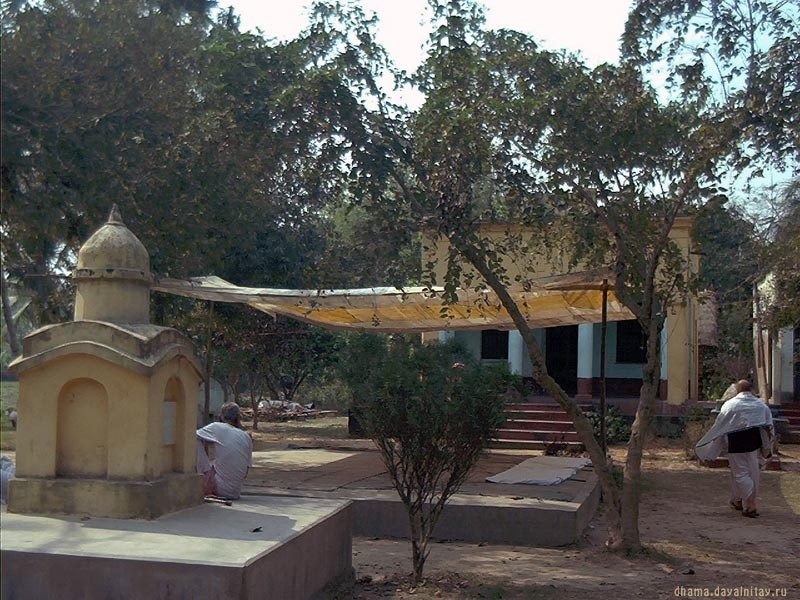
Some years after His conversation with the two brothers at Puri, Sri Chaitanya Mahaprabhu set out from Nilachala on what would become His first attempt to reach Vrindavana. The journey was cut short in Bengal by the huge crowds of devotees who wanted to see Him. Moving through Nadia district, the Lord visited one household after another: Srivasa Thakura's house, then Shivananda Sena's, then Vasudeva Datta's. From there He came to the house of Vidya-Vacaspati at Vidyanagara, Madhusudana Vachaspati's own home.
News Travels Faster Than the Lord #
The Chaitanya-charitamrita, quoting the Chaitanya-bhagavata's account of the same events, describes what happened next in vivid terms. Word of the Lord's arrival at Vidyanagara spread through the surrounding countryside almost instantly, and people came from every direction chanting the names of Hari. The crowd grew so dense that people could not find open ground to stand on. They had to clear paths through the forest simply to approach the house. Across the Ganges, still more people tried to reach Vidyanagara by boat. The crossing became so crowded that Madhusudana Vachaspati acted at once. He hurried to assemble as large a fleet of boats as he could gather, and still it was not enough. People crossed however they were able, some without waiting for a boat at all.
It is easy to miss how extraordinary this scene was when we read only a list of place names in a purport. For a few days, an ordinary scholar's house on the bank of the Ganges became the place that the devotees of an entire district most wanted to reach. Its owner found himself, in effect, running a ferry service he had set up in a hurry, so that his neighbors could see the Lord he was hosting.
A Quiet Departure at Night #
The crowd around Vachaspati's house did not grow smaller. Sri Chaitanya Mahaprabhu consistently avoided public show when He could, so in the end He chose to leave instead of letting the commotion continue. The Chaitanya-charitamrita states simply that "the Lord remained some time at the house of Vidya-Vacaspati, but then, because it was too crowded, He went to Kuliya," the nearby town on the far side of the Ganges, in what is now Nabadwip itself. Srila Prabhupada's purport gives the exact place of Vachaspati's house: Vidyanagara, close to Koladvipa, the older name for the Kuliya area. From Kuliya the Lord's Bengal travels continued, and in time they drew in a still larger crowd, which included Sri Nityananda Prabhu. As is well known, the attempt to reach Vrindavana ended altogether when the devotees persuaded the Lord to turn back toward Puri.
For Madhusudana Vachaspati himself, this episode is the last full account that the Chaitanya-charitamrita gives of him in Bengal. What is recorded after this comes from a different city entirely, and it is told on Teacher of the Goswamis in Kashi.
Scriptural evidence for this chapter (1)
Quoted in the text above:
- Madhya 16.207 Sri Chaitanya-charitamrita
Chapter 3
Teacher of the Goswamis in Kashi
The little that is recorded of his years as a Vedanta teacher in Benares, and what is not known.
The last episode we have of Madhusudana Vachaspati takes the story far from his Ganges-side house at Vidyanagara. According to Srila Prabhupada's purport to Chaitanya-charitamrita Adi-lila 10.85, the young Jiva Goswami first toured the nine islands of Navadvipa-dhama in the footsteps of Nityananda Prabhu. Then he traveled on to Benares (Kashi) to study Sanskrit, and there he studied "under Madhusudana Vacaspati." Prabhupada writes that only after finishing that education did Jiva Goswami go on to Vrindavana to take shelter of his uncles, Sri Rupa and Sri Sanatana Goswami. There, in time, he was given diksha by Rupa Goswami. Prabhupada credits this detail of Jiva's education to the Bhakti-ratnakara, the eighteenth-century Gaudiya Vaishnava devotional biography by Narahari Chakravarti.
A Second Student, More Loosely Recorded #
The reference site gaudiyahistory.iskcondesiretree.com, drawing on the same Bhakti-ratnakara tradition, also names Vachaspati as a teacher of Sanatana Goswami. It describes him as staying for a time at Ramkeli, where Sanatana is said to have studied scripture under him before he himself turned toward Sri Chaitanya Mahaprabhu. This detail is reported as tradition, not as something confirmed. It does not appear in the Chaitanya-charitamrita passages on Madhusudana Vachaspati. It appears only in a second-hand collection that cites Bhakti-ratnakara verses, and those verses could not be checked directly against a full translation. So readers who want the fuller claim should treat it as tradition recorded outside the Chaitanya-charitamrita, not as something Krishnadasa Kaviraja Goswami himself states.
What the Bhakti-ratnakara Preserves #
Most of what is known about Madhusudana Vachaspati's years in Kashi survives only because Narahari Chakravarti chose to record it in the Bhakti-ratnakara. He wrote it a generation or more after the events. The Bhakti-ratnakara is a very long Bengali devotional biography. It is built mainly around the life of Narottama Dasa Thakura and the devotees who carried the movement forward after Sri Chaitanya Mahaprabhu's own associates had passed. An earlier teacher like Vachaspati appears there almost in passing, as part of the larger account of how the Six Goswamis and their students continued the tradition. He is not given a life story of his own. That is common enough for less central figures of this period. But it also means that finer details, such as how long he actually taught in Kashi or when he himself left this world, were simply never set down.
What Is Not Recorded #
This is also where the record of Madhusudana Vachaspati's life becomes very thin. No source gives a year for his move to Kashi, a year for his birth or disappearance, or any account of his life after teaching Jiva Goswami. Some later compilations list him and his scholarly title, Vidyavacaspati, as though they belonged to two different people. But the Chaitanya-charitamrita's own usage makes clear that they are one man. Apart from that, this is all that remains of Madhusudana Vachaspati's life: the Lord's instruction to the two brothers at Puri, a crowded house on the Ganges, and, at the far end of his life, a quiet classroom in Benares. There one of Gaudiya Vaishnavism's most productive writers received his early training in Vedanta.
Scriptural evidence for this chapter (1)
tanra madhye rupa-sanatana — bada sakha
anupama, jiva, rajendradi upasakha
Word for word
tanra: within that; madhye: in the midst of; rupa-sanatana: the branch known as Rupa-Sanatana; bada sakha: the big branch; anupama: Anupama; jiva: Jiva; rajendra-adi: and Rajendra and others; upasakha: their subbranches.
Among these branches, Rupa and Sanatana were principal. Anupama, Jiva Gosvami and others, headed by Rajendra, were their subbranches.
From the purport: Purport excerpt: "After visiting Navadvipa-dhama he went to Benares to study Sanskrit under Madhusudana Vacaspati, and after finishing his studies in Benares he went to Vrindavana and took shelter of his uncles, Sri Rupa and Sanatana. This is described in the Bhakti-ratnakara."
Srila Prabhupada's own purport, the primary source for Madhusudana Vachaspati's role as Jiva Goswami's Vedanta teacher in Kashi.
Closing
Son of a Nadia Scholar's House #
According to a purport in the Chaitanya-charitamrita, Madhusudana Vachaspati's father was a scholar named Mahesvara Vishrada. He was a classmate of Nilambara Chakravarti, who was himself Sri Chaitanya Mahaprabhu's maternal grandfather. Mahesvara Vishrada lived in a village called Vidyanagara in the Nadia district of Bengal and had two sons: Madhusudana Vachaspati and Vasudeva Sarvabhauma. The younger of the two, Vasudeva, went on to become the celebrated Sarvabhauma Bhattacharya, chief pandit of the royal court at Jagannatha Puri. His conversion by Mahaprabhu is one of the best-recorded events in the entire Gaudiya tradition. Madhusudana stayed closer to the family home at Vidyanagara. He earned the scholarly title Vachaspati, sometimes written Vidya-Vacaspati, and the Chaitanya-charitamrita generally calls him by this title.
Two Brothers, Two Instructions #
The clearest single episode involving Madhusudana Vachaspati comes from Sri Chaitanya Mahaprabhu's years at Jagannatha Puri, not long after Sarvabhauma's own conversion. The Chaitanya-charitamrita records that the Lord, "out of His causeless mercy," called the two brothers together and gave them a personal instruction. Sarvabhauma was told to worship Lord Jagannatha, whom Mahaprabhu described as the Supreme in the form of wood. Vachaspati was told to worship mother Ganges, the same Supreme Lord manifest as water. "Lord Jagannatha is the Supreme Lord Himself in the form of wood, and the river Ganges is the Supreme Lord Himself in the form of water" (Sri Chaitanya-charitamrita, Madhya-lila 15.135). It is a small verse of only a few lines. But it places Vachaspati directly at his brother's side during one of the most important periods of Mahaprabhu's Puri pastimes. It also gives him, in the Lord's own words, a specific devotional service of his own, not a role borrowed from his brother's larger story.
One Name or Two #
We must honestly note a real confusion in how later sources have handled this figure. The reference site gaudiyahistory.iskcondesiretree.com carries two separate short biography pages, one titled "Madhusudana Vachaspati" and another titled "Vidyavacaspati," and the two do not fully agree with each other. One describes him as a disciple of Sarvabhauma. The other correctly describes him as Sarvabhauma's brother. The Chaitanya-charitamrita itself settles this clearly. In one purport (Madhya 6.18) it gives his personal name, Madhusudana Vacaspati, and everywhere else it calls him Vidya-Vacaspati. These are plainly one and the same person, Sarvabhauma's brother. No source gives a year of birth or disappearance for him. Apart from the Vidyanagara and Kashi episodes above, little else is recorded of his life. That is a smaller record than his brother's. But what does survive comes from Sri Chaitanya Mahaprabhu's own dealings with him, and that gives it great value.
- Sri Chaitanya-charitamrita, Madhya-lila 6.18 (purport)
- Sri Chaitanya-charitamrita, Madhya-lila 15.133-136
- Sri Chaitanya-charitamrita, Madhya-lila 16.207 (purport)
- Sri Chaitanya-charitamrita, Adi-lila 10.85 (purport)
- Madhusudana Vachaspati - Gaudiya History (ISKCON Desire Tree)
- Vidyavacaspati - Gaudiya History (ISKCON Desire Tree)
- Vidyavacaspati, Brother of Sarvabhauma Bhattacharya - ISKCON Mayapur
