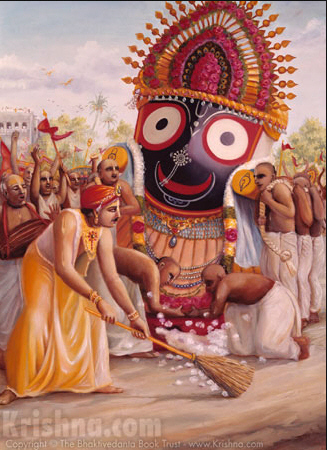
Every year at Jagannatha Puri, the deities of Jagannatha, Balarama and Subhadra are carried from the main temple to the Gundicha temple in three great chariots. The chariots are dragged by ropes through huge crowds. The crowds were so large that Sri Chaitanya Mahaprabhu organized His own kirtana party into seven separate singing groups just to be heard over them. In the middle of this festival, on a road packed with pilgrims, Maharaja Prataparudra finally found a way past the rule that had kept him from the Lord for years. He did not do it by asking again. He did it by picking up a broom.
| Detail | Description |
|---|---|
| First act of service | Sweeping the road before Jagannatha's chariot with a golden-handled broom |
| Scriptural reference | Chaitanya-charitamrita, Madhya-lila 13.15-18 |
| Second act, later that day | Entering the Balagandi garden dressed as an ordinary Vaishnava |
| What he recited | The gopis' verses of separation from Srimad-Bhagavatam 10.31 (gopi-gita) |
| The Lord's response | Rose and embraced him before asking who he was |
| Modern survival | The ritual, called Chera Pahara, is still performed at Puri's Ratha-yatra today |
The Chera Pahara: A King With a Broom #
The dayitas, Jagannatha's powerful hereditary carriers, moved the heavy deity from the temple's throne toward the waiting chariot. As they did, Prataparudra stepped in ahead of the procession. Krishnadasa Kaviraja Goswami records it simply: "King Pratāparudra personally engaged in the Lord's service by cleansing the road with a broom that had a golden handle. The King sprinkled the road with sandalwood-scented water. Although he was the owner of the royal throne, he engaged in menial service for the sake of Lord Jagannatha" (Madhya-lila 13.15-16). Something like this had happened before in his family. Tradition holds that his own father, Purushottama Deva, had performed the same act a generation earlier, a detail told on The Gajapati Throne of Odisha. But by Prataparudra's time the act had become more like an established custom. It survives today as the ritual called Chera Pahara, still performed at Puri's Ratha-yatra by the ceremonial Gajapati of the region.
Menial Service From the Most Exalted Person #
Krishnadasa Kaviraja stops to explain why this mattered: "Although the King was the most exalted respectable person, still he accepted menial service for the Lord; he therefore became a suitable candidate for receiving the Lord's mercy... Simply by rendering this service, the King received the mercy of the Lord" (Madhya-lila 13.17-18). The point is not that sweeping a road has special spiritual power in itself. The point is that a man with every worldly excuse not to do it chose to do it anyway, in public, in front of his own court.
Anger as a Warning, Not a Verdict #
The mercy was not obvious to onlookers right away. Later that same day, Sarvabhauma Bhattacharya again mentioned the King's longing for an audience. Sri Chaitanya Mahaprabhu showed outward anger, and this frightened Prataparudra badly. Sarvabhauma reassured the King privately: "The Lord is very satisfied with you. By pointing you out, He was teaching His personal associates how to behave with mundane people" (Madhya-lila 13.187). In other words, the anger was a display meant to teach the Lord's own disciples. It was not a judgement on the King. This difference only makes sense once the rest of the day's events are known.
Following Sarvabhauma's Plan to Balagandi #
At midday the chariots stopped at a spot called Balagandi, midway between the temple and Gundicha. There it was customary for devotees of every rank to offer cooked food to the Lord. While the crowds pressed in around the offerings, Sri Chaitanya Mahaprabhu, exhausted from hours of ecstatic dancing, withdrew to rest in a nearby garden. This was the chance Sarvabhauma had been waiting for. He told the King exactly how to use it: set aside the royal dress, enter alone in the appearance of an ordinary Vaishnava, and recite from the chapters of Srimad-Bhagavatam describing Krishna's rasa dance with the gopis while the Lord lay absorbed.
Massaging the Lord's Feet in the Dress of a Vaishnava #
Prataparudra did exactly this. The Chaitanya-charitamrita's own chapter summary states it plainly: "Following Sarvabhauma Bhattacharya's instructions, the King had given up his royal dress. He now entered the garden in the dress of a Vaishnava" (Madhya-lila 14.5). He asked the assembled devotees' permission before approaching, then fell down and touched the Lord's feet, and as Sri Chaitanya Mahaprabhu lay with His eyes closed in ecstatic absorption, the King began, expertly, to massage His legs (Madhya-lila 14.6-7).
The Verse That Broke the Silence #
The King began reciting the gopi-gita, the chapter of Srimad-Bhagavatam beginning "jayati te 'dhikam," in which the gopis of Vrindavana cry out for Krishna's return. Hearing it, Sri Chaitanya Mahaprabhu urged him on again and again: "Go on reciting, go on reciting" (Madhya-lila 14.9). Then the King reached the ninth verse of that chapter: "My Lord, the nectar of Your words and the descriptions of Your activities are the life and soul of those who are always aggrieved in this material world... Those who spread the message of Godhead are certainly the most munificent welfare workers" (Srimad-Bhagavatam 10.31.9, quoted at Madhya-lila 14.13). At that word, munificent, meaning very generous, the Lord rose in ecstatic love and embraced him.
Embraced Before His Name Was Known #
What follows is the detail Gaudiya Vaishnavas return to again and again: "Śrī Caitanya Mahāprabhu immediately embraced the King and cried, 'You are the most munificent! You are the most munificent!' At this point Śrī Caitanya Mahāprabhu did not know who the King was" (Madhya-lila 14.14). The text clearly says that the mercy came first. The recognition came only afterward, when the Lord finally asked, "Who are you?" The King's answer became Prataparudra's own well-known reply for the rest of his life: he was the servant of the Lord's servants (Madhya-lila 14.17-18).
A Family Custom, and a Ritual That Still Continues #
According to the Kanchi legend, this began as a single act of royal humility performed by Prataparudra's father. By this point it had become a settled family practice. That day the King went further. He moved from sweeping a road to setting aside his entire royal identity in a garden. It is this decision that the Chaitanya-charitamrita treats as the actual turning point. We should be clear about what the sources do and do not say. Nothing here describes Prataparudra disguised as a common laborer or sweeper in the Balagandi garden scene itself. The texts describe him giving up royal dress for the appearance of an ordinary Vaishnava devotee. This is related to the humility of the sweeping he had done earlier that same day, but it is a different kind of humility. Both acts together are what the rest of Puri's Vaishnava community saw and never forgot. What happened to that relationship afterward is told on Meeting Sri Chaitanya Mahaprabhu.
