Long before he had heard the name Sri Chaitanya Mahaprabhu, Prataparudra was already one of the most powerful rulers in eastern India. He was the third emperor of a dynasty that his own grandfather had founded. He had also inherited a kingdom that his father had spent a lifetime expanding and defending. To understand the king who later swept a temple road with his own hands, we must first understand the empire he ruled.
| Detail | Description |
|---|---|
| Dynasty | Suryavamsha Gajapati, founded by his grandfather Kapilendra Deva |
| Title | Gajapati, "lord of elephants" |
| Father | Purushottama Deva |
| Mother | Padmavati (also given as Rupambika) |
| Capital | Cuttack (Kataka); later shifted to Khurda |
| Reign | c. 1497-1540 CE |
| Territory at its height | From the Bengal frontier south to the Krishna river near Rajahmundry |
Grandson of the Dynasty's Founder #
Odishan chronicles describe how Prataparudra's grandfather, Kapilendra Deva, seized the throne from Kajjalabhanu, the last king of the preceding Ganga dynasty, while that king was away on campaign. They say that he then founded the line that historians call the Suryavamsha Gajapatis. Kapilendra's son and successor, Purushottama Deva, recovered territory the kingdom had lost and also pushed its borders further. He credited his victories to the direct help of Lord Jagannatha on the battlefield. Prataparudra inherited the throne from his father in 1497 and ruled from Cuttack. Like his father and grandfather before him, he carried the title Gajapati, which marked him as commander of one of India's largest war-elephant corps.
A Family Habit of the Broom #
One story from his father's reign should be told here, because it appears again, in a changed form, in Prataparudra's own life. Purushottama Deva had once been engaged to a princess of Kanchi. Her father came to Puri to see his future son-in-law, and he happened to arrive during Ratha-yatra. There he saw Purushottama sweeping the road before Lord Jagannatha's chariot. This was a customary royal act of humility. But the visiting king was not familiar with Odishan devotion, and he took it as a real insult to his daughter. He cancelled the match on the spot. Then came Purushottama's furious war against Kanchi, and in the end his hard-won marriage to the princess after all. This part is Odishan legend, not something that can be checked point by point. But the custom behind it is real. Sweeping the Ratha-yatra road was already an established royal duty in this family a generation before Prataparudra performed it in front of Sri Chaitanya Mahaprabhu on The Disguise at Ratha-yatra.
Wars on Three Frontiers #
Prataparudra's reign was rarely peaceful. As a young king still in his teens, he drove back an invasion from the Hussain Shahi rulers of Bengal on his northern border. For years afterward he fought the Vijayanagara empire to his south over the fortified town of Udayagiri and the Rayalaseema country around it. This campaign dragged on for well over a year before ending in a negotiated withdrawal. During these same years he was deeply absorbed in devotional life. Historians who have studied the period note that this is sometimes blamed, fairly or not, for his weakening control over military affairs. Late in his reign, in 1531, forces of the Qutb Shahi sultanate of Golconda struck from the southwest and took the fort and administrative center of Kondapalli. Each of these campaigns cost Odisha territory, even when Prataparudra won the immediate battle. In the end, the empire he passed on was smaller than the one he had inherited.
The Emperor Who Built at Puri #
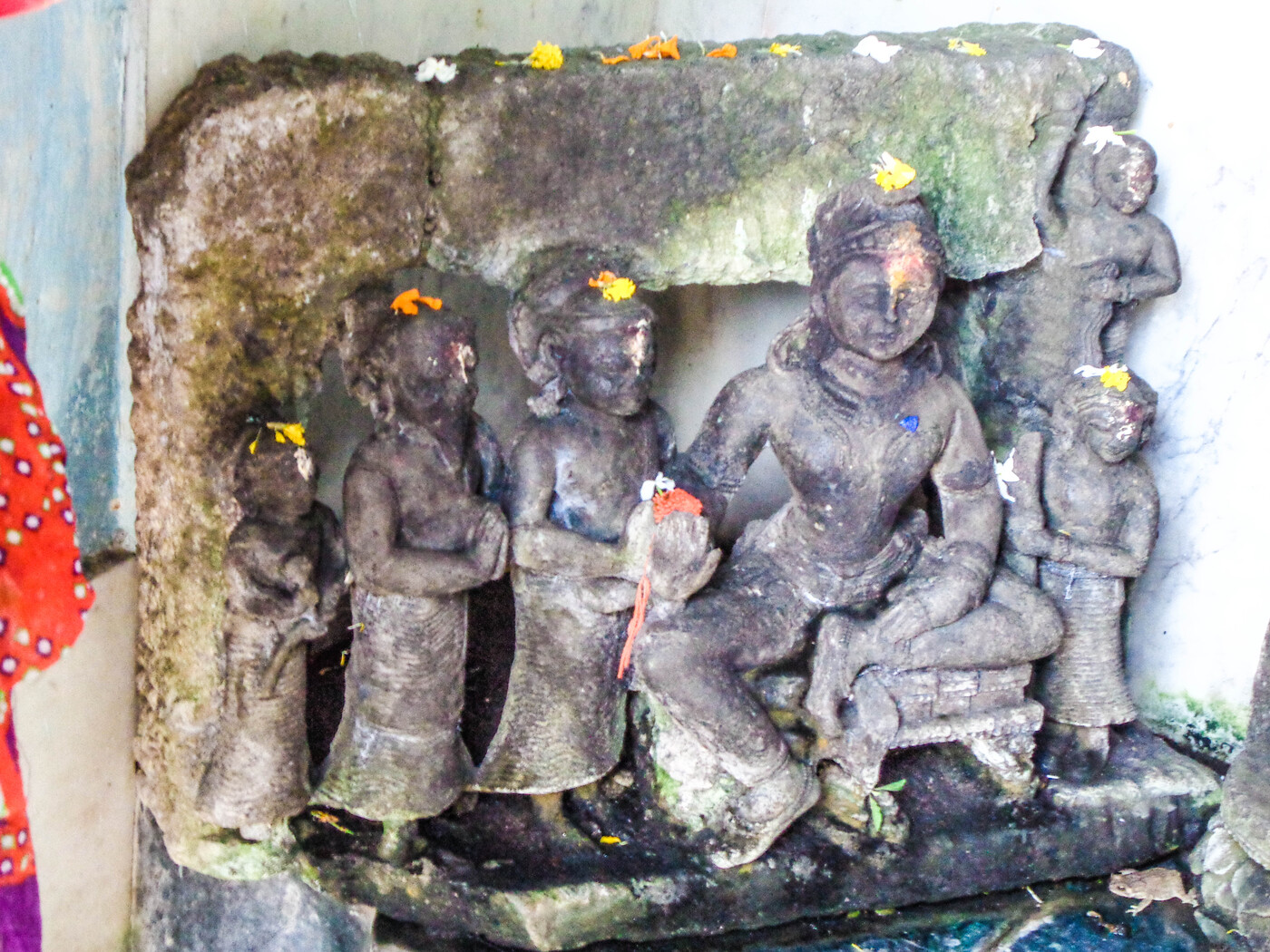
Even a king fighting three wars found time to build. Tradition credits Prataparudra with building the audience hall of the Jagannatha temple at Puri. Inscriptions and temple art from villages near his capital also show a reign that truly cared about Odisha's sacred architecture, not only its battlefields. One example is a depiction of him still preserved at the Sarpeswar temple near Choudwar, built during his rule. In this same period, the Ratha-yatra road-sweeping that his family had practiced for at least a generation became a fixed ritual. It is still called Chera Pahara, and it is performed by the ceremonial Gajapati of Puri down to the present day.
A Family of Devotees #
The Bhakti-ratnakara names Prataparudra's chief queen, Gauri Devi, as the mother of five sons. The eldest of them was Purushottama Jana. Prataparudra had at least four other wives as well. Sources differ slightly on the exact number of his sons, and one modern count goes as high as thirty-two. The Gaudiya sources agree that the King's household, not only the King himself, was drawn into devotion to Sri Chaitanya Mahaprabhu once He arrived at Puri. This is worth remembering as we turn to the years when the Lord Himself would not receive the man at the head of that household.
Why He Matters to This Story #
None of this history of wars and royal succession would have made Prataparudra memorable to Gaudiya Vaishnavas by itself. What makes him unusual is this. He was a ruler of high rank, tested in battle, secure on his family's throne, and master of an empire reaching toward Andhra. Yet for years he was refused an audience by a barefoot sannyasi living in his own temple town. And when the audience finally came, it came only after the emperor set aside every mark of his rank. That refusal, and the reasoning behind it, is told on Forbidden by Sannyasa Etiquette.
