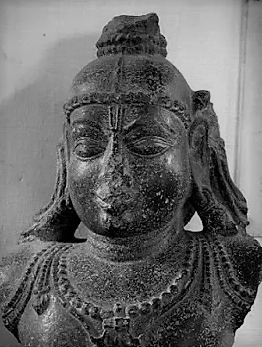
Maharaja Prataparudra did not retire from ruling once he had won the mercy of Sri Chaitanya Mahaprabhu. He went on governing and fighting for his kingdom for roughly another two decades. The empire he left behind at his death in 1540 shows a harder side of his story, next to the devotional one. This page describes that later reign, along with two points on which the sources do not fully agree.
| Detail | Description |
|---|---|
| Death | 1540 CE |
| Reign length | c. 1497-1540, roughly forty-three years |
| Major wars after meeting the Lord | Continued campaigns against Vijayanagara; loss of Kondapalli to Golconda forces, 1531 |
| Attributed literary works | Saraswati-vilasa, Pratapa-martanda, Kautuka-chintamani, Nirnaya-sangraha (authorship of at least one disputed) |
| Successor | Kalua Deva (also given as Kaluwa Pratapa) |
| Dynasty's fate | Overthrown within a generation by the minister Govinda Vidyadhara |
Three Wars for One Kingdom #
Prataparudra's military life did not end with his devotion to the Lord. Rather, the two went on side by side throughout his reign. His long, costly conflict with Vijayanagara over the fort of Udayagiri and the country around it continued for well over a year of campaigning. It ended in a negotiated withdrawal. Later, in 1531, the Qutb Shahi sultanate of Golconda struck at his southwestern territory. Its forces captured Kondapalli, an important administrative center, along with a number of other forts. One relic of that southern war survives to this day. It is the upper portion of a Bala Gopala deity, which the invading Vijayanagara forces carried off from Udayagiri as a trophy of their victory. It is still preserved as a visible sign of how much territory and sacred property changed hands during these campaigns. Under Prataparudra's father, Odisha's empire had reached as far south as Rajahmundry. Over the course of Prataparudra's reign it shrank for good. In spite of his personal virtues as a devotee, the kingdom he ruled at his death was smaller than the one his father had left him.
Sarpeswar and the Buildings of a Reign #
Alongside the fighting, Prataparudra's reign left a real mark on Odishan sacred architecture. He is credited with building the audience hall of the Jagannatha temple at Puri. Images of him are also preserved in temple art from his own lifetime. The best-known example is at the Sarpeswar temple near Choudwar, built during his rule, where a depiction of him survives among the temple's carvings. During his reign, the road-sweeping act he performed at the Ratha-yatra, described on The Disguise at Ratha-yatra, also became a fixed royal custom. It is still performed today as the Chera Pahara ritual by the Gajapati of Puri at the start of every year's festival.
Books Attributed to a Busy King #
Odishan literary tradition attributes several Sanskrit and Odia works to Prataparudra, including Saraswati-vilasa, Pratapa-martanda, Kautuka-chintamani and Nirnaya-sangraha. But a word of caution is needed here. At least two of these, Saraswati-vilasa and Pratapa-martanda, are credited elsewhere to named scholars at his court, not to the King himself. Saraswati-vilasa is credited to Lolla Lakshmidhara, and Pratapa-martanda to Ramakrishna. His court's support for writers is clearer in another case. Srila Prabhupada's own purport to the Chaitanya-charitamrita states plainly that "the drama named Caitanya-candrodaya was written under his direction" (Adi-lila 10.135-136, purport). This refers to the ten-act Sanskrit play composed by Kavi Karnapura Goswami. The purport's statement gives some independent support to a separate tradition that the play was first staged at Puri's Chandana-yatra festival in Prataparudra's own court. A short devotional song addressed to Radha and signed with Prataparudra's name also survives in a manuscript held at the Bangiya Sahitya Parishad library in Calcutta. But the people who catalogued it note real doubt about whether it is really his. That doubt remains open, and a reader should not take the song as a confirmed authentic composition of his.
When the Lord Left Puri #
Sri Chaitanya-charitamrita states that Sri Chaitanya Mahaprabhu spent His last eighteen years continuously at Jagannatha Puri (Madhya-lila 1.22). According to later tradition, He disappeared there in 1534 at the Tota Gopinatha temple. By then, Prataparudra's devotion to Him had lasted two decades. The later devotional chronicle Bhakti-ratnakara remembers the King as unable to bear the loss. It says he fell to the ground in grief and needed the company of Ramananda Raya simply to become calm again. The same source states that the King left Puri afterward and spent the rest of his own life elsewhere. This detail is given here as the tradition's own claim, not as a historical fact confirmed by other evidence. This is because Bhakti-ratnakara is a devotional biography compiled later, not a record written at the time.
A Kingdom That Did Not Outlive Him #
Prataparudra died in 1540, having ruled for more than four decades. His dynasty did not last long after him. Within a short time his successors were killed, and the throne was seized by Govinda Vidyadhara, a minister who had served under him. This ended the Suryavamsha Gajapati line that Prataparudra's grandfather Kapilendra Deva had founded, and a new dynasty began in its place. For roughly six centuries Odisha had been one of the major powers of eastern India. In effect, that status ended with this change.
Two Honest Uncertainties #
Two points should be stated plainly, not smoothed over. First, the sources disagree about which dynasty Prataparudra belonged to. In his purport to the Chaitanya-charitamrita (Adi-lila 10.135-136), Srila Prabhupada describes him as belonging "to the dynasty of the Gaṅga kings," but the historical record on The Gajapati Throne of Odisha and the Gaudiya History website's account of his family say something different. They say that his grandfather, Kapilendra Deva, took the throne from the last king of the earlier Ganga line and started a completely new dynasty, the Suryavamsha Gajapatis. That page follows the more detailed family history. Here we also record the purport's own words, instead of quietly choosing one version. Second, no available source states exactly where and when Prataparudra died, or where he spent his final years after Sri Chaitanya Mahaprabhu's disappearance. Only the year 1540 and the fact of his grief are reasonably well supported. No source doubts the place he holds in Gaudiya Vaishnava memory. He is remembered not as a footnote to a greater man's life. He is remembered as living proof, in Srila Prabhupada's words, that "the more fallen a person is, the more he has the right to be delivered by the Lord, provided, of course, he surrenders unto the Lord" (Chaitanya-charitamrita, Madhya-lila 11.46, purport).
