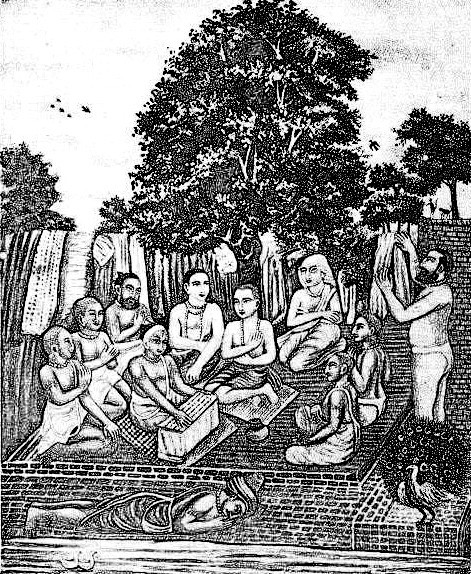
The embrace in the Balagandi garden was not a single, isolated moment of mercy that then faded. Once Sri Chaitanya Mahaprabhu had accepted Maharaja Prataparudra's service, a real relationship followed. At first the King could reach Him only through a secret meeting, for which he had to hide who he was. Over the following years this changed into an open embrace given in full daylight, with no disguise needed at all.
| Detail | Description |
|---|---|
| First words after the embrace | "Who are you?", asked only after the Lord had embraced him |
| The King's reply | "I am the most obedient servant of Your servants" |
| New name given to the Lord | Pratāparudra-santrātā, "the deliverer of Maharaja Prataparudra" |
| Later open meeting | Under a bakula tree at Cuttack, en route to Vrindavana |
| Daily discipline | Massaging the feet of Kashi Mishra, the Lord's Puri host |
| Protective role | Formed part of the outer security ring during Ratha-yatra kirtana |
Servant of the Servants #
When Sri Chaitanya Mahaprabhu finally asked the man He had just embraced who he was, Prataparudra's answer became the phrase Gaudiya Vaishnavas most associate with him: "My Lord, I am the most obedient servant of Your servants. It is my ambition that You will accept me as the servant of Your servants" (Chaitanya-charitamrita, Madhya-lila 14.18). Notice what he did not ask for. He did not request rank in the Lord's eyes. He asked only for a place among those who serve the Lord's own servants. In his purport to this verse, Srila Prabhupada compares this wish to that of Prahlada Maharaja and Dhruva Maharaja, who refused every material blessing and chose exactly this position instead. In the same spirit, at this same Ratha-yatra, Sri Chaitanya Mahaprabhu Himself had declared His own identity in these words: "I am not a brahmana, I am not a kshatriya, I am not a vaishya or a shudra... I identify Myself only as the servant of the servant of the servant of the lotus feet of Lord Sri Krishna, the maintainer of the gopis" (Madhya-lila 13.80). Sri Chaitanya Mahaprabhu then briefly showed him a glimpse of His own divine opulence, and asked him to keep it secret (Madhya-lila 14.19-20).
A Name That Followed Him #
The Chaitanya-charitamrita records that the mercy shown to Prataparudra that day left a permanent mark on how the devotees spoke of the Lord Himself: "Śrī Caitanya Mahāprabhu showed such mercy to the King that from that day on the Lord became known as Pratāparudra-santrātā, the deliverer of Mahārāja Pratāparudra" (Madhya-lila 16.108). It is remarkable what this name remembers. It does not remember a miracle performed for the world. It remembers mercy shown to a single king who had once been refused.
Standing Guard at His Own Ratha-yatra #
Prataparudra's place in the Lord's Puri years was not only a matter of devotional feeling. It also had a very practical side. During the chariot festival, the Lord's kirtana parties danced in ecstatic states that drew enormous crowds. The devotees organized themselves into rings for the Lord's protection. Krishnadasa Kaviraja records that the King and his own attendants formed the outer ring, holding back the press of pilgrims (Madhya-lila 13.90). In this same setting, Srivasa Thakura was standing in front of the King and blocking his view. The King's minister Haricandana pushed him aside again and again, and Srivasa slapped him in return. Haricandana was angry and was about to speak to Srivasa. But Prataparudra personally stepped in and stopped him outright. He told Haricandana that he should feel fortunate, not insulted, to have been touched, even in anger, by a devotee like Srivasa (Madhya-lila 13.96). Ordinarily this king commanded complete respect from everyone. Yet in his own temple town he was content to take the side of a Bengali brahmana's honor over his own minister's.
Kashi Mishra's Daily Visitor #
Away from the crowds, Prataparudra kept a quieter, more private discipline. Throughout His Puri years, Sri Chaitanya Mahaprabhu lived in a small room called the Gambhira, attached to the house of the brahmana Kashi Mishra. Prataparudra himself had originally suggested this house to the devotees as a quiet and secluded place, as told in the account of the Lord's years at Jagannatha Puri. According to Gaudiya tradition, whenever the King was at Puri, he made a habit of going daily to Kashi Mishra's house after his midday meal. There he would massage Kashi Mishra's feet and ask about the state of Lord Jagannatha's temple service. This was not the same as taking formal initiation from Kashi Mishra, and no source claims that it was. But it shows a ruler who valued ordinary, repeated service done with his own hands more than any honor his rank could otherwise command.
An Open Embrace Under a Bakula Tree at Cuttack #
Years later, when Sri Chaitanya Mahaprabhu set out from Puri on His attempted journey to Vrindavana, His route passed directly through Prataparudra's own capital. The Lord was resting under a bakula tree in a garden outside a temple at Cuttack. There Ramananda Raya found Him and immediately went to inform the King. Prataparudra hurried to the spot. This time there was no need for disguise or secrecy. He "fell flat to offer Him obeisances... Being overwhelmed with love, the King again and again got up and fell down" (Madhya-lila 16.102-104). Sri Chaitanya Mahaprabhu stood and embraced him a second time, and the Chaitanya-charitamrita notes that the Lord's own body was bathed in the King's tears (Madhya-lila 16.105-106). This is very different from the secrecy of the Balagandi garden. There the King had needed a disguise to come near the Lord. Now it happened in the open, with Ramananda Raya simply walking over to fetch the King.
Four Months a Year, for as Long as the Lord Allowed #
Every year during the rains, the devotees of Bengal traveled to Puri. They stayed through the four months of Chaturmasya before returning home. Once, at the devotees' request, Sri Chaitanya Mahaprabhu agreed to extend His own residence at Puri through that same four-month period. Of that moment it is recorded: "hearing this, King Pratāparudra became very, very happy" (Madhya-lila 16.285). This small, human detail says as much about the relationship as any grander episode. What became of that relationship in the years after is told on Legacy and Later Reign, along with the wars, buildings and disputed records of Prataparudra's own reign.
