Raghunatha Bhatta Goswami's devotion at Vrindavana was never only about recitation. Chaitanya-charitamrita says plainly that he surrendered himself fully to Govinda's lotus feet, and that those feet became, in the most literal sense, his life and soul. What followed from that surrender was decades of active service: to a Deity, to a temple, and eventually to a community of devotees who looked to him for guidance.
| Detail | Description |
|---|---|
| Deity served | Sri Govinda, at the temple built under his direction |
| Ornaments he personally made | A flute and shark-shaped earrings, among others |
| Years of service to Govinda | About forty, by tradition |
| Eventual residence | A cottage near Radha-kunda |
| Traditional eternal identity | Raga-manjari, a gopi-associate of Radha and Krishna, per the Gaura-ganoddesha-dipika |
Building a Home for Govinda #
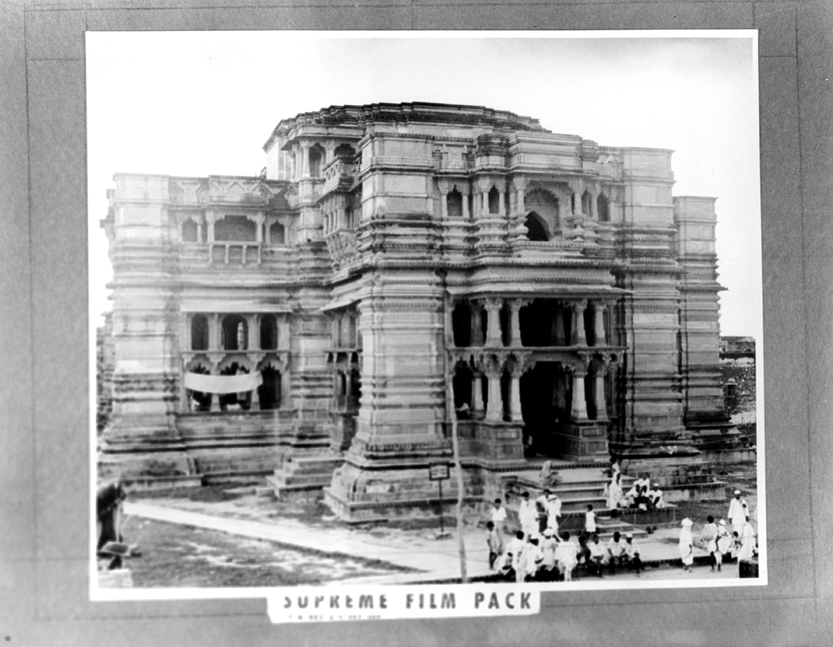
Chaitanya-charitamrita records that under Raghunatha Bhatta's own order, one of his disciples took on the construction of a temple for Govinda in Vrindavana. This was the same Deity whose worship Rupa Gosvami had earlier helped re-establish in the town. Another devotional account names that disciple directly as Raja Man Singh of Amber. This is the same Man Singh remembered elsewhere in Vrindavana's history as a patron of temple-building in this era. The account says Raghunatha Bhatta asked him to oversee the work himself. Raghunatha Bhatta personally supplied ornaments for the Deity, making a flute and a pair of shark-shaped earrings among other adornments. Later devotional tradition adds a well-known detail to this story. It says that the temple's wealthy donor and builder was inspired directly by Raghunatha Bhatta. It also says that this same red sandstone temple, among the most admired in all of northern India, still stands in Vrindavana today, more than four centuries later. Wikipedia's summary says the temple was built by his disciples only after his passing. But the Chaitanya-charitamrita purport tradition places its construction under his own direction during his lifetime. So the two accounts do not fully agree on the timing. What is not disputed is that Raghunatha Bhatta gave roughly forty years of his life to Govinda's service.
A Teacher for Devotees From Bengal #
Later Gaudiya Vaishnava tradition remembers Raghunatha Bhatta Goswami as more than a reciter and a temple's inspiration. It also remembers him as a guide to other devotees. One account holds that he accepted disciples from the eastern regions of Bengal (Gauda) specifically. In much the same way, his Vrindavana companion Gopala Bhatta Gosvami is said to have guided devotees arriving from the west and south of India. This detail rests on a single devotional source, not on Chaitanya-charitamrita itself. So it should be read as a later tradition about his role, not as a settled historical fact. But it fits naturally with everything else remembered about him. By that point his whole life was open to anyone who wanted to hear the Bhagavatam properly recited.
Neighbors at Radha-kunda #
Raghunatha Bhatta eventually made his own home beside Radha-kunda. Radha-kunda is the small lake in Vraja that Sri Chaitanya Mahaprabhu Himself is said to have identified during His own visit as the place where Radha and Krishna once bathed together. This placed him close to Raghunatha Dasa Goswami. Raghunatha Dasa Goswami had settled at the same kunda after his own arrival from Jagannatha Puri, and he spent roughly four decades there in extreme austerity. Sources describe the two Raghunathas as close companions in this Radha-kunda community of Goswamis. They were not guru and disciple to one another. Theirs was a friendship of shared devotion, not a formal spiritual relationship. Their names are still linked together in Krishnadasa Kaviraja Goswami's own repeated prayer at "the feet of Sri Rupa and Sri Raghunatha," a line traditionally understood to honor both Raghunathas at once.
A Gopi's Name Behind the Goswami's Robes #
Gaudiya Vaishnava theology holds that every one of the Six Goswamis carries a second, eternal identity within Krishna's own pastimes in Vraja, hidden behind their outward life as renounced scholars and preachers. For Raghunatha Bhatta Goswami, the Gaura-ganoddesha-dipika names that identity as Raga-manjari, one of Radha's own intimate gopi attendants, said to reside eternally in a cottage beside Radha-kunda in her spiritual form just as Raghunatha Bhatta did in his physical one. Some sources give the name slightly differently, as Rasa-manjari, though Raga-manjari is the form recorded in Srila Prabhupada's own purport to Chaitanya-charitamrita.
By the time of his final years, Raghunatha Bhatta Goswami had become, in his own quiet way, as central to the spiritual life of Vrindavana as any of his more famous companions. How that life came to its end, and what still remains of it at Vrindavana, is told in Disappearance and Legacy.
