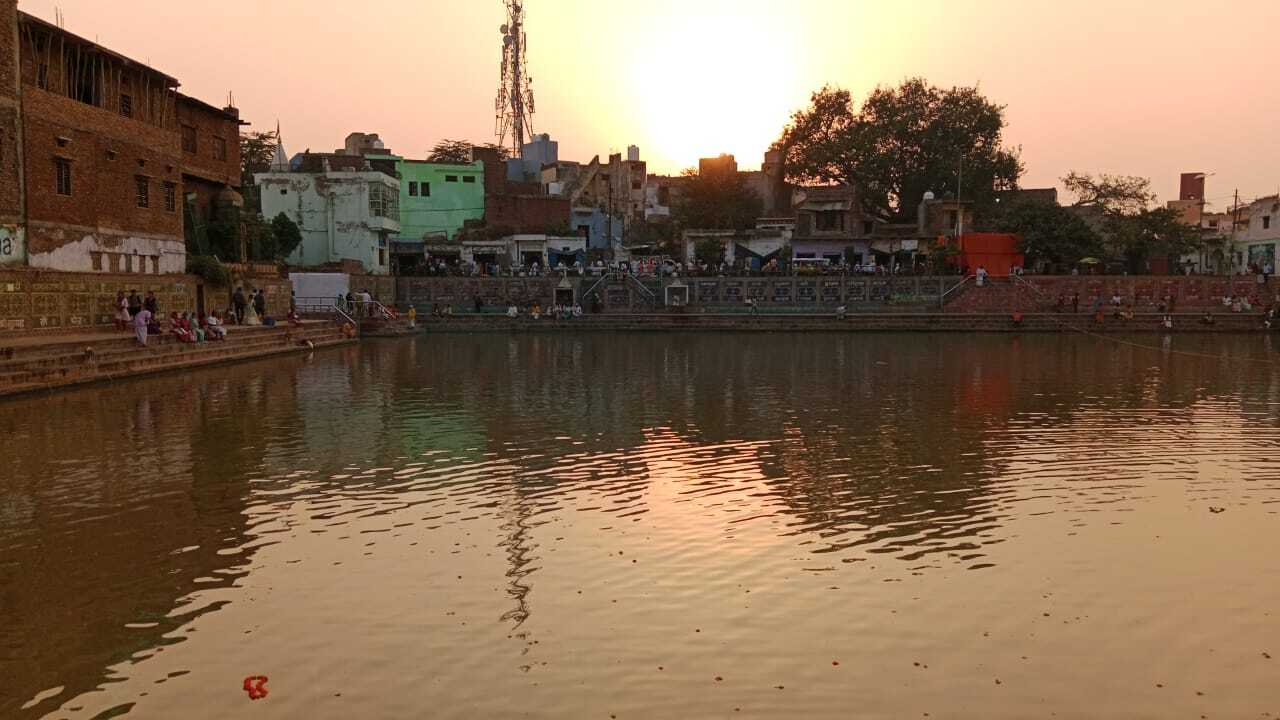
Raghunatha Bhatta Goswami is generally said to have disappeared from this world around 1579, though a few sources place it a year or so later. As with several of the Six Goswamis, modern accounts do not fully agree on any single date. One detail is recorded consistently, and it is stranger and more specific than most disappearance stories in this tradition. It is said that Jiva Gosvami feared that hostile hands might dishonor Raghunatha Bhatta's body after death, and so had it cremated instead of buried in the usual Vaishnava manner. The ashes, it is said, were then divided between two samadhi sites. One is at Radha-kunda itself. The other is in the area of Vrindavana known today as the Chaurasi, or Eighty-Four, Samadhis. Another devotional account of the same tradition gives the second site a different figure, calling it simply the Sixty-Four Samadhis area near the Govindaji temple. The two counts do not agree, so readers should not treat the exact number as certain.
| Detail | Description |
|---|---|
| Disappearance | c. 1579 (a small number of sources give 1580) |
| Body's fate | Cremated, by tradition on the order of Jiva Gosvami, to protect it from desecration |
| Samadhi sites | Radha-kunda, and a second Vrindavana samadhi cluster near the Govindaji temple |
| Preserved relics | A Srimad-Bhagavatam volume, tulasi garland, and wooden sandals (paduka), still honored at Raghunatha Bhatta Goswami's Peeth, Vrindavana |
| Literary output | None: unlike the other Goswamis, he wrote no books, having "learned everything simply by hearing shastra" |
No Books, and No Need of Them #
There is one thing Raghunatha Bhatta Goswami did not do. Every other member of the Six Goswamis, such as Rupa Gosvami, Sanatana Gosvami, Jiva Gosvami and Raghunatha Dasa Goswami, left behind written works that shaped Gaudiya Vaishnava theology for centuries. Raghunatha Bhatta Goswami wrote nothing. The biographical tradition on the Gaudiya History website explains this simply. He was a scholar in every subject, but he had learned it all directly by hearing scripture, and his genius showed itself in his voice, not in writing. In a movement that produced an entire cartload of handwritten books from Vrindavana, as Srila Prabhupada once described it, Raghunatha Bhatta Goswami's contribution was the sound of the Bhagavatam itself. He carried it, in one unforgettable voice, into the ears of everyone who heard him.
What Srila Prabhupada Taught About Him #
Srila Prabhupada returned often to the invocation that Gaudiya Vaishnavas recite daily in praise of the Six Goswamis. He made a point of explaining who "the other Raghunatha" actually was. In a 1968 lecture in Los Angeles on the Sri Sad-gosvamy-ashtaka, he told his students plainly: "There are two Raghus: one Raghunatha dasa Gosvami and one Raghunatha Bhatta Gosvami." He went on to explain that Raghunatha Dasa Gosvami carried the title dasa on account of his family's social standing. But in spiritual terms, both men belonged equally among the six who "picked up Lord Caitanya's eight verses and wrote so many books". For Raghunatha Bhatta specifically, this description applies more to what he preached aloud than to what he wrote down. Elsewhere, Prabhupada taught from Narottama Dasa Thakura's own verse in praise of the Six Goswamis. There he insisted that no one can rightly call themselves a follower of this line, a rupanuga Vaishnava, without following the standard the Goswamis themselves set. Raghunatha Bhatta Goswami met that standard not through books, as Narottama Dasa Thakura himself did, but through a lifetime devoted entirely to the Bhagavatam's own words.
A Heart Breaking at the Samadhi #
Narahari Chakravarti's Bhakti-ratnakara preserves a scene of devotees actually standing before Raghunatha Bhatta Goswami's samadhi, generations after his disappearance, and hearing his glories sung by Srinivasa Acharya:
"As I look upon the samadhi tomb of Raghunatha Bhatta, my heart breaks and my eyes are awash with tears. But who is not overjoyed as soon as he hears Raghunatha Bhatta Gosvami's glories? He was such an expert teacher of all the scriptures that even Brihaspati would joyfully cheer upon hearing his explanations of Vaishnava doctrine. There is nothing to which his discourses on the Bhagavatam can be compared. Even Vyasa himself wishes to sit and listen to him speak, knowing that this will bring him happiness. Even the gods were astonished when they observed his devotional practices."
Hearing this, the Bhakti-ratnakara says, the assembled devotees fell to the ground in respect before continuing on together to the Govindaji temple, the very temple whose construction Raghunatha Bhatta Goswami had once inspired.
A Living Address in Vrindavana #
Raghunatha Bhatta Goswami is not only a name in old texts. He still has a physical address in Vrindavana. Tradition holds that several things connected with him are preserved and still worshipped at a site known as Raghunatha Bhatta Goswami's Peeth, near the historic Bhatt-ji-ki-Haveli in Vrindavana. They are the tulasi garland and betel that Sri Chaitanya Mahaprabhu once placed in his hands, a Srimad-Bhagavatam volume connected to his memory, and his own wooden sandals. Pilgrims visiting the wider Vraja circuit today can still walk to his samadhi near Radha-kunda, not far from where Raghunatha Dasa Goswami himself is buried. They can also visit the Govinda temple whose construction Raghunatha Bhatta once inspired.
His Place Among the Six #
Raghunatha Bhatta Goswami's legacy was never meant to stand alone. He belongs to a set of six names that Gaudiya Vaishnavas have chanted together for five centuries: Rupa Gosvami, Sanatana Gosvami, Raghunatha Bhatta Gosvami, Jiva Gosvami, Gopala Bhatta Gosvami, and Raghunatha Dasa Gosvami. This lineage runs forward through Krishnadasa Kaviraja Goswami, who named Raghunatha Bhatta as one of his own instructing spiritual masters. It continues through Narottama Dasa Thakura, Vishvanatha Chakravarti Thakura and Baladeva Vidyabhusana, down to Srila Prabhupada and the worldwide movement he founded. Of all six, Raghunatha Bhatta Goswami left the fewest written records. Yet in a real sense, his influence is the most alive. Every time the Bhagavatam is read aloud with feeling in a Gaudiya Vaishnava temple anywhere in the world, something of the standard he set five hundred years ago at Vrindavana is still being followed.
