Ramachandra grew up in a household that, from the outside, already seemed to belong to Krishna. His father, Chiranjiva Sena of Shrikhanda, is named directly in Sri Chaitanya-charitamrita as one of a close circle of devotees who traveled every year to Puri for Ratha-yatra. Mukunda, Narahari Sarakara and Raghunandana were also in this circle. But Chiranjiva died while his two sons, Ramachandra and the younger Govinda, were still young. The boys were then raised by their maternal grandfather, Damodara Kaviraja. Damodara was a real poet himself, but he was also a firm worshiper of Durga in the Shakta tradition. Both brothers grew up worshiping deities who represent Krishna's external energy. By early adulthood Ramachandra had made a name for himself as a practicing physician and as a skilled poet.
A Palanquin Passes Jajigram #
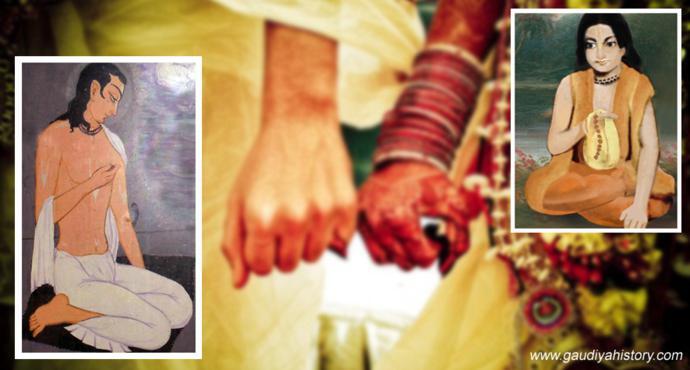
None of that reputation prepared Ramachandra for what happened on his wedding day. After the wedding he sat in a palanquin beside his new bride, Ratnamala (given elsewhere as Ratanala). The procession was carrying them toward his home at Kumaranagara. On the way, the party passed through Jajigram, and past the house of Shrinivasa Acharya. Shrinivasa Acharya happened to be sitting on his own veranda, discussing Krishna-katha with his disciples.
Narahari Chakravarti Thakura's *Bhakti-ratnakara* records what happened next as something neither man could fully explain. When Ramachandra saw the Acharya, a feeling he had not known before rose in his heart. It was not the passing interest of a stranger. It was closer to meeting a very dear friend after a long separation. Shrinivasa Acharya felt the same pull toward Ramachandra. Seeing the young bridegroom in his palanquin, he turned to his own associates and asked who he was, what caste he belonged to, and where he lived. They told him that the young man was Ramachandra, a skilled poet and physician of Kumaranagara. The Acharya only smiled.
A Sleepless Night, and a Return at Dawn #
The wedding celebrations went ahead as planned. Ramachandra's new household welcomed its bride with the usual noise and festivity. But all the accounts agree that his mind never really left Jajigram. He got through the day, and as soon as night fell, he made his way back. He stayed until morning in the house of a local brahmana. At daybreak he went straight to Shrinivasa Acharya and fell at his feet.
Shrinivasa Acharya, who had spent that same day and night thinking of the young man he had seen in the palanquin, lifted him up and embraced him. What he said next is the line by which this meeting is still remembered: "Birth after birth, you are my most dear friend. In the same way that the Lord arranged my meeting with Narottama Dasa Thakura at Vrindavana, He has now reunited me with another dear friend." Ramachandra stayed on, studying the writings of the Six Goswamis under the Acharya's direct guidance, and in due course was initiated with the Radha-Krishna mantra.
Facing Down a Shakta Challenge #
Initiation did not bring the matter to a quiet end. Ramachandra returned home wearing Vaishnava tilaka in the traditional twelve places and carrying a chanting bead-bag. His Shakta relatives and neighbors were upset, because his own grandfather had been a lifelong devotee of Lord Shiva. One day, as Ramachandra was returning from his bath, they faced him directly. They asked how he, the grandson of such a devotee, could give up Shiva's worship completely.
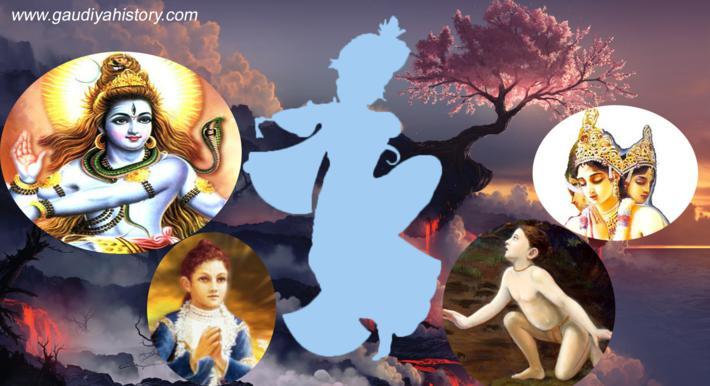
The same source records Ramachandra's reply. He did not insult anyone's faith. Instead, he explained a short point of Vaishnava philosophy. Shiva and Brahma, he said, are themselves great devotees and expansions of Krishna's own energy. So worship of Krishna nourishes them too, just as watering a tree's root feeds every leaf and branch. He gave the examples of Prahlada, Dhruva and Vibhishana, devotees of Krishna whom Shiva and Brahma naturally favored. Ravana, Kumbhakarna and Banasura were different. They were devotees of Shiva only in name, and they came to ruin because they were never devotees of Krishna Himself. He added that Brahma's own power to create the universe, and Shiva's own power to bless it, both come from their earlier service to Vishnu. His questioners, the account says, had no answer and fell silent.
After that confrontation, Ramachandra's old life never again had any real hold on him. The story of what came next continues on Pilgrimage to Vrindavana and the Kaviraja Title. It tells of his own journey to Vrindavana, and of the title that stayed with him for the rest of his life.
