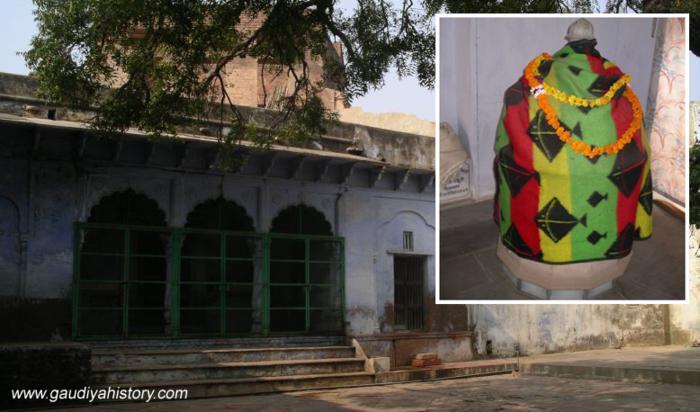
The Kheturi festival grew out of a discovery that Narottama Dasa Thakura made by following the guidance of his own dream. He found an abandoned granary belonging to a local brahmana. It was said to be full of poisonous snakes, which had kept everyone else away. Narottama Dasa Thakura went in anyway. Inside, guarded by those same snakes, he found six self-manifest Deities: Sri Gauranga-deva, Sri Vallabhi-kanta, Sri Vraja-mohana, Sri Radha-kanta, Sri Radha-ramana and Sri Krishna. By then Jahnava-mata was the senior-most figure among the Gaudiya Vaishnavas. She ruled that since the Deities were self-manifest, no formal installation ceremony was required, only a mahabhisheka. She named Shrinivasa Acharya to perform it, with Shyamananda Prabhu, Ramachandra Kaviraja and Narottama Dasa Thakura himself leading the kirtana. Devotees came together from all over Gauda-mandala, Kshetra-mandala and Vraja-mandala. Later tradition remembers this as the largest single gathering of Gaudiya Vaishnavas in the generation after Sri Chaitanya Mahaprabhu himself. It is said that no festival since has equaled it in scale.
A Brother Brought to Krishna Consciousness #
Kheturi was not the only matter that concerned Ramachandra in these years. There was also a matter in his own family. His younger brother, Govinda, had been raised with him in their grandfather's Shakta tradition, but by then he had been formally initiated by Shrinivasa Acharya. Govinda fell seriously ill and seemed to be near death. Ramachandra grew anxious that his brother's final thoughts should be fixed on Krishna. This was in the spirit of the well-known Srimad-Bhagavatam verse which says that the highest fruit of any path is simply "to remember the Personality of Godhead" at life's end (Bhagavatam 2.1.6). Ramachandra asked Narottama Dasa Thakura to arrange for the Bhagavatam to be recited to Govinda. As was his nature, Narottama did not want to present himself as anyone's spiritual authority. So instead he wrote to Shrinivasa Acharya and asked him to do it. Hearing the Bhagavatam recited at his bedside changed Govinda completely. By tradition, the well-known kirtana "bhaja re mana, sri-nanda-nandana" first came from his lips while he was in this state. The song is still counted among the classics of Vaishnava padavali literature.
A Second Journey to Vrindavana #
After Kheturi, Shrinivasa Acharya returned to Vrindavana, and Ramachandra Kaviraja went with him, this time for good. Later in life, Shrinivasa Acharya and Narottama Dasa Thakura together instructed him to make one more journey back to Vraja. But when he arrived, he found that the Goswamis and other direct associates of Mahaprabhu he had met and been blessed by on his first pilgrimage had by then all left this world. These are the men described on Pilgrimage to Vrindavana and the Kaviraja Title. Tradition says he could not bear the weight of that separation, and he did not live long after it himself.
Disappearance and Samadhi #
Sources do not agree on the exact date of Ramachandra Kaviraja's disappearance. One account places it on the third day of the dark fortnight of the month of Pausha, another on Krishna-trayodashi of Magha. But the sources agree that he passed away in Vrindavana after his own guru's disappearance. They also agree that his samadhi stands in the Dhira Samira grove, directly beside Shrinivasa Acharya's own. So guru and disciple, in death as in life, remain within sight of one another. His chief disciple was Harirama Acharya. The Deities that Ramachandra and Govinda had worshiped together were later moved from Teliya Budhari to Bhagavangola. They continue to be worshiped there today by the followers of Rama Dasa Babaji.
It is said that Narottama Dasa Thakura's own grief at Ramachandra's passing shaped two of his most lasting works, *Prema-bhakti-chandrika* and *Prarthana*. The second of these preserves the line by which their friendship is still remembered: "daya kara sri-acarya prabhu srinivasa, ramacandra sanga mage narottama dasa," "Be merciful, O Prabhu Shrinivasa Acharya, Narottama Dasa begs for the association of Ramachandra." Narottama is also remembered to have said, more simply, that if he were ever to take human birth again he would still want an associate like Ramachandra Kaviraja at his side. Five centuries later, that longing still shows most clearly who Ramachandra Kaviraja really was. He was not mainly a theologian or a builder of institutions. He was a friend whose company another great Vaishnava thought worth begging for.
