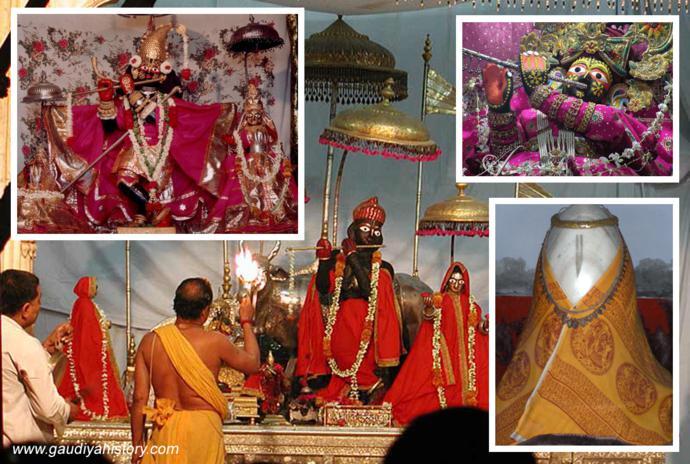
Ramachandra set out for Vrindavana not long after his initiation. He went with his guru's blessing. By tradition, he also asked permission from the elder Vaishnava Raghunandana and others of Shrikhanda. For a devotional text, the record of his route is unusually exact about places. He went through Gaya, Kashi and Prayaga to Mathura. There he bathed and rested at Vishrama-ghat. Then he took darshan of the ancient Adi-Keshava temple, and finally went on to Vrindavana itself.
Reunited With His Guru, and Introduced to Jiva Goswami #
Shrinivasa Acharya was in Vrindavana when Ramachandra arrived. Ramachandra's first act was to fall at his guru's feet. Then he fell at the feet of Jiva Goswami and brought him news of the Vaishnavas back in Bengal. Shrinivasa Acharya's affection for his disciple only grew deeper in Vraja. Tradition records that the Malla king Bir Hambir of Bishnupur later became Shrinivasa Acharya's own formal initiated disciple. The same tradition says that it was Ramachandra who served the king as siksha-guru, guiding him in the day-to-day practice of devotional life. This showed unusual trust, because Ramachandra himself had been a Vaishnava for only a short time.
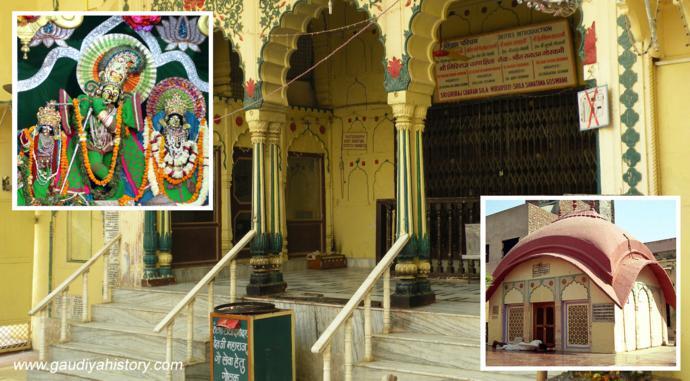
On Jiva Goswami's own instruction, Ramachandra was taken to see the Deities of Govinda, Gopinatha and Madana-mohana, and to the samadhi of Sanatana Goswami. From there he went on to receive the personal blessings of three more of the small circle of direct associates whom Sri Chaitanya Mahaprabhu had first sent to uncover and restore the lost holy places of Vraja. The first was Gopala Bhatta Goswami, the South Indian brahmana who would later compile the Hari-bhakti-vilasa. This is the manual of Deity worship that Gaudiya temples still follow. The second was Lokanatha Goswami, who is traditionally credited with first rediscovering the site of Radha-kunda itself. The third was Bhugarbha Goswami, one of Lokanatha Goswami's own closest associates in Vraja.
Radha-Damodara, Radha-kunda, and an Embrace From Raghunatha Dasa Goswami #
The *Bhakti-ratnakara* describes in some detail what happened at the Radha-Damodara temple. Ramachandra went there with Jiva Goswami and stood before Rupa Goswami's samadhi. What came over him there is described as an ecstatic change that everyone present could see. It is said that this amazed the Vaishnavas who saw it, and they took it as a sign of real devotion, not a show. From the temple he went on to bathe in the twin lakes of Radha-kunda and Shyama-kunda. Tradition connects these waters with Krishna's rasa-lila with Radharani and her gopi friends. By then the lakes had already been the home and bhajana-sthal of Raghunatha Dasa Goswami for decades. Raghunatha Dasa Goswami was not a man who easily showed warmth. Even his admiring biographers describe him this way. Yet when Ramachandra offered his obeisances there, the Goswami embraced him affectionately.
The Kaviraja Title #
While Ramachandra was in this same company, the Vaishnavas of Vraja heard him recite samples of his own poetry. By the *Bhakti-ratnakara*'s own account, Paramananda Bhattacharya was among them. After that, Jiva Goswami and the others decided together to award him the title Kaviraja, meaning king of poets. Srila Prabhupada's purport to Chaitanya-charitamrita, Adi-lila 11.51, gives much the same account in far fewer words. It credits the honor to Jiva Goswami's appreciation of "Sri Ramacandra Kaviraja's great devotion to Lord Krsna." The title placed him among the eight kavirajas, the poet-disciples of Shrinivasa Acharya. Later Vaishnava tradition remembers him by this title, not only by his birth name.
After some more time in the Goswamis' company, Ramachandra was instructed to return to Bengal. He traveled back slowly, through Shrikhanda, Jajigram and Kalna. Finally he arrived at Mayapura to receive the blessings of Ishana Thakura. Then he took up his life again alongside Shrinivasa Acharya and Narottama Dasa Thakura. Not long after, this partnership was tested by a very different kind of challenge, told on The Disguised Shopkeepers of Kumarapura.
Ramachandra's brief time at Radha-kunda was only a visit. He did not settle there. His own base remained Shrinivasa Acharya's household and, in time, Vrindavana in general. But the community of renounced Vaishnavas that Raghunatha Dasa Goswami had gathered at Radha-kunda lasted for generations after this meeting. About a century later, Vishvanatha Chakravarti Thakura wrote his famous commentaries at Radha-kunda. He belonged to the same continuing line of learned devotees who had renounced the world. They kept Raghunatha Dasa Goswami's bhajana alive at the two lakes long after the generation Ramachandra met there had passed on.
