Srila Sadashiva Pandit
The Twelfth Branch of the Chaitanya Tree, First Host of Nityananda Prabhu in Navadwip
The complete life, on one page: The main biography and every pastime page, in order, in one place
Introduction
Sri Chaitanya-charitamrita counts Sadashiva Pandit among the direct branches of what it calls the tree of Sri Chaitanya Mahaprabhu's own devotion. By Krishnadasa Kaviraja Goswami's own count, he is the twelfth branch. He is named in a chapter given entirely to naming Mahaprabhu's closest Navadwip associates one by one. Very little survives about his life beyond a handful of short, specific scenes. But those scenes place him at the center of some of the most important early moments of the sankirtan movement. He was the householder in whose home Nityananda Prabhu first stayed on reaching Navadwip. He was a member of the kirtan circle that gathered nightly at Srivasa Thakura's house. He was one of the few devotees the Lord confided in about His own hidden sorrow. And he was the devotee entrusted with costumes when Mahaprabhu staged a pageant of Krishna's Vraja-lila.
Before going further, Sadashiva Pandit must not be confused with another devotee. Sri Chaitanya-charitamrita separately names a devotee called Sadashiva Kaviraja, not Pandit. He is the twenty-third prominent associate in an entirely different list, the branches of Nityananda Prabhu's own tree. This Sadashiva Kaviraja is described as the father of Purushottama Dasa. The two men share a first name and lived in the same generation, but Chaitanya-charitamrita itself keeps them apart. One is a branch of Mahaprabhu's tree with the title Pandita. The other is a branch of Nityananda Prabhu's tree with the title Kaviraja. What follows is only about the first of them, Sadashiva Pandit.
| Detail | Description |
|---|---|
| Standing in the text | Twelfth branch of the Chaitanya tree, per Sri Chaitanya-charitamrita, Adi-lila 10.34 |
| Home | Navadwip; his house was Nityananda Prabhu's first residence there |
| Primary sources | Sri Chaitanya-charitamrita (Adi-lila 10.34); Vrindavana Dasa Thakura's Chaitanya-bhagavata (several chapters) |
| Known companions in these episodes | Nityananda Prabhu, Srivasa Thakura, Murari Gupta, Buddhimanta Khan, Chandrashekhara Acharya |
| Birth / disappearance | Neither is recorded in the surviving sources |
| Not to be confused with | Sadashiva Kaviraja, a separate associate of Nityananda Prabhu named at Sri Chaitanya-charitamrita, Adi-lila 11.38 |
Scriptural evidence for the introduction (2)
সদাশিবপণ্ডিত যাঁর প্রভুপদে আশ ।
প্রথমেই নিত্যানন্দের যাঁর ঘরে বাস ॥
sadāśiva-paṇḍita yāṅra prabhu-pade āśa
prathamei nityānandera yāṅra ghare vāsa
Word for word
sadāśiva-paṇḍita: Sadāśiva Paṇḍita; yāṅra: whose; prabhu-pade: unto the lotus feet of the Lord; āśa: constant desire; prathamei: in the beginning; nityānandera: of Lord Nityānanda; yāṅra: of whom; ghare: in the home; vāsa: residence.
Sadashiva Pandita, the twelfth branch, was always eager to serve the lotus feet of the Lord. It was his good fortune that when Lord Nityananda came to Navadvipa He resided at his house.
From the purport: Purport excerpt: "It is mentioned in the Caitanya-bhagavata, Antya-khanda, chapter nine, that Sadasiva Pandita was a pure devotee and that Nityananda Prabhu resided at his house."
The one verse in the Chaitanya-charitamrita's own text naming Sadashiva Pandit directly, and the source for his standing as the twelfth branch of the Chaitanya tree and host of Nityananda Prabhu's first Navadwip residence.
শ্রীসদাশিব কবিরাজ—বড় মহাশয় ।
শ্রীপুরুষোত্তম দাস—তাঁহার তনয় ॥
śrī-sadāśiva kavirāja — baḍa mahāśaya
śrī-puruṣottama-dāsa — tāṅhāra tanaya
Word for word
śrī-sadāśiva-kavirāja: Śrī Sadāśiva Kavirāja; baḍa mahāśaya: great respectable gentleman; śrī-puruṣottama-dāsa: Śrī Puruṣottama dāsa; tāṅhāra tanaya: his son.
The twenty-third and twenty-fourth prominent devotees of Nityananda Prabhu were Sadasiva Kaviraja and his son Purushottama Dasa, who was the tenth gopala.
Cited here only to document the disambiguation: this is a separate devotee, Sadashiva Kaviraja, listed among Nityananda Prabhu's own associates in a different chapter, not the subject here.
Chapter 1
Nityananda's First Home in Navadwip
The first door Lord Nityananda Prabhu knocked on in Navadwip was that of a householder, Sadashiva Pandit, who himself belonged to the movement's earliest kirtan circle.
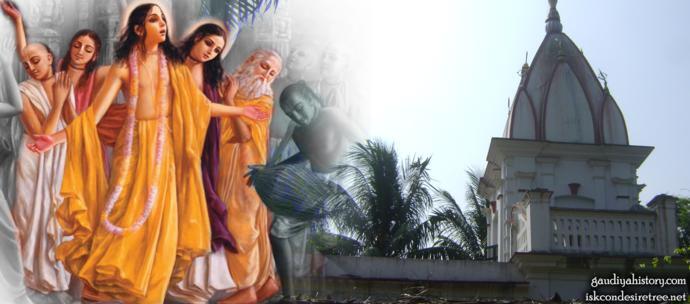
Sri Chaitanya-charitamrita remembers Sadashiva Pandit above all for this. When Nityananda Prabhu first arrived in Navadwip, He came to Sadashiva Pandit's house and stayed there. Krishnadasa Kaviraja Goswami names him the twelfth branch of the tree of Mahaprabhu's own devotion. He sums up his character in a single phrase, a devotee who "placed all his hopes at the Lord's feet," and then adds, almost as an afterthought, the detail that gives him his lasting place in the record. That detail is his good fortune in hosting Nityananda Prabhu's very first stay in the town.
| Detail | Description |
|---|---|
| Textual source | Sri Chaitanya-charitamrita, Adi-lila 10.34, with purport |
| Event | Nityananda Prabhu's first residence on arriving in Navadwip |
| Confirmed elsewhere | Vrindavana Dasa Thakura's Chaitanya-bhagavata, Antya-khanda, chapter nine (per Srila Prabhupada's purport) |
| Also present at | Nightly kirtan at Srivasa Thakura's house |
An Arrival That Changed Everything #
Gaudiya Vaishnava tradition remembers Nityananda Prabhu's arrival in Navadwip as one of the most important moments of Mahaprabhu's early mission. It was the meeting of the Lord with the associate who would become, alongside Mahaprabhu Himself, one of the two central figures of the sankirtan movement. In the verse that names Sadashiva Pandit, Sri Chaitanya-charitamrita does not describe the drama of that arrival. Instead it records a plain, everyday fact. Nityananda Prabhu needed somewhere to stay, and Sadashiva Pandit's house was where He first went. Srila Prabhupada's purport confirms the same event from a second, independent source. Srila Prabhupada notes that Vrindavana Dasa Thakura's Chaitanya-bhagavata records in its Antya-khanda that Sadashiva Pandit was a pure devotee and that Nityananda Prabhu stayed at his house. Two of Gaudiya Vaishnavism's most authoritative texts, written independently, agree on this single fact about him.
Think about what this meant in practice. Nityananda Prabhu did not arrive in Navadwip as a stranger looking for any shelter at all. He arrived as a wandering sannyasi whom no one yet recognized. The household that took Him in did so before anyone knew His full identity, or the role He would come to play. In other words, Sadashiva Pandit's hospitality came first. Only afterward did it become clear whom he had sheltered. Looking back on the moment, the tradition marked it as important enough to record by name.
Part of the Kirtan Circle at Srivasa Thakura's House #
Sadashiva Pandit's place in the movement was not limited to this one act of hospitality. Vrindavana Dasa Thakura's Chaitanya-bhagavata names him among the devotees who gathered nightly for kirtan at Srivasa Thakura's house in Navadwip. Tradition remembers this courtyard as the movement's own early headquarters. There Mahaprabhu and His closest associates sang and danced together, often late into the night. Later generations would come to see this as the seed of the entire sankirtan movement. The same passage lists him alongside Gopinatha, Jagadisha, Shriman, Shridhara, Vakreshvara Pandit, Shrigarbha and Shuklambar. This is a roll call of the circle's founding members, not a group that gathered around Mahaprabhu only after His public fame had spread.
Sadashiva Pandit was host to Nityananda Prabhu's first stay in Navadwip, and a member of Srivasa Thakura's own kirtan circle. Taken together, these two details place him at the center of the movement's earliest days, both in place and among its people. This was in the years before Mahaprabhu's own ecstatic transformation had become widely known. The page Confidant of the Lord and Keeper of the Vraja-Lila Costumes tells what happened once that transformation did become visible, and how the Lord placed deeper trust in Sadashiva Pandit as a result.
Chapter 2
Confidant of the Lord and Keeper of the Vraja-Lila Costumes
Chosen to hear the Lord's own hidden sadness at Shuklambar's house, then trusted with the costumes for a pageant of Krishna's Vraja-lila.
Two separate episodes in Vrindavana Dasa Thakura's Chaitanya-bhagavata place Sadashiva Pandit closer to Mahaprabhu's own inner life than almost any other detail recorded about him. Both belong to the years after the Lord returned to Navadwip from Gaya, where He had taken initiation from Ishvara Puri. By then He had begun to show His astonished devotees signs of a devotion unlike anything they had seen in Him before.
| Detail | Description |
|---|---|
| Textual source | Vrindavana Dasa Thakura, Chaitanya-bhagavata, Adi-khanda, chapters 1, 2 and 18 |
| First episode | Present at Shuklambar's house when Mahaprabhu named him among those He would confide His sadness to |
| Second episode | Given charge of costumes, with Buddhimanta Khan, for a Vraja-lila pageant at Chandrashekhara Acharya's house |
| Also recorded | Bhakti-ratnakara 12.2903-4, on the same costume pastime |
Told the Lord's Secret Sadness #
After Gaya, Mahaprabhu began to show the ecstatic symptoms of divine love in public. At that time He told Sadashiva Pandit to be present the next day at the house of a devotee named Shuklambar. There He would reveal to the assembled devotees what had happened to Him. Chaitanya-bhagavata records the Lord's own words: "You, Sadashiva Pandit, should also come tomorrow to Shuklambar's house." When that gathering took place, Mahaprabhu did something more than simply display His transformation before the group. He turned to three devotees by name and told them He would share with them what He was not yet ready to reveal to everyone: "I will reveal all My sadness to you, Shriman Pandit, Sadashiva and Murari Gupta." Chaitanya-bhagavata records the three of them, together with Shuklambar himself, gathered around the Lord as He spoke.
This is a small scene, recorded in only a few lines. But it marks Sadashiva Pandit as one of a very small circle whom Mahaprabhu chose to confide in directly. He spoke to them about an inner state that He kept from the wider public a little longer. Mahaprabhu, who is Krishna Himself, turned to three devotees with the words "I will reveal all My sadness to you." To be one of those three is a genuine mark of closeness, whatever else may or may not be recorded about a person's life.
Costumes for the Krishna-Lila Pageant #
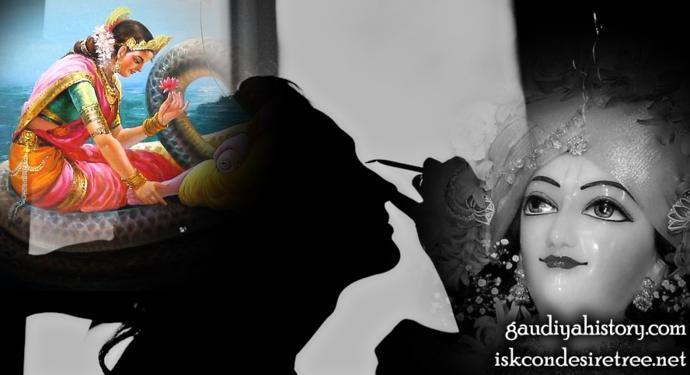
Some time afterward, Mahaprabhu decided to stage a pageant of Krishna's own Vraja-lila pastimes at the house of Chandrashekhara Acharya, with His devotees taking the roles of Krishna's associates in the drama. For this, Chaitanya-bhagavata records, the Lord called for Sadashiva Pandit and a devotee named Buddhimanta Khan and gave them the entire responsibility for costumes and makeup, telling them to go at once and arrange what the actors would need. "Overjoyed, Buddhimanta and Sadashiva immediately went home to fulfill the duties given them by the Lord," the text says of their response.
The later Gaudiya compilation Bhakti-ratnakara adds a striking detail about just how far their preparations went. At the house of Chandrashekhara Acharya, Buddhimanta Khan and Sadashiva Pandit made all the costume arrangements needed for Mahaprabhu Himself to appear in the role of Lakshmi Devi. In the text's words, this was so that the whole gathering would become intoxicated by the singing of the Holy Names that followed the performance. Dressing the Lord Himself for a role in His own pastime play was not a small task, nor just a formality. Chaitanya-bhagavata describes the joy the two devotees felt on receiving this service. This suggests that the circle itself understood it as an honor, not a tiresome duty.
Sadashiva Pandit's name appears in Gaudiya Vaishnava sources in one more context. Chaitanya-bhagavata records that Sadashiva Pandit, in whose home Nityananda Prabhu had earlier been sheltered, was one of the devotees who later travelled with Mahaprabhu's party toward Jagannatha Puri. So the record gives us these episodes: hosting Nityananda Prabhu's first Navadwip stay, singing kirtan at Srivasa Thakura's house, hearing the Lord's confided sorrow, and preparing costumes for the Vraja-lila pageant. Beyond these, no further detail about Sadashiva Pandit's life survives in any source. We say this plainly instead of filling the gap with guesswork.
Closing
The Twelfth Branch of the Tree #
Sri Chaitanya-charitamrita's tenth chapter of Adi-lila is built around a single extended image. Mahaprabhu's own devotion is pictured as a tree, and each close devotee is named as one of its branches or twigs. Krishnadasa Kaviraja Goswami reaches Sadashiva Pandit as the twelfth branch and describes him in one line. He says that Sadashiva Pandit was always eager to serve the lotus feet of the Lord, and that it was his good fortune that Nityananda Prabhu, on first coming to Navadwip, stayed at his house. Srila Prabhupada's purport on the verse adds only a little more, pointing back to an earlier work for confirmation. Srila Prabhupada notes that the Chaitanya-bhagavata records in its Antya-khanda that Sadashiva Pandit was a pure devotee and that Nityananda Prabhu stayed at his home. The mula text itself claims nothing more for him. It gives him no separate chapter and no long episode of his own. But the tradition treats Nityananda Prabhu's arrival as a turning point in the sankirtan movement. So to be named as host to Nityananda Prabhu's very first stay in Navadwip is a real honour.
Nights of Kirtan at Srivasa Thakura's House #
Vrindavana Dasa Thakura's Chaitanya-bhagavata, the earliest full biography of Mahaprabhu, places Sadashiva Pandit inside the inner circle that gathered for kirtan at Srivasa Thakura's house in Navadwip during the earliest days of the movement. It names him there alongside Gopinatha, Jagadisha, Shriman, Shridhara, Vakreshvara, Shrigarbha and Shuklambar. This was the group whose nightly singing marked the real beginning of congregational chanting as Mahaprabhu would come to teach it. They sang in a courtyard that later tradition remembers as the movement's own headquarters. Because he is counted in this list, alongside devotees such as Vakreshvara Pandit, Sadashiva Pandit belongs among the founding members of that circle, not among those who joined it later.
Witness to the Lord's Hidden Sorrow #
After Mahaprabhu returned to Navadwip from Gaya, where He had taken initiation from Ishvara Puri, His devotees began to see displays of ecstatic love unlike anything they had witnessed in Him before. Sadashiva Pandit was among the first to see it. Chaitanya-bhagavata records that Mahaprabhu told him directly to be present at Shuklambar's house. There, in front of the gathered devotees, He would soon reveal the change that had come over Him. When that day came, the Lord singled out Sadashiva Pandit by name for something even more personal: "I will reveal all My sadness to you, Shriman Pandit, Sadashiva and Murari Gupta," He said. He was trusting these three devotees with something He was not yet ready to share more widely. In the accounts of Mahaprabhu's early life at Navadwip, there are very few moments where He is shown speaking of His inner pain directly to particular companions. This is one of them, and Sadashiva Pandit is one of the three He chose.
Costumes for the Vraja-Lila Pageant #
Some time later, Mahaprabhu decided to stage a pageant of Krishna's Vraja-lila pastimes at the house of Chandrashekhara Acharya, with devotees taking on the roles of Krishna's own associates. For this performance He gave the entire responsibility for costumes and makeup to Sadashiva Pandit and a devotee named Buddhimanta Khan. He sent them off at once to arrange everything needed. Chaitanya-bhagavata describes Sadashiva as ecstatic simply to have been given the order. The later compilation Bhakti-ratnakara adds that the two devotees prepared costumes so complete that Mahaprabhu Himself could appear in the role of Lakshmi Devi. In the text's own words, this was so that the whole gathering would become intoxicated by the singing of the Holy Names that followed. The episode is small, but it tells us something. Sadashiva Pandit was not trusted with a public role in the drama itself. He was trusted with the quiet but necessary work that let the pageant happen at all.
A Life the Record Leaves Thin #
Chaitanya-bhagavata also notes, in passing, that Sadashiva Pandit was among the devotees who later travelled with Mahaprabhu's party to Jagannatha Puri. So the same householder whose house had sheltered Nityananda Prabhu's first days in Navadwip evidently stayed connected to the movement as it grew and eventually moved toward Puri. Beyond this handful of scenes, however, no source records anything more. There is no birth year, no family, and no date or place of disappearance. The sources we found do not name a guru for him. They speak only of his direct devotion to Mahaprabhu Himself. We say this plainly instead of hiding it. Sadashiva Pandit's place in the tradition rests entirely on a small number of specific, well-recorded moments, not on a connected life story.
- Sri Chaitanya-charitamrita, Adi-lila 10.34, with purport (vedabase.io)
- Sri Chaitanya-charitamrita, Adi-lila 11.38 (vedabase.io) — the separate devotee Sadashiva Kaviraja
- Sadashiva Pandit — Gaudiya History (ISKCON Desire Tree), excerpted from Shrila Bhakti Ballabh Tirtha Maharaj, "Shri Chaitanya: His Life & Associates"
