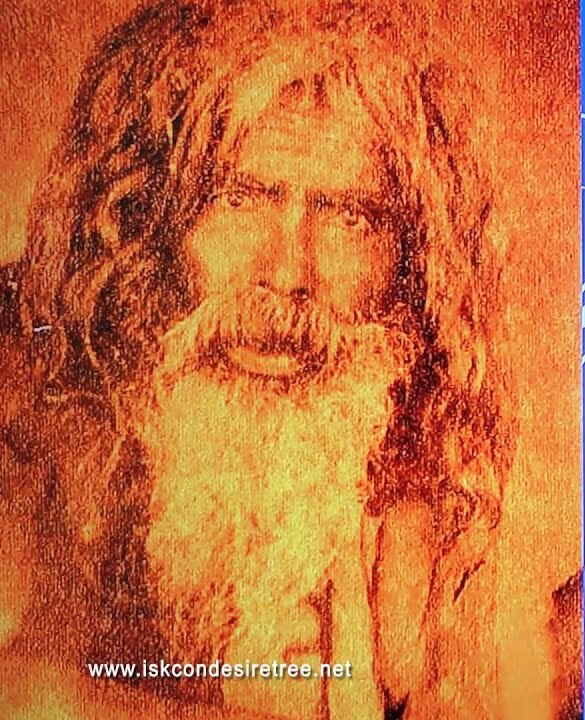
Ser Khan
Pathan official won over by Shyamananda Pandit's kirtan
Also known as Sher Khan, Shera Khan, Chaitanya Dasa (his name after initiation)
“In a dream I first saw Allah in a very frightening form. He suddenly became angry and warned me to take initiation from Sri Shyamananda Prabhu, otherwise I will have to go to hell.”
Ser Khan describing the dream that led him to surrender to Shyamananda Pandit, as translated in one Bengali biography of Shyamananda (Sri Krishna-priya Sri Shyamananda Prabhu, trans. Baladeva Dasa). This dream detail appears in this telling but not in the older Prema-vilasa account, which goes straight from his illness to his surrender.
Ser Khan (also spelled Sher Khan or Shera Khan) was a Pathan official of the Muslim administration in Orissa. Gaudiya Vaishnava tradition remembers him for exactly one episode. It was a violent clash with a sankirtana party led by Shyamananda Pandit, and it ended, surprisingly, in his own conversion. After that encounter he took diksha and lived out his days as a Vaishnava under the name Chaitanya Dasa.
He should not be confused with two other men who share part of his name. Sher Shah Suri was the sixteenth-century founder of the Sur Empire and a famous rival of the Mughals. He is an unrelated historical ruler with no connection to this story. Satyaraja Khan is also a completely different person, from a different family and a different chapter of the tradition's history. Satyaraja Khan was a Bengali householder devotee who personally questioned Sri Chaitanya Mahaprabhu about spiritual life. He lived generations earlier in Kulina-grama as a descendant of Gunaraja Khan. Ser Khan belongs to neither story. He appears only later, in Orissa, in the circle of Shyamananda Pandit.
| Detail | Description |
|---|---|
| Original name | Ser Khan (also Sher Khan, Shera Khan) |
| Name after initiation | Chaitanya Dasa |
| Background | Pathan; an official of the local Muslim administration in Orissa, described in one account as deputy or ruler of the Ambua-Dharenda pargana |
| Guru | Shyamananda Pandit |
| Setting | Dharenda, on the Orissa-Bengal border, near Shyamananda's own birthplace |
| Textual source | Prema-vilasa, chapter 19 (Nayanananda Dasa), and later retellings drawn from it |
| Approximate period | Later 1500s to early 1600s, during Shyamananda's preaching mission in Orissa |
A Local Official Meets a Kirtan Party #
Shyamananda Pandit's preaching base was in and around Dharenda, in northern Orissa. This was the very region where he himself had been born. After years of study in Vrindavana under Jiva Goswami, he returned to Bengal and Orissa carrying the Goswamis' books. He also carried a mission to spread sankirtana among people who had never before joined a Vaishnava procession. Ser Khan held some kind of official post in that same district under the Muslim administration. One telling of the story calls him a deputy or even the ruler of the Ambua-Dharenda pargana. But nothing beyond that description survives to tell us his exact rank. Every version of the story agrees that he did not welcome the sight of Shyamananda's growing kirtan party moving through his territory.
The Mridanga Broken, and What Followed #
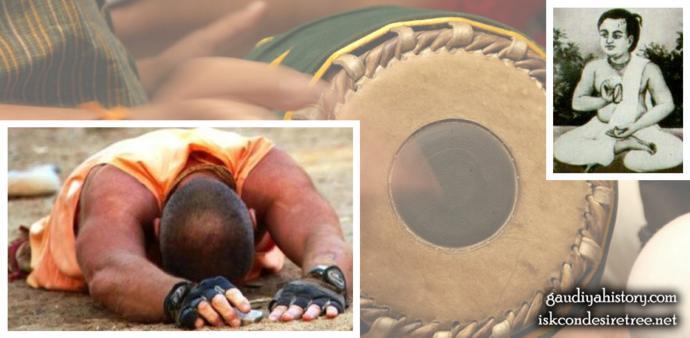
According to Prema-vilasa, when Shyamananda's followers came through singing, Ser Khan ordered them to stop. Shyamananda refused, so Ser Khan and his men broke the mridanga and began harassing the devotees outright. A related telling of the same story comes from a later Bengali biography of Shyamananda. It tells the confrontation in two stages. In this telling, the first day ended only in threats. The next day Shyamananda came back with an even larger party, and it was then that Ser Khan's men turned violent. They smashed instruments and threw the kartals into a river. The two tellings do not fully agree on whether this was one clash or two. But they agree on what mattered. Shyamananda could not bear to see his devotees attacked, and something in his response frightened Ser Khan badly. Prema-vilasa says he let out a roar that left Ser Khan violently ill, vomiting blood. The Bengali biography adds a vivid detail beyond that. It says the roar carried something like fire, and it singed the beards of the men who had raised their hands against the sankirtana party.
From Ser Khan to Chaitanya Dasa #
Whatever exactly happened, Ser Khan was shaken enough to change course completely. In one version of events, he falls at Shyamananda's feet the very next day and begs forgiveness. A more detailed retelling adds that the turning point came in a dream that night. In that dream, it says, a fearsome figure warned him that he would go to hell unless he took initiation from Shyamananda. Frightened by what he had seen and by what had already happened to his own body, Ser Khan came before Shyamananda with his men, confessed, and asked for shelter. Sources describe Shyamananda's anger as never separate from his mercy. He accepted Ser Khan, gave him harinama and diksha, and renamed him Chaitanya Dasa. One account goes on to say that Ser Khan later used his position to help manage and protect Shyamananda's growing mission in the area. But this detail is far less confirmed by other sources than the conversion story itself. It should be read as something one telling adds, not as an established fact.
What the Record Does Not Say #
Ser Khan's story survives almost entirely through Prema-vilasa and through later Bengali and English retellings built on it. Prema-vilasa is a devotional biography of Narottama Dasa Thakura, Shrinivasa Acharya and Shyamananda Pandit, composed by Nayanananda Dasa. Ser Khan does not appear in Sri Chaitanya-charitamrita or Chaitanya-bhagavata. Both of these books end their story before Shyamananda's own later preaching in Orissa took place. He also has no listed identity in Gaura-ganoddesha-dipika. That book lists the eternal associates present during Mahaprabhu's own manifest pastimes, not converts won over in a later generation. No birth year, death year, or family background for him has come down in any source. So this is all that is known: one dramatic episode, a new name, and very little else. But even that much fits a pattern seen again and again in Gaudiya Vaishnava history. Sankirtana wins over the very people who set out to stop it.
Scriptural evidence
harer nāma harer nāma
harer nāmaiva kevalam
kalau nāsty eva nāsty eva
nāsty eva gatir anyathā
"In this Age of Kali there is no other means, no other means, no other means for self-realization than chanting the holy name, chanting the holy name, chanting the holy name of Lord Hari."
Quoted by Krishnadasa Kaviraja Goswami from the Brihan-naradiya Purana, establishing why sankirtana carries the force it does in this age, the same force that overturned Ser Khan's opposition. Verified on vedabase.io.
kali-kāle nāma-rūpe kṛṣṇa-avatāra
nāma haite haya sarva-jagat-nistāra
In this Age of Kali, the holy name of the Lord, the Hare Krishna maha-mantra, is the incarnation of Lord Krishna. Simply by chanting the holy name, one associates with the Lord directly. Anyone who does this is certainly delivered.
Krishnadasa Kaviraja Goswami's own statement, immediately following 17.21, on why the holy name delivers absolutely anyone who takes it up, even someone who first came to attack it. Verified on vedabase.io.
Frequently asked
When was Ser Khan born?
Ser Khan appeared Not recorded in Not recorded.
Who was the guru of Ser Khan?
The spiritual master of Ser Khan was Srila Shyamananda Pandit.
When and where did Ser Khan disappear?
Ser Khan disappeared Not recorded at Not recorded.
What are the main pastimes of Ser Khan?
The pastimes covered here include: The Surrender at Dharenda.