Sri Sulochana
The Forty-Second Branch of the Chaitanya Tree
The complete life, on one page: The main biography and every pastime page, in order, in one place
Introduction
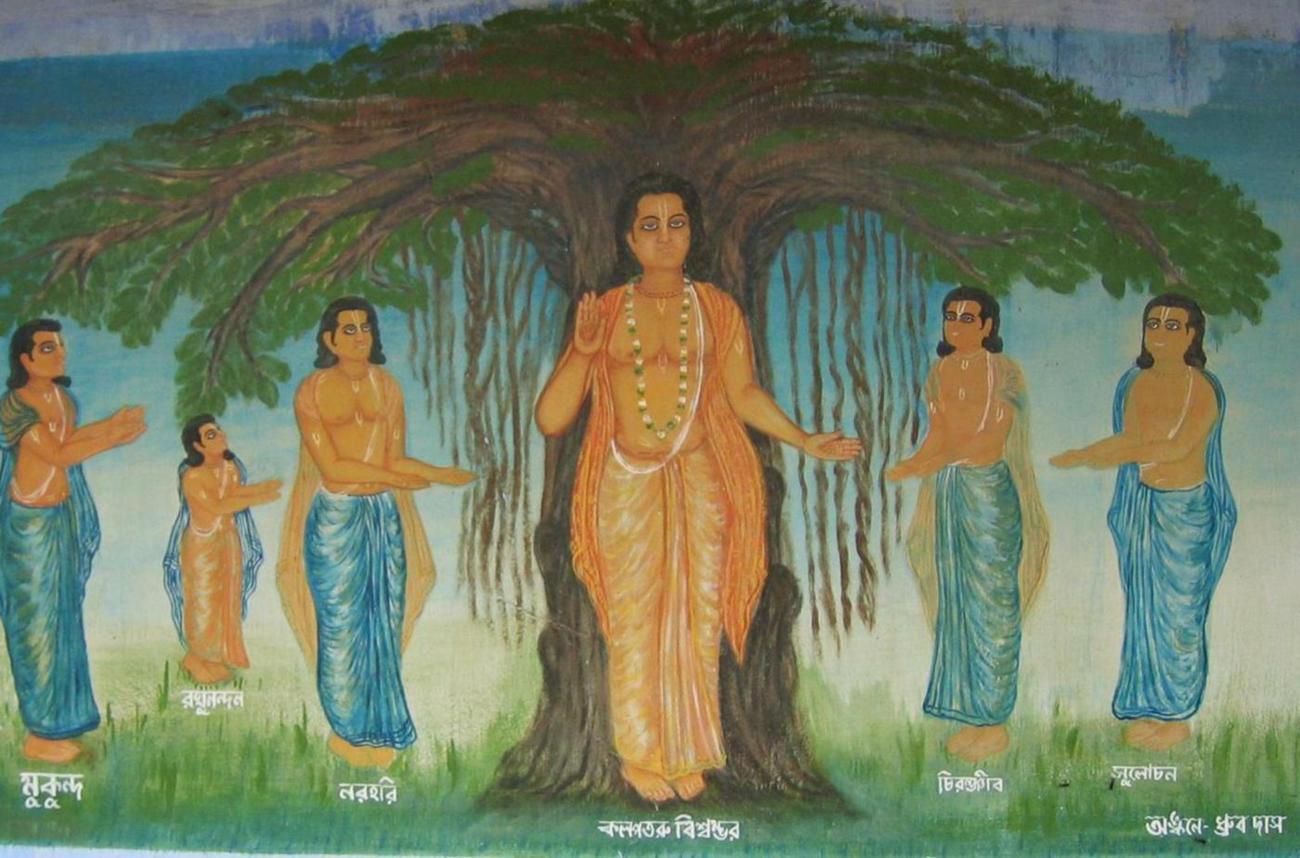
Sulochana is one of the devotees Krishnadasa Kaviraja Goswami names in the long roll call of associates who gathered around Sri Chaitanya Mahaprabhu in Bengal. The name has no connection to the Ramayana's Sulochana, wife of Indrajit, or to any other unrelated Sulochana outside Gaudiya Vaishnavism. The Sulochana described here is the Bengali devotee Krishnadasa Kaviraja places among Mahaprabhu's own associates in Sri Chaitanya-charitamrita.
| Detail | Description |
|---|---|
| Position in Chaitanya's tree | Forty-second branch, named beside Chiranjiva (Chaitanya-charitamrita, Adi 10.78-79) |
| Home village | Srikhanda, near Katwa in Bengal (Prabhupada's purport); or Shrihatta, per Gaura-ganoddesha-dipika |
| Close companion | Chiranjiva, the forty-first branch and fellow Srikhanda devotee |
| Neighboring devotees | Named alongside Narahari Sarkar Thakura and Raghunandana Thakura's family |
| Identity | The gopi Chandrashekhara, one of Srimati Radharani's maidservants (Gaura-ganoddesha-dipika 194-207) |
Scriptural evidence for the introduction (3)
khaṇḍavāsī mukunda-dāsa, śrī-raghunandana / narahari-dāsa, cirañjīva, sulocana / ei saba mahā-śākhā -- caitanya-kṛpā-dhāma / prema-phala-phula kare yāhāṅ tāhāṅ dāna
Word for word
khaṇḍa-vāsī mukunda-dāsa -- of the name Mukunda dasa, resident of Khanda; śrī-raghunandana -- of the name Raghunandana; narahari-dāsa -- of the name Narahari dasa; cirañjīva -- of the name Chiranjiva; sulocana -- of the name Sulochana; ei saba -- all of them; mahā-śākhā -- great branches; caitanya-kṛpā-dhāma -- of Lord Sri Chaitanya Mahaprabhu, the reservoir of mercy; prema-phala-phula kare yāhāṅ tāhāṅ dāna -- distribute the fruit and flower of love of Godhead anywhere and everywhere.
Sri Khandavasi Mukunda and his son Raghunandana were the thirty-ninth branch of the tree, Narahari was the fortieth, Chiranjiva the forty-first and Sulochana the forty-second. They were all big branches of the all-merciful tree of Chaitanya Mahaprabhu. They distributed the fruits and flowers of love of Godhead anywhere and everywhere.
From the purport: Purport excerpt: "Cirañjiva and Sulocana were both residents of Śrikhaṇḍa, where their descendants are still living."
The verse that fixes Sulochana's place as the forty-second branch of Chaitanya Mahaprabhu's tree, alongside his companion Chiranjiva; Prabhupada's purport gives their shared home village as Srikhanda.
vasanta, navānī hoḍa, gopāla, sanātana / viṣṇāi hājarā, kṛṣṇānanda, sulocana
Word for word
vasanta -- of the name Vasanta; navānī hoḍa -- of the name Navani Hoda; gopāla -- of the name Gopala; sanātana -- of the name Sanatana; viṣṇāi hājarā -- of the name Vishnai Hajara; kṛṣṇānanda -- of the name Krishnananda; sulocana -- of the name Sulochana.
Vasanta was the fifty-first, Navani Hoda the fifty-second, Gopala the fifty-third, Sanatana the fifty-fourth, Vishnai the fifty-fifth, Krishnananda the fifty-sixth and Sulochana the fifty-seventh.
A second devotee named Sulochana, listed here among Lord Nityananda Prabhu's own personal associates rather than among Chaitanya Mahaprabhu's own branches in Adi-lila 10; no available source establishes whether this is the same person named twice or a different devotee who shared the name.
कलकण्ठी कुराङ्गाक्षी चन्द्रिका चन्द्रशेखरा ।
या याः स्वयोग्यसेवायां नियुक्ताः सन्ति राधया ॥१९७॥
गौरेण तत्प्रियैः सार्धं धृतपुरुषविग्रहः ।
खेलन्ति स्म स्वभावानुसारात्ताः क्रमशो यथा ॥१९८॥
हर्याचार्यो गौरसङ्गी मिश्रः श्रीनयनस्तथा ।
कविदत्तो रामदासश्चिरञ्जीवसुलोचनौ ॥२०७॥
kalakaṇṭhī kurāṅgākṣī candrikā candraśekharā |
yā yāḥ sva-yogya-sevāyāṁ niyuktāḥ santi rādhayā ||197||
gaureṇa tat-priyaiḥ sārdhaṁ dhṛta-puruṣa-vigrahaḥ |
khelanti sma svabhāvānusārāt tāḥ kramaśo yathā ||198||
...
hary-ācāryo gaura-saṅgī miśraḥ śrī-nayanas tathā |
kavidatto rāma-dāsaś cirañjīva-sulocanau ||207||
Malati, Candralatika, Manjumedha, Varangada, Ratnavali, Kamala, Gunacuda, Sukesini, Karpura-manjari, Syama-manjari, Sveta-manjari, Vilasa-manjari, Kamalekha, Mauna-manjari, Gandhonmada, Rasonmada, Candrika, and Candrasekhara, were among the maidservants of Srimati Radharani. Assuming male forms they appeared among Lord Caitanya's associates, and each displayed his particular kind of ecstatic love for the Lord. These gopis became ... Kavidatta, Ramadasa, Ciranjiva, and Sulocana respectively.
Verses 194-197 list eighteen maidservants of Srimati Radharani ending with Chandrika and Chandrashekhara; verse 198 says they appeared in male form in the same order; verses 199-207 list the devotees ending with Chiranjiva and Sulochana. So Sulochana is the gopi Chandrashekhara, as Prabhupada's purport to Adi 10.78-79 reads the same list for Chiranjiva (Chandrika, verse 207). Sanskrit: diacritic edition of the Gaura-ganoddesha-dipika; English translation as published at bvmlu.org.
Chapter 1
The Srikhanda Singers at Ratha-yatra
How Krishnadasa Kaviraja Goswami placed Sulochana's home circle among the seven sankirtana parties that danced before Lord Jagannatha's chariot.
Krishnadasa Kaviraja Goswami's account of the Ratha-yatra festival in Jagannatha Puri describes how Sri Chaitanya Mahaprabhu organized His Bengali devotees into seven separate sankirtana parties, each singing and dancing before Lord Jagannatha's chariot in its own space (Chaitanya-charitamrita, Madhya-lila 13). One of these seven parties was made up entirely of devotees from Srikhanda, the same small circle that included Sulochana.
| Detail | Description |
|---|---|
| Setting | Ratha-yatra festival, Jagannatha Puri |
| Format | Seven separate sankirtana parties, stationed around Lord Jagannatha's chariot |
| Srikhanda's dancers | Narahari and Raghunandana, named in the verse (Madhya 13.46) |
| Sulochana's presence | Inferred from his listed membership in the same Srikhanda circle (Adi 10.78-79); not individually named in this verse |
Seven Parties Before the Chariot #
Krishnadasa Kaviraja names each of the seven parties and their dancers in turn. The first was led by Mukunda as chief singer. In the second, the senior Haridasa Thakura danced. The third was under Govinda Ghosha's leadership, and in the fourth Vakreshvara Pandita danced. The fifth came from the village of Kulinagrama, with Ramananda and Satyaraja as dancers. The sixth was formed by Sri Advaita Acharya from Shantipura, with Acyutananda dancing. The seventh was the party of Srikhanda. Four of the seven chanted and danced directly in front of the chariot, one stood on each side, and one more followed at the back. In this way the whole procession moved around Lord Jagannatha like a wall of sound and movement. Mahaprabhu Himself moved between the parties in ecstatic dance. Each group kept its own singing separate from the others, so that the different melodies would not blur together.
The Party from Srikhanda #
Among these seven, one party belonged entirely to the devotees of Srikhanda. Krishnadasa Kaviraja records it in a single short verse: "Another party was formed by the people of Khanda. These people were singing in a different place. In that group, Narahari Prabhu and Raghunandana were dancing" (Madhya-lila 13.46). This is the same Srikhanda circle that Krishnadasa Kaviraja lists together earlier in his work, as the thirty-ninth through forty-second branches of Chaitanya Mahaprabhu's tree: Mukunda dasa, Raghunandana Thakura, Narahari Sarkar Thakura, Chiranjiva, and Sulochana. Two of the five are named here as the party's dancers. The verse does not separately name the other three, Mukunda dasa, Chiranjiva and Sulochana. But nothing in the text suggests that they stood anywhere else.
What the Verse Does, and Does Not, Say #
This is all that Chaitanya-charitamrita actually says, and no more. Madhya-lila 13.46 places "the people of Khanda," Sulochana's own home circle, among the seven official sankirtana parties at one of Mahaprabhu's own festivals. They were singing before Him as He watched and danced. The verse does not put Sulochana's own name in it. Sulochana is connected with this party only because of Krishnadasa Kaviraja's earlier statement, in Adi-lila, that he belonged to this exact group of Srikhanda devotees. No verse names him personally at the festival itself. This difference should be kept clear. The scene should not be made fuller than the text supports.
Scriptural evidence for this chapter (1)
Quoted in the text above:
- Madhya 13.46 Sri Chaitanya-charitamrita
Closing
Srikhanda or Shrihatta: Two Sources Disagree #
The sources even disagree about where Sulochana lived. Prabhupada's purport to Adi 10.78-79 states directly: "Cirañjiva and Sulocana were both residents of Śrikhaṇḍa, where their descendants are still living," and this is the same village, four miles west of Katwa, that was already home to Raghunandana Thakura and Narahari Sarkar Thakura's families. But Kavi Karnapura's own Gaura-ganoddesha-dipika says something else. In the very passage that gives Sulochana's identity in Krishna-lila (see below), it states that Chiranjiva and Sulochana "lived in the village of Shrihatta." These are two different places in Bengal, and nothing in the sources explains the difference. So we note both, instead of quietly picking one. The fuller written evidence points to Srikhanda: the descendants, the neighboring families, and the land records Prabhupada cites. But Kavi Karnapura's own text says Shrihatta.
His Identity in Krishna-lila #
Kavi Karnapura's Gaura-ganoddesha-dipika holds that many of Mahaprabhu's male associates were, in their eternal identity, gopis of Vraja who took male form to serve Him in Gaura-lila. The same group of verses names Chiranjiva as the former gopi Chandrika. It then closes its list with Sulochana as the former gopi Chandrashekhara, one of the many maidservants of Shrimati Radharani. Prabhupada's own purport confirms that Chiranjiva was Chandrika and gives the verse number (Gaura-ganoddesha-dipika, verse 207). But it does not give Sulochana's own verse number. The link between Sulochana and Chandrashekhara rests on the way Kavi Karnapura's text places the two names last, in matching order, in both of its parallel lists. This Chandrashekhara is not connected with the historical Chandrashekhara Acharya of Varanasi, a different person whom the same tradition remembers separately.
In the Sanskrit this pattern is easy to see. Verse 197 ends the list of gopis with Chandrika and Chandrashekhara. Verse 198 says these gopis took male form and appeared in the same order (kramashah). Verse 207 then ends the list of devotees with Chiranjiva and Sulochana:
kalakaṇṭhī kurāṅgākṣī candrikā candraśekharā
yā yāḥ sva-yogya-sevāyāṁ niyuktāḥ santi rādhayā
gaureṇa tat-priyaiḥ sārdhaṁ dhṛta-puruṣa-vigrahaḥ
khelanti sma svabhāvānusārāt tāḥ kramaśo yathā
...
kavidatto rāma-dāsaś cirañjīva-sulocanau
"...Candrika, and Candrasekhara, were among the maidservants of Srimati Radharani. Assuming male forms they appeared among Lord Caitanya's associates, and each displayed his particular kind of ecstatic love for the Lord. These gopis became ... Kavidatta, Ramadasa, Ciranjiva, and Sulocana respectively." (Gaura-ganoddesha-dipika 194-207)
A Second Devotee of the Same Name #
Chaitanya-charitamrita is not finished with the name Sulochana after Adi-lila 10. One chapter later, a devotee named Sulochana appears again in the list of Lord Nityananda Prabhu's own personal associates. He is the fifty-seventh in that separate list, following Vasanta, Navani Hoda, Gopala, Sanatana, Vishnai and Krishnananda (Adi-lila 11.50). Krishnadasa Kaviraja gives no further word about this second Sulochana. Prabhupada's purport to the verse says nothing that either links him to the Srikhanda devotee described above or separates him from that devotee. None of the sources tell us whether this is one man remembered twice, in two different groupings, or two different devotees who happened to share a name. The question remains open.
- Sri Chaitanya-charitamrita, Adi-lila 10.78-79 (vedabase.io)
- Sri Chaitanya-charitamrita, Adi-lila 11.50 (vedabase.io)
- Sri Gaura-ganoddesha-dipika by Kavi Karnapura, English translation (Gaudiya History, ISKCON Desire Tree)
- Sulochana -- biography page (Gaudiya History, ISKCON Desire Tree)
- Chiranjiva -- biography page (Gaudiya History, ISKCON Desire Tree)
