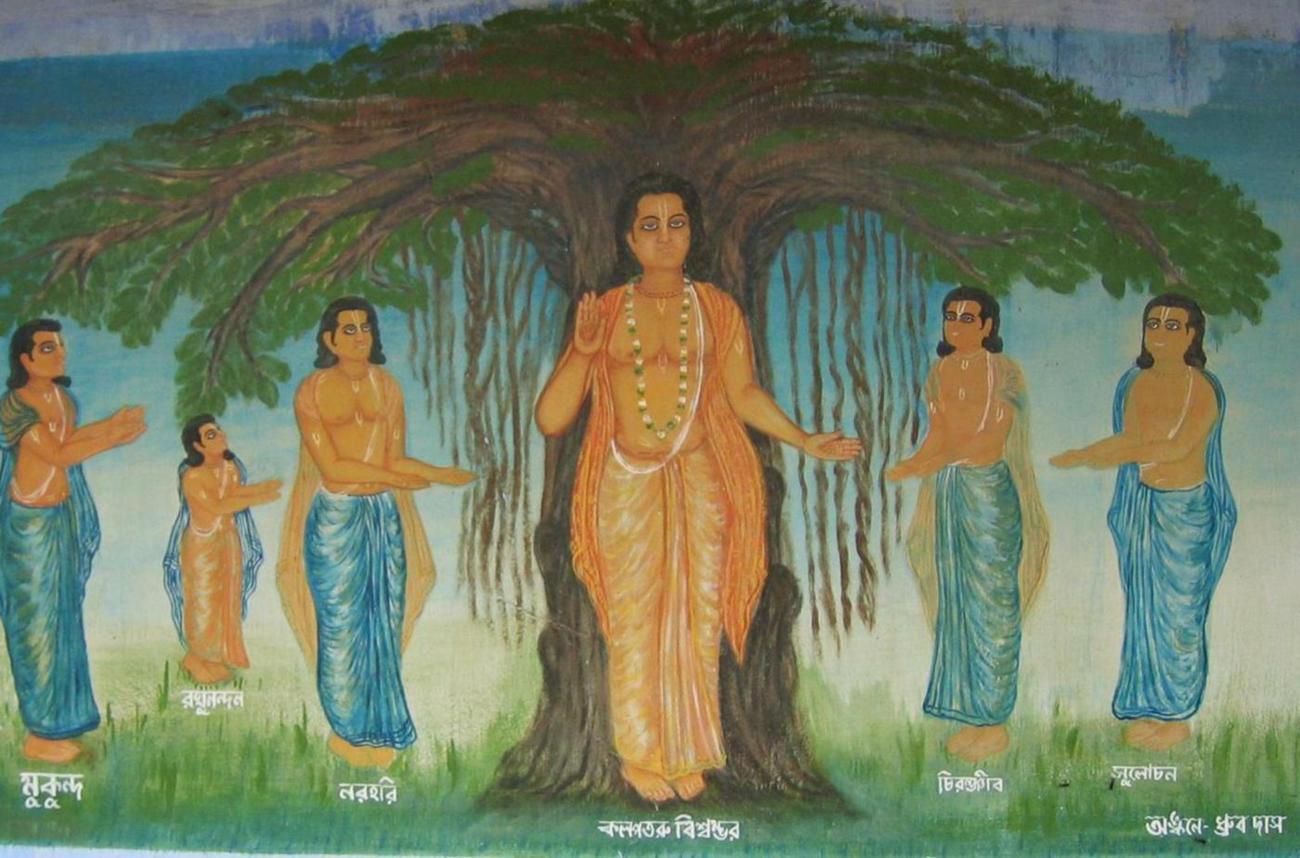
Sri Sulochana
The Forty-Second Branch of the Chaitanya Tree
Also known as Sulocana
“They were all big branches of the all-merciful tree of Chaitanya Mahaprabhu. They distributed the fruits and flowers of love of Godhead anywhere and everywhere.”
Krishnadasa Kaviraja Goswami's description of Sulochana and his companions, Sri Chaitanya-charitamrita, Adi-lila 10.79
Sulochana is one of the devotees Krishnadasa Kaviraja Goswami names in the long roll call of associates who gathered around Sri Chaitanya Mahaprabhu in Bengal. The name has no connection to the Ramayana's Sulochana, wife of Indrajit, or to any other unrelated Sulochana outside Gaudiya Vaishnavism. The Sulochana described here is the Bengali devotee Krishnadasa Kaviraja places among Mahaprabhu's own associates in Sri Chaitanya-charitamrita.
| Detail | Description |
|---|---|
| Position in Chaitanya's tree | Forty-second branch, named beside Chiranjiva (Chaitanya-charitamrita, Adi 10.78-79) |
| Home village | Srikhanda, near Katwa in Bengal (Prabhupada's purport); or Shrihatta, per Gaura-ganoddesha-dipika |
| Close companion | Chiranjiva, the forty-first branch and fellow Srikhanda devotee |
| Neighboring devotees | Named alongside Narahari Sarkar Thakura and Raghunandana Thakura's family |
| Identity | The gopi Chandrashekhara, one of Srimati Radharani's maidservants (Gaura-ganoddesha-dipika 194-207) |
Named Among the Branches of the Chaitanya Tree #
Krishnadasa Kaviraja Goswami describes Sri Chaitanya Mahaprabhu's following as a single all-merciful tree with many branches. In this list Sulochana has an exact, numbered place. He is the forty-second branch, named together with his close friend Chiranjiva, the forty-first. The same two verses name three devotees just before them. Khandavasi Mukunda dasa and his son Raghunandana Thakura are the thirty-ninth branch, and Narahari Sarkar Thakura is the fortieth. Krishnadasa Kaviraja's own summary line for the whole group states plainly what they did with their lives: "They were all big branches of the all-merciful tree of Chaitanya Mahaprabhu. They distributed the fruits and flowers of love of Godhead anywhere and everywhere." Beyond this one line, the text gives Sulochana no separate sentence of his own. His recorded life cannot be separated from this small circle of five men.
Srila Prabhupada's own purport to this verse tells a good deal about Chiranjiva's family, but adds nothing more about Sulochana himself. Chiranjiva's elder son, Ramachandra Kaviraja, was a disciple of Shrinivasa Acharya and a close associate of Narottama Dasa Thakura. His younger son, Govinda Dasa Kaviraja, became one of Bengal's best-loved Vaishnava poets. Both sons have their own pages: see Ramachandra Kaviraja and Govinda Dasa Kaviraja. No similar family record survives for Sulochana himself. The purport names his companion's wife, father-in-law and two sons, but says nothing more about Sulochana's own household. The record shows this Srikhanda circle together in an actual scene, not just named in a list, only once. That scene comes years later at the Ratha-yatra festival in Jagannatha Puri. See The Srikhanda Singers at Ratha-yatra.
Srikhanda or Shrihatta: Two Sources Disagree #
The sources even disagree about where Sulochana lived. Prabhupada's purport to Adi 10.78-79 states directly: "Cirañjiva and Sulocana were both residents of Śrikhaṇḍa, where their descendants are still living," and this is the same village, four miles west of Katwa, that was already home to Raghunandana Thakura and Narahari Sarkar Thakura's families. But Kavi Karnapura's own Gaura-ganoddesha-dipika says something else. In the very passage that gives Sulochana's identity in Krishna-lila (see below), it states that Chiranjiva and Sulochana "lived in the village of Shrihatta." These are two different places in Bengal, and nothing in the sources explains the difference. So we note both, instead of quietly picking one. The fuller written evidence points to Srikhanda: the descendants, the neighboring families, and the land records Prabhupada cites. But Kavi Karnapura's own text says Shrihatta.
His Identity in Krishna-lila #
Kavi Karnapura's Gaura-ganoddesha-dipika holds that many of Mahaprabhu's male associates were, in their eternal identity, gopis of Vraja who took male form to serve Him in Gaura-lila. The same group of verses names Chiranjiva as the former gopi Chandrika. It then closes its list with Sulochana as the former gopi Chandrashekhara, one of the many maidservants of Shrimati Radharani. Prabhupada's own purport confirms that Chiranjiva was Chandrika and gives the verse number (Gaura-ganoddesha-dipika, verse 207). But it does not give Sulochana's own verse number. The link between Sulochana and Chandrashekhara rests on the way Kavi Karnapura's text places the two names last, in matching order, in both of its parallel lists. This Chandrashekhara is not connected with the historical Chandrashekhara Acharya of Varanasi, a different person whom the same tradition remembers separately.
In the Sanskrit this pattern is easy to see. Verse 197 ends the list of gopis with Chandrika and Chandrashekhara. Verse 198 says these gopis took male form and appeared in the same order (kramashah). Verse 207 then ends the list of devotees with Chiranjiva and Sulochana:
kalakaṇṭhī kurāṅgākṣī candrikā candraśekharā
yā yāḥ sva-yogya-sevāyāṁ niyuktāḥ santi rādhayā
gaureṇa tat-priyaiḥ sārdhaṁ dhṛta-puruṣa-vigrahaḥ
khelanti sma svabhāvānusārāt tāḥ kramaśo yathā
...
kavidatto rāma-dāsaś cirañjīva-sulocanau
"...Candrika, and Candrasekhara, were among the maidservants of Srimati Radharani. Assuming male forms they appeared among Lord Caitanya's associates, and each displayed his particular kind of ecstatic love for the Lord. These gopis became ... Kavidatta, Ramadasa, Ciranjiva, and Sulocana respectively." (Gaura-ganoddesha-dipika 194-207)
A Second Devotee of the Same Name #
Chaitanya-charitamrita is not finished with the name Sulochana after Adi-lila 10. One chapter later, a devotee named Sulochana appears again in the list of Lord Nityananda Prabhu's own personal associates. He is the fifty-seventh in that separate list, following Vasanta, Navani Hoda, Gopala, Sanatana, Vishnai and Krishnananda (Adi-lila 11.50). Krishnadasa Kaviraja gives no further word about this second Sulochana. Prabhupada's purport to the verse says nothing that either links him to the Srikhanda devotee described above or separates him from that devotee. None of the sources tell us whether this is one man remembered twice, in two different groupings, or two different devotees who happened to share a name. The question remains open.
Scriptural evidence
Quoted in the text above:
- Verses 194-207 Gaura-ganoddesha-dipika
Further verses:
khaṇḍavāsī mukunda-dāsa, śrī-raghunandana / narahari-dāsa, cirañjīva, sulocana / ei saba mahā-śākhā -- caitanya-kṛpā-dhāma / prema-phala-phula kare yāhāṅ tāhāṅ dāna
Word for word
khaṇḍa-vāsī mukunda-dāsa -- of the name Mukunda dasa, resident of Khanda; śrī-raghunandana -- of the name Raghunandana; narahari-dāsa -- of the name Narahari dasa; cirañjīva -- of the name Chiranjiva; sulocana -- of the name Sulochana; ei saba -- all of them; mahā-śākhā -- great branches; caitanya-kṛpā-dhāma -- of Lord Sri Chaitanya Mahaprabhu, the reservoir of mercy; prema-phala-phula kare yāhāṅ tāhāṅ dāna -- distribute the fruit and flower of love of Godhead anywhere and everywhere.
Sri Khandavasi Mukunda and his son Raghunandana were the thirty-ninth branch of the tree, Narahari was the fortieth, Chiranjiva the forty-first and Sulochana the forty-second. They were all big branches of the all-merciful tree of Chaitanya Mahaprabhu. They distributed the fruits and flowers of love of Godhead anywhere and everywhere.
From the purport: Purport excerpt: "Cirañjiva and Sulocana were both residents of Śrikhaṇḍa, where their descendants are still living."
The verse that fixes Sulochana's place as the forty-second branch of Chaitanya Mahaprabhu's tree, alongside his companion Chiranjiva; Prabhupada's purport gives their shared home village as Srikhanda.
vasanta, navānī hoḍa, gopāla, sanātana / viṣṇāi hājarā, kṛṣṇānanda, sulocana
Word for word
vasanta -- of the name Vasanta; navānī hoḍa -- of the name Navani Hoda; gopāla -- of the name Gopala; sanātana -- of the name Sanatana; viṣṇāi hājarā -- of the name Vishnai Hajara; kṛṣṇānanda -- of the name Krishnananda; sulocana -- of the name Sulochana.
Vasanta was the fifty-first, Navani Hoda the fifty-second, Gopala the fifty-third, Sanatana the fifty-fourth, Vishnai the fifty-fifth, Krishnananda the fifty-sixth and Sulochana the fifty-seventh.
A second devotee named Sulochana, listed here among Lord Nityananda Prabhu's own personal associates rather than among Chaitanya Mahaprabhu's own branches in Adi-lila 10; no available source establishes whether this is the same person named twice or a different devotee who shared the name.
- Sri Chaitanya-charitamrita, Adi-lila 10.78-79 (vedabase.io)
- Sri Chaitanya-charitamrita, Adi-lila 11.50 (vedabase.io)
- Sri Gaura-ganoddesha-dipika by Kavi Karnapura, English translation (Gaudiya History, ISKCON Desire Tree)
- Sulochana -- biography page (Gaudiya History, ISKCON Desire Tree)
- Chiranjiva -- biography page (Gaudiya History, ISKCON Desire Tree)
Frequently asked
When was Sri Sulochana born?
Sri Sulochana appeared Not individually recorded (a contemporary of Sri Chaitanya Mahaprabhu) in Srikhanda, Bengal, per Prabhupada's purport -- or Shrihatta, per Gaura-ganoddesha-dipika; sources disagree.
When and where did Sri Sulochana disappear?
Sri Sulochana disappeared Not recorded in any source found at Not recorded in any known source.
What are the main pastimes of Sri Sulochana?
The pastimes covered here include: The Srikhanda Singers at Ratha-yatra.