Srila Svarupa Damodara Goswami
Mahaprabhu's Confidential Secretary at Jagannatha Puri
The complete life, on one page: The main biography and every pastime page, in order, in one place
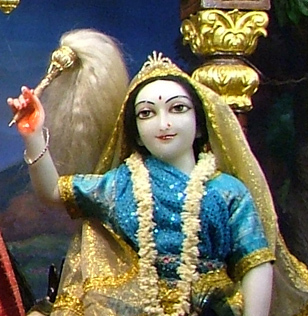
Introduction
Svarupa Damodara Goswami was the most confidential secretary and constant companion of Sri Chaitanya Mahaprabhu during the Lord's eighteen years at Jagannatha Puri. Before he came to the Lord as a renunciant, he had already been a well-known Navadvipa scholar and singer named Purushottama Acharya, and already a devotee of the Lord. Everything that followed grew from that early bond. This includes his sudden renunciation, and his role as the one person who could check what was safely sung in Mahaprabhu's presence. It also includes his identity in Krishna's own Vraja-lila, and the private diary (his kadacha) that later became a foundation of Sri Chaitanya-charitamrita.
| Detail | Description |
|---|---|
| Earlier name | Purushottama Acharya (also called Purushottama Bhattacharya) |
| Native background | Raised in Navadvipa in his maternal grandfather Jayarama Chakravarti's house; his father, Padmagarbha Acharya, was originally of Bhitadiya on the Brahmaputra in East Bengal |
| Renunciation | Took brahmacharya vows at Varanasi under Chaitanyananda Bharati soon after Mahaprabhu's own sannyasa |
| Role at Puri | The Lord's secretary; screened all songs, poems and books before they could be recited in Mahaprabhu's presence |
| Literary work | Kept a private Sanskrit diary (kadacha) of the Lord's Puri-years pastimes; also compiled a treatise on music, Sangita-damodara |
| Identity | Vishakha-devi, the sakhi who taught Radha the arts; some call him Lalita (Gaura-ganoddesha-dipika 160; Chaitanya-charitamrita Adi 4.105 purport) |
| Disappearance | On a Ratha-yatra day in the month of Ashadha |
At a Glance
- Was already a respected scholar and singer in Navadvipa, and already a devotee of Chaitanya Mahaprabhu, years before he ever took a vow of renunciation.
- Left everything the moment Mahaprabhu accepted sannyasa, took his own vows at Varanasi, and reunited with the Lord at Puri as a plain, title-less brahmachari.
- Became the one person whose approval every song, verse or book needed before it could be sung or read to Mahaprabhu.
- Nursed the Lord back from unconsciousness again and again during the Lord's most extreme states of spiritual ecstasy.
- Kept the day-by-day notebook that, through Raghunatha Dasa Goswami, became a direct source for Krishnadasa Kaviraja Goswami's Sri Chaitanya-charitamrita.
Scriptural evidence for the introduction (2)
অতি গূঢ় হেতু সেই ত্রিবিধ প্রকার ।
দামোদরস্বরূপ হৈতে যাহার প্রচার ॥
ati gudha hetu sei tri-vidha prakara
damodara-svarupa haite yahara pracara
Word for word
ati: very; gudha: esoteric; hetu: reason; sei: that; tri-vidha: three; prakara: kinds; damodara-svarupa haite: from Svarupa Damodara; yahara: of which; pracara: the proclamation.
That most confidential cause is threefold. Svarupa Damodara has revealed it.
States directly that the deepest, threefold reason for Mahaprabhu's appearance was disclosed specifically through Svarupa Damodara.
कलामशिक्षयद्राधां या विशाखा व्रजे पुरा ।
साद्य स्वरूप गोस्वामी तत्तद्भाव विलासवान् ॥१६०॥
kalām aśikṣayad rādhāṁ yā viśākhā vraje purā |
sādya svarūpa gosvāmī tat tad bhāva vilāsavān ||160||
Srimati Visakha-gopi, who formerly taught the various fine arts to Srimati Radharani in Vrajabhumi, appeared during Lord Caitanya's advent as Svarupa Damodara Gosvami, who was filled with the various splendid manifestations of ecstatic love of Godhead.
From the purport: Svarūpa Dāmodara has been identified as Lalitā-devī, the second expansion of Rādhārāṇī. However, text 160 of Kavi-karṇapūra's authoritative Gaura-gaṇoddeśa-dīpikā describes Svarūpa Dāmodara as the same Viśākhā-devī who serves the Lord in Goloka Vṛndāvana. Therefore it is to be understood that Śrī Svarūpa Dāmodara is a direct expansion of Rādhārāṇī who helps the Lord experience the attitude of Rādhārāṇī.
Identifies Svarupa Damodara as Vishakha, who taught Radha the fine arts in Vraja; Srila Prabhupada cites this verse as authoritative over the popular Lalita identification. Sanskrit: diacritic edition of the Gaura-ganoddesha-dipika; English translation as published at bvmlu.org. Purport excerpt: Srila Prabhupada, Chaitanya-charitamrita Adi 4.105.
Chapter 1
Birth and Early Life as a Scholar and Singer
How a Navadvipa pandit named Purushottama Acharya became a devotee of Chaitanya Mahaprabhu long before either man renounced anything.
Long before he was known as Svarupa Damodara, he was Purushottama Acharya, a young scholar and singer of Navadvipa. By the account Krishnadasa Kaviraja Goswami himself gives, he was already a devotee then. He had taken shelter of Sri Chaitanya Mahaprabhu years before the Lord ever accepted sannyasa.
| Detail | Description |
|---|---|
| Birth name | Purushottama Acharya (also Purushottama Bhattacharya) |
| Father | Padmagarbha Acharya, son-in-law of Jayarama Chakravarti |
| Father's native village | Bhitadiya, on the bank of the Brahmaputra, in East Bengal |
| Raised at | Navadvipa, in his maternal grandfather Jayarama Chakravarti's household |
| Reputation before renunciation | A gifted scholar and singer, and already a devotee in Mahaprabhu's Navadvipa circle |
A Household Without a Father Present #
According to the family details given in the Gaudiya Vaishnava Abhidhana, Svarupa Damodara's father, Padmagarbha Acharya, belonged to a family from Bhitadiya, a village on the Brahmaputra river in what is now Bangladesh. Padmagarbha had married into the family of Jayarama Chakravarti, a resident of Navadvipa, and by custom went to live in his father-in-law's house. Soon after his son's birth, though, Padmagarbha left his wife and infant behind and travelled to Mithila and then Kashi to pursue advanced scriptural study. So the boy who would become Svarupa Damodara grew up in his mother's home, not his father's, among his maternal grandfather's family in Navadvipa. Nothing in the sources records his mother's name, and no year is given for his birth.
Scholar and Singer, Not Yet a Renunciant #
Every source agrees that, well before any question of sannyasa arose, Purushottama Acharya was already an unusually accomplished man. Sri Chaitanya-charitamrita later calls him fully the equal of Brihaspati, the priest of the demigods, in scriptural learning. It compares his singing to that of the Gandharvas, heaven's own musicians. Devotional retellings describe him as a locally celebrated pandit and singer even before he took any vow. Some modern accounts go further, suggesting a brief connection to a royal court. That claim about support from a royal court could not be confirmed in Sri Chaitanya-charitamrita, in Krishnadasa Kaviraja Goswami's own summary in Madhya-lila, or in any of the older biographical collections we checked. It is reported here only as a detail some later writers repeat, not as an established fact. What is well recorded is simpler and, in its own way, more remarkable. By his own later words, this brilliant young man had already given his heart to Chaitanya Mahaprabhu while the Lord was still a householder in Navadvipa. This was well before the events that would make Him famous throughout Bengal.
Devotion Before the Lord's Sannyasa #
Sri Chaitanya-charitamrita states the point directly: "When Svarupa Damodara was residing at Navadvipa under the shelter of Sri Chaitanya Mahaprabhu, his name was Purushottama Acharya." This one line is important. It means his bond with the Lord did not begin at Puri, and did not begin with renunciation. It began earlier, in Navadvipa, in the ordinary years before Mahaprabhu left home. Later the two men were separated by vows, by the miles between Navadvipa and Jagannatha Puri, and by years apart. But this early attachment is what made the news of Mahaprabhu's sannyasa unbearable to him. Looking back, it also links the locally admired Navadvipa scholar with the one whom Gaudiya Vaishnava tradition would later name as one of Radharani's own closest companions. That identity is discussed on spiritual-identity-as-lalita-sakhi.
The Break That Sent Him to Varanasi #
Everything changed in the month of Magha, when Chaitanya Mahaprabhu, then twenty-four years old, accepted the renounced order of sannyasa and prepared to leave Navadvipa for good. Purushottama Acharya, by Krishnadasa Kaviraja Goswami's own description, went "almost mad" with the pain of separation. He did not wait, hesitate, or seek permission from his own family. He left at once for Varanasi, the traditional seat of Dashanami renunciation. He was determined to take a vow of his own. He would not remain behind as a householder scholar while his Lord walked away into sannyasa. The page joining-sri-chaitanya-mahaprabhu-at-puri tells in full what happened next in Varanasi. It tells of the guru who initiated him, the unusual, incomplete form of renunciation he chose, and the journey that finally reunited him with Mahaprabhu at Puri.
Later he became the Lord's secretary, the singer no one could equal, and the keeper of a private record that would shape Sri Chaitanya-charitamrita itself. Looking back from all that he later became, we can see why this Navadvipa chapter matters. It shows that Svarupa Damodara was never a stranger whom Mahaprabhu happened to notice at Puri. He was already one of the Lord's own before either of them had renounced anything at all.
Scriptural evidence for this chapter (1)
Quoted in the text above:
- Madhya 10.103 Sri Chaitanya-charitamrita
Chapter 2
Joining Sri Chaitanya Mahaprabhu at Puri
From a grief-stricken vow at Varanasi to a tearful reunion with the Lord at Jagannatha Puri.
Purushottama Acharya's journey from a grieving scholar in Varanasi to Svarupa Damodara Goswami, secretary of Sri Chaitanya Mahaprabhu, took only a few months. But it decided the course of the rest of his life.
| Detail | Description |
|---|---|
| Sannyasa-guru | Chaitanyananda Bharati, a Dashanami renunciant of Varanasi |
| Order given | To study Vedanta-sutra and teach it to others |
| Form of renunciation | Gave up tuft of hair and sacred thread; declined saffron cloth and a sannyasa title |
| Name after renunciation | Svarupa (brahmachari name); "Damodara" added later at Puri |
| Arrival at Puri | Shortly after Paramananda Puri and around the time of Ramananda Raya's own arrival |
An Incomplete Sannyasa, By Choice #
At Varanasi, Purushottama Acharya took his vows from Chaitanyananda Bharati, a sannyasi of the Dashanami order, who instructed him to study the Vedanta-sutra and teach it to others. But he did not go through with the full formal ceremony expected of a Dashanami sannyasi. He gave up the two outward marks that a twice-born man gives up when he enters renunciation: his shikha, or tuft of hair, and his sacred thread. But he refused the ochre cloth, the sannyasa-daṇḍa, and any of the titles (such as Tirtha or Bharati) that mark a full sannyasi. According to Bhaktivinoda Thakura's commentary, his reason was this. He did not want a title that might bring the danger of pride, or any outward mark that might draw attention or respect. He wanted only the freedom to worship Krishna undisturbed. So for the rest of his life he remained, strictly speaking, a naishthika-brahmachari. He kept only the name given him at that stage, Svarupa.
The Name Damodara #
The second half of his famous name was added only after he reached Nilachala, Jagannatha Puri, and rejoined Mahaprabhu. Tradition holds that Chaitanya Mahaprabhu Himself began calling him Damodara, delighted by his extraordinary skill as a singer. It holds that this personal name was simply joined to the brahmachari name Svarupa he already carried. The sources do not fully agree on exactly how the two names came together. But the result was the name by which he is remembered: Svarupa Damodara. The name recalls both his formal identity as a renunciant and the one gift of his that most delighted the Lord.
Arrival and Reunion #
Sri Chaitanya-charitamrita places his arrival at Puri in a specific sequence: Paramananda Puri had already reached the Lord, and Svarupa Damodara came soon after, "an ocean of transcendental mellows," in Krishnadasa Kaviraja Goswami's words. He offered obeisances and recited a Sanskrit verse of welcome composed for the occasion. The poet Kavi Karnapura later preserved this verse in his Chaitanya-chandrodaya-nataka. It praises Mahaprabhu as an ocean of mercy able to end all quarrels among scriptures and awaken the deepest transcendental bliss. As Chaitanya-charitamrita records, Mahaprabhu's response was immediate and personal. He raised Svarupa Damodara up and embraced him. Mahaprabhu said that He had dreamed of this arrival the night before. Just as a blind man rejoices at suddenly gaining sight, so He now rejoiced at getting Svarupa Damodara back. Svarupa Damodara, in turn, humbly confessed his own fault. He said he had abandoned the Lord's company and gone to a foreign land with no trace of real love in his heart. Mahaprabhu answered only that Krishna's mercy, not any merit of Svarupa Damodara's own, had bound him by the neck and dragged him back.
After this reunion, Svarupa Damodara paid his respects in turn to Nityananda Prabhu, then to Jagadananda, Mukunda, Sankara, Sarvabhauma Bhattacharya, and finally Paramananda Puri. Then Mahaprabhu arranged a quiet place for him to live alone, with a servant to assist him. At about this same time, Ramananda Raya, until then a royal governor at Vidyanagara, also arrived at Puri. This began a friendship between the two men that would shape the rest of the Lord's manifest life. It is told more fully on friendship-with-ramananda-raya.
Settling Into a Role No One Else Could Fill #
From nearly the moment of his arrival, Svarupa Damodara's position at Puri was unlike anyone else's. Sri Chaitanya-charitamrita says it clearly: he was "the limit of all learned scholarship," yet he rarely spoke with anyone and preferred solitude, remaining largely unknown even to people living nearby. He is described as directly representing Mahaprabhu as a kind of "second expansion" of the Lord Himself. This description points ahead to the far more demanding role he would soon take on. He would check every song, poem and book that anyone hoped to bring before Mahaprabhu. He would also stand guard over the Lord's own body and mind during the Lord's most overwhelming states of ecstasy. Both of these duties, and the often dramatic episodes that show them, are gathered on keeper-of-the-lords-innermost-moods.
Scriptural evidence for this chapter (1)
সন্ন্যাস করিলা শিখা-সূত্রত্যাগ-রূপ ।
যোগপট্ট না নিল, নাম হৈল ‘স্বরূপ’ ॥
sannyasa karila shikha-sutra-tyaga-rupa
yoga-patta na nila, nama haila 'svarupa'
Word for word
sannyasa karila: accepted the sannyasa order; shikha: tuft of hair; sutra: sacred thread; tyaga-rupa: in the form of giving up; yoga-patta: saffron-colored dress; na nila: did not accept; nama haila svarupa: his name became Svarupa.
Upon accepting sannyasa, Purushottama Acharya followed the regulative principles by giving up his tuft of hair and sacred thread, but he did not accept the saffron-colored dress. Also, he did not accept a sannyasi title but remained as a naishthika-brahmachari.
The precise, unusual form of his renunciation - deliberately incomplete by ordinary Dashanami standards.
Chapter 3
Keeper of the Lord's Innermost Moods
Checking every song and poem before Mahaprabhu heard it, and searching for Him again and again during the Lord's most extreme states of ecstasy.
No one else at Puri held the position Svarupa Damodara held. He was truly the gatekeeper of Sri Chaitanya Mahaprabhu's inner life. He decided what poetry the Lord could safely hear. He also went out again and again to find the Lord in person when ecstasy carried Him beyond ordinary outer awareness.
| Detail | Description |
|---|---|
| Screening role | Examined every song, verse or book before it could be recited to Mahaprabhu |
| Standard applied | Agreement with bhakti-siddhanta; freedom from rasabhasa, the clashing of incompatible devotional moods |
| Recorded rescues | Antya-lila describes at least three nights the Lord left His locked room in ecstasy and had to be found and revived |
| Constant companions | Ramananda Raya, and the personal attendant Govinda |
| Key source | Sri Chaitanya-charitamrita, Antya-lila, chapters 14, 17 and 18 |
The Man Who Decided What the Lord Could Hear #
Krishnadasa Kaviraja Goswami states the arrangement clearly. Whoever wanted to bring a book, poem, or song before Chaitanya Mahaprabhu had to bring it to Svarupa Damodara first. Mahaprabhu, he explains, took no pleasure in literature that went against the conclusions of devotional service, or that mixed rasas that do not fit together, an offense called rasabhasa. It was Svarupa Damodara's duty alone to catch such faults before they ever reached the Lord's ears. The standard he held was strict. One Bengali poet wrote a play that many Vaishnavas praised, and his friend Bhagavan Acharya of Halisahar brought it forward. But its very first verse went against basic Vaishnava conclusions. Svarupa Damodara pointed out the fault at once. Then, seeing the poet's distress, he gently told him to study Srimad-Bhagavatam under a Vaishnava, take shelter of Mahaprabhu's feet, and keep the company of devotees before attempting such work again. He was just as firm with Bhagavan Acharya's own brother, Gopala Bhattacharya, who followed Shankara's Mayavada philosophy. Svarupa Damodara refused outright to let him lecture the devotees on Vedanta. He warned that even a single hearing of Mayavada teaching can quietly persuade a soul that it, rather than Krishna, is the Supreme.
Whose Gaudiya Are You #
One episode shows how far Mahaprabhu's trust in him went. During the cleaning of the Gundicha temple, an uneducated Bengali brahmana, moved by devotion and not by rules of proper behaviour, scooped up the water that had washed Mahaprabhu's feet inside Lord Jagannatha's own temple and drank it. There was no real offense in it, because Mahaprabhu is himself the Supreme Personality of Godhead. But the Lord showed sharp displeasure anyway, as a lesson for public behavior. He directed his complaint straight to Svarupa Damodara: "Just see the behavior of your Bengali Vaishnava!" The purport in Sri Chaitanya-charitamrita explains the real point of the word "your" here. The original Bengali actually reads "your Gaudiya," and the meaning is that all Gaudiya Vaishnavas belong, in a real sense, to Svarupa Damodara. It was through him that Mahaprabhu's own conclusions about devotional life reached everyone else.
The Nights He Vanished #
Sri Chaitanya-charitamrita's Antya-lila records again and again, in exact detail, what happened as Mahaprabhu's feelings of separation from Krishna grew deeper in His final Puri years. More than once, Svarupa Damodara and the attendant Govinda found that Mahaprabhu Himself was gone, although all three doors of His room were still bolted from outside. On one such night they found Him unconscious near the Simha-dvara gate. His body was unnaturally lengthened, and the joints of His bones were loosened. Svarupa Damodara sang the holy names into His ear until Mahaprabhu suddenly came back to outer awareness with a cry of "Haribol!" On another night, Mahaprabhu crossed three high walls while the doors were locked and bolted in the same way. He fell among a herd of cows from the Tailanga district. His limbs were drawn entirely into His body "like a tortoise," His mouth was foaming, His skin was marked with eruptions, and tears were still flowing from His eyes. The cows themselves pressed close around Him and would not be driven off. Svarupa Damodara organized a search party with torches and found Him. He led the effort to bring Mahaprabhu back to consciousness through congregational chanting. Still dazed, Mahaprabhu asked where He was and what had happened. Svarupa Damodara answered by singing a verse from Srimad-Bhagavatam about the irresistible sweetness of Krishna's flute-song. He chose that verse because he understood, better than anyone, what mood the Lord needed to hear expressed back to Him.
Pulled From the Sea #
The most striking rescue of all took place on an autumn full-moon night near the Ai-tota garden by the seashore. Absorbed in memories of Krishna's rasa-lila, Mahaprabhu mistook the ocean for the Yamuna River and swam into it. The currents carried His unconscious body south toward Konarka. There a fisherman, thinking he had caught an enormous fish, pulled Him up in his net. The moment the fisherman touched the Lord's transformed body, waves of ecstatic symptoms overtook him too. In his fright, he thought he had been possessed by a ghost. Svarupa Damodara and the other devotees searched the beach through the night and found the two of them together. Svarupa Damodara had to slap the terrified fisherman and chant Hare Krishna over him before the man calmed down enough to understand what had really happened. Congregational chanting then revived Mahaprabhu Himself. Still half in trance, He described what He had seen and felt of Krishna's water-pastimes with the gopis.
Reading the Lord's Own Secret Verse #
Even when Mahaprabhu was outwardly calm, Svarupa Damodara understood Him more deeply than anyone else did. While dancing before Lord Jagannatha's cart at Ratha-yatra, the Lord would sometimes recite a Sanskrit verse about a worldly lover meeting his beloved again. As Krishnadasa Kaviraja Goswami puts it, the words "appeared to be the hankering between some ordinary boy and girl," but their real, exalted meaning "was known only to Svarupa Damodara." One year, Rupa Goswami happened to overhear the verse. By the Lord's own grace he understood its hidden sense, and he secretly composed a verse in answer that revealed that meaning. He left it written on a palm leaf on the roof of his hut. When Mahaprabhu found and read it, He fell into such intense ecstasy that Rupa Gosvami, arriving moments later, dropped to the floor like a rod. Mahaprabhu was astonished that an outsider could have understood His most private thought. He turned at once to Svarupa Damodara for an explanation. Only Svarupa Damodara could give an answer worth trusting. He said that Rupa Gosvami must have received the Lord's own special blessing. This is one of the clearest proofs in the entire text that Svarupa Damodara's closeness to Mahaprabhu's inner life was more than devotion. It was a deep understanding that no one else was thought capable of. On that occasion, not even Rupa Gosvami himself was thought capable of it beforehand.
Scriptural evidence for this chapter (4)
রাত্রে প্রলাপ করে স্বরূপের কণ্ঠ ধরি’ ।
আবেশে আপন ভাব কহয়ে উঘাড়ি’ ॥
ratre pralapa kare svarupera kantha dhari'
aveshe apana bhava kahaye ughadi'
Word for word
ratre: at night; pralapa: delirium; kare: does; svarupera: of Svarupa Damodara; kantha dhari': embracing the neck; aveshe: in ecstasy; apana: His own; bhava: mood; kahaye: speaks; ughadi': disclosing.
At night He talked incoherently in grief with His arms around Svarupa Damodara's neck. He spoke out His heart in ecstatic inspiration.
Describes the sheer physical closeness of the two men during Mahaprabhu's nightly outpourings of separation.
এই শ্লোকের অর্থ জানে একলে স্বরূপ ।
দৈবে সে বৎসর তাহাঁ গিয়াছেন রূপ ॥
ei shlokera artha jane ekale svarupa
daive se vatsara tahan giyachena rupa
Word for word
ei: this; shlokera: of the verse; artha: the meaning; jane: knows; ekale: alone; svarupa: Svarupa Damodara; daive: by chance; se vatsara: that year; tahan: there; giyachena: went; rupa: Rupa Gosvami.
This verse appears to be the hankering between some ordinary boy and girl, but its actual deep meaning was known only to Svarupa Damodara. By chance, one year Rupa Gosvami was also present there.
The clearest single statement that Svarupa Damodara's understanding of Mahaprabhu's hidden meaning was, ordinarily, unique among the devotees.
শিক্ষা লাগি’ স্বরূপে ডাকি’ কহিল তাঁহারে ।
এই দেখ তোমার ‘গৌড়ীয়া’র ব্যবহারে ॥
shiksha lagi' svarupe daki' kahila tanhare
ei dekha tomara 'gaudiyara' vyavahare
Word for word
shiksha lagi': for instruction; svarupe: unto Svarupa Damodara; daki': calling; kahila: said; tanhare: unto him; ei dekha: just see here; tomara: your; gaudiyara: of this Vaishnava from Bengal; vyavahare: in the behavior.
The Lord then called for Svarupa Damodara and told him, "Just see the behavior of your Bengali Vaishnava!"
From the purport: Purport excerpt (Madhya 12.127): "It is significant that Sri Caitanya Mahaprabhu told Svarupa Damodara Gosvami that the Bengali Vaishnava was 'your Gaudiya Vaishnava.' This means that all Gaudiya Vaishnavas who are followers of the Caitanya cult are subordinate to Svarupa Damodara Gosvami."
A striking moment in which Mahaprabhu addresses Gaudiya Vaishnavism itself as belonging, in a real sense, to Svarupa Damodara.
পেটের ভিতর হস্ত-পদ — কূর্মের আকার ।
মুখে ফেন, পুলকাঙ্গ, নেত্রে অশ্রুধার ॥
petera bhitara hasta-pada — kurmera akara
mukhe phena, pulakanga, netre ashru-dhara
Word for word
petera bhitara: within the abdomen; hasta-pada: the arms and legs; kurmera akara: just like a tortoise; mukhe: in the mouth; phena: foam; pulaka-anga: eruptions on the body; netre: in the eyes; ashru-dhara: a flow of tears.
His arms and legs had entered the trunk of His body, exactly like those of a tortoise. His mouth was foaming, there were eruptions on His body, and tears flowed from His eyes.
The physical severity of the ecstatic states Svarupa Damodara had to manage, found lying among the cows near the Simha-dvara.
Chapter 4
Spiritual Identity as Lalita Sakhi
Why Gaudiya Vaishnava tradition places Svarupa Damodara among Radharani's two or three closest gopi friends - and why sources disagree on her exact name.
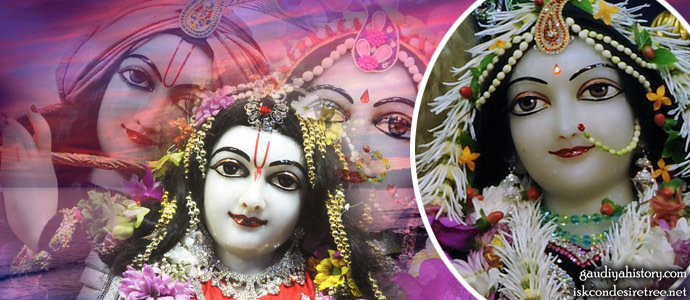
Gaudiya Vaishnava tradition holds that the devotees who surrounded Sri Chaitanya Mahaprabhu at Puri were, behind their outward lives, residents of Krishna's own Vraja pastimes. For Svarupa Damodara, the sources agree that this identity places him very close to Radharani, as one of her nearest friends in Vraja. But they do not agree on that friend's exact name.
| Detail | Description |
|---|---|
| Root text | Kavi Karnapura's Gaura-ganoddesha-dipika |
| Identity given there | Vishakha-devi, one of Radha's eight principal sakhis |
| Popular alternative | Lalita-sakhi, Radha's other closest confidential friend |
| Supporting verse | A Gaura-ganoddesha-dipika verse describing Vishakha, Radha's own art-teacher in Vraja, as reborn as Svarupa Goswami |
| Parallel Puri pairing | With Ramananda Raya, likened to Lalita and Vishakha as Radha's two confidantes |
What the Gaura-ganoddesha-dipika Actually Says #
Kavi Karnapura's Gaura-ganoddesha-dipika is the traditional key that links each of Chaitanya Mahaprabhu's associates with a figure from Krishna's Vraja-lila. It names Svarupa Damodara as Vishakha-devi. In Vraja, Vishakha is remembered as the sakhi who personally taught Radharani the arts. A verse quoted in several later biographical sources makes the claim directly. It says that the same Vishakha who once taught Radha in Vraja has now, in Gaura-lila, become Svarupa Goswami, delighting in the moods of Radha and Krishna all over again. This is the identity that the earliest sources actually support when they are read strictly. Most detailed Gaudiya biographies of him treat it as the one with real support in the texts.
Why Lalita-sakhi Is Still the Name Most People Use #
Yet in everyday devotional speech, Svarupa Damodara is called an incarnation of Lalita-sakhi far more often than of Vishakha. This is so in pranama mantras recited for him, in short popular biographies, and even in some material published by Gaudiya institutions. One traditional pranama mantra recited in his honor addresses him directly as an incarnation of Lalita, most dear to Chaitanya Mahaprabhu. Yet the same tradition also cites the Gaura-ganoddesha-dipika, which names him Vishakha instead, and the two descriptions are left side by side without being reconciled. This difference cannot honestly be settled. So instead of quietly choosing one name, we state it plainly. The root verse says Vishakha. A wide and old stream of popular devotion says Lalita. No source explains how the two claims fit together, or which one replaced the other in common use. The same question comes up with Ramananda Raya, his own closest companion at Puri. Srila Prabhupada's own purport to Chaitanya-charitamrita describes Ramananda Raya as "considered an incarnation of Arjuna and by some an incarnation of Vishakhadevi." So the very name Vishakha is attached to both men, in different sources and at different times. This shows that this kind of double naming did not happen only with Svarupa Damodara.
Radha's Two Closest Friends, Reflected at Puri #
Whichever name is correct, every source agrees on the closeness itself, and this is the deeper point. Among the eight principal sakhis of Radharani, Lalita and Vishakha are remembered as her two nearest and most trusted friends. They are present at her side in almost every important moment of her life with Krishna. Devotional writers describe Svarupa Damodara and Ramananda Raya at Puri in exactly those terms. Night after night, the two of them shared with Mahaprabhu the innermost truths of Radha-Krishna prema, in a way no one else present was able to follow. In this way they reflected at Puri the role that Lalita and Vishakha played for Radharani herself in Vraja. This comparison is more than poetry. It matches what both men actually did for the Lord in His final years, which is discussed on friendship-with-ramananda-raya.
Why the Identity Mattered to His Role #
This spiritual identity is not a side detail in Svarupa Damodara's story. It is perhaps the very reason the tradition trusts his judgment on everything else. He was the gatekeeper who checked poetry for rasabhasa. He alone understood a private verse that Mahaprabhu recited in a fit of ecstasy. He sang exactly the right song at exactly the right moment to draw the Lord back from unconsciousness. All of this points to a closeness with Radha's own moods that an ordinary scholar, however brilliant, could not simply learn from books. Whether that closeness is best explained by calling him Vishakha or Lalita, the tradition's larger claim is the same. His understanding of Mahaprabhu's ecstasies, described at length on keeper-of-the-lords-innermost-moods, came from somewhere beyond ordinary scholarship. It came from having already stood, in another life, in the place where only Radha's nearest friends stand.
Scriptural evidence for this chapter (2)
kalam ashikshayad radham ya vishakha vraje pura
sadya svarupa-gosvami tat-tad-bhava-vilasavan
Word for word
kalam: the arts; ashikshayat: taught; radham: to Radha; ya vishakha: the Vishakha who; vraje pura: formerly in Vraja; sadya: now; svarupa-gosvami: Svarupa Gosvami; tat-tad-bhava-vilasavan: rejoicing in those same moods.
That same Vishakha who previously taught Radha the arts in Vraja is today Svarupa Goswami, who rejoices in the moods of Radha and Krishna.
The root-text basis for identifying Svarupa Damodara as Vishakha-devi rather than Lalita-sakhi, quoted in secondary sources describing this verse as text 160 of the Gaura-ganoddesha-dipika.
Among His associates, Lord Caitanya Mahaprabhu enjoyed paternal loving affection from Paramananda Puri, friendly affection with Ramananda Raya, unalloyed service from Govinda and others, and humors of conjugal love with Gadadhara, Jagadananda and Svarupa Damodara.
From the purport: Purport excerpt: "Ramananda Raya, who is considered an incarnation of Arjuna and by some an incarnation of Vishakhadevi, enjoyed unalloyed fraternal love with the Lord."
Shows the same Lalita/Vishakha naming uncertainty extending to Ramananda Raya as well in Srila Prabhupada's own purport, not only to Svarupa Damodara.
Chapter 5
The Kadacha and Chaitanya-charitamrita
How a private notebook of Sanskrit notes, never published in Svarupa Damodara's own name, became the foundation of Sri Chaitanya-charitamrita.
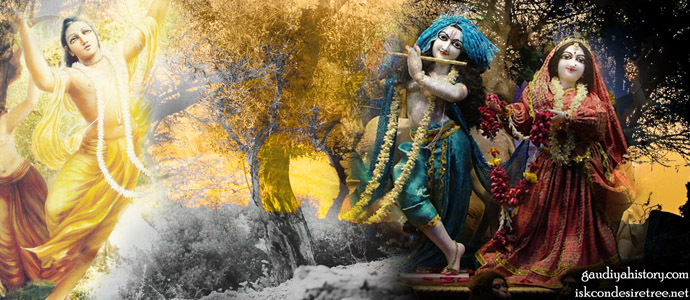
Sri Chaitanya-charitamrita, the single most detailed account of Sri Chaitanya Mahaprabhu's life, does not claim to be a firsthand record. Its own author says plainly that its material for the Lord's later years came from somewhere else first: a private notebook kept by Svarupa Damodara Goswami.
| Detail | Description |
|---|---|
| Common name | Kadacha, sometimes rendered kariacha |
| What it covered | The Lord's madhya-lila and antya-lila - his travels and his Puri years |
| Form | Brief Sanskrit summary-notes, not a finished narrative |
| Transmission | Svarupa Damodara to Raghunatha Dasa Goswami to Krishnadasa Kaviraja Goswami |
| Published as a separate book | No - it survives only inside Sri Chaitanya-charitamrita itself |
Two Note-Keepers, Two Halves of a Life #
Krishnadasa Kaviraja Goswami clearly explains where he took his material from for each part of the Lord's life. Murari Gupta, he explains, had already recorded the Lord's household years, the adi-lila, in summary form. Svarupa Damodara did the same work for everything that came after: the Lord's sannyasa, his travels, and the eighteen years at Jagannatha Puri. All of this was set down as brief notes "kept within a book," in Krishnadasa Kaviraja's own phrase. He says plainly that these two men's notes are "the basis of this book." So almost everything a reader finds in the madhya-lila and antya-lila portions of Chaitanya-charitamrita rests, in the end, on Svarupa Damodara's notes. As the Lord's own secretary, Svarupa Damodara chose what to write down at the time.
Sanskrit Notes, Not a Finished Book #
Svarupa Damodara did not produce a polished biography. Tradition describes his kadacha as a set of short Sanskrit summary-verses. It was a working record of the Lord's daily moods and activities, not a literary work meant to be passed around. He seems never to have intended it as a public work at all. Instead, according to Bhaktivinoda Thakura's commentary, he taught its contents directly to one person, Raghunatha Dasa Goswami. Raghunatha Dasa was born into a rich and noble family, but he walked away from his family's wealth. In time he became Svarupa Damodara's own attendant and constant assistant, giving sixteen years of confidential service at Puri. Vaishnavas of later generations knew of Svarupa Damodara's kadacha only because Raghunatha Dasa Goswami had heard it directly from him and carried it forward.
From Raghunatha Dasa to Krishnadasa Kaviraja #
Krishnadasa Kaviraja Goswami himself names the final link in the chain, in one of the most quoted passages of the entire work. The Lord's pastimes, he writes, are the topmost of jewels, "kept in the storehouse of Svarupa Damodara Gosvami, who has explained them to Raghunatha dasa Gosvami, who has repeated them to me." He says that whatever he had heard from Raghunatha Dasa Goswami, he set down in the book now offered to devotees everywhere. This is not a vague claim of inspiration. It names three people, in order, through whom the material for Chaitanya-charitamrita's account of the Lord's later life was passed down. But we should be clear about what this does and does not prove. It shows where Krishnadasa Kaviraja Goswami says his information came from. It does not confirm that information independently, because the kadacha itself was never kept as a separate text that the finished book could be checked against. Still, this claim comes from the author at the very moment he is explaining his own method, and no other account of the Puri years survives to contradict it. For these reasons, Gaudiya Vaishnava tradition has always accepted it as reliable.
A Diary That Only Survives Secondhand #
It is quietly touching that Svarupa Damodara's own writing disappeared so completely into someone else's book. He is remembered as one of the great scholars of his generation. Sri Chaitanya-charitamrita compares him to Brihaspati himself for learning. Yet not one line of his private kadacha survives independently today. His Sangita-damodara, a book on music, is mentioned in tradition, but it too has not been preserved in a form we can read today. Everything of his writing that reaches a modern reader comes through Raghunatha Dasa Goswami's memory and Krishnadasa Kaviraja Goswami's pen. In a real sense, then, reading Sri Chaitanya-charitamrita's madhya-lila and antya-lila is the closest anyone today can come to reading Svarupa Damodara's own kadacha. Svarupa Damodara spent his life making sure that the right words, and no others, reached Mahaprabhu. Perhaps this is exactly what such a man would have wanted for his own words.
Scriptural evidence for this chapter (3)
প্রভুর যে শেষলীলা স্বরূপ–দামোদর ।
সূত্র করি’ গ্রন্থিলেন গ্রন্থের ভিতর ॥
prabhura ye shesha-lila svarupa-damodara
sutra kari' granthilena granthera bhitara
Word for word
prabhura: of the Lord; ye: whatever; shesha-lila: pastimes at the end; svarupa-damodara: Svarupa Damodara; sutra kari': in the form of notes; granthilena: recorded; granthera: a book; bhitara: within.
His later pastimes [the madhya-lila and antya-lila] were recorded in the form of notes by His secretary, Svarupa Damodara Gosvami, and thus kept within a book.
The single clearest statement that Svarupa Damodara's kadacha, not eyewitness memory alone, underlies Chaitanya-charitamrita's account of the Puri years.
সেই, অনুসারে লিখি লীলা–সূত্রগণ ।
বিস্তারি’ বর্ণিয়াছেন তাহা দাস–বৃন্দাবন ॥
sei, anusare likhi lila-sutra-gana
vistari' varniyachena taha dasa-vrndavana
Word for word
sei: that; anusare: following; likhi: I write; lila-sutra-gana: the notes on the pastimes; vistari': very explicitly; varniyachena: has described; taha: that; dasa-vrndavana: Vrndavana dasa Thakura.
The notes kept by Sri Svarupa Damodara and Murari Gupta are the basis of this book. Following those notes, I write of all the pastimes of the Lord. The notes have been described elaborately by Vrndavana dasa Thakura.
Krishnadasa Kaviraja Goswami's own statement of method, naming Svarupa Damodara's notes as one of his two source documents.
চৈতন্যলীলা-রত্ন-সার, স্বরূপের ভাণ্ডার,
তেঁহো থুইলা রঘুনাথের কণ্ঠে ।
তাহাঁ কিছু যে শুনিলুঁ, তাহা ইহাঁ বিস্তারিলুঁ,
ভক্তগণে দিলুঁ এই ভেটে ॥
caitanya-lila-ratna-sara, svarupera bhandara,
teṅho thuila raghunathera kanthe
tahan kichu ye shuniluṅ, taha ihan vistariluṅ,
bhakta-gane diluṅ ei bhete
Word for word
caitanya-lila: the pastimes of Lord Caitanya; ratna-sara: the topmost jewel; svarupera: of Svarupa Damodara; bhandara: of the storehouse; tenho: he; thuila: kept; raghunathera kanthe: around the neck of Raghunatha dasa; taha: that; ye shuniluṅ: whatever I have heard; vistariluṅ: I have described; bhakta-gane: unto the devotees; diluṅ ei bhete: I have given this offering.
The pastimes of Sri Caitanya Mahaprabhu are the topmost of jewels. They have been kept in the storehouse of Svarupa Damodara Gosvami, who has explained them to Raghunatha dasa Gosvami, who has repeated them to me. Whatever little I have heard from Raghunatha dasa Gosvami I have described in this book, which is presented to all devotees.
From the purport: Purport excerpt: "All the activities of Sri Caitanya Mahaprabhu were noted by His personal secretary Svarupa Damodara and repeated to Raghunatha dasa Gosvami, who memorized them... This is called the parampara system, from Sri Caitanya Mahaprabhu to Svarupa Damodara to Raghunatha dasa Gosvami to Kaviraja Gosvami."
The three-link chain, named in the author's own words: Svarupa Damodara to Raghunatha Dasa Goswami to Krishnadasa Kaviraja Goswami himself.
Chapter 6
Friendship with Ramananda Raya
A renounced scholar and a resigned royal governor became Mahaprabhu's twin companions in exploring the deepest truths of prema.
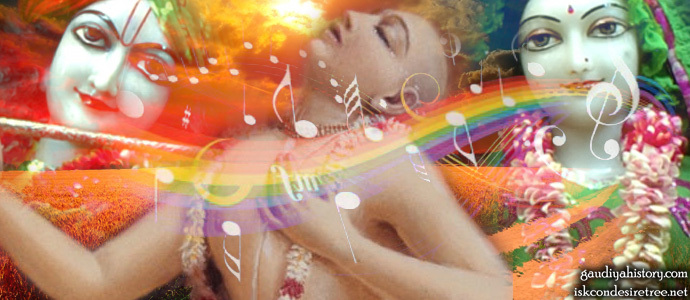
Two men arrived at Puri not long after each other, from very different lives. They became the two pillars of Sri Chaitanya Mahaprabhu's final years. One was Svarupa Damodara, the renunciant scholar and singer. The other was Ramananda Raya, the governor who had just resigned a royal post to sit at the Lord's feet.
| Detail | Description |
|---|---|
| Ramananda Raya's background | Governor of Vidyanagara under King Prataparudra before joining Mahaprabhu at Puri |
| Shared role | Nightly companions to Mahaprabhu, exploring the deepest truths of krishna-prema |
| Division of gifts | Svarupa Damodara sang; Ramananda Raya recited poetry and drama |
| Traditional pairing | Likened to Lalita and Vishakha, Radha's two closest confidantes |
| Shared presence | Named together at the Lord's side through his final, most intense years |
Two Different Roads to the Same Room #
Ramananda Raya reached Puri from an entirely different direction than Svarupa Damodara. He was already governing Vidyanagara under King Prataparudra when he first met the Lord on the bank of the Godavari during Mahaprabhu's South Indian pilgrimage, and only later resigned his post at the Lord's request to settle permanently at Puri. Svarupa Damodara, on the other hand, came by way of devotion in Navadvipa and a vow of renunciation that he took on himself in Varanasi. Sri Chaitanya-charitamrita places their arrivals close together in time, and from that point on the two men's names appear together again and again, almost as a fixed pair, in every account of the Lord's private evenings.
Divided Gifts, One Purpose #
The pairing worked because each man served the same need in a very different way, and each served it completely. Svarupa Damodara sang. He sang the poems of Vidyapati and Chandidasa and Jayadeva Gosvami's Gita-govinda, and Sri Chaitanya-charitamrita says he sang them with the skill of a Gandharva. Ramananda Raya recited. He recited verses from his own play, the Jagannatha-vallabha-nataka, and from Srimad-Bhagavatam and other sources, chosen for their poetic beauty. Night after night, the two of them would sit with Mahaprabhu as He tasted the pastimes and moods of Radha and Krishna. One supplied music and the other supplied words. Together they helped express the Lord's ecstasies in a way neither could have done alone. Sri Chaitanya-charitamrita states directly that Mahaprabhu enjoyed madhurya-rasa, the mellow of conjugal love, specifically in the company of Gadadhara Pandita, Jagadananda Pandita, and Svarupa Damodara. He treasured Ramananda Raya's friendship for its own distinct rasa. Between them, the two men covered almost every mood that the Lord needed to have drawn out and expressed.
Lalita and Vishakha, Reflected at Puri #
Devotional writers describe this pairing using the same image used for Radha's own two closest gopi friends in Vraja. Just as Lalita and Vishakha never left Radharani's side, Svarupa Damodara and Ramananda Raya never left Mahaprabhu's. The comparison is more than a convenient one. As explained on spiritual-identity-as-lalita-sakhi, Gaudiya tradition identifies both men with figures from that same inner circle of sakhis. But the sources do not clearly agree on which name belongs to which associate. Different accounts attach both Lalita and Vishakha to each man. Still, no source disputes the main claim itself. Between them, Svarupa Damodara and Ramananda Raya held the two seats closest to Mahaprabhu's own heart, exactly as their gopi counterparts hold the two seats closest to Radha's.
Together to the End #
Mahaprabhu's final years deepened into what devotees call His divyonmada, the divine madness of separation. In that time Svarupa Damodara and Ramananda Raya, named as a pair, stayed constantly at His side. They worked to calm Him and, at the same time, to nourish His mood. Sri Chaitanya-charitamrita's own closing chapter records the Lord speaking to the two of them directly. He stresses to them, and through them to the world, that congregational chanting of the holy name is the one certain means of deliverance in this age. Mahaprabhu was reciting His own Sanskrit verses to these same two men, and no one else, and relishing their meaning with them. He was doing this on the very nights just before the point where Sri Chaitanya-charitamrita, by its own account, begins only to hint at what came next. The page disappearance-and-mahaprabhus-grief tells what became of that partnership, and of Svarupa Damodara himself, in the Lord's last days. It also explains what is still genuinely uncertain about the order of events.
Scriptural evidence for this chapter (1)
পুরীর বাৎসল্য মুখ্য, রামানন্দের শুদ্ধসখ্য,
গোবিন্দাদ্যের শুদ্ধদাস্যরস ।
গদাধর, জগদানন্দ, স্বরূপের মুখ্য রসানন্দ,
এই চারি ভাবে প্রভু বশ ॥
purira vatsalya mukhya, ramanandera shuddha-sakhya,
govindadyera shuddha-dasya-rasa
gadadhara, jagadananda, svarupera mukhya rasananda,
ei cari bhave prabhu vasha
Word for word
purira: of Paramananda Puri; vatsalya: paternal affection; mukhya: chiefly; ramanandera: of Raya Ramananda; shuddha-sakhya: pure fraternity; govinda-adyera: of Govinda and others; shuddha-dasya-rasa: the pure mellow of servitorship; gadadhara jagadananda svarupera: of Gadadhara, Jagadananda and Svarupa Damodara; mukhya rasananda: the chief mellow of pleasure; ei cari bhave: by these four moods; prabhu vasha: the Lord is controlled.
Among His associates, Lord Caitanya Mahaprabhu enjoyed paternal loving affection from Paramananda Puri, friendly affection with Ramananda Raya, unalloyed service from Govinda and others, and humors of conjugal love with Gadadhara, Jagadananda and Svarupa Damodara. Sri Caitanya Mahaprabhu enjoyed all these four mellows, and thus He remained obliged to His devotees.
Distinguishes the particular flavor of devotion Mahaprabhu received from each close associate, placing Svarupa Damodara among those relating to Him in the mood of conjugal love.
Chapter 7
Disappearance and Mahaprabhu's Grief
What Sri Chaitanya-charitamrita says, and what it leaves unsettled, about whether the Lord or Svarupa Damodara left this world first.
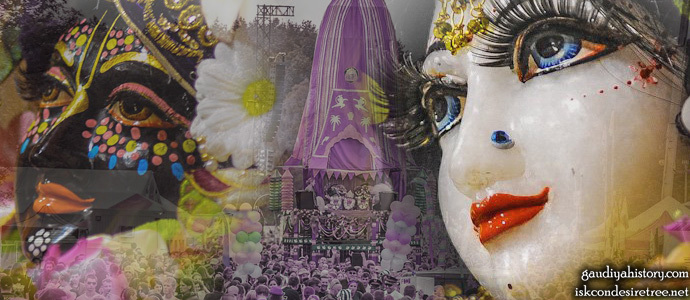
Sri Chaitanya-charitamrita famously does not describe Sri Chaitanya Mahaprabhu's own disappearance directly. Krishnadasa Kaviraja Goswami says only that he "hints" at it before ending the book. The book holds back in the same way about Svarupa Damodara's own passing. So there is a real gap in our knowledge of exactly when he passed away in relation to the Lord.
| Detail | Description |
|---|---|
| Mahaprabhu's disappearance | Saka era 1455 (1534 CE), after forty-eight years in this world |
| Svarupa Damodara's disappearance | On a Ratha-yatra day, in the month of Ashadha; year not recorded |
| Order of events | Genuinely disputed - see below |
| Constant companions in the final years | Svarupa Damodara and Ramananda Raya |
| Final instruction given to them | That congregational chanting of the holy name is the one sure means of deliverance in this age |
Years of Deepening Grief #
Whatever the exact order of their deaths, every account agrees that the final years at Puri were years of growing sorrow for Mahaprabhu Himself. His feelings of separation from Krishna, described at length on keeper-of-the-lords-innermost-moods, grew steadily more extreme. Devotees call these fits divyonmada, divine madness. In them the Lord's body went through changes that terrified onlookers, even as these changes showed how deeply He was absorbed within. The loss of Haridasa Thakura, whom Mahaprabhu personally carried and buried with His own hands, was one sad event in those years. Throughout it all, Svarupa Damodara and Ramananda Raya, as described on friendship-with-ramananda-raya, remained constantly at His side. They sang and recited to nourish and calm a grief that, by its very nature, could never be fully satisfied in this world.
What Chaitanya-charitamrita Actually Says #
Here we need to slow down and be careful. A number of later devotional retellings describe Svarupa Damodara's own death as a blow that deepened Mahaprabhu's grief in the Lord's last days. This implies that Svarupa Damodara passed away first, while the Lord was still living, and that this loss played a direct part in Mahaprabhu's own decline and disappearance. The story is very widely told in this way. But Sri Chaitanya-charitamrita's own text, in its account of Raghunatha Dasa Goswami's life, gives the order the other way around. It says that Raghunatha Dasa Goswami rendered confidential service at Puri for sixteen years, "and after the disappearance of both the Lord and Svarupa Damodara, he left Jagannatha Puri and went to Vrindavana." This names the Lord's disappearance first, and Svarupa Damodara's second. Several later biographical summaries agree with this reading. They describe Svarupa Damodara as passing away "not long after the Lord's disappearance," on a later Ratha-yatra day.
We report this disagreement here instead of quietly choosing one side. Only this much can be said with confidence. The two men's departures from this world came close together in time. They were so close that a later generation of devotees remembered them almost as a single event. Where Sri Chaitanya-charitamrita's own wording addresses the question at all, it places Svarupa Damodara's passing after the Lord's, not before it. And no source gives a year for Svarupa Damodara's own disappearance. The sources only repeat the detail that it fell on a day of Ratha-yatra, in the month of Ashadha.
Raghunatha Dasa Goswami's Departure #
The one thing every source agrees on is what came next. Once both Mahaprabhu and Svarupa Damodara had left this world, Raghunatha Dasa Goswami finally left Jagannatha Puri for Vrindavana. For sixteen years he had served as Svarupa Damodara's own attendant, and he became so identified with him that he was known simply as "Svarupa's Raghu." In Vrindavana he sought out Rupa Goswami and Sanatana Goswami. Tradition says he intended to end his own life at Govardhana Hill instead of living on without either of the two men he had served. The Vrindavana Goswamis refused to let him do it, and instead accepted him as a spiritual brother. From that point on, Raghunatha Dasa Goswami carried with him everything Svarupa Damodara had taught him of the Lord's confidential Puri pastimes. What he told from then on eventually reached Krishnadasa Kaviraja Goswami and became Sri Chaitanya-charitamrita, as described on the-kadacha-and-chaitanya-charitamrita.
A Legacy Preserved Only Secondhand #
Later tradition does not point with confidence to any separate samadhi of Svarupa Damodara at Puri. Instead, devotional sources place a symbolic samadhi for him among the sixty-four memorial samadhis near the Radha-Govinda temple in Vrindavana. Yet, as far as the record shows, he himself never actually visited Vrindavana in this life. This strange fact suits a man whose entire service was to stay unnoticed. In Sri Chaitanya-charitamrita's own words, he was someone who "did not generally converse with anyone" and "liked to remain alone." He built no institution, founded no line of disciples that history remembers by name, and published no book under his own name. What he left instead was less visible, but in the end far more lasting. For years he quietly kept the private notes of a devoted secretary. Those notes turned out to be the one thing later generations of Gaudiya Vaishnavas most needed in order to understand what had been witnessed in Sri Chaitanya Mahaprabhu at all.
Scriptural evidence for this chapter (2)
ষোড়শ বৎসর কৈল অন্তরঙ্গ–সেবন ।
স্বরূপের অন্তর্ধানে আইলা বৃন্দাবন ॥
shodasha vatsara kaila antaranga-sevana
svarupera antardhane aila vrndavana
Word for word
shodasha: sixteen; vatsara: years; kaila: did; antaranga: confidential; sevana: service; svarupera: of Svarupa Damodara; antardhane: at the disappearance; aila: came; vrndavana: to Vrndavana.
He rendered confidential service to the Lord for sixteen years at Jagannatha Puri, and after the disappearance of both the Lord and Svarupa Damodara, he left Jagannatha Puri and went to Vrindavana.
The only place in Chaitanya-charitamrita's own verses addressing the relative timing; the word-for-word Bengali names only Svarupa Damodara's own disappearance, while Srila Prabhupada's authorized translation makes explicit that the Lord's disappearance came first - the basis for the honest note above on the disputed order of events.
হর্ষে প্রভু কহেন, — “শুন স্বরূপ-রামরায় ।
নামসঙ্কীর্তন — কলৌ পরম উপায় ॥
harshe prabhu kahena, — "shuna svarupa-rama-raya
nama-sankirtana — kalau parama upaya
Word for word
harshe: in jubilation; prabhu: Sri Chaitanya Mahaprabhu; kahena: says; shuna: please hear; svarupa-rama-raya: My dear Svarupa Damodara Gosvami and Ramananda Raya; nama-sankirtana: chanting of the holy name of the Lord; kalau: in this Age of Kali; parama upaya: the best means.
In great jubilation, Sri Chaitanya Mahaprabhu said, "My dear Svarupa Damodara and Ramananda Raya, know from Me that chanting the holy names is the most feasible means of salvation in this Age of Kali."
Mahaprabhu's own final teaching, given directly and only to these two associates, in the closing chapter of Chaitanya-charitamrita.
Closing
Songs in the Vaishnava Song Book #
The Vaishnava Song Book carries 1 song attributed to Srila Svarupa Damodara Goswami. See the full author page here.
- Sri Chaitanya-charitamrita, Madhya-lila 10.101-129 (arrival and early life at Puri)
- Sri Chaitanya-charitamrita, Adi-lila 4.103-110 (the confidential cause revealed by Svarupa Damodara)
- Sri Chaitanya-charitamrita, Adi-lila 13.15-17, 46-47 (his notes as the basis of Chaitanya-charitamrita)
- Sri Chaitanya-charitamrita, Antya-lila 14, 17 and 18 (guardianship during ecstasy)
- Sri Chaitanya-charitamrita, Madhya-lila 2.77-85 (kirtan, rasa, and the kadacha's transmission)
- Sri Chaitanya-charitamrita, Adi-lila 10.92-97, 124-131 (secretary to Raghunatha Dasa Goswami; devotees of Puri)
- Gaudiya History (ISKCON Desire Tree): Svarupa Damodara Goswami
- Gaudiya History (ISKCON Desire Tree): Svarupa Damodara Goswami - Biography
- Sri Chaitanya Math / PrabhupadaRays.com: Swarupa Damodara
- ISKCON Bangalore: Sri Svarupa Damodara Goswami
- Stephen Knapp: Svarupa Damodar Goswami
