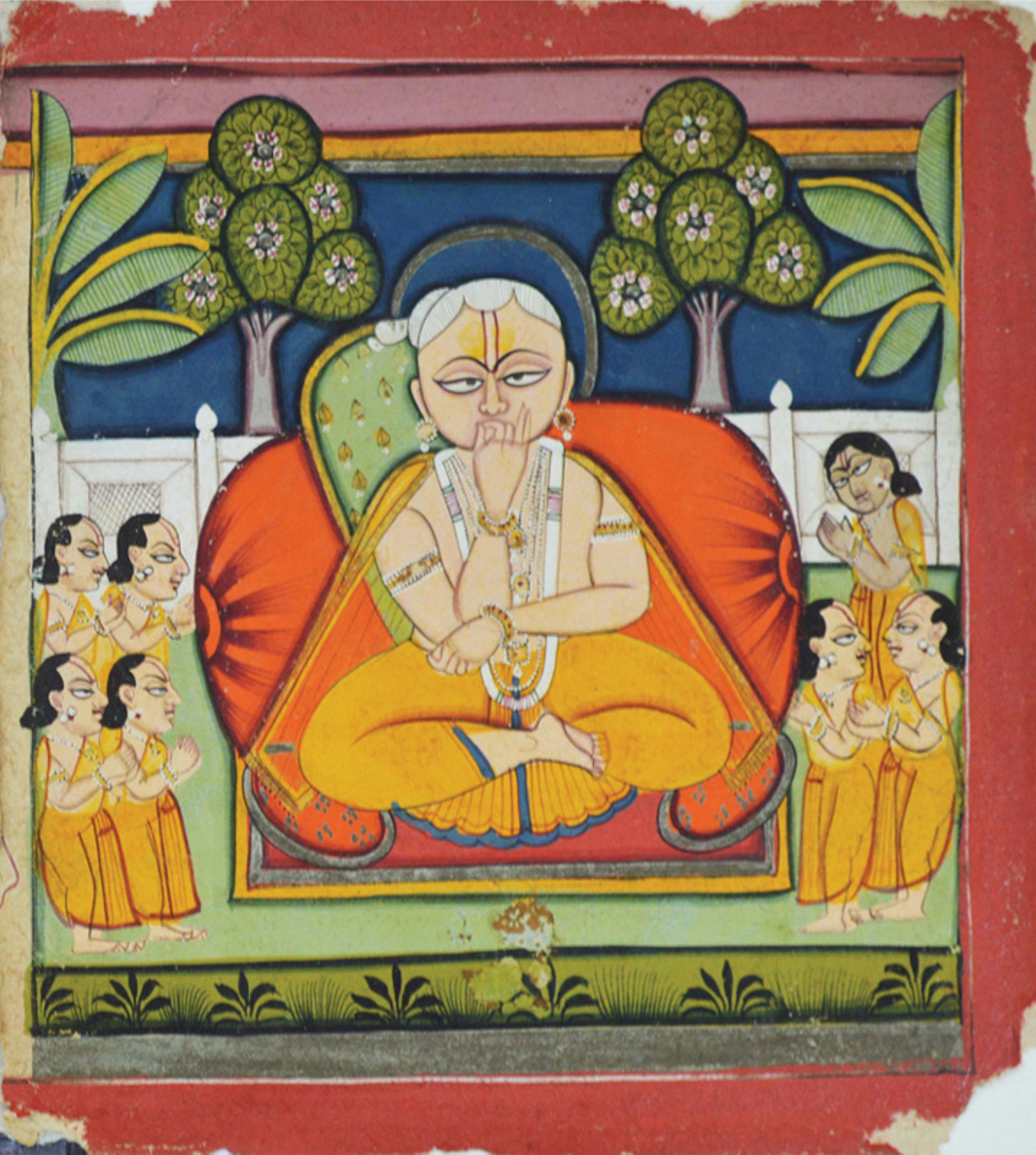
A Deity Neither Brother Would Climb the Hill to See #
Srila Rupa Gosvami and Sanatana Gosvami had made a private rule for themselves in Vrindavana. They would not climb Govardhana Hill, because they held the hill itself to be non-different from Krishna. A devotee does not put his foot on the body of the Lord he worships. Sri Chaitanya Mahaprabhu Himself, on seeing Govardhana, recited a verse in this same mood: "Of all the devotees, this Govardhana Hill is the best! O my friends, this hill supplies Krishna and Balarama, as well as Their calves, cows and cowherd friends, with all kinds of necessities: water for drinking, very soft grass, caves, fruits, flowers and vegetables. In this way the hill offers respect to the Lord. Being touched by the lotus feet of Krishna and Balarama, Govardhana Hill appears very jubilant" (Srimad-Bhagavatam 10.21.18, quoted in Chaitanya-charitamrita, Madhya-lila 18.34). So they could see the Gopala Deity, who was worshipped near the foot of the hill, only by Krishna's own arrangement. Chaitanya-charitamrita describes this arrangement: Gopala Himself would sometimes give an excuse to leave His usual place and fulfil a devotee's heart's desire. In Rupa Gosvami's later years, old age settled the matter in another way. He was too frail even to travel to Govardhana, so he simply could not go.
Gopala Comes to Mathura #
In that period, fear of raids by Muslim forces was reason enough to move a Deity from an unprotected village shrine to a safer house. This is exactly what happened to Gopala. He was taken to Mathura and kept for a full month in the house of Vitthalanatha, who is also called Vitthaleshvara in Chaitanya-charitamrita. Vitthalanatha was the youngest son of the great Vallabha-sampradaya teacher Vallabhacharya, and he was himself already a leading acharya of that separate Vaishnava lineage. Nothing in the record suggests any deep personal tie between Rupa Gosvami's Gaudiya circle and Vitthalanatha's own line. Vitthalanatha's house simply happened to be where the Deity was sheltered that season. Rupa Gosvami was so old that it was worth making the journey to Mathura for this unusual visit, instead of waiting for Gopala to return to Vraja.
A Month of Vrindavana's Devotees Under One Roof #
What followed was really a small gathering of Vrindavana's leading devotees, away from Vrindavana itself. Chaitanya-charitamrita names them one by one across several verses: first Gopala Bhatta Gosvami, Raghunatha Dasa Gosvami, Raghunatha Bhatta Gosvami and Lokanatha Dasa Gosvami, then Bhugarbha Gosvami, Jiva Gosvami, Yadava Acharya and Govinda Gosvami. Only after this long list of well-known names does the text add a final, shorter group: "He was also accompanied by Sri Uddhava dasa, Madhava, Sri Gopala dasa and Narayana dasa" (Chaitanya-charitamrita, Madhya-lila 18.51). It is the only time Uddhava Dasa appears by name in this episode. Chaitanya-charitamrita gives him nothing more than his place at the end of that list. It records no words of his and no special act. He was simply there, one of the last and least-known names among the devotees who stayed together in Mathura for that month, until the Gopala Deity's darshan was finally given.
What the Verse Does and Does Not Say #
It would be easy to read more into this than the text supports. Chaitanya-charitamrita does not say that Uddhava Dasa traveled with the senior Gosvamis as an equal. It says only that he was present. It does not say what, if anything, he said or did during the month. It also gives no sign of how he came to be counted in this particular company, instead of staying in Vrindavana. But the verse does show plainly that a devotee named Uddhava Dasa was a real and recognized member of Vrindavana's devotee community during Rupa Gosvami's lifetime. In his own careful list, Krishnadasa Kaviraja Goswami groups him with a small circle of otherwise minor associates, not with the senior Goswamis he traveled alongside.
