Srila Uddhava Dasa
A Branch of Gadadhara Pandit Named in the Chaitanya-charitamrita
The complete life, on one page: The main biography and every pastime page, in order, in one place
Introduction
Two much more famous people share this name, and this Uddhava Dasa is neither of them. One is Krishna's own dear friend and cousin Uddhava, the counselor of the Srimad-Bhagavatam's Dvaraka-lila and the one who received the celebrated Uddhava-gita. He belongs to an entirely different part of Vaishnava literature. The other is Srila Paramananda Puri. His life story shows that the Gaura-ganoddesha-dipika identifies him as that very Uddhava, who came again to be at Sri Chaitanya Mahaprabhu's side. The Uddhava Dasa described here is a third person. He was an ordinary Gaudiya Vaishnava devotee of Vrindavana, named directly in Krishnadasa Kaviraja Goswami's Chaitanya-charitamrita. Only a handful of lines about his life have come down to us.
| Detail | Description |
|---|---|
| Home | Vrindavana |
| Named in | Sri Chaitanya-charitamrita, Adi-lila 12.84, as one of the branches of Sri Gadadhara Pandit's spiritual family |
| Best known for | Present when Srila Rupa Gosvami saw the Gopala Deity at Vitthalanatha's house in Mathura; met Shrinivasa Acharya and Raghava Goswami at Sanatana Goswami's hut in Nandishvara |
| Praised in | A single verse of Yadunatha Das's Shakha-nirnayamrita (verse 35) |
| Identity | An empowered (avesha) incarnation of the moon-god, named with Chandrashekhara Acharya (Gaura-ganoddesha-dipika 112) |
| Disappearance | Not recorded |
Scriptural evidence for the introduction (3)
srinatha cakravarti, ara uddhava dasa
jitamitra, kasthakata-jagannatha-dasa
Word for word
srinatha cakravarti - Srinatha Cakravarti; ara - and; uddhava dasa - Uddhava dasa; jitamitra - Jitamitra; kasthakata jagannatha-dasa - Kasthakata Jagannatha dasa.
The fifteenth branch was Srinatha Cakravarti; the sixteenth, Uddhava; the seventeenth, Jitamitra; and the eighteenth, Jagannatha dasa.
From the purport: Purport excerpt: "Similarly, verse 35 mentions Uddhava dasa as being greatly qualified in distributing love of Godhead to everyone."
The verse that formally places Uddhava Dasa as one of the branches of Gadadhara Pandit's spiritual family in the Chaitanya-charitamrita's devotee-tree; the purport quotes Srila Bhaktisiddhanta Sarasvati Thakura's Anubhasya, which in turn cites the Shakha-nirnayamrita.
ati-dinajane purna-prema-vitta-pradayakam
shrimad-uddhava-dasakhyam vande'ham guna-shalinam
I venerate the highly virtuous Uddhava Das, who gave the wealth of love to those who were most fallen.
A verse of praise about Uddhava Dasa by Yadunatha Das, quoted (via Srila Bhaktisiddhanta Sarasvati Thakura's Anubhasya) in the Chaitanya-charitamrita purport to Adi-lila 12.84; the Sanskrit text itself is not on vedabase, so this citation follows the transliteration given by Gaudiya History, which credits it to "Sri Chaitanya: His Life & Associates" by Srila Bhakti Ballabh Tirtha Maharaj.
चन्द्रशेखर आचार्यश्चन्द्रो ज्ञेयो विचक्षणैः ।
श्रीमानुद्धवदासोऽपि चन्द्रावेशावतारकः ॥११२॥
candraśekhara ācāryaś candro jñeyo vicakṣaṇaiḥ |
śrīmān uddhava-dāso'pi candrāveśāvatārakaḥ ||112||
The learned devotees know that Candrasekhara Acarya was an incarnation of the moon-god and Sriman Uddhava dasa was an empowered incarnation of the moon-god.
Names Sriman Uddhava Dasa as an empowered (avesha) incarnation of the moon-god, beside Chandrashekhara Acharya; a separate identity from Paramananda Puri, whom verse 118 identifies as Uddhava. Sanskrit: diacritic edition of the Gaura-ganoddesha-dipika; English translation as published at bvmlu.org.
Chapter 1
Seeing Gopala at Vitthalanatha's House
Fear of Muslim raiders sent a beloved Vraja Deity to a house in Mathura, and gave an aging Rupa Gosvami - and Uddhava Dasa - one more darshan.
A Deity Neither Brother Would Climb the Hill to See #
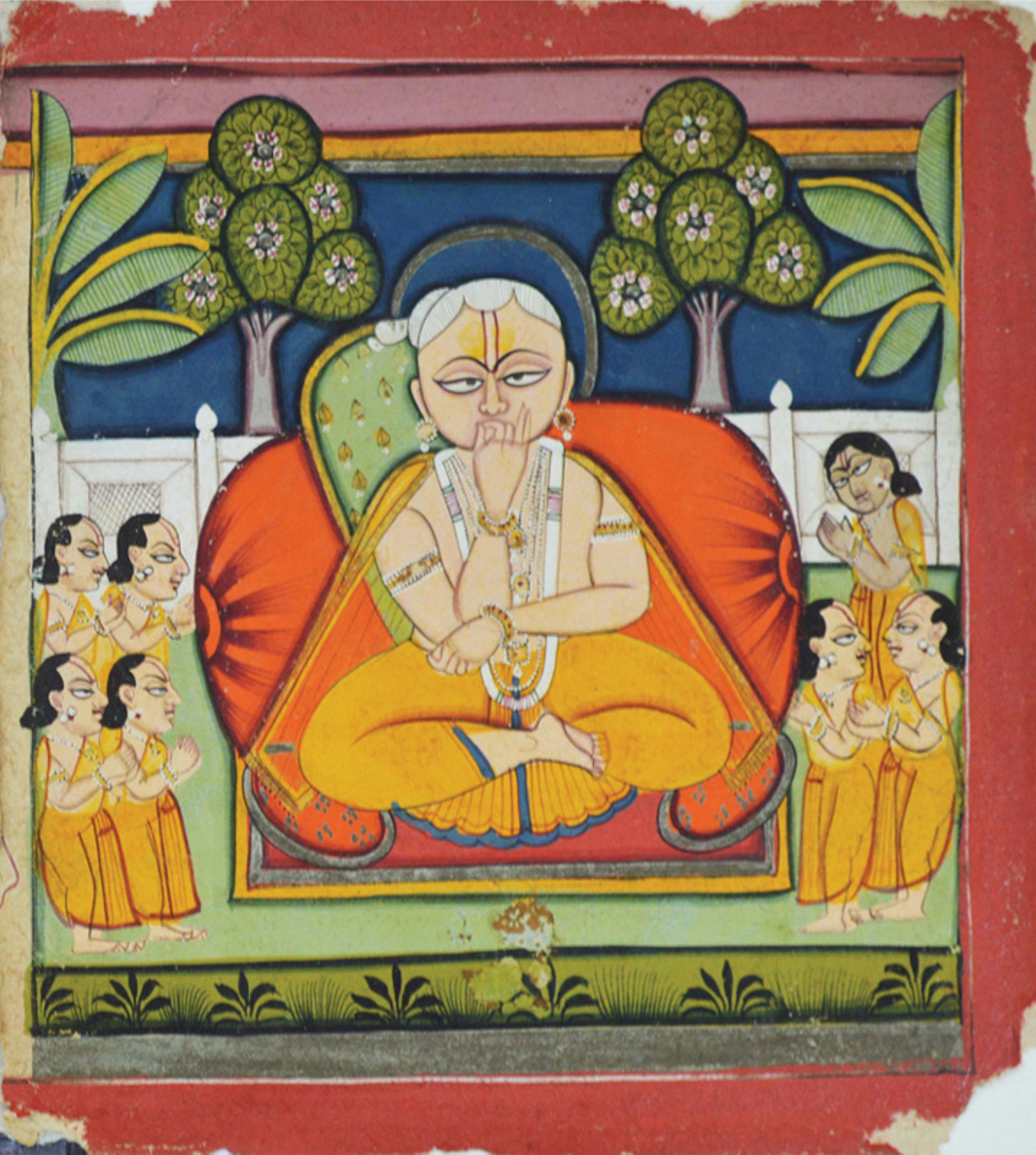
Srila Rupa Gosvami and Sanatana Gosvami had made a private rule for themselves in Vrindavana. They would not climb Govardhana Hill, because they held the hill itself to be non-different from Krishna. A devotee does not put his foot on the body of the Lord he worships. Sri Chaitanya Mahaprabhu Himself, on seeing Govardhana, recited a verse in this same mood: "Of all the devotees, this Govardhana Hill is the best! O my friends, this hill supplies Krishna and Balarama, as well as Their calves, cows and cowherd friends, with all kinds of necessities: water for drinking, very soft grass, caves, fruits, flowers and vegetables. In this way the hill offers respect to the Lord. Being touched by the lotus feet of Krishna and Balarama, Govardhana Hill appears very jubilant" (Srimad-Bhagavatam 10.21.18, quoted in Chaitanya-charitamrita, Madhya-lila 18.34). So they could see the Gopala Deity, who was worshipped near the foot of the hill, only by Krishna's own arrangement. Chaitanya-charitamrita describes this arrangement: Gopala Himself would sometimes give an excuse to leave His usual place and fulfil a devotee's heart's desire. In Rupa Gosvami's later years, old age settled the matter in another way. He was too frail even to travel to Govardhana, so he simply could not go.
Gopala Comes to Mathura #
In that period, fear of raids by Muslim forces was reason enough to move a Deity from an unprotected village shrine to a safer house. This is exactly what happened to Gopala. He was taken to Mathura and kept for a full month in the house of Vitthalanatha, who is also called Vitthaleshvara in Chaitanya-charitamrita. Vitthalanatha was the youngest son of the great Vallabha-sampradaya teacher Vallabhacharya, and he was himself already a leading acharya of that separate Vaishnava lineage. Nothing in the record suggests any deep personal tie between Rupa Gosvami's Gaudiya circle and Vitthalanatha's own line. Vitthalanatha's house simply happened to be where the Deity was sheltered that season. Rupa Gosvami was so old that it was worth making the journey to Mathura for this unusual visit, instead of waiting for Gopala to return to Vraja.
A Month of Vrindavana's Devotees Under One Roof #
What followed was really a small gathering of Vrindavana's leading devotees, away from Vrindavana itself. Chaitanya-charitamrita names them one by one across several verses: first Gopala Bhatta Gosvami, Raghunatha Dasa Gosvami, Raghunatha Bhatta Gosvami and Lokanatha Dasa Gosvami, then Bhugarbha Gosvami, Jiva Gosvami, Yadava Acharya and Govinda Gosvami. Only after this long list of well-known names does the text add a final, shorter group: "He was also accompanied by Sri Uddhava dasa, Madhava, Sri Gopala dasa and Narayana dasa" (Chaitanya-charitamrita, Madhya-lila 18.51). It is the only time Uddhava Dasa appears by name in this episode. Chaitanya-charitamrita gives him nothing more than his place at the end of that list. It records no words of his and no special act. He was simply there, one of the last and least-known names among the devotees who stayed together in Mathura for that month, until the Gopala Deity's darshan was finally given.
What the Verse Does and Does Not Say #
It would be easy to read more into this than the text supports. Chaitanya-charitamrita does not say that Uddhava Dasa traveled with the senior Gosvamis as an equal. It says only that he was present. It does not say what, if anything, he said or did during the month. It also gives no sign of how he came to be counted in this particular company, instead of staying in Vrindavana. But the verse does show plainly that a devotee named Uddhava Dasa was a real and recognized member of Vrindavana's devotee community during Rupa Gosvami's lifetime. In his own careful list, Krishnadasa Kaviraja Goswami groups him with a small circle of otherwise minor associates, not with the senior Goswamis he traveled alongside.
Scriptural evidence for this chapter (2)
Quoted in the text above:
- Madhya 18.51 Sri Chaitanya-charitamrita
- Madhya 18.34 (quoting Srimad-Bhagavatam 10.21.18) Sri Chaitanya-charitamrita
Chapter 2
With Shrinivasa, Narottama and Raghava at Nandishvara
At Sanatana Goswami's hut in Nandishvara he met Raghava's touring party with great joy, and later he was among those who saw the Goswamis' books off to Bengal.
A Meeting at Sanatana Goswami's Hut #
This second, later mention does not come from the Chaitanya-charitamrita. It comes from Narahari Chakravarti Thakura's later history, the Bhakti-ratnakara. Srila Jiva Goswami had sent Shrinivasa Acharya and Narottama Dasa Thakura to see all the holy places of Vraja-mandala, with Srila Raghava Pandita Goswami of Govardhana as their guide. On the way the three came back to Nandishvara, the hill of Nanda Maharaja, and Raghava went to the hut beside Pavana-sarovara where Sanatana Goswami had once lived. Sanatana's disciple Gopala Mishra, the son of Sanatana's family priest, was there, and Uddhava Dasa was among the devotees present. The Bhakti-ratnakara says:
śrī-uddhava dāsa mādhavādi ye ye chilā / paraspara mili' sabe mahā harṣa hailā
"Sri Uddhava Dasa, Madhava and all the others who were there met one another, and everyone was overjoyed." (Bhakti-ratnakara, Fifth Wave, p. 252, 1912 Bengali edition; English rendering ours)
The people of Vraja quickly brought food, and that day there was a great festival there. One line, printed in brackets in the 1912 edition, adds that they all spent the night in nama-sankirtana, singing the holy names together. At dawn Raghava took his leave and set out again with the two young devotees (pp. 252-253). The whole visit is told in Through the Forests of Vraja.
A twentieth-century reference work, the Gaudiya Vaishnava Abhidhana, describes this meeting as Uddhava Dasa receiving the travellers at his own ashrama (vol. 3, p. 1156), and some later accounts repeat this. The Bhakti-ratnakara itself places the meeting at Sanatana Goswami's hut in Nandishvara, with Gopala Mishra and Uddhava Dasa among the devotees there. The Raghava of this journey is not the same person as Raghava Pandit of Panihati, who is remembered chiefly for the yearly bhandara he sent to Jagannatha Puri.
Seeing Off the Scriptures to Bengal #
The same source mentions Uddhava Dasa again, later. He was among the devotees who gathered in Vrindavana for a much more important departure. On that day Shrinivasa Acharya, Narottama Dasa Thakura and Shyamananda Prabhu set out for Bengal, carrying the precious manuscripts of Rupa Gosvami, Sanatana Gosvami, Jiva Gosvami and the other Vrindavana Goswamis. Otherwise, these scriptures would have stayed locked away in Vraja, unread by the growing community of Gaudiya Vaishnavas back in Bengal and Odisha. In its list of the Vaishnavas who gathered at Sri Govinda's temple on the morning the books were loaded onto the cart, the Bhakti-ratnakara names "Sri Uddhava, who from time to time went to Gauda", that is, to Bengal, most likely this same Uddhava Dasa (Sixth Wave, p. 486). The fuller story of that journey is part of Shrinivasa Acharya's own life. It includes the theft of the manuscripts along the way and their safe arrival in the end, and it is told at length in Carrying the Scriptures to Bengal.
A Small, Steady Presence #
Together with the Vitthalanatha episode, these two mentions give only the outline of a life, not its details. They show a Vrindavana devotee who was, it seems, settled there. He was known well enough to be named twice across a generation of Gaudiya Vaishnava history. In his younger years he was present at a Deity's darshan. In his later years he was still among the Vaishnavas of Vraja, meeting the young pilgrims with joy at Nandishvara and gathering with the others when the books left for Bengal. Bhakti-ratnakara does not say when he died or where, and nothing in either source suggests he wrote, taught or left disciples. What it does keep, in two short and separate mentions, is a small, steady presence at the edges of some of Gaudiya Vaishnavism's better-known events. He is exactly the kind of quiet devotee that the tradition's own histories were careful to still name.
Closing
Not Krishna's Uddhava, and Not Paramananda Puri #
It is important to clear up this confusion at the start, because all three names appear close together in Gaudiya Vaishnava literature. Krishna's Uddhava is a full personality of the Bhagavatam itself. He is the wisest of the Yadus, the friend Krishna chose to receive His final instructions before leaving this world. Paramananda Puri is a historical sannyasi of Sri Chaitanya Mahaprabhu's own generation. The Gaura-ganoddesha-dipika (verse 118) identifies him as that same Uddhava, returned to Gaura's side. Uddhava Dasa, the plain, ordinary devotee described here, is neither of these. He never appears in the Bhagavatam. The Gaura-ganoddesha-dipika, at verse 112, identifies him quite differently. Tradition says he was an avesha incarnation of the Moon-god, not of Krishna's own cousin and counselor. What survives of his actual life does not come from any account of Dvaraka or of Mahaprabhu's Puri years. It comes from two short, specific mentions of him in Vrindavana, in the generation after the Six Goswamis settled there.
In the diacritic Sanskrit edition of the Gaura-ganoddesha-dipika this is verse 112. It names Uddhava Dasa right after Chandrashekhara Acharya:
candraśekhara ācāryaś candro jñeyo vicakṣaṇaiḥ
śrīmān uddhava-dāso'pi candrāveśāvatārakaḥ
"The learned devotees know that Candrasekhara Acarya was an incarnation of the moon-god and Sriman Uddhava dasa was an empowered incarnation of the moon-god." (Gaura-ganoddesha-dipika 112)
The verse gives only his name. It does not say where this Uddhava Dasa lived, so by itself it cannot tell apart the devotees of this name described below.
A Branch of Gadadhara Pandit's Family #
Sri Chaitanya-charitamrita builds much of its account of Mahaprabhu's community around the image of a great tree. Nityananda Prabhu, Advaita Acharya and Gadadhara Pandit are its three central trunks, and their followers are branches and sub-branches spreading out from each. In this picture, Adi-lila 12.84 names Uddhava Dasa as the sixteenth branch coming from Gadadhara Pandit, together with Shrinatha Chakravarti, Jitamitra and Kashthakata Jagannatha Dasa. Srila Bhaktisiddhanta Sarasvati Thakura's Anubhasya, quoted in Srila Prabhupada's own purport to this verse, adds one more detail from an older source, the Shakha-nirnayamrita of Yadunatha Das: "Similarly, verse 35 mentions Uddhava dasa as being greatly qualified in distributing love of Godhead to everyone." That same verse 35, read in full, is a short verse of praise, not a biography. It tells us that he was regarded as generous with bhakti toward the most fallen. It does not tell us where he was born or whom he served as guru. Neither source explains whether "branch of Gadadhara Pandit" here means formal discipleship, or simply a place within Gadadhara Pandit's wider circle of devotion. Nothing more should be guessed beyond what the texts themselves state.
Two Devotees Who Share a Name #
The sources themselves raise one more difficulty. The Gaudiya Vaishnava Abhidhana, a later reference book of Gaudiya Vaishnava biography, states that there were at least two separate devotees called Uddhava Dasa. One was a follower of Sanatana Gosvami who worshipped in Vraja on the bank of Pavana Sarovara. The second was a much later figure. He was born Krishnakanta Majumdar, was an initiated disciple of Radhamohana Thakura, lived in Murshidabad district, and wrote devotional songs about Radha-Krishna's pastimes. Neither Chaitanya-charitamrita nor Bhakti-ratnakara clearly says whether either of these two men, listed in a later book, is the same person named in the two episodes above. They also do not say whether a third Uddhava Dasa, not recorded anywhere else, is meant. Here the two episodes above are given to Chaitanya-charitamrita's Vrindavana devotee, the one present at Vitthalanatha's house and among the devotees at Sanatana Goswami's hut in Nandishvara. We do not force an answer that the sources themselves do not give.
