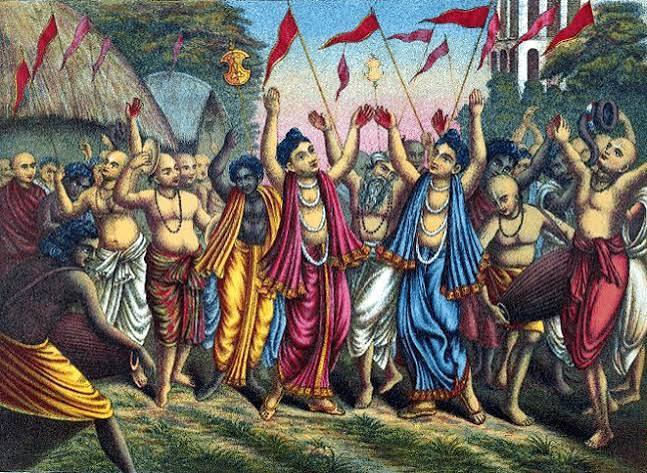
Every available source remembers Vakresvara Pandita's disappearance on the sixth day of the bright fortnight of the month of Ashadha. In the Gaudiya Vaishnava calendar, this day comes about two weeks after his appearance day, which falls on the fifth day of the dark fortnight of the same month. As with his appearance, no year is recorded anywhere. So the date is reported here as devotional memory, not as settled history.
| Detail | Description |
|---|---|
| Disappearance day | Sixth day of the bright fortnight of Ashadha (traditional; no year recorded) |
| Traditional samadhi location | The "64 Samadhis" area associated with Vrindavana, per secondary sources |
| Literary legacy in his own name | None survives; no book or composition by Vakresvara Pandita himself is known to survive |
| Biography written about him | Gaura-krishnodaya, by the Oriya devotee Sri Govinda dasa, referenced in Srila Prabhupada's own purport, but not known to survive in any widely accessible form |
| Living legacy | The spiritual line running through Gopala Guru Goswami and Dhyanachandra Goswami, and the continued worship of Sri Radha-Kanta at Puri |
No Book of His Own #
Rupa Goswami, Sanatana Goswami and several of the other great Gaudiya teachers left behind their own theological and literary works. But from the available sources, Vakresvara Pandita does not appear to have written anything under his own name. His importance to the tradition was never as an author. Srila Prabhupada's own purport to Chaitanya-charitamrita Adi 10.17 notes that his life was instead the subject of someone else's book: "Sri Govinda dasa, an Oriya devotee of Lord Caitanya Mahaprabhu, has described the life of Vakresvara Pandita in his book Gaura-krsnodaya." That book does not appear to have a modern edition or translation that is easy to find, and we could not locate its contents or check them directly. Still, it is recorded here because it shows that a fuller biography dedicated to Vakresvara Pandita once existed in the tradition, even though it cannot be read today.
Instead, his memory has been carried forward by exactly what made him special in life: his dancing, his mercy toward Devananda Pandita, and above all his guru-disciple line. Devotional sources place his own samadhi, or memorial tomb, in the area of Vrindavana known as the "64 Samadhis," where memorials are kept to many Vaishnavas of the generation that lived through Sri Chaitanya Mahaprabhu's own pastimes. But this detail rests on a single secondary source, and it could not be checked separately against a primary account.
A Living Spiritual Line #
Sri Chaitanya-charitamrita's own text confirms directly that Vakresvara Pandita's role as guru to Gopala Guru Goswami did not end with his own disappearance. Gopala Guru Goswami went on to train Sri Dhyanachandra Goswami. Together the two of them produced the Sri Gaura-Govindarcana-Smarana-Paddhati, a manual for meditative worship of Gauranga and Radha-Govinda that some Gaudiya Vaishnavas still consult today. That entire written tradition is real, dated and still in use. Its first link goes back to Vakresvara Pandita's own initiation of a young Oriya boy named Makaradhvaja Pandit. So, although Vakresvara Pandita left no book of his own, his teaching lived on through his disciple, and then through his disciple's disciple. Very few of Sri Chaitanya Mahaprabhu's other named branches can claim a line carried forward as directly as this.
The Deity He Served, Still Worshipped Today #
Vakresvara Pandita worshipped the Deity of Sri Sri Radha-Kanta at Kashi Mishra's house at Puri after Mahaprabhu's own disappearance. The Deity is still worshipped there today, at what is now called the Sri Radha-Kanta Matha, or the Gambhira, at Balisahi in Puri. It is an active Gaudiya Vaishnava pilgrimage site. Over the centuries it was expanded, first by Gopala Guru Goswami and then by later caretakers. But it rests on the seva that Vakresvara Pandita himself first took up. Gopala Guru Goswami's own legacy page describes that temple, and the devotional traditions still connected to it, in fuller detail. The tradition's memory of Vakresvara Pandita himself is simpler, and in its own way more striking. His dancing expressed his love for Krishna so completely that Sri Chaitanya Mahaprabhu Himself, watching it, wished aloud that He had two wings like it instead of one.
