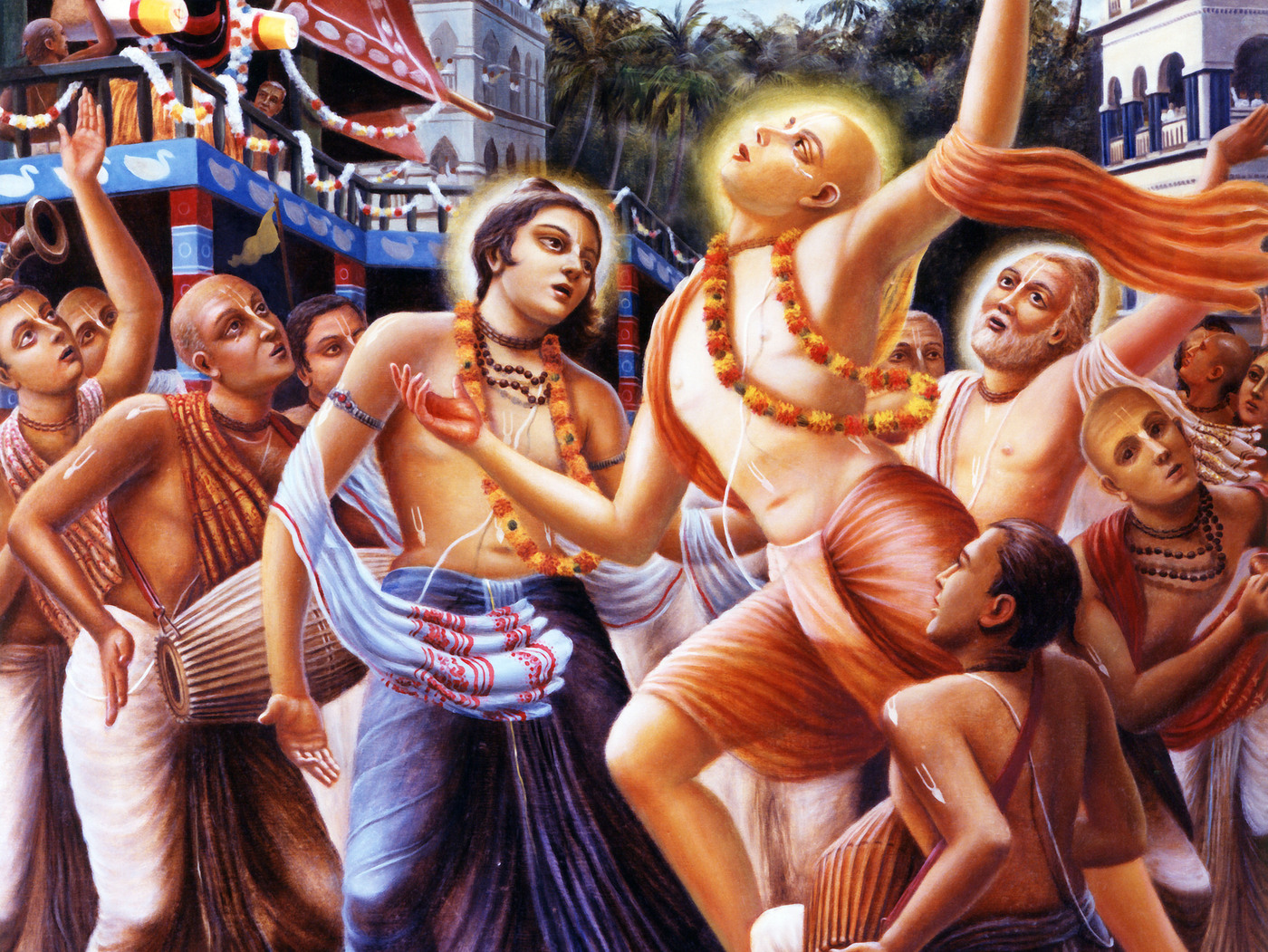
If Vakresvara Pandita is remembered for one thing above all others, it is his ability to dance in devotional ecstasy for far longer than an ordinary body should allow. This is unusual for a devotional memory of this kind. The exact number connected with it comes from Sri Chaitanya-charitamrita's own text, not only from later popular retelling.
| Detail | Description |
|---|---|
| Recorded duration of his ecstatic dance | Seventy-two hours (twenty-four prahara), continuous |
| Textual source for this number | Sri Chaitanya-charitamrita, Adi-lila 10.17, and Srila Prabhupada's purport there |
| Setting | A dramatic performance at the house of Srivasa Pandita |
| Mahaprabhu's own words afterward | "You are like a wing. If I had another like you, I would be able to fly in the sky" |
| A second, separate feat of mercy | Freeing the scholar Devananda Pandita from an offense against a Vaishnava |
Seventy-Two Hours Without Stopping #
Sri Chaitanya-charitamrita states plainly that Vakresvara Pandita "could dance with constant ecstasy for seventy-two hours" (Adi 10.17). Srila Prabhupada's purport gives more detail about this short statement. Quoting the Gaura-ganoddesha-dipika of Kavi Karnapura, it explains that this happened during a dramatic performance at the house of Srivasa Thakura. It says that Vakresvara Pandita was one of the chief dancers in that performance. It also says that he was considered an incarnation of Aniruddha, one of the four original expansions of Lord Vishnu (Vasudeva, Sankarshana, Aniruddha and Pradyumna). Kavi Karnapura's own verse puts it even more directly. As the purport's source explains, Krishna Himself personally entered Vakresvara Pandita's body and made him dance. Seventy-two hours means a full three days and nights without food, sleep or rest. This same length of time is repeated in every available source, from Sri Chaitanya-charitamrita's own text, through Srila Prabhupada's purport, to every later biographical retelling. So it is one of the more reliable specific numbers anywhere in this devotee's story. It is not the kind of figure that grows with each retelling.
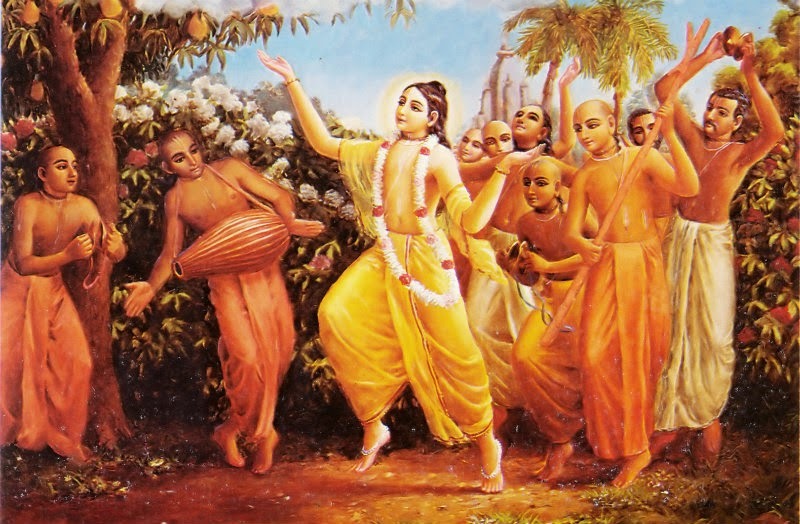
When that dance reached its peak, Sri Chaitanya-charitamrita records what happened next in Vakresvara Pandita's own words: still absorbed in ecstasy, he caught hold of Mahaprabhu's feet and said, "O Chandramukha! Please give me ten thousand Gandharvas. Let them sing as I dance, and then I will be greatly happy" (Adi 10.19). Mahaprabhu's reply is one of the most quoted lines connected to any of His individual associates: "I have only one wing like you, but if I had another, certainly I would fly in the sky!" (Adi 10.20). This is a striking image for the Lord Himself to use about a devotee. The image does not say that Vakresvara served Him. It says that Vakresvara's own ecstatic dancing was itself a wing carrying the Lord's sankirtana forward.
Dancing at Puri's Ratha-Yatra #
This was not a single, isolated episode. Once Vakresvara Pandita settled at Jagannatha Puri with Mahaprabhu, he took a regular part in the sankirtana of the annual Ratha-yatra festival. Sri Chaitanya-charitamrita's Madhya-lila describes the seven kirtan parties Mahaprabhu organized to accompany Lord Jagannatha's chariots, and names Vakresvara Pandita as the leader of dancing in one of them, alongside Srivasa Thakura leading another (Madhya 11.228). Years later, during the Gundicha-marjana festivities that followed one Ratha-yatra, the text records a direct echo of the earlier scene at Srivasa Thakura's house: "Sri Chaitanya Mahaprabhu then ordered Vakresvara Pandita to dance, and as he began to dance, the Lord began to sing" (Madhya 14.100). Once, his dancing had drawn a longing wish from the Lord Himself. Years later, Vakresvara Pandita was still the one Mahaprabhu turned to and personally sang for.
The Redemption of Devananda Pandita #
A second story shows a different side of the same gift. It is preserved in Sri Chaitanya-Bhagavata, not in Sri Chaitanya-charitamrita. Devananda Pandita was a respected teacher of Srimad-Bhagavatam at Kuliya, across the Ganges from Navadvipa. But he was proud of his scholarship and, at that time, did not yet believe in Mahaprabhu. Once Srivasa Thakura wept in ecstatic love while listening to his class. Some of Devananda's students thought this was a disturbance and removed Srivasa Thakura from the room, and Devananda did nothing to stop them. Word of the insult reached Mahaprabhu. He is recorded as teaching, in response, that a person who blasphemes a Vaishnava must use that same mouth to glorify Krishna and His devotees. This is because the two kinds of Bhagavata, the book and the person, are not separate. By this account, Devananda was able to correct his offense through Vakresvara Pandita. One evening Vakresvara came to Kuliya to lead kirtan at a devotee's house, and he danced for two full praharas (six hours). Devananda kept the crowd in order so that Vakresvara would not be disturbed, and afterward he fell at Vakresvara's feet. Vakresvara blessed him simply: "Krishna-bhakti hauk," may you attain devotion to Krishna. From that day, the sources say, faith awoke in Devananda's heart. When Mahaprabhu later met him, He is recorded as saying that Devananda had earned the Lord's own notice because he had served Vakresvara, since "Krishna has made His home in the heart of Vakresvara Pandita; as Krishna dances in his heart, so Vakresvara Pandita himself dances." This episode is recorded only in Sri Chaitanya-Bhagavata, which has no complete English text available online. It is taken here from a secondary translation on Gaudiya History, not from a direct citation of the original text, so we report it with that in mind.
Taken together, these episodes explain why, in every available source, Vakresvara Pandita's name is almost never separated from the word ecstasy. His dancing was not a performance skill separate from his devotion. In every account gathered here, it was his devotion itself, made visible.
