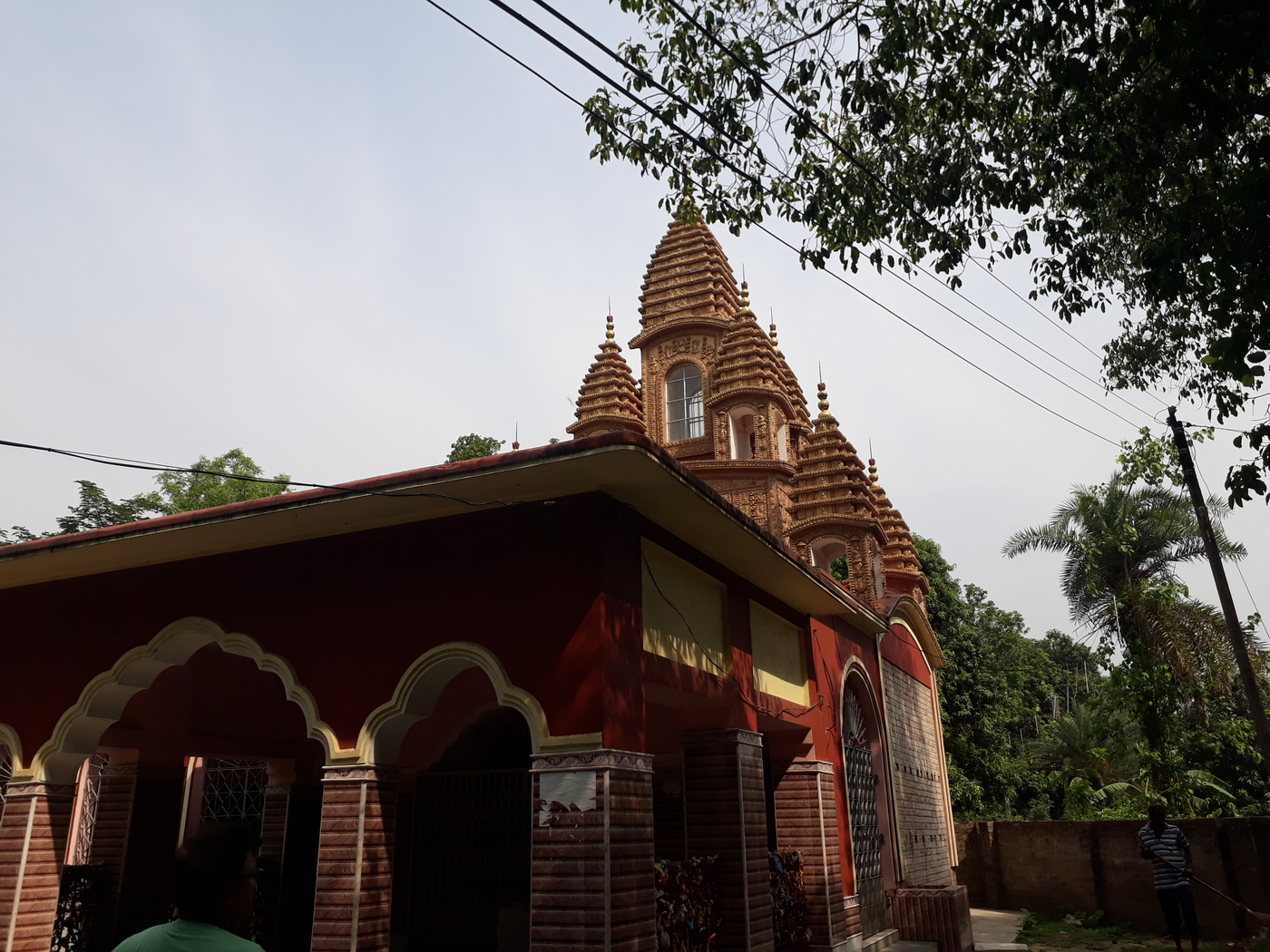
Almost nothing is recorded about Vakresvara Pandita's life before he found Sri Chaitanya Mahaprabhu. Gaudiya tradition places his birth in Guptipara, a village near Triveni on the Bhagirathi river in Bengal. Many of Mahaprabhu's earliest Bengali associates came from this same general region along the Ganges. No year survives for his birth. The only date passed down for it comes from Sri Dhyanachandra Goswami's own Dhyana-chandra-paddhati. It gives the fifth day of the dark fortnight of the month of Ashadha (roughly June-July), a lunar tithi still observed today as his appearance day. Without a year attached to it, this should be read as devotional memory, not as a settled historical date.
| Detail | Description |
|---|---|
| Birthplace | Guptipara, near Triveni, Bengal |
| First appears in Mahaprabhu's company | Among the early sankirtana gatherings at Navadvipa |
| Known for, even as a young devotee | Exceptional skill as a singer and dancer |
| Houses where he is recorded dancing | Those of Srivasa Pandita and Chandrashekhara Acharya |
| Later home | Jagannatha Puri, at Kashi Mishra's house, alongside Mahaprabhu Himself |
Joining the Sankirtana Movement at Navadvipa #
This part of his life is well recorded, because Sri Chaitanya-charitamrita records it directly. Vakresvara Pandita became part of Sri Chaitanya Mahaprabhu's congregational chanting movement in Navadvipa close to its very beginning. He was quickly recognized as one of its most gifted performers. He is named as a regular presence at the nightly kirtan gatherings held at the house of Srivasa Thakura. These were the same gatherings where Mahaprabhu first revealed His own divinity to His closest devotees. He is also named at the house of Acharyaratna, also known as Chandrashekhara Acharya. There, dramatic performances of Krishna's pastimes were sometimes staged, with Mahaprabhu Himself taking a role. According to Srila Prabhupada's purport to Chaitanya-charitamrita, Vakresvara Pandita first danced for seventy-two unbroken hours during one of these performances at Srivasa Thakura's house. This pastime is important enough to be told separately on The Ecstatic Dancer.
Sri Chaitanya-charitamrita's own structure shows how central Vakresvara Pandita was considered to be in this circle. The tenth chapter of the Adi-lila is built entirely around the image of Mahaprabhu as a tree and his devotees as its branches. It names the branches in order. Srivasa Thakura and his brothers are the first branch, Acharyaratna is the second, Pundarika Vidyanidhi the third, Gadadhara Pandita the fourth, and Vakresvara Pandita the fifth. Jagadananda Pandita follows immediately as the sixth. This is a real honor given in the text itself, not a later devotional addition. Krishnadasa Kaviraja Goswami named him among the few devotees important enough to be counted one by one, instead of being grouped under a subbranch. Some later retellings describe Vakresvara Pandita as "the fifth branch of Nityananda Prabhu's tree". But the chapter itself is titled "The Trunk, Branches and Subbranches of the Caitanya Tree," and its own numbering makes clear that the tree is Sri Chaitanya Mahaprabhu's own, not Nityananda Prabhu's. This difference is important. Vakresvara Pandita's place in the tradition comes from being counted directly among Mahaprabhu's own innermost branches.
No Recorded Diksha Guru #
The sources we found do not name a diksha guru, or formal initiating spiritual master, for Vakresvara Pandita. What they do record is his close association with Sri Chaitanya Mahaprabhu, and that Gopala Guru Goswami and others later received initiation from him. That part of his story is told in full on Training Gopala Guru Goswami.
Following Mahaprabhu to Puri #
When Sri Chaitanya Mahaprabhu accepted the sannyasa order of renunciation and settled at Jagannatha Puri, Vakresvara Pandita went with Him and stayed there for the rest of his life. Sri Chaitanya-charitamrita's Madhya-lila names him among the devotees who made their permanent home with the Lord at Nilachala. There he is grouped together with Gadadhara Pandita, Damodara Pandita, Sankara and Haridasa Thakura (Madhya 1.252). Elsewhere he is named among the wider circle that included Svarupa Damodara Goswami (Adi 10.124-126). Secondary biographical tradition adds that he was also present during Mahaprabhu's journey north to Ramakeli to meet Sanatana Goswami and Rupa Goswami. But this detail does not appear directly in Sri Chaitanya-charitamrita's own account of that journey, so it should be read with that in mind. The text does confirm, again and again and by name, that Vakresvara Pandita remained one of the fixed, recognized members of Mahaprabhu's Puri household for the rest of the Lord's manifest pastimes. He was present at the annual Ratha-yatra and in the gatherings at Kashi Mishra's house. Tradition says he was present right up to Mahaprabhu's own disappearance. The following pages describe what this closeness meant in practice. It meant dancing that drew the Lord's own personal praise. It also meant the worship of a Deity that would eventually pass through his hands to a new generation.
