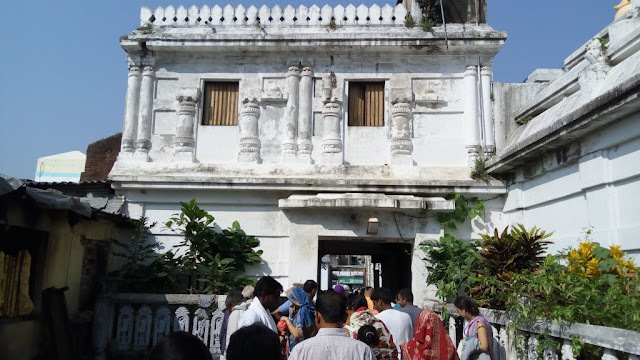
After Sri Chaitanya Mahaprabhu's own disappearance, Vakresvara Pandita remained at Puri. In the years that followed, he became a formally recognized guru. This role is confirmed not only by devotional memory but also by Srila Prabhupada's own purport to Sri Chaitanya-charitamrita.
| Detail | Description |
|---|---|
| Textual basis for his role as guru | Srila Prabhupada's purport to Adi 10.17 |
| Foremost named disciple | Sri Gopala Guru Goswami |
| Disciple's own disciple | Sri Dhyanachandra Goswami |
| Deity passed down through this line | Sri Sri Radha-Kanta, at Kashi Mishra's house (the Gambhira), Puri |
| Disputed identity | The gopi Tungavidya Sakhi, claimed for Vakresvara Pandita by one later text, for Gopala Guru Goswami by an unsourced popular claim, and assigned to two entirely different people by the Gaura-ganoddesha-dipika itself |
A Documented Guru-Disciple Line #
Sri Chaitanya-charitamrita's purport to Adi 10.17 states plainly that Vakresvara Pandita had many disciples in Orissa. They were known as Gaudiya Vaishnavas, although they were themselves Oriyas. The purport names two of them directly: "Sri Gopalaguru and his disciple Sri Dhyanacandra Gosvami." This one line gives solid support, in the text itself, for Gopala Guru Goswami's discipleship under Vakresvara Pandita. It does not rest only on later biographical retelling. A second purport, to Adi 10.131, tells us what this discipleship led to in practice. Kashi Mishra's house at Puri, the same house Mahaprabhu Himself had lived in during His Puri years, "was inherited by Vakresvara Pandita and then by his disciple Gopalaguru Gosvami, who established a Deity of Radhakanta there." Secondary biographical tradition also states that Vakresvara Pandita himself first worshipped the Deity of Sri Radha-Kanta at that same house. When we read the two together, the fuller picture is this. Vakresvara Pandita took up the seva of Radha-Kanta at Kashi Mishra's house after Mahaprabhu's own disappearance. When his own time came, that seva passed to Gopala Guru Goswami, along with the house itself, which was later known as the Gambhira. Gopala Guru Goswami expanded the altar with four more Deities. Gopala Guru Goswami's own page tells that side of the story in fuller detail. It includes his training under Svarupa Damodara Goswami and Raghunatha Dasa Goswami, and his own teaching of Dhyanachandra Goswami.
An Unresolved Question, Looked at Freshly #
A truly disputed claim has grown around this same relationship. Was Vakresvara Pandita previously the gopi Tungavidya Sakhi in Krishna's own pastimes in Vraja, or was it instead his disciple Gopala Guru Goswami? Tungavidya Sakhi is one of Srimati Radharani's eight principal companions. Gaudiya History's biography of Gopala Guru Goswami states that "according to some, Gopal Guru Goswami was the gopi known as Tungavidya Sakhi," without citing a specific text for the claim. Another source says something different. Gaudiya History's separate biography of Vakresvara Pandita and the website isvara.org both quote, independently, a translation of Sri Dhyanachandra Goswami's own Dhyana-chandra-paddhati. Dhyanachandra was Gopala Guru Goswami's own direct disciple. In this translation he writes that "that person who was previously very expert in the arts of singing and dancing, the gopi, Tungavidya, is presently renowned in the world as Vakreshwar Pandit." The second claim rests on a named, specific text, written by someone in the direct line of disciplic succession from both men. The first claim gives no textual citation at all. On its own, this would favor Vakresvara Pandita, not Gopala Guru Goswami, as the better-supported candidate for this identity.
But the Gaura-ganoddesha-dipika itself makes the picture even more complicated, instead of settling it. This book, written by Kavi Karnapura, a contemporary of Mahaprabhu's own associates, is the foundational Gaudiya Vaishnava text for exactly this kind of identity. The difficulty appears when we go beyond the single verse usually quoted and read its fuller text. Verse 71, the verse always cited for Vakresvara Pandita, identifies him only as an incarnation of Aniruddha. It says nothing about Tungavidya Sakhi or any other gopi. Separately, verse 168 of the same text states that "Sukeshi-gopi appeared as Makaradhvaja," and Makaradhvaja Pandit was Gopala Guru Goswami's own birth name, before Mahaprabhu gave him the title "guru." If this identification is followed, the Gaura-ganoddesha-dipika's own answer to "who was Gopala Guru Goswami previously" is Sukeshi-gopi, not Tungavidya Sakhi. Tungavidya-gopi herself appears twice more in the same text, assigned to two entirely different Bengali Vaishnavas. Verse 163 names her as the previous identity of Kavi Karnapura Goswami's own teacher, Prabodhananda Saraswati, while verse 170 assigns her instead to a devotee named Vidyavachaspati. Neither of those two is Vakresvara Pandita or Gopala Guru Goswami.
There is one further complication, and it should be stated honestly, not smoothed over. A separate translation of Gaura-ganoddesha-dipika 71, on the Gaudiya History website next to a Sanskrit text, includes an extra line. This line names a gopi called Sasirekha in connection with Vakresvara Pandita. It appears nowhere in the fuller translation of the same text used above, which comes from an independent source. Instead, that fuller translation, in its own verse 166, names a gopi Shashirekha-devi as the previous identity of a completely different devotee, Sri Kashishvara Goswami. The most likely explanation is that this one translation has mixed material from two separate verses, and that there is no real third claim. But this cannot be fully confirmed from the available sources, so the difference is reported here instead of being quietly settled.
Put plainly, there is no settled answer to "who was Tungavidya Sakhi." We can say with real confidence that the claim from a specific, named source favors Vakresvara Pandita over Gopala Guru Goswami. But the oldest and most authoritative identity text available, the Gaura-ganoddesha-dipika itself, does not actually support that claim either. Instead, it names a different gopi, Sukeshi, for Gopala Guru Goswami by name. And it assigns Tungavidya Sakhi twice over to two unrelated Vaishnavas. So, both here and on Gopala Guru Goswami's own page, this is reported honestly as an open question, not settled with a convenient answer.
Not One of the Twelve Gopalas #
Popular retellings sometimes loosely group Vakresvara Pandita with famous groups of Mahaprabhu's associates. But he does not belong to the "twelve gopalas," which are a specific and separately recorded circle of boyhood cowherd companions. They are connected with Nityananda Prabhu's later preaching in Bengal. The recorded grouping that truly includes him is the one already discussed above: Sri Chaitanya-charitamrita's own count of the named branches of Sri Chaitanya Mahaprabhu's tree, where he stands fifth.
