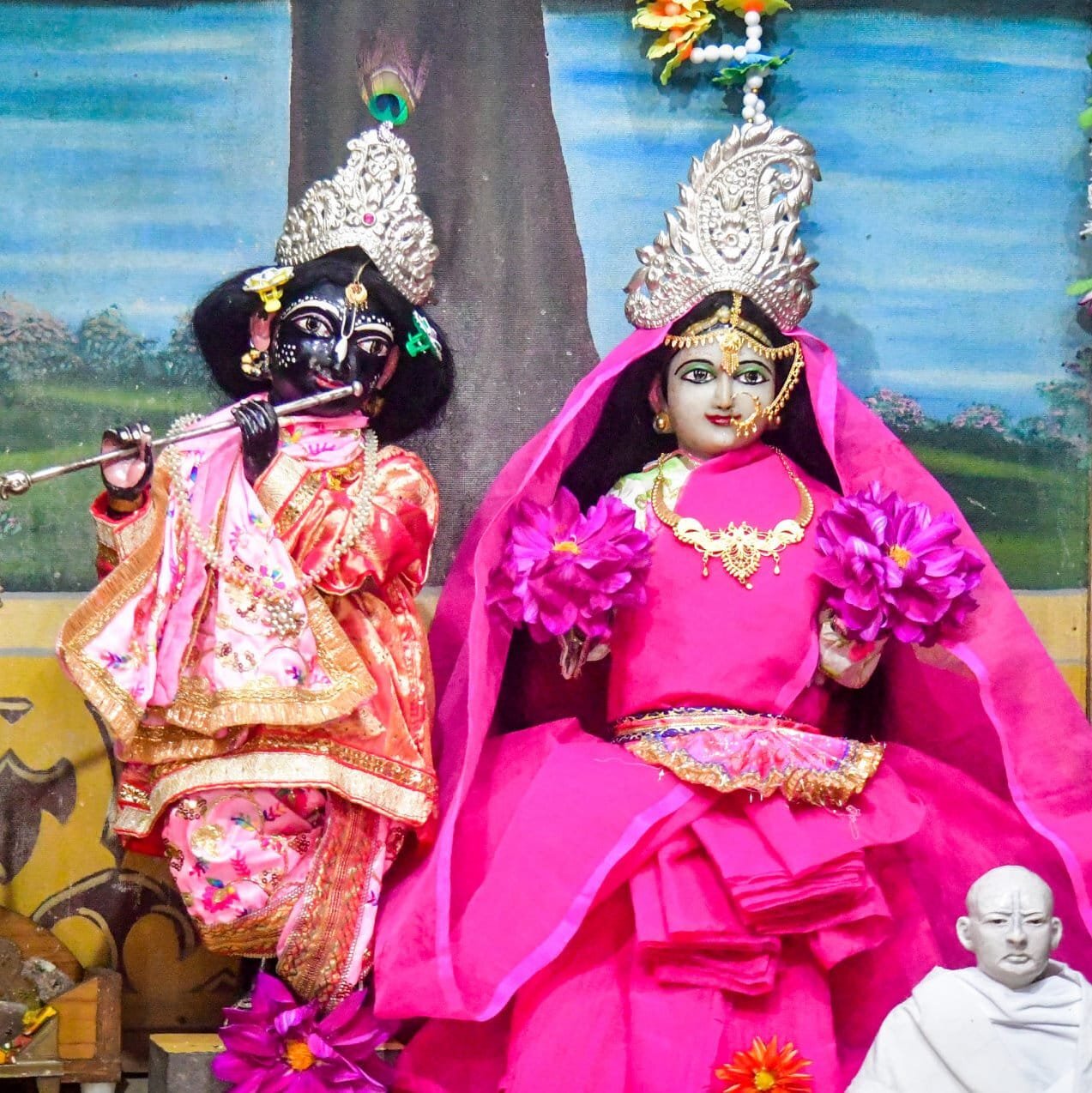
Sri Chaitanya-charitamrita preserves the story of Vasudeva Datta's prayer to bear the sins of the whole world in careful, verse-by-verse detail. A second, equally famous episode involving Vasudeva Datta is not told in Krishnadasa Kaviraja Goswami's own text at all. It comes down through Sri Chaitanya-bhagavata, Vrindavana Dasa Thakura's earlier biography of Mahaprabhu. Most readers today know it through Srila Prabhupada's own purport, which quotes and summarizes it directly. This page follows that purport closely, and it shows clearly where the story actually comes from.
| Detail | Description |
|---|---|
| Setting | Srivasa Pandita's house |
| Original textual source | Sri Chaitanya-bhagavata (Vrindavana Dasa Thakura) |
| How it reaches most readers | Quoted and summarized in Srila Prabhupada's purport to Chaitanya-charitamrita, Adi-lila 10.41 |
| The statement | That Mahaprabhu's body existed only to please Vasudeva Datta, who could sell it as he wished |
| Number of times spoken | Three |
"He Can Sell Me Anywhere" #
While staying at Srivasa Pandita's house, Mahaprabhu is recorded to have said, in front of the devotees gathered there, "I am only Vasudeva Datta's man. My body is only meant to please Vasudeva Datta, and he can sell Me anywhere. I will not do otherwise." He did not say it once and move on. Sri Chaitanya-bhagavata records that He repeated this vow three separate times, and added an instruction that no one present should ever disbelieve it. "All My dear devotees," He is recorded as saying, "I tell you the truth. My body is especially meant for Vasudeva Datta."
Why Three Times #
In Vedic and devotional literature, this kind of repetition is not accidental. A statement made three times over becomes the strongest form of emphasis there is, closer to an oath than an ordinary remark. Mahaprabhu was not simply expressing affection. He was making sure, in advance, that no devotee could later read the statement as poetic exaggeration or a passing mood. The word "anywhere" in "sell Me anywhere" makes the point even stronger. In the language of the vow, Vasudeva Datta's ownership is complete and without conditions. It even includes the possibility that Vasudeva Datta could give that ownership to someone else entirely, as he chose.
Not Ownership, But Intimacy #
No Gaudiya Vaishnava teacher reads this vow as a literal claim about property. Instead, it shows a teaching at the very heart of the tradition, in its fullest form. The Supreme Personality of Godhead is the owner of everything that exists. Yet He willingly submits Himself to the love of His pure devotees. He even goes so far as to call His own body theirs, not His. Krishna says as much Himself in the Bhagavad-gita: "A person in full consciousness of Me, knowing Me to be the ultimate beneficiary of all sacrifices and austerities, the Supreme Lord of all planets and demigods, and the benefactor and well-wisher of all living entities, attains peace from the pangs of material miseries" (Bhagavad-gita 5.29). The same Lord who is every being's true well-wisher is the one who, out of love, calls Himself the property of one devotee. The same principle is seen in Vasudeva Datta's prayer to bear the world's sins. There, too, a devotee's love drew an almost unthinkable response from Sri Chaitanya Mahaprabhu. Both the love and the response were given freely, without any calculation on either side.
A Smaller Echo of the Same Affection #
Sri Chaitanya-charitamrita records a second, quieter moment that points to the same depth of feeling. The Bengali Vaishnavas arrived at Jagannatha Puri for their annual visit and were greeted one by one at Kashi Mishra's house. As soon as Mahaprabhu saw Vasudeva Datta, He placed His hand on his body. He told him directly that although Mukunda Datta had been His friend since childhood, seeing Vasudeva gave Him even greater happiness. Srila Prabhupada's purport notes plainly that here Vasudeva Datta, the older brother of Mukunda Datta, was being honoured above the very friend whose company Mahaprabhu had shared since boyhood. Together with the three-fold vow at Srivasa Pandita's house, these two episodes suggest a pattern, not a single outburst of feeling. Something in Vasudeva Datta's devotion moved Mahaprabhu this openly, and it moved Him more than once, in more than one setting.
A Purport That Carries Two Stories at Once #
Srila Prabhupada's purport to Chaitanya-charitamrita, Adi-lila 10.41 also deserves attention for a different reason. In a single paragraph, it tells of this three-fold vow. Then it moves directly to the statement that Vasudeva Datta later initiated Yadunandana Acharya, the priest who would go on to become Raghunatha Dasa Goswami's own spiritual master. A reader who sees only the purport's summary could easily take that line as the complete account. But Krishnadasa Kaviraja Goswami's own account of the episode, much later in the Antya-lila (6.161-162), tells the story with more carefully chosen words. Disappearance and Legacy shows exactly what those words say.
