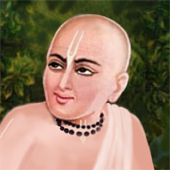
Vasudeva Ghosh's largest and most lasting gift is not any single event in his life. It is the body of Bengali devotional songs he left behind. The Vaishnava songs collection keeps thirty-three of them under his name. Several of these were checked against independent devotional sources. This confirms that they are the same compositions long credited to him in Gaudiya Vaishnava tradition, and not a modern mistake.
An Authorized Vaishnava Poet #
Srila Prabhupada's purport to Chaitanya-charitamrita places Vasudeva Ghosh among the great Vaishnava song-writers: "he composed many nice songs about Lord Sri Chaitanya Mahaprabhu, and these are all authorized Vaishnava songs, like the songs of Narottama Dasa Thakura, Bhaktivinoda Thakura, Lochana Dasa Thakura and Govinda Dasa Thakura and other great Vaishnavas" (Chaitanya-charitamrita, Madhya 11.88, purport). That is a short list. Prabhupada himself placed Vasudeva Ghosh on it, and this is one of the clearest signs of how seriously the tradition takes him. He is seen not only as a singer of other people's songs, but as a poet who wrote his own.
What the Songs Are About #
The songs kept in the collection fall into two broad groups. Most are about Gauranga-lila, the life and pastimes of Sri Chaitanya Mahaprabhu. One of these is "Sacira Anginaya Nace" ("Dancing in Saci's Courtyard"), which shows the infant Visvambhara playing hide-and-seek with His mother. Another is "Mayera Anguli Dhari Sisu Gaura-Hari" ("Grasping His Mother's Finger"), a tender scene of the infant Lord learning to walk and stumbling into Mother Saci's lap. Others turn from His childhood to the sankirtana movement itself, and to Nadiya's streets filled with the sound of the Lord's chanting. Examples are "Jaya Jaya Kala Raba Nadiya Nagare" and "Gora Nace Sacira Dulaliya." A smaller number of songs are directly about Krishna's own Vraja-lila. One example is "Sundara Kundala Naina," which describes Krishna's ornaments and His rasa dance among the gopis of Vrindavan. Its language comes straight from classical Vaishnava padavali writing. These songs remind us that Vasudeva Ghosh, as Gunatunga-sakhi, belongs to Krishna's Vraja pastimes too, not to Gauranga-lila alone. His identity as Gunatunga-sakhi is discussed on Spiritual Identity and Teachings.
A Sample in His Own Words #
"Yadi Gaura Na Hoito" ("If Gaura Had Not Appeared") is probably his best-known song, and it shows his usual method. It does not tell a story. Instead, it argues a devotional point in the poet's own voice. It opens by asking what would have become of the world's devotees had Gauranga never appeared in this Age of Kali. It answers that without Him no one would ever have learned of Srimati Radharani's supreme position in the kingdom of divine love. Another song, "Jaya Jaya Jagannatha Sacira," makes a related point from a different angle. It shows the Deity at Jagannatha Puri, the son of Saci at Nadiya, and Krishna of Vraja as one Supreme Person appearing in three forms. This point is looked at more closely on Spiritual Identity and Teachings.
Written for Singing, Not Reading #
Unlike a written biography or a book of theology, a pada was written to be sung. Vasudeva Ghosh's songs still carry their original musical instructions. Several songs in the collection name the raga they were meant to be sung in. "Gora Guna Gao Suni" is set to Mallara-raga, and "Nadiya Akase Asi Udila Gauranga Sasi" to Kalyana-raga. "Sacira Anginaya Nace" and several other Gauranga childhood songs are set to Beloyara-raga. This was the same custom followed by classical Bengali padavali poets in general. This detail is easy to miss on the page, but it was central to how the songs were used. They were never meant to be read silently, only sung out loud. Vasudeva Ghosh himself is remembered singing in just this way before Mahaprabhu, as told on The Kirtan That Moved Mahaprabhu.
Still Sung Today #
Vasudeva Ghosh's songs have not stayed locked away in manuscripts or scholarly collections. Several are still part of living Gaudiya Vaishnava kirtan practice. And it is not only his songs that are sung. His own name is sung too. Bhaktivinoda Thakura's Gaura-arati is the song sung at the evening worship of the Deity of Gauranga in Gaudiya Vaishnava temples worldwide. This includes the ISKCON tradition, which traces its own line back through Srila Prabhupada. The Gaura-arati has the line "narahari-adi kori' camara dhulaya, sanjaya-mukunda-vasu-ghosh-adi gaya": "Narahari and others fan the Lord with camaras, while Sanjaya, Mukunda, Vasu Ghosh and others sing." Four and a half centuries after his disappearance, Vasudeva Ghosh's name is still called out every night. It is called out during the same worship that his own songs were written to inspire. His disappearance is discussed on Disappearance and Legacy.
