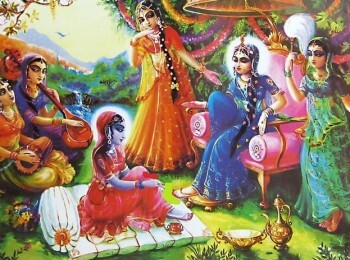
Gaudiya Vaishnavas hold that Mahaprabhu's closest associates were not devotees who rose to greatness through practice alone. We believe they are eternal residents of Krishna's own Vraja pastimes who came down with Him, or came to Him, in His Navadvipa lila. For the three Ghosh brothers, this identity is recorded by name.
Three Gopis Named by Kavi Karnapura #
Kavi Karnapura's Gaura-ganoddesha-dipika is the traditional Gaudiya reference work that lists the Vraja identities of Mahaprabhu's associates. It gives a single verse for all three brothers together: "kalavati rasollasa gunatunga vraje sthitah, sri-vishakha-kritam gitam gayanti sma yada ta matah, govinda-madhavananda-vasudeva yatha-kramam": "Govinda, Madhava and Vasudeva were three gopis in Vraja, namely Kalavati, Rasollasa and Gunatunga, who used to sing the songs composed by [Radha's confidential friend] Vishakha" (Gaura-ganoddesha-dipika 188). The verse gives the three identities in the same order as the brothers' names: Govinda Ghosh as Kalavati-sakhi, Madhava Ghosh as Rasollasa-sakhi, and Vasudeva Ghosh as Gunatunga-sakhi. In their eternal identity they are singers. They are gopis who perform Vishakha's own compositions for Radha and Krishna in Vraja. So, tradition holds, their role as Mahaprabhu's kirtan singers was not a skill they learned along the way. It was the very same service, carried from one lila into another. Their kirtan is described on The Kirtan That Moved Mahaprabhu.
Madhurya-rasa and Radha as Shelter #
Srila Bhaktisiddhanta Sarasvati Thakura writes about the brothers' place among the kinds of rasa, or devotional relationship, in Gaudiya Vaishnava teaching. He says all three are situated in madhurya-rasa, the conjugal mood that belongs to the gopis of Vraja. They belong to that group of devotees who accept Srimati Radharani herself as their ultimate ashraya-vigraha. This means she is their shelter, and the one toward whom their devotion is finally directed, even while their service is offered in the direct company of Sri Krishna. This is the same rasa in which Rupa Goswami and Sanatana Goswami would later explain Krishna bhakti most fully. So it places Vasudeva Ghosh's songs inside a very specific devotional lineage. They are not just general poems of praise. His songs are discussed at length on Devotional Songs and Literary Legacy.
What the Songs Themselves Teach #
Vasudeva Ghosh left no separate philosophical book. His teaching is found only in his songs. Read together, they return again and again to one idea. Sri Chaitanya Mahaprabhu, Krishna, and Lord Jagannatha are, in the end, one and the same Supreme Person, appearing in different forms for different purposes. One of his songs kept in the Vaishnava songs collection, "Jaya Jaya Jagannatha Sacira," opens by glorifying "the dear son of Jagannatha Misra and Saci Devi," and then describes Him in two ways. The song says that on the altar at Nilachala the Lord holds the conch, disc, club, and lotus. But when the same Lord walks the streets of Nadiya, He carries instead the staff and waterpot of a sannyasi. Vasudeva Ghosh makes the same point even more directly in another song: "Vasudeva Ghosha kahe kari' jora hatha, yei gaura sei krishna sei jagannatha": "Vasudeva Ghosh says, with folded hands: whoever is Gaura is Krishna, and the same is Jagannatha." Another well-known song, "Yadi Gaura Na Hoito," does not tell a story. It makes a devotional argument instead. Without Gauranga's appearance in this age, the song says, no one could have learned that Radharani stands supreme in the realm of divine love, and life itself would hardly be worth living. Neither song argues philosophy the way a Sanskrit philosophical book would. Both simply accept the conclusion as true and sing from within it. That is how associates of Mahaprabhu such as Vasudeva Ghosh chose to teach. They taught through direct, sung devotion, not through systematic argument. In this they were unlike the philosopher-Goswamis of Vrindavan such as Rupa Goswami and Jiva Goswami.
One Family, One Service #
The Gaura-ganoddesha-dipika names all three brothers in a single verse, instead of treating each one separately. This fits the way Gaudiya Vaishnava tradition generally speaks of groups of close gopi associates. Each gopi's own identity matters, but it is never separate from the small circle of companions she serves with. As Gunatunga-sakhi, Vasudeva Ghosh is never described singing Vishakha's songs alone. Gunatunga sings them together with Kalavati and Rasollasa, who are his own brothers Govinda and Madhava in their Vraja forms. The same pattern repeats in Vasudeva Ghosh's life as a Ghosh brother in Navadvipa. His family and his devotional identity are never pulled apart. This is one reason the three brothers are treated together, wherever the sources allow it, across the fuller account on Birth and the Three Ghosh Brothers. Even so, Vasudeva Ghosh's own distinct contribution stays clearly in view: his singing, his songs, and the verse that names him specifically.
