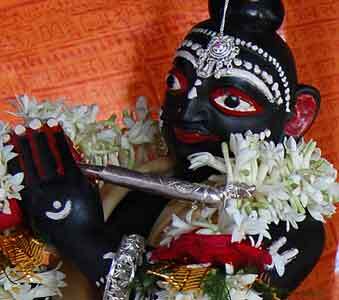
The three Ghosh brothers, Govinda, Madhava, and Vasudeva, are almost always spoken of together in Gaudiya Vaishnava tradition, and their birth story is no different. No source treats any one of them apart from the other two. But the sources do genuinely disagree about exactly where the family came from.
The Kulai Tradition #
The more detailed and more often repeated account places the family's home village at Kulai, on the western bank of the Ajay river, about twenty kilometres west of Katwa in Bengal. This tradition names the brothers' father as Ballava Ghosh. It also describes a large neem tree at the family home there. Later, it is said, Narahari Sarkara's circle at Srikhanda used wood from this tree to carve deities of Chaitanya Mahaprabhu in His dancing form. Ballava Ghosh moved the family to Halisahar, in what is now North 24 Parganas. A few years after that, the three brothers are said to have moved on again, this time to Navadvipa itself, where they came to know Sri Chaitanya Mahaprabhu and Nityananda Prabhu directly.
The Sri Hatta Tradition #
A different, less common tradition instead traces the family to Sri Hatta, the same eastern Bengal region, now in Bangladesh, that Mahaprabhu's own father's family came from. It names a village called either Baduna or Burangi grama, and says the brothers' father lived at Kumara Hatta. This version agrees with the Kulai tradition on the point that matters most for the rest of their lives: after their father died, Govinda, Vasudeva, and Madhava Ghosh went to live in Navadvipa dhama. Which village is correct remains unresolved; both traditions describe the same family arriving at the same place, Navadvipa, for the same reason.
A Kayastha Family of the Uttara-Radhiya Section #
On the brothers' social background there is no real disagreement. Srila Prabhupada's own purport to Sri Caitanya-caritamrita states it directly: "The three brothers Govinda, Madhava and Vasudeva Ghosa all belonged to a kayastha family" of the Uttara-Radhiya, or northern Rarh, section of Bengal. This was a respected family of scribes and administrators, not a brahmin one. This shows that from the very first generation of Mahaprabhu's movement, birth into a priestly family was never needed for closeness to the Lord. The same purport adds a remark about Madhava Ghosh that shows the family's musical gift very clearly: "Madhava Ghosa was expert in performing kirtana. No one within this world could compete with him. He was known as the singer of Vrindavana and was very dear to Sri Nityananda Prabhu."
Listed as Branches of the Chaitanya Tree #
However their childhood unfolded, all sources come together again once the brothers reach Navadvipa. Krishnadasa Kaviraja Goswami lists the many devotees of Mahaprabhu as branches of one great tree. He names Govinda, Madhava, and Vasudeva Ghosh as the eighty-second, eighty-third, and eighty-fourth branches, and adds simply that Lord Chaitanya and Nityananda used to dance in their kirtana performances (Chaitanya-charitamrita, Adi 10.115). A few verses later the text describes a further turn in the brothers' lives. Sri Chaitanya Mahaprabhu ordered Nityananda Prabhu back to Bengal to preach, and three devotees went with Him. Madhava and Vasudeva Ghosh were among them. But Govinda Ghosh chose to stay at Jagannatha Puri with Mahaprabhu and, the text says, "felt great satisfaction" (Adi 10.117-118). Because of this, Krishnadasa Kaviraja Goswami notes that Madhava and Vasudeva Ghosh came to be counted among the devotees of both Lords at once (Adi 11.14-15). This small detail shows how easily devotees moved between Mahaprabhu's Navadvipa circle and Nityananda's Bengal preaching mission.
Each brother eventually settled at his own sripat, or place of bhajana: Govinda at Agradwip, Madhava at Dainhat, and Vasudeva at Tamluk, each not far from the others along the lower Ganga and its Bengal tributaries. Bhaktisiddhanta Sarasvati Thakura's Anubhasya commentary on Chaitanya-charitamrita records something about the Deity of Gopinatha installed at Govinda Ghosh's sripat at Agradwip (the commentary places it at "Danihata, near the Agradvipa railway station"). To this day, this Deity still performs the annual shraddha ceremony marking Govinda's own passing. The tradition is kept up by the raja-vamsha family of Krishnanagara descended from Raja Krishnachandra. What happened at each brother's own sripat, and what became of Vasudeva Ghosh's own kirtan and songwriting once he settled at Tamluk, are told further on The Kirtan That Moved Mahaprabhu and Disappearance and Legacy.
