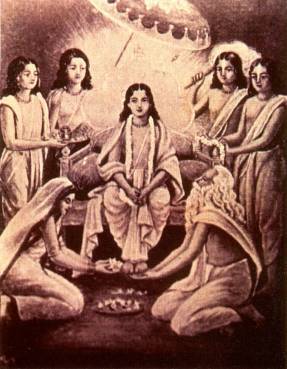
Chaitanya-charitamrita names many devotees who sang kirtan for Mahaprabhu. What sets Vasudeva Ghosh apart is that Krishnadasa Kaviraja Goswami singles out his voice specifically, not just the combined singing of the three brothers, in one of the most striking single lines in the whole text.
Even Wood and Stone Would Melt #
In the eleventh chapter of Adi-lila, while describing devotees counted in Nityananda Prabhu's own circle, Krishnadasa Kaviraja Goswami writes: "vasudeva gite kare prabhura varnane, kastha-pasana drave yahara sravane": "When Vasudeva Ghosha described Lord Caitanya and Nityananda while performing kirtana, even wood and stone would melt upon hearing it" (Chaitanya-charitamrita, Adi 11.19). It is one of the few places in the whole text where the effect of one singer on his listeners, not of a whole party, is described in such strong terms. That is why Vasudeva Ghosh's name, even more than his brothers', has become a sign of the great emotional power a kirtaniya's voice can carry.
Pleasing the Lord at Puri #
The three brothers together receive similar praise later in the book. This comes in the chapter on Mahaprabhu's bheda-kirtana pastimes at Jagannatha Puri. When the devotees from Bengal arrived there, Gopinatha Acharya pointed them out one by one to King Prataparudra. He named Govinda, Madhava, and Vasudeva Ghosh and added: "tina bhaira kirtane prabhu payena santosa": "They are three brothers, and their sankirtana, congregational chanting, pleases the Lord very much" (Chaitanya-charitamrita, Madhya 11.88). In his purport to this verse, Prabhupada mentions again the detail about Vasudeva Ghosh's songwriting. He places it alongside the work of Narottama Dasa Thakura, Bhaktivinoda Thakura, and Lochana Dasa Thakura. This line of devotional songwriters is explored more fully on Devotional Songs and Literary Legacy.
Every Year at the Ratha-yatra #
The brothers' most regularly recorded performance happened every year. Each year they travelled to Jagannatha Puri for the Ratha-yatra festival and took their place among the kirtan parties formed for the occasion. Chaitanya-charitamrita describes the arrangement exactly. Mahaprabhu formed a kirtan group with Govinda Ghosh as its leader. The younger Haridasa, Vishnudasa, and Raghava Pandita were the singers responding to him (Madhya 13.42). Then "two brothers named Madhava Ghosh and Vasudeva Ghosh also joined this group as responsive singers. Vakresvara Pandita was the dancer" (Madhya 13.43). Prabhupada's purport to an earlier verse notes that this was one of seven such kirtan parties formed for the festival. According to the purport, each party had a lead singer, several responding singers, and one dancer, and Mahaprabhu Himself moved among them in ecstasy. The brothers were placed under Govinda's leadership, with Vakreshvara Pandita, one of the Lord's own favourite dancers, in their group. This itself was a sign of how highly the brothers were regarded.
A Singing Style Fit for Both Lords #
Tradition says that the Ghosh brothers' kirtan was special because of its sweetness, not because of volume or clever technique. Bengali devotional writing calls this sweetness in the voice itself madhurya. It is different from the madhurya-rasa of their spiritual identity, which is discussed on Spiritual Identity and Teachings. Madhava Ghosh in particular is remembered as a kirtan singer with no equal. He was called "the singer of Vrindavana" and was especially dear to Nityananda Prabhu. It is said again and again that Nityananda Prabhu danced simply on hearing him begin. The same praise fits both Lords easily. Mahaprabhu was delighted at Puri, and Nityananda danced in Bengal. This is part of why the brothers are remembered as belonging equally to both circles. Their own story traces this back to their family's roots, as told on Birth and the Three Ghosh Brothers.
No verse anywhere in Chaitanya-charitamrita says that Vasudeva Ghosh's voice was actually better than every other kirtaniya's. In other places, the text is careful to say that none of Mahaprabhu's associates should be thought lesser or greater than another. Many singers of the sankirtana movement are praised. But among all that praise, the wood-and-stone verse is still one of the most vivid pictures the tradition has ever given us of what devotional song can do.
The Scale of the Ratha-yatra Kirtan #
The Ratha-yatra kirtan parties the brothers belonged to were not small gatherings. Chaitanya-charitamrita describes several such groups formed for the festival. Each was built around a lead singer and a set of responding singers, with one dancer moving in front of the chariot. Some accounts of the full arrangement count as many as twenty-four chanters and sixteen mridanga players across all the parties combined. They also describe Mahaprabhu Himself walking among them and garlanding the performers with His own hand. Govinda Ghosh was given charge of one of these parties. His two brothers were happy to join it as responding singers, instead of seeking separate recognition. This shows how the three of them understood their service. For them it was not about three separate reputations built up side by side. It was one family's offering, given together year after year, at the one festival Mahaprabhu Himself loved most to attend.
