Srila Vasudeva Ghosh
Poet-Singer of the Three Ghosh Brothers
The complete life, on one page: The main biography and every pastime page, in order, in one place
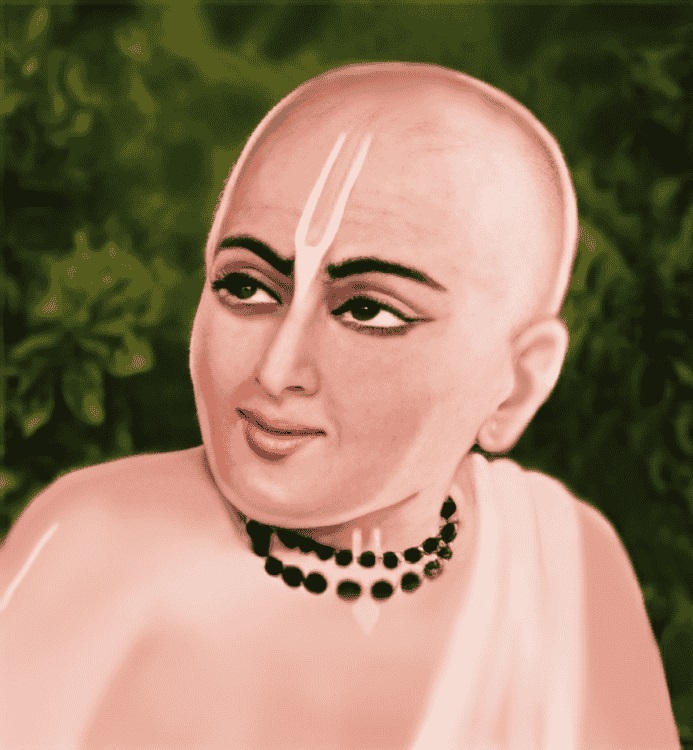
Introduction
Among Sri Chaitanya Mahaprabhu's companions at Navadvipa, three brothers stand out: Govinda, Madhava, and Vasudeva Ghosh. Of the three, the youngest, Vasudeva Ghosh, is remembered with the most fondness. Sri Chaitanya-charitamrita lists him and his brothers among the branches of the great tree of Mahaprabhu's devotees, and says that Vasudeva Ghosh's own kirtan was so powerful that "even wood and stone would melt upon hearing it." He was also one of the most prolific songwriters in the whole Gaudiya Vaishnava tradition, and the Vaishnava songs collection still preserves thirty-three of his Bengali padas today.
| Detail | Description |
|---|---|
| Birth | Year not known. Born at Kulai, near Katwa on the Ajay river, Bengal (some sources say Sri Hatta instead) |
| Family | A kayastha family of the Uttara-Radhiya (northern Rarh) group. Brothers Govinda Ghosh and Madhava Ghosh |
| Role at Puri | Responding singer, with brother Madhava, in Govinda Ghosh's kirtan party at the yearly Ratha-yatra festival |
| Identity | Gunatunga-sakhi, a gopi who sang Vishakha's songs in Vraja (Gaura-ganoddesha-dipika 188; Chaitanya-charitamrita Adi 10.115 purport) |
| Sripat | Tamluk, also known as Narpota, Bengal |
| Literary legacy | Wrote Bengali devotional songs about Sri Chaitanya Mahaprabhu. Thirty-three are kept in the /songs/ collection |
| Disappearance | Exact date not known. Observed on a tithi in the month of Kartika |
Scriptural evidence for the introduction (1)
कलावती रसोल्लासा गुणतुङ्गा व्रजे स्थिता ।
श्री विशाखा कृतं गीतं गायन्ति स्माद्य ता मताः ।
गोविन्द माधवानन्दवासुदेवा यथाक्रमम् ॥१८८॥
kalāvatī rasollāsā guṇatuṅgā vraje sthitā |
śrī viśākhā kṛtaṁ gītaṁ gāyanti smādya tā matāḥ |
govinda mādhavānanda-vāsudevā yathākramam ||188||
The vraja-gopis Kalavati-devi, Rasollasa-devi, and Gunatunga-devi, who sang the songs composed by Visakha-devi, later appeared as Govinda, Madhavananda, and Vasudeva respectively.
From the purport: According to the Gaura-gaṇoddeśa-dīpikā (188), the three brothers were formerly Kalāvatī, Rasollāsā and Guṇatuṅgā, who recited the songs composed by Śrī Viśākhā-gopī.
Identifies the three Ghosh brothers, in order, as the gopis Kalavati, Rasollasa and Gunatunga; Vasudeva Ghosh is Gunatunga. Sanskrit: diacritic edition of the Gaura-ganoddesha-dipika; English translation as published at bvmlu.org. Purport excerpt: Srila Prabhupada, Chaitanya-charitamrita Adi 10.115.
Chapter 1
Birth and the Three Ghosh Brothers
Two different traditions about the family's home village, and the one fact every source agrees on: the three brothers came to Navadvipa together.
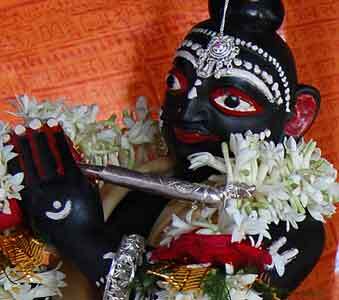
The three Ghosh brothers, Govinda, Madhava, and Vasudeva, are almost always spoken of together in Gaudiya Vaishnava tradition, and their birth story is no different. No source treats any one of them apart from the other two. But the sources do genuinely disagree about exactly where the family came from.
The Kulai Tradition #
The more detailed and more often repeated account places the family's home village at Kulai, on the western bank of the Ajay river, about twenty kilometres west of Katwa in Bengal. This tradition names the brothers' father as Ballava Ghosh. It also describes a large neem tree at the family home there. Later, it is said, Narahari Sarkara's circle at Srikhanda used wood from this tree to carve deities of Chaitanya Mahaprabhu in His dancing form. Ballava Ghosh moved the family to Halisahar, in what is now North 24 Parganas. A few years after that, the three brothers are said to have moved on again, this time to Navadvipa itself, where they came to know Sri Chaitanya Mahaprabhu and Nityananda Prabhu directly.
The Sri Hatta Tradition #
A different, less common tradition instead traces the family to Sri Hatta, the same eastern Bengal region, now in Bangladesh, that Mahaprabhu's own father's family came from. It names a village called either Baduna or Burangi grama, and says the brothers' father lived at Kumara Hatta. This version agrees with the Kulai tradition on the point that matters most for the rest of their lives: after their father died, Govinda, Vasudeva, and Madhava Ghosh went to live in Navadvipa dhama. Which village is correct remains unresolved; both traditions describe the same family arriving at the same place, Navadvipa, for the same reason.
A Kayastha Family of the Uttara-Radhiya Section #
On the brothers' social background there is no real disagreement. Srila Prabhupada's own purport to Sri Caitanya-caritamrita states it directly: "The three brothers Govinda, Madhava and Vasudeva Ghosa all belonged to a kayastha family" of the Uttara-Radhiya, or northern Rarh, section of Bengal. This was a respected family of scribes and administrators, not a brahmin one. This shows that from the very first generation of Mahaprabhu's movement, birth into a priestly family was never needed for closeness to the Lord. The same purport adds a remark about Madhava Ghosh that shows the family's musical gift very clearly: "Madhava Ghosa was expert in performing kirtana. No one within this world could compete with him. He was known as the singer of Vrindavana and was very dear to Sri Nityananda Prabhu."
Listed as Branches of the Chaitanya Tree #
However their childhood unfolded, all sources come together again once the brothers reach Navadvipa. Krishnadasa Kaviraja Goswami lists the many devotees of Mahaprabhu as branches of one great tree. He names Govinda, Madhava, and Vasudeva Ghosh as the eighty-second, eighty-third, and eighty-fourth branches, and adds simply that Lord Chaitanya and Nityananda used to dance in their kirtana performances (Chaitanya-charitamrita, Adi 10.115). A few verses later the text describes a further turn in the brothers' lives. Sri Chaitanya Mahaprabhu ordered Nityananda Prabhu back to Bengal to preach, and three devotees went with Him. Madhava and Vasudeva Ghosh were among them. But Govinda Ghosh chose to stay at Jagannatha Puri with Mahaprabhu and, the text says, "felt great satisfaction" (Adi 10.117-118). Because of this, Krishnadasa Kaviraja Goswami notes that Madhava and Vasudeva Ghosh came to be counted among the devotees of both Lords at once (Adi 11.14-15). This small detail shows how easily devotees moved between Mahaprabhu's Navadvipa circle and Nityananda's Bengal preaching mission.
Each brother eventually settled at his own sripat, or place of bhajana: Govinda at Agradwip, Madhava at Dainhat, and Vasudeva at Tamluk, each not far from the others along the lower Ganga and its Bengal tributaries. Bhaktisiddhanta Sarasvati Thakura's Anubhasya commentary on Chaitanya-charitamrita records something about the Deity of Gopinatha installed at Govinda Ghosh's sripat at Agradwip (the commentary places it at "Danihata, near the Agradvipa railway station"). To this day, this Deity still performs the annual shraddha ceremony marking Govinda's own passing. The tradition is kept up by the raja-vamsha family of Krishnanagara descended from Raja Krishnachandra. What happened at each brother's own sripat, and what became of Vasudeva Ghosh's own kirtan and songwriting once he settled at Tamluk, are told further on The Kirtan That Moved Mahaprabhu and Disappearance and Legacy.
Scriptural evidence for this chapter (3)
govinda, madhava, vasudeva -- tina bhai
yan-sabara kirtane nace caitanya-nitai
Word for word
govinda -- Govinda; madhava -- Madhava; vasudeva -- Vasudeva; tina bhai -- three brothers; yan-sabara -- all of whom; kirtane -- in the performance of sankirtana; nace -- dance; caitanya-nitai -- Lord Caitanya and Nityananda Prabhu.
The three brothers Govinda, Madhava and Vasudeva were the eighty-second, eighty-third and eighty-fourth branches of the tree. Lord Caitanya and Nityananda used to dance in their kirtana performances.
From the purport: Purport excerpt: "Madhava Ghosa was expert in performing kirtana. No one within this world could compete with him. He was known as the singer of Vrindavana and was very dear to Sri Nityananda Prabhu."
Names the three Ghosh brothers together as branches of Mahaprabhu's devotional tree and records their kayastha family background.
ramadasa, madhava, ara vasudeva ghosa
prabhu-sange rahe govinda paiya santosa
Word for word
ramadasa -- Ramadasa; madhava -- Madhava; ara -- and; vasudeva ghosa -- Vasudeva Ghosa; prabhu-sange -- in the company of Lord Caitanya Mahaprabhu; rahe -- remained; govinda -- Govinda; paiya -- feeling; santosa -- great satisfaction.
These three were Ramadasa, Madhava Ghosa and Vasudeva Ghosa. Govinda Ghosa, however, remained with Sri Caitanya Mahaprabhu at Jagannatha Puri and thus felt great satisfaction.
Records that Madhava and Vasudeva Ghosh accompanied Nityananda Prabhu back to Bengal to preach, while Govinda Ghosh stayed at Puri with Mahaprabhu.
nityanande ajna dila yabe gaude yaite
mahaprabhu ei dui dila tanra sathe
ataeva dui-gane dunhara ganana
madhava-vasudeva ghoserao ei vivarana
Word for word
nityanande -- unto Lord Nityananda; ajna -- order; dila -- gave; yabe -- when; gaude -- to Bengal; yaite -- to go; mahaprabhu -- Sri Caitanya Mahaprabhu; ei dui -- these two; dila -- gave; tanra sathe -- with Him; ataeva -- therefore; dui-gane -- in both the parties; dunhara -- two of them; ganana -- are counted; madhava -- Madhava; vasudeva -- Vasudeva; ghoserao -- of the surname Ghosa; ei -- this; vivarana -- description.
When Nityananda Prabhu was ordered to go to Bengal to preach, these two devotees [Sri Ramadasa and Gadadhara dasa] were ordered to go with Him. Thus they are sometimes counted among the devotees of Lord Caitanya and sometimes among the devotees of Lord Nityananda. Similarly, Madhava Ghosa and Vasudeva Ghosa belonged to both groups of devotees simultaneously.
From the purport: Purport excerpt: Bhaktisiddhanta Sarasvati Thakura's Anubhasya records that the Deity of Sri Gopinathaji near Agradvipa "accepted Govinda Ghosa as His father" and "even until today, the Deity performs the sraddha ceremony on the anniversary of the death of Govinda Ghosa."
Explains why Madhava and Vasudeva Ghosh are counted among the associates of both Chaitanya Mahaprabhu and Nityananda Prabhu, and preserves Bhaktisiddhanta Sarasvati's own account of the Gopinatha Deity tradition near Agradwip.
Chapter 2
The Kirtan That Moved Mahaprabhu
The specific verses in Chaitanya-charitamrita describing the effect of Vasudeva Ghosh's singing, and the brothers' regular place in the Ratha-yatra kirtan parties at Puri.
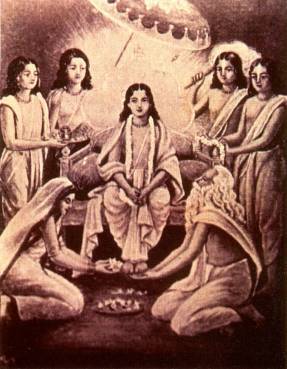
Chaitanya-charitamrita names many devotees who sang kirtan for Mahaprabhu. What sets Vasudeva Ghosh apart is that Krishnadasa Kaviraja Goswami singles out his voice specifically, not just the combined singing of the three brothers, in one of the most striking single lines in the whole text.
Even Wood and Stone Would Melt #
In the eleventh chapter of Adi-lila, while describing devotees counted in Nityananda Prabhu's own circle, Krishnadasa Kaviraja Goswami writes: "vasudeva gite kare prabhura varnane, kastha-pasana drave yahara sravane": "When Vasudeva Ghosha described Lord Caitanya and Nityananda while performing kirtana, even wood and stone would melt upon hearing it" (Chaitanya-charitamrita, Adi 11.19). It is one of the few places in the whole text where the effect of one singer on his listeners, not of a whole party, is described in such strong terms. That is why Vasudeva Ghosh's name, even more than his brothers', has become a sign of the great emotional power a kirtaniya's voice can carry.
Pleasing the Lord at Puri #
The three brothers together receive similar praise later in the book. This comes in the chapter on Mahaprabhu's bheda-kirtana pastimes at Jagannatha Puri. When the devotees from Bengal arrived there, Gopinatha Acharya pointed them out one by one to King Prataparudra. He named Govinda, Madhava, and Vasudeva Ghosh and added: "tina bhaira kirtane prabhu payena santosa": "They are three brothers, and their sankirtana, congregational chanting, pleases the Lord very much" (Chaitanya-charitamrita, Madhya 11.88). In his purport to this verse, Prabhupada mentions again the detail about Vasudeva Ghosh's songwriting. He places it alongside the work of Narottama Dasa Thakura, Bhaktivinoda Thakura, and Lochana Dasa Thakura. This line of devotional songwriters is explored more fully on Devotional Songs and Literary Legacy.
Every Year at the Ratha-yatra #
The brothers' most regularly recorded performance happened every year. Each year they travelled to Jagannatha Puri for the Ratha-yatra festival and took their place among the kirtan parties formed for the occasion. Chaitanya-charitamrita describes the arrangement exactly. Mahaprabhu formed a kirtan group with Govinda Ghosh as its leader. The younger Haridasa, Vishnudasa, and Raghava Pandita were the singers responding to him (Madhya 13.42). Then "two brothers named Madhava Ghosh and Vasudeva Ghosh also joined this group as responsive singers. Vakresvara Pandita was the dancer" (Madhya 13.43). Prabhupada's purport to an earlier verse notes that this was one of seven such kirtan parties formed for the festival. According to the purport, each party had a lead singer, several responding singers, and one dancer, and Mahaprabhu Himself moved among them in ecstasy. The brothers were placed under Govinda's leadership, with Vakreshvara Pandita, one of the Lord's own favourite dancers, in their group. This itself was a sign of how highly the brothers were regarded.
A Singing Style Fit for Both Lords #
Tradition says that the Ghosh brothers' kirtan was special because of its sweetness, not because of volume or clever technique. Bengali devotional writing calls this sweetness in the voice itself madhurya. It is different from the madhurya-rasa of their spiritual identity, which is discussed on Spiritual Identity and Teachings. Madhava Ghosh in particular is remembered as a kirtan singer with no equal. He was called "the singer of Vrindavana" and was especially dear to Nityananda Prabhu. It is said again and again that Nityananda Prabhu danced simply on hearing him begin. The same praise fits both Lords easily. Mahaprabhu was delighted at Puri, and Nityananda danced in Bengal. This is part of why the brothers are remembered as belonging equally to both circles. Their own story traces this back to their family's roots, as told on Birth and the Three Ghosh Brothers.
No verse anywhere in Chaitanya-charitamrita says that Vasudeva Ghosh's voice was actually better than every other kirtaniya's. In other places, the text is careful to say that none of Mahaprabhu's associates should be thought lesser or greater than another. Many singers of the sankirtana movement are praised. But among all that praise, the wood-and-stone verse is still one of the most vivid pictures the tradition has ever given us of what devotional song can do.
The Scale of the Ratha-yatra Kirtan #
The Ratha-yatra kirtan parties the brothers belonged to were not small gatherings. Chaitanya-charitamrita describes several such groups formed for the festival. Each was built around a lead singer and a set of responding singers, with one dancer moving in front of the chariot. Some accounts of the full arrangement count as many as twenty-four chanters and sixteen mridanga players across all the parties combined. They also describe Mahaprabhu Himself walking among them and garlanding the performers with His own hand. Govinda Ghosh was given charge of one of these parties. His two brothers were happy to join it as responding singers, instead of seeking separate recognition. This shows how the three of them understood their service. For them it was not about three separate reputations built up side by side. It was one family's offering, given together year after year, at the one festival Mahaprabhu Himself loved most to attend.
Scriptural evidence for this chapter (4)
Quoted in the text above:
- Adi 11.19 Sri Caitanya-caritamrita
Further verses:
govinda, madhava ghosa, ei vasu-ghosa
tina bhaira kirtane prabhu payena santosa
Word for word
govinda -- Govinda Ghosa; madhava ghosa -- Madhava Ghosa; ei -- this; vasu-ghosa -- Vasudeva Ghosa; tina bhaira -- of the three brothers; kirtane -- in the sankirtana; prabhu -- the Lord; payena santosa -- gets very much pleasure.
“Here also are Govinda Ghosa, Madhava Ghosa and Vasudeva Ghosa. They are three brothers, and their sankirtana, congregational chanting, pleases the Lord very much.
From the purport: Purport excerpt: "Vasudeva Ghosa... composed many nice songs about Lord Sri Caitanya Mahaprabhu, and these are all authorized Vaishnava songs, like the songs of Narottama dasa Thakura, Bhaktivinoda Thakura, Locana dasa Thakura, Govinda dasa Thakura and other great Vaishnavas."
Places Vasudeva Ghosh's songwriting in the same rank as Narottama Dasa Thakura and Bhaktivinoda Thakura, and records the Agradwip/kayastha family background.
govinda-ghosa -- pradhana kaila ara sampradaya
haridasa, visnudasa, raghava, yahan gaya
Word for word
govinda-ghosa -- Govinda Ghosa; pradhana -- the chief; kaila -- formed; ara -- another; sampradaya -- group; haridasa -- the younger Haridasa; visnudasa -- Visnudasa; raghava -- Raghava; yahan -- where; gaya -- sing.
The Lord formed another group, appointing Govinda Ghosa as leader. In this group the younger Haridasa, Visnudasa and Raghava were the responding singers.
Establishes Govinda Ghosh's role as the appointed leader of a kirtan party at the Ratha-yatra festival in Jagannatha Puri.
madhava, vasudeva-ghosa, -- dui sahodara
nrtya karena tahan pandita-vakresvara
Word for word
madhava -- Madhava; vasudeva-ghosa -- Vasudeva Ghosa; dui sahodara -- two brothers; nrtya karena -- dances; tahan -- there; pandita-vakresvara -- Vakresvara Pandita.
Two brothers named Madhava Ghosa and Vasudeva Ghosa also joined this group as responsive singers. Vakresvara Pandita was the dancer.
Places Madhava and Vasudeva Ghosh in Govinda's kirtan party at the Ratha-yatra, with Vakreshvara Pandita as their dancer.
Chapter 3
Spiritual Identity and Teachings
His identity as Gunatunga-sakhi in the Gaura-ganoddesha-dipika, his place in madhurya-rasa, and the theology carried inside his own songs.
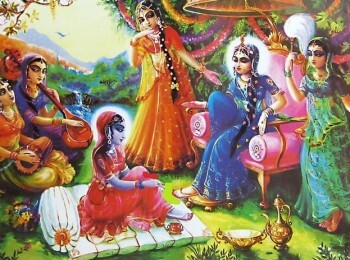
Gaudiya Vaishnavas hold that Mahaprabhu's closest associates were not devotees who rose to greatness through practice alone. We believe they are eternal residents of Krishna's own Vraja pastimes who came down with Him, or came to Him, in His Navadvipa lila. For the three Ghosh brothers, this identity is recorded by name.
Three Gopis Named by Kavi Karnapura #
Kavi Karnapura's Gaura-ganoddesha-dipika is the traditional Gaudiya reference work that lists the Vraja identities of Mahaprabhu's associates. It gives a single verse for all three brothers together: "kalavati rasollasa gunatunga vraje sthitah, sri-vishakha-kritam gitam gayanti sma yada ta matah, govinda-madhavananda-vasudeva yatha-kramam": "Govinda, Madhava and Vasudeva were three gopis in Vraja, namely Kalavati, Rasollasa and Gunatunga, who used to sing the songs composed by [Radha's confidential friend] Vishakha" (Gaura-ganoddesha-dipika 188). The verse gives the three identities in the same order as the brothers' names: Govinda Ghosh as Kalavati-sakhi, Madhava Ghosh as Rasollasa-sakhi, and Vasudeva Ghosh as Gunatunga-sakhi. In their eternal identity they are singers. They are gopis who perform Vishakha's own compositions for Radha and Krishna in Vraja. So, tradition holds, their role as Mahaprabhu's kirtan singers was not a skill they learned along the way. It was the very same service, carried from one lila into another. Their kirtan is described on The Kirtan That Moved Mahaprabhu.
Madhurya-rasa and Radha as Shelter #
Srila Bhaktisiddhanta Sarasvati Thakura writes about the brothers' place among the kinds of rasa, or devotional relationship, in Gaudiya Vaishnava teaching. He says all three are situated in madhurya-rasa, the conjugal mood that belongs to the gopis of Vraja. They belong to that group of devotees who accept Srimati Radharani herself as their ultimate ashraya-vigraha. This means she is their shelter, and the one toward whom their devotion is finally directed, even while their service is offered in the direct company of Sri Krishna. This is the same rasa in which Rupa Goswami and Sanatana Goswami would later explain Krishna bhakti most fully. So it places Vasudeva Ghosh's songs inside a very specific devotional lineage. They are not just general poems of praise. His songs are discussed at length on Devotional Songs and Literary Legacy.
What the Songs Themselves Teach #
Vasudeva Ghosh left no separate philosophical book. His teaching is found only in his songs. Read together, they return again and again to one idea. Sri Chaitanya Mahaprabhu, Krishna, and Lord Jagannatha are, in the end, one and the same Supreme Person, appearing in different forms for different purposes. One of his songs kept in the Vaishnava songs collection, "Jaya Jaya Jagannatha Sacira," opens by glorifying "the dear son of Jagannatha Misra and Saci Devi," and then describes Him in two ways. The song says that on the altar at Nilachala the Lord holds the conch, disc, club, and lotus. But when the same Lord walks the streets of Nadiya, He carries instead the staff and waterpot of a sannyasi. Vasudeva Ghosh makes the same point even more directly in another song: "Vasudeva Ghosha kahe kari' jora hatha, yei gaura sei krishna sei jagannatha": "Vasudeva Ghosh says, with folded hands: whoever is Gaura is Krishna, and the same is Jagannatha." Another well-known song, "Yadi Gaura Na Hoito," does not tell a story. It makes a devotional argument instead. Without Gauranga's appearance in this age, the song says, no one could have learned that Radharani stands supreme in the realm of divine love, and life itself would hardly be worth living. Neither song argues philosophy the way a Sanskrit philosophical book would. Both simply accept the conclusion as true and sing from within it. That is how associates of Mahaprabhu such as Vasudeva Ghosh chose to teach. They taught through direct, sung devotion, not through systematic argument. In this they were unlike the philosopher-Goswamis of Vrindavan such as Rupa Goswami and Jiva Goswami.
One Family, One Service #
The Gaura-ganoddesha-dipika names all three brothers in a single verse, instead of treating each one separately. This fits the way Gaudiya Vaishnava tradition generally speaks of groups of close gopi associates. Each gopi's own identity matters, but it is never separate from the small circle of companions she serves with. As Gunatunga-sakhi, Vasudeva Ghosh is never described singing Vishakha's songs alone. Gunatunga sings them together with Kalavati and Rasollasa, who are his own brothers Govinda and Madhava in their Vraja forms. The same pattern repeats in Vasudeva Ghosh's life as a Ghosh brother in Navadvipa. His family and his devotional identity are never pulled apart. This is one reason the three brothers are treated together, wherever the sources allow it, across the fuller account on Birth and the Three Ghosh Brothers. Even so, Vasudeva Ghosh's own distinct contribution stays clearly in view: his singing, his songs, and the verse that names him specifically.
Chapter 4
Devotional Songs and Literary Legacy
Thirty-three surviving songs, several of them checked against independent sources, about Gauranga-lila and about Krishna's own Vraja pastimes.
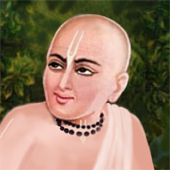
Vasudeva Ghosh's largest and most lasting gift is not any single event in his life. It is the body of Bengali devotional songs he left behind. The Vaishnava songs collection keeps thirty-three of them under his name. Several of these were checked against independent devotional sources. This confirms that they are the same compositions long credited to him in Gaudiya Vaishnava tradition, and not a modern mistake.
An Authorized Vaishnava Poet #
Srila Prabhupada's purport to Chaitanya-charitamrita places Vasudeva Ghosh among the great Vaishnava song-writers: "he composed many nice songs about Lord Sri Chaitanya Mahaprabhu, and these are all authorized Vaishnava songs, like the songs of Narottama Dasa Thakura, Bhaktivinoda Thakura, Lochana Dasa Thakura and Govinda Dasa Thakura and other great Vaishnavas" (Chaitanya-charitamrita, Madhya 11.88, purport). That is a short list. Prabhupada himself placed Vasudeva Ghosh on it, and this is one of the clearest signs of how seriously the tradition takes him. He is seen not only as a singer of other people's songs, but as a poet who wrote his own.
What the Songs Are About #
The songs kept in the collection fall into two broad groups. Most are about Gauranga-lila, the life and pastimes of Sri Chaitanya Mahaprabhu. One of these is "Sacira Anginaya Nace" ("Dancing in Saci's Courtyard"), which shows the infant Visvambhara playing hide-and-seek with His mother. Another is "Mayera Anguli Dhari Sisu Gaura-Hari" ("Grasping His Mother's Finger"), a tender scene of the infant Lord learning to walk and stumbling into Mother Saci's lap. Others turn from His childhood to the sankirtana movement itself, and to Nadiya's streets filled with the sound of the Lord's chanting. Examples are "Jaya Jaya Kala Raba Nadiya Nagare" and "Gora Nace Sacira Dulaliya." A smaller number of songs are directly about Krishna's own Vraja-lila. One example is "Sundara Kundala Naina," which describes Krishna's ornaments and His rasa dance among the gopis of Vrindavan. Its language comes straight from classical Vaishnava padavali writing. These songs remind us that Vasudeva Ghosh, as Gunatunga-sakhi, belongs to Krishna's Vraja pastimes too, not to Gauranga-lila alone. His identity as Gunatunga-sakhi is discussed on Spiritual Identity and Teachings.
A Sample in His Own Words #
"Yadi Gaura Na Hoito" ("If Gaura Had Not Appeared") is probably his best-known song, and it shows his usual method. It does not tell a story. Instead, it argues a devotional point in the poet's own voice. It opens by asking what would have become of the world's devotees had Gauranga never appeared in this Age of Kali. It answers that without Him no one would ever have learned of Srimati Radharani's supreme position in the kingdom of divine love. Another song, "Jaya Jaya Jagannatha Sacira," makes a related point from a different angle. It shows the Deity at Jagannatha Puri, the son of Saci at Nadiya, and Krishna of Vraja as one Supreme Person appearing in three forms. This point is looked at more closely on Spiritual Identity and Teachings.
Written for Singing, Not Reading #
Unlike a written biography or a book of theology, a pada was written to be sung. Vasudeva Ghosh's songs still carry their original musical instructions. Several songs in the collection name the raga they were meant to be sung in. "Gora Guna Gao Suni" is set to Mallara-raga, and "Nadiya Akase Asi Udila Gauranga Sasi" to Kalyana-raga. "Sacira Anginaya Nace" and several other Gauranga childhood songs are set to Beloyara-raga. This was the same custom followed by classical Bengali padavali poets in general. This detail is easy to miss on the page, but it was central to how the songs were used. They were never meant to be read silently, only sung out loud. Vasudeva Ghosh himself is remembered singing in just this way before Mahaprabhu, as told on The Kirtan That Moved Mahaprabhu.
Still Sung Today #
Vasudeva Ghosh's songs have not stayed locked away in manuscripts or scholarly collections. Several are still part of living Gaudiya Vaishnava kirtan practice. And it is not only his songs that are sung. His own name is sung too. Bhaktivinoda Thakura's Gaura-arati is the song sung at the evening worship of the Deity of Gauranga in Gaudiya Vaishnava temples worldwide. This includes the ISKCON tradition, which traces its own line back through Srila Prabhupada. The Gaura-arati has the line "narahari-adi kori' camara dhulaya, sanjaya-mukunda-vasu-ghosh-adi gaya": "Narahari and others fan the Lord with camaras, while Sanjaya, Mukunda, Vasu Ghosh and others sing." Four and a half centuries after his disappearance, Vasudeva Ghosh's name is still called out every night. It is called out during the same worship that his own songs were written to inspire. His disappearance is discussed on Disappearance and Legacy.
Chapter 5
Disappearance and Legacy
The Narpota pastime at Tamluk, two differing traditions about his samadhi, and a body of song still sung today.
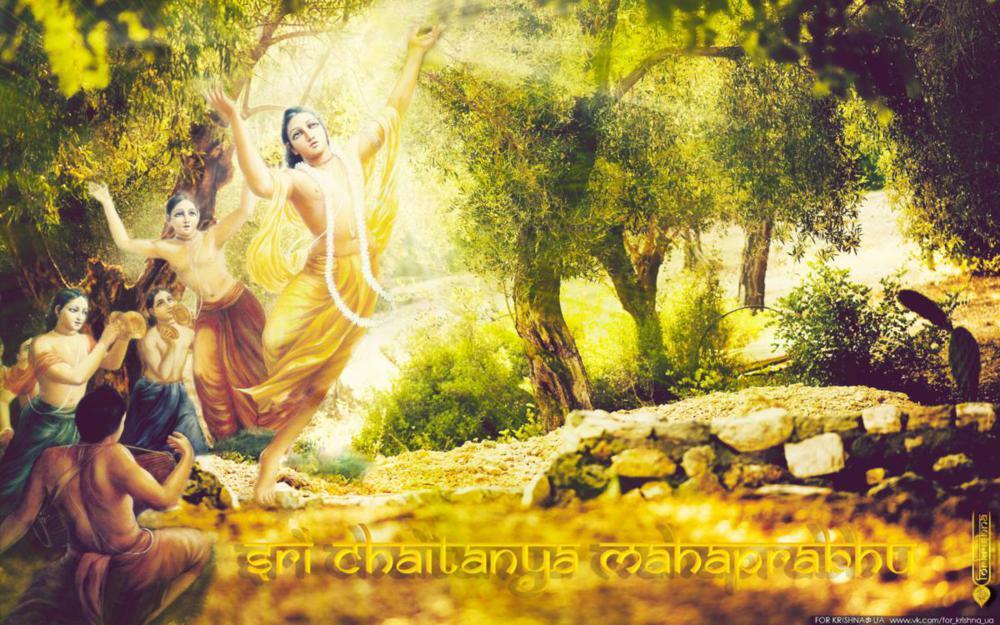
After Mahaprabhu sent him back to Bengal, Vasudeva Ghosh settled at Tamluk, on the banks of the Rupnarayan river in what is now East Medinipur district. According to the most detailed tradition about his final years, it was at Tamluk that his grief at Mahaprabhu's disappearance led to a special pastime. His sripat is still named after that pastime today.
The Narpota Pastime #
Tradition holds that Vasudeva Ghosh had made his home at Tamluk at the very spot where Sri Chaitanya Mahaprabhu had once stopped overnight on His way to Puri, begging His first alms after taking sannyasa, and blessing the ground with an all-night kirtan. When news reached Vasudeva Ghosh that Mahaprabhu had left this world, the story goes, he could not bear to keep living without Him. Together with his wife, he had a pit dug at that same spot, covered their own eyes, and had themselves buried alive rather than go on without Gauranga's company. Mahaprabhu, the story continues, appeared there in person, had their eyes uncovered, and gently corrected Vasudeva Ghosh, telling him that his body was not his own to give up, since it belonged to the Lord he served. Asked to choose a blessing instead, Vasudeva Ghosh asked only to go on enjoying Mahaprabhu's eternal company at that very place, and tradition says the blessing was granted. The place has been called Narpota ever since, from the Bengali for a human being (nara) buried (pota), and a sripat called Sri Mahaprabhu Mandira stands there today, its own Deity of Gauranga said to hold His hands in a mudra found nowhere else.
Two Traditions About His Samadhi #
Sources genuinely disagree about where Vasudeva Ghosh's own samadhi is. One detailed tradition belongs to the Tamluk temple itself and names the exact place. It says Vasudeva Ghosh's samadhi lies at the Narpota site, beneath a Bakul tree said to have stood there for five centuries, with his brother Madhava Ghosh's samadhi nearby. A few short reference notes found online instead place his samadhi among the Chaunsath Samadhi, or 64 Samadhis, near Vrindavan. But the very same line, word for word, is also used for his brother Govinda Ghosh and for the unrelated Lochana Dasa Thakura. This suggests it is a general note used for several devotees, not a specific tradition about Vasudeva Ghosh himself. The tradition at Narpota names a specific place, and it matches where his brother Madhava is also said to rest. So it is the far more believable account. No source brings these two claims together, and none gives a firm year for his passing. What several sources agree on is that his disappearance is traditionally observed on a tithi in the Bengali month of Kartika.
His Brothers' Endings #
Govinda Ghosh's own final years are better recorded than his brother's, and they offer a helpful comparison. Govinda had installed the Deity of Gopinatha at Agradwip on Mahaprabhu's own instruction. In old age he grew anxious, because he had no son to perform his funeral rites. Then, tradition says, Gopinatha appeared to him in a dream and promised to perform the ceremony Himself. Bhaktisiddhanta Sarasvati Thakura's own Anubhasya commentary on Chaitanya-charitamrita confirms two things. The Gopinatha Deity at Agradwip is still cared for by the raja-vamsha family of Krishnanagara, and the Deity still performs a shraddha ceremony every year on the day of Govinda Ghosh's disappearance. This is a rare case of a recorded ritual, centuries old, that grows directly out of the life of one of Mahaprabhu's own associates. Madhava Ghosh, the "singer of Vrindavana" praised without equal in Prabhupada's own purport, is remembered almost entirely for his singing, not for any similar story about his final years. What is recorded of his life is covered on Birth and the Three Ghosh Brothers and The Kirtan That Moved Mahaprabhu.
What Endures #
Whatever the true place of his samadhi, Vasudeva Ghosh's most lasting legacy is not a building. It is his songs, which are still in daily use. The thirty-three songs kept in the Vaishnava songs collection are still sung by Gaudiya Vaishnavas. They are discussed at length on Devotional Songs and Literary Legacy. His own name is also sung every night, alongside Sanjaya and Mukunda, in Bhaktivinoda Thakura's Gaura-arati wherever the Deity of Gauranga is worshipped. Every account we have of him says that his whole life was given to one act: singing for his Lord. So it is a fitting way for his memory to continue.
Closing
Listed Among the Branches of the Chaitanya Tree #
In the tenth chapter of Adi-lila, Krishnadasa Kaviraja Goswami lists the many devotees of Mahaprabhu as branches of one great tree. Govinda, Madhava, and Vasudeva Ghosh appear together as the eighty-second, eighty-third, and eighty-fourth branches (Chaitanya-charitamrita, Adi 10.115). A few verses later, the text says that when Nityananda Prabhu was sent back to Bengal to preach, Madhava and Vasudeva went with him, while Govinda stayed at Jagannatha Puri with Mahaprabhu (Adi 10.117-118). It then adds that Madhava and Vasudeva Ghosh came to be counted among the devotees of both Lords at once (Adi 11.14-15). Krishnadasa Kaviraja Goswami's text remains the oldest and most trusted source for almost everything we reliably know about the three brothers.
Songs in the Vaishnava Song Book #
The Vaishnava Song Book carries 33 songs attributed to Srila Vasudeva Ghosh: see the full author page here.
- Sri Caitanya-caritamrita, Adi-lila 10.115, purport
- Sri Caitanya-caritamrita, Adi-lila 10.117-118
- Sri Caitanya-caritamrita, Adi-lila 11.14-15, purport (Bhaktisiddhanta Sarasvati Anubhasya)
- Sri Caitanya-caritamrita, Adi-lila 11.19
- Sri Caitanya-caritamrita, Madhya-lila 11.88, purport
- Sri Caitanya-caritamrita, Madhya-lila 13.42-43
- Vasudeva Ghosh - Biography | Gaudiya History
- Sri Govinda, Vasudeva and Madhava Ghosh - Official Blog of ISKCON Bangalore
- Vasudeva Ghosh, Govinda Ghosh, and Madhava Ghosh - Stephen Knapp
- Vasudeva Ghosh - Biography | Sripat Narpota, Tamluk - The Gaudiya Treasures of Bengal
- Vasudeva Ghosh - Vaishnav Songs, ISKCON Desire Tree
