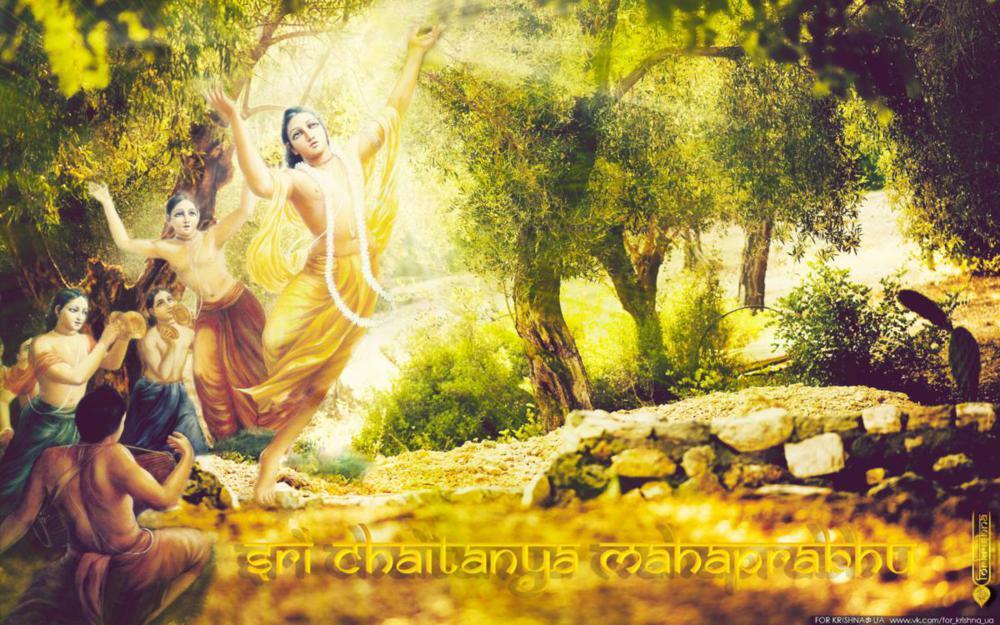
After Mahaprabhu sent him back to Bengal, Vasudeva Ghosh settled at Tamluk, on the banks of the Rupnarayan river in what is now East Medinipur district. According to the most detailed tradition about his final years, it was at Tamluk that his grief at Mahaprabhu's disappearance led to a special pastime. His sripat is still named after that pastime today.
The Narpota Pastime #
Tradition holds that Vasudeva Ghosh had made his home at Tamluk at the very spot where Sri Chaitanya Mahaprabhu had once stopped overnight on His way to Puri, begging His first alms after taking sannyasa, and blessing the ground with an all-night kirtan. When news reached Vasudeva Ghosh that Mahaprabhu had left this world, the story goes, he could not bear to keep living without Him. Together with his wife, he had a pit dug at that same spot, covered their own eyes, and had themselves buried alive rather than go on without Gauranga's company. Mahaprabhu, the story continues, appeared there in person, had their eyes uncovered, and gently corrected Vasudeva Ghosh, telling him that his body was not his own to give up, since it belonged to the Lord he served. Asked to choose a blessing instead, Vasudeva Ghosh asked only to go on enjoying Mahaprabhu's eternal company at that very place, and tradition says the blessing was granted. The place has been called Narpota ever since, from the Bengali for a human being (nara) buried (pota), and a sripat called Sri Mahaprabhu Mandira stands there today, its own Deity of Gauranga said to hold His hands in a mudra found nowhere else.
Two Traditions About His Samadhi #
Sources genuinely disagree about where Vasudeva Ghosh's own samadhi is. One detailed tradition belongs to the Tamluk temple itself and names the exact place. It says Vasudeva Ghosh's samadhi lies at the Narpota site, beneath a Bakul tree said to have stood there for five centuries, with his brother Madhava Ghosh's samadhi nearby. A few short reference notes found online instead place his samadhi among the Chaunsath Samadhi, or 64 Samadhis, near Vrindavan. But the very same line, word for word, is also used for his brother Govinda Ghosh and for the unrelated Lochana Dasa Thakura. This suggests it is a general note used for several devotees, not a specific tradition about Vasudeva Ghosh himself. The tradition at Narpota names a specific place, and it matches where his brother Madhava is also said to rest. So it is the far more believable account. No source brings these two claims together, and none gives a firm year for his passing. What several sources agree on is that his disappearance is traditionally observed on a tithi in the Bengali month of Kartika.
His Brothers' Endings #
Govinda Ghosh's own final years are better recorded than his brother's, and they offer a helpful comparison. Govinda had installed the Deity of Gopinatha at Agradwip on Mahaprabhu's own instruction. In old age he grew anxious, because he had no son to perform his funeral rites. Then, tradition says, Gopinatha appeared to him in a dream and promised to perform the ceremony Himself. Bhaktisiddhanta Sarasvati Thakura's own Anubhasya commentary on Chaitanya-charitamrita confirms two things. The Gopinatha Deity at Agradwip is still cared for by the raja-vamsha family of Krishnanagara, and the Deity still performs a shraddha ceremony every year on the day of Govinda Ghosh's disappearance. This is a rare case of a recorded ritual, centuries old, that grows directly out of the life of one of Mahaprabhu's own associates. Madhava Ghosh, the "singer of Vrindavana" praised without equal in Prabhupada's own purport, is remembered almost entirely for his singing, not for any similar story about his final years. What is recorded of his life is covered on Birth and the Three Ghosh Brothers and The Kirtan That Moved Mahaprabhu.
What Endures #
Whatever the true place of his samadhi, Vasudeva Ghosh's most lasting legacy is not a building. It is his songs, which are still in daily use. The thirty-three songs kept in the Vaishnava songs collection are still sung by Gaudiya Vaishnavas. They are discussed at length on Devotional Songs and Literary Legacy. His own name is also sung every night, alongside Sanjaya and Mukunda, in Bhaktivinoda Thakura's Gaura-arati wherever the Deity of Gauranga is worshipped. Every account we have of him says that his whole life was given to one act: singing for his Lord. So it is a fitting way for his memory to continue.
