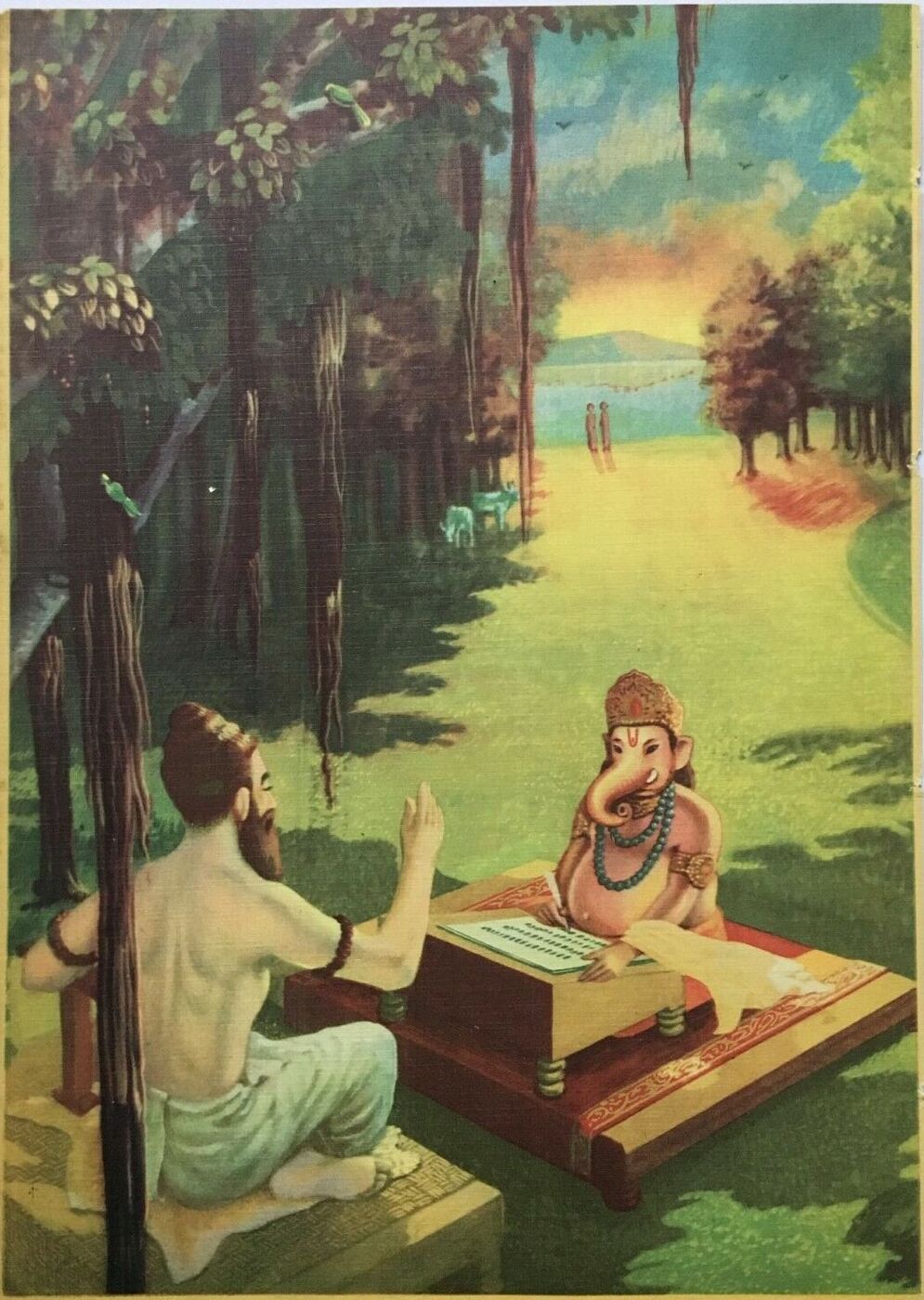
Even after dividing the Vedas into four parts, most people still could not access them. Formal Vedic study required initiation, years of training, and a certain social position. By the rules of the time, entire classes of society simply could not have that position. Srimad-Bhagavatam says Vyasadeva saw this gap and answered it directly. The text describes his thinking this way: "Out of compassion, the great sage thought it wise that this would enable men to achieve the ultimate goal of life. Thus he compiled the great historical narration called the Mahabharata for women, laborers and friends of the twice-born" (Srimad-Bhagavatam 1.4.25). An itihasa, a narrated history, needed no initiation to hear. It could carry the same conclusions the Vedas taught, wrapped inside the story of a real royal family's war. In this way it could reach an audience that the Vedas themselves were closed to.
The Fifth Veda and Eighteen Puranas #
For exactly this reason, tradition calls the Mahabharata the fifth Veda. It is not an extra book added to the four. It carries their meaning to people the original four could not reach. Tradition also gives Vyasadeva credit for compiling the eighteen major Puranas, such as the Vishnu Purana, Bhagavata Purana, Padma Purana, Vayu Purana and the rest. Each is a large work of stories that weaves together cosmology (the structure of the universe), genealogy (family lines) and devotional teaching around a particular deity or theme. Puranas are not history in the modern, record-keeping sense. In the tradition's own understanding, they are a kind of literature made to carry Vedic conclusions in story form. They are useful precisely because anyone can listen to a story and remember it, even someone who could never sit through a detailed study of the grammar of a Vedic hymn.
The Legend of Ganesha's Pen #
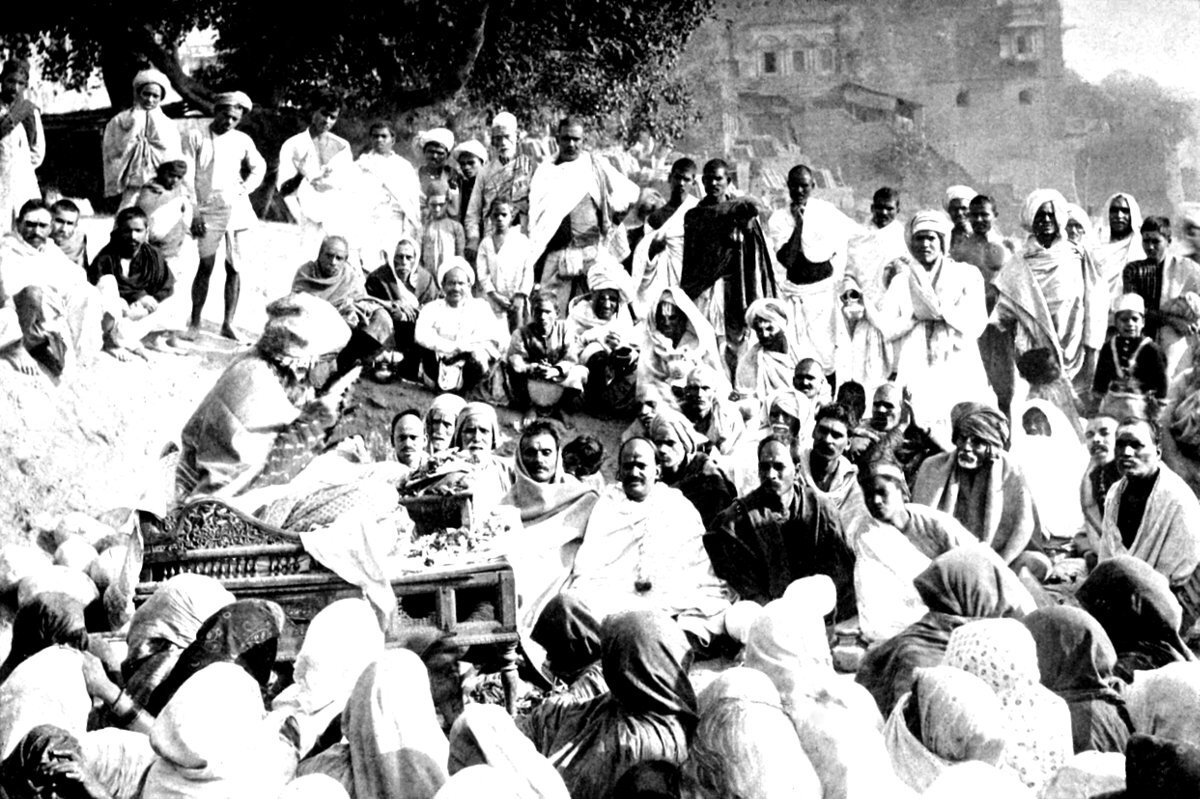
A well-loved story, more devotional legend than recorded history, holds that when Vyasadeva was ready to set the Mahabharata down in writing, he called on Lord Ganesha to act as his scribe. Ganesha agreed on one condition: that Vyasadeva recite without ever pausing, or he would stop writing at once. Vyasadeva accepted, but added a condition of his own: Ganesha must understand each verse fully before writing it down. So whenever the sage put in a verse with a very deep philosophical meaning, even Ganesha needed a moment to take it in. This gave Vyasadeva a short time to compose his next lines. This story is a popular tradition, not a proven fact, but it still shows a real truth about the text. The Mahabharata really does contain passages that pack very deep philosophy into a few words, set among long stretches of simpler storytelling. The Bhagavad-gita is the chief of these passages.
Vyasa Inside His Own Story #
Vyasa is unique because he wrote the Mahabharata and played a big role as a character in it. When the Kuru line was about to die out because there was no successor, his mother Satyavati asked him to father children on behalf of his dead half-brother Vichitravirya. This was done under the ancient custom of niyoga. From this came Dhritarashtra, born blind; Pandu, born pale; and Vidura, born of a servant woman and celebrated in the epic for his wisdom and detachment. While Pandu was still alive, Vyasadeva guided Gandhari through the suffering of her own difficult pregnancy with the Kauravas. Later, after Pandu's death, he consoled the widowed Kunti and her young sons, the Pandavas. He is also the sage who granted his disciple Sanjaya a form of mystic vision. With it, Sanjaya could witness the entire battle of Kurukshetra from the palace at Hastinapura and narrate it, moment by moment, to the blind king Dhritarashtra. This narration is how the Bhagavad-gita itself has come down to us. Sanjaya says this himself at the very close of the Gita: "By the mercy of Vyasa, I have heard these most confidential talks directly from the master of all mysticism, Krishna, who was speaking personally to Arjuna" (Bhagavad-gita 18.75). Srila Prabhupada's purport confirms plainly that "Vyasa was the spiritual master of Sanjaya."
Still Not Enough #
By the time all of this was finished, Vyasadeva had produced a body of literature few individuals in any tradition have matched: four organized Vedas, a vast itihasa, and eighteen Puranas. And still, Srimad-Bhagavatam records, something in him remained unsettled. That surprising dissatisfaction, and what it eventually produced, is the subject of The Dejection of Vyasadeva. His philosophical summary of the Vedanta itself, the Vedanta-sutra, is told separately on Writing the Vedanta-Sutra.
