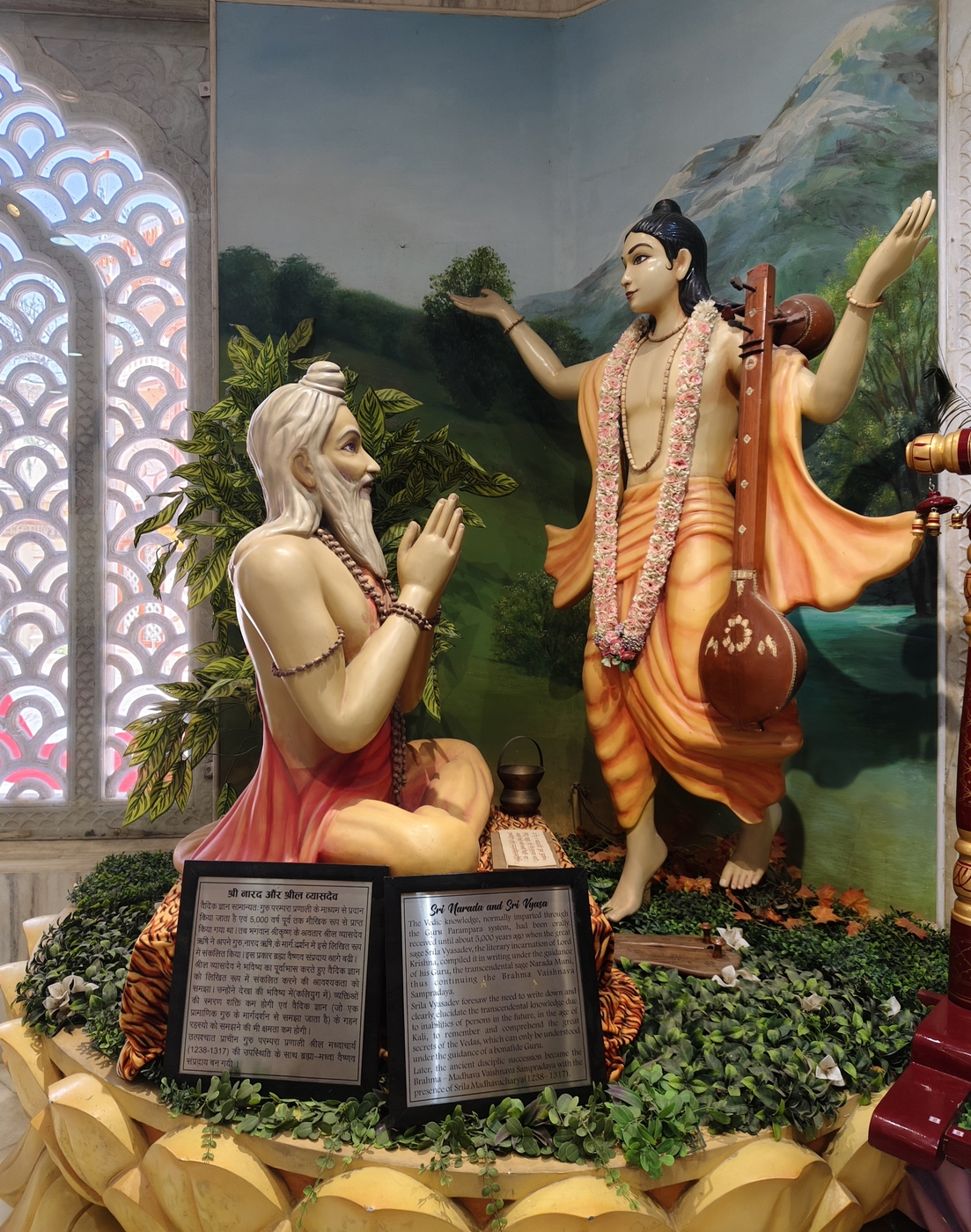
Srimad-Bhagavatam begins the account of its own origin with a question. The sages gathered at Naimisharanya asked Suta Gosvami directly: Krishna-Dvaipayana Vyasa, "the great sage," had already produced the Vedas, the Mahabharata, and the Puranas, so where did he get the inspiration to compile Srimad-Bhagavatam at all? Suta's answer does not describe a proud final achievement at the end of a finished career. It describes a crisis.
A Morning by the River #
One morning, having bathed in the waters of the Sarasvati at his ashrama in Shamyaprasa, Vyasadeva sat down alone to concentrate his mind, as was his daily practice. Srimad-Bhagavatam says that, with his own inner vision, he began to see real faults in the new age that was settling over the world. Then he looked in the same way at his own completed life's work. What he found troubled him. In the text's own words: "Thus the great sage Vyasadeva, who is very kind to the ignorant masses, edited the Vedas so they might be assimilated by less intellectual men... O twice-born brahmanas, still his mind was not satisfied, although he engaged himself in working for the total welfare of all people" (Srimad-Bhagavatam 1.4.24-26). By his own account, he had "under strict disciplinary vows, humbly worshipped the Vedas, the spiritual master and the altar of sacrifice," and, through the Mahabharata, had shown the path of religion even to those the Vedas themselves could not reach. And still: "I am feeling incomplete, though I myself am fully equipped with everything required by the Vedas. This may be because I did not specifically point out the devotional service of the Lord, which is dear both to perfect beings and to the infallible Lord" (Srimad-Bhagavatam 1.4.30-31). He could name what troubled him with surprising honesty. But he could not yet name its cure.
Narada Muni Arrives #
Srimad-Bhagavatam says that just at this moment Narada Muni reached Vyasadeva's cottage on the bank of the Sarasvati. Gaudiya Vaishnava tradition holds Narada to be Vyasadeva's own spiritual master. The way the text describes his reception shows this position: "At the auspicious arrival of Sri Narada, Sri Vyasadeva got up respectfully and worshiped him, giving him honor equal to that given to Brahmaji, the creator." You can read the full account of who Narada is on his own page, along with the earlier turning point in his own life that shaped the instruction he was about to give. Here we follow what happened next.
Narada's Diagnosis of the Problem #
Narada himself listed Vyasadeva's achievements: the Mahabharata, the explanation of impersonal Brahman, and the whole structure of Vedic knowledge, organized and preserved. Then he asked the question at the center of the whole episode. Why, despite all this, was Vyasadeva still so unhappy? Vyasadeva's answer was direct. Everything Narada had said was true, and still he was not at peace, and he did not know why. Narada then named the cause of the problem, in words that Gaudiya Vaishnavism has never stopped repeating since: "You have not actually broadcast the sublime and spotless glories of the Personality of Godhead. That philosophy which does not satisfy the transcendental senses of the Lord is considered worthless" (Srimad-Bhagavatam 1.5.8). Narada explained that Vyasadeva's works had thoroughly covered dharma, artha, kama and moksha (religious duty, economic development, sense gratification and liberation). These are the four recognized goals of human life. But none of these works, however broadly and skillfully explained, described the Supreme Lord's own personal pastimes for their own sake, and not as a means to something else.
What Narada Told Him to Do #
Narada did not only point out what was missing. He also gave Vyasadeva a specific instruction, speaking to him by name: "O Vyasadeva, your vision is completely perfect. Your good fame is spotless. You are firm in vow and situated in truthfulness. And thus you can think of the pastimes of the Lord in trance for the liberation of the people in general from all material bondage" (Srimad-Bhagavatam 1.5.13). This was not to be a new book of philosophy, and not another itihasa centered around human kings and wars. It was to be a direct, meditative description of the Lord's own transcendental activities, written in samadhi, not worked out by logical argument. What that instruction actually produced, and how Vyasadeva carried it out, is told next on Narada's Instruction and the Writing of Srimad-Bhagavatam.
