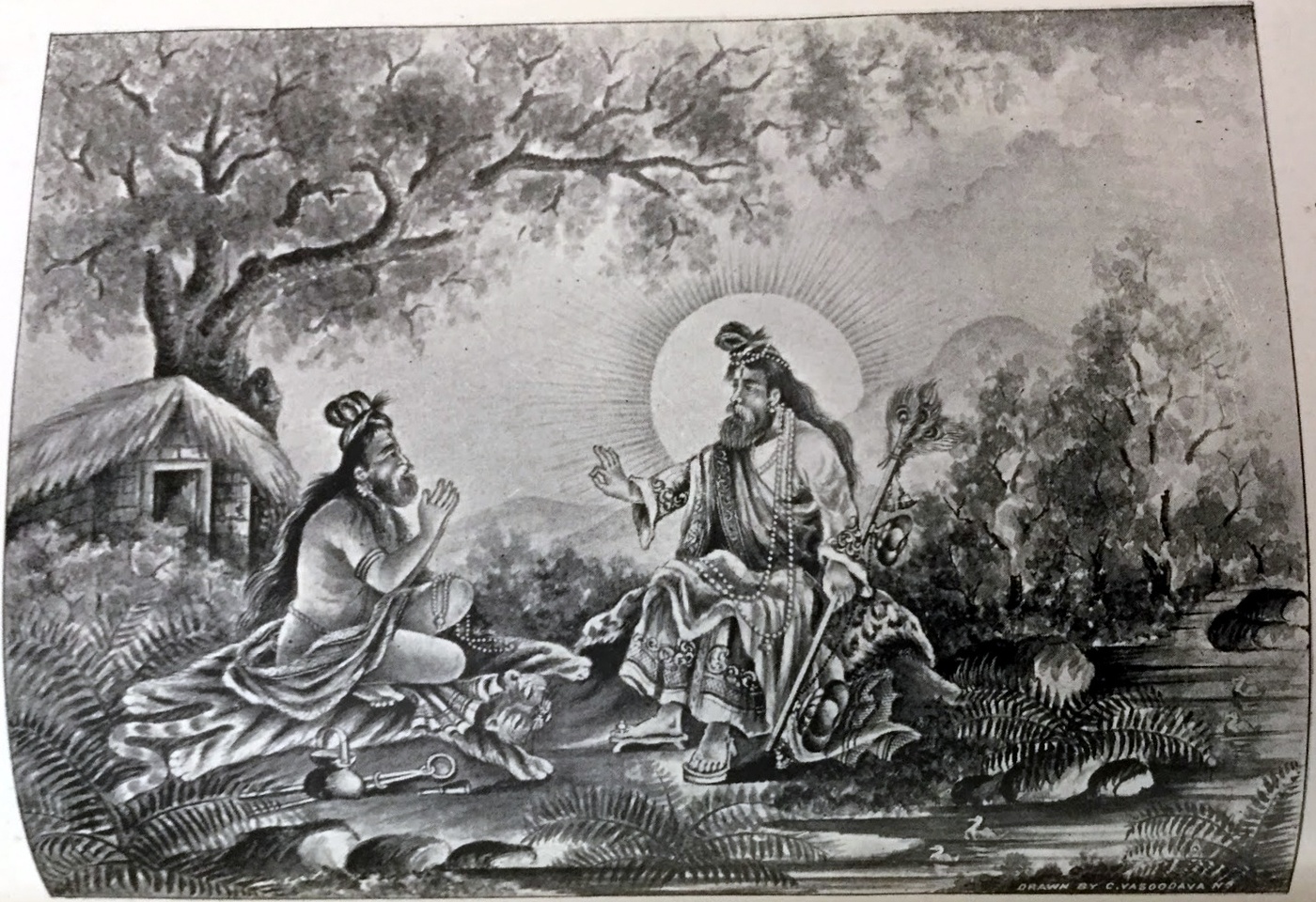
Narada Muni did not simply point out what was missing from Vyasadeva's life's work and then leave. Before he left, vina in hand, to continue his own wandering, he gave something more. He spoke from his own experience. In the same conversation, Narada told Vyasadeva the story of his own earlier life. As a boy born to a maidservant, he had once served a group of wandering sages during a single rainy season. From them, almost by chance, he received instruction in bhakti. It was so powerful that it changed the rest of his existence, through two different bodies. The full story is on Narada Muni's own page. In this conversation, Narada told it as proof by example. He was teaching his own disciple a clear lesson. Devotional hearing and chanting about the Supreme Lord's activities could change an uneducated servant boy this completely. So a literature built entirely around that same subject, written by someone as realized as Vyasadeva, would surely do good for everyone who heard it.
Returning to Samadhi #
The seventh chapter of Srimad-Bhagavatam continues the story right where the fifth chapter ended. Vyasadeva returned to his ashrama at Shamyaprasa, on the western bank of the Sarasvati, and sat down again. This time his aim was not to organize existing knowledge. He fixed his mind in bhakti-yoga, devotional linking, instead of in the dry work of sorting and listing that had produced the divided Vedas. The text says plainly that the result was direct perception: "Thus he fixed his mind, perfectly engaging it by linking it in devotional service without any tinge of materialism, and thus he saw the Absolute Personality of Godhead along with His external energy, which was under full control" (Srimad-Bhagavatam 1.7.4). This was not further study. Narada had told him to think of the Lord's pastimes "in trance," in samadhi. Srimad-Bhagavatam describes its own writing in exactly this way. It came from realization, not from research.
Twelve Cantos, Eighteen Thousand Verses #
From that samadhi, Vyasadeva produced Srimad-Bhagavatam itself. Sri Chaitanya-charitamrita later describes this text very exactly: "Srimad-Bhagavatam is the supreme Purana, and it was compiled by the Supreme Personality of Godhead in His incarnation as Vyasadeva. There are twelve cantos, 335 chapters and eighteen thousand verses" (Sri Chaitanya-charitamrita, Madhya 25.143-144, quoting the Garuda Purana). Its opening verses do not describe it modestly. They call it "the mature fruit of the desire tree of Vedic literatures... though its nectarean juice was already relishable for all, including liberated souls" (Srimad-Bhagavatam 1.1.3). It is a fruit that ripened fully only at the very end of the tree's growth, after the Vedas, the Mahabharata, the Puranas, and the Vedanta-sutra had already been produced.
Teaching It to His Own Son First #
Vyasadeva did not release this finished work to the world directly. Srimad-Bhagavatam records that he taught it first to his own son: "The great sage Vyasadeva, after compiling the Srimad-Bhagavatam and revising it, taught it to his own son, Sri Shukadeva Gosvami, who was already engaged in self-realization" (Srimad-Bhagavatam 1.7.8). This detail is very important for the tradition's theology. Every account agrees that Shukadeva Gosvami was already a liberated soul, absorbed in impersonal self-realization from birth. He seemed to have no need for any further scripture at all. Yet he still found the Bhagavatam worth receiving from his father, and worth carrying forward. Throughout Gaudiya Vaishnavism, this is treated as proof of one clear point. Devotional literature about the Lord's own pastimes attracts even those who have already attained liberation. The tradition calls this the atmarama principle.
Meant to Be Spoken Aloud #
There is one more, quieter point to notice here. Vyasadeva did not simply leave Srimad-Bhagavatam as a finished manuscript and think his work was complete. He taught it aloud to one particular person. He did this in the same personal, teacher-to-disciple way in which he himself had organized the Vedas and given each portion to Paila, Jaimini, Vaishampayana and Sumantu. Understood in this way, Srimad-Bhagavatam was never meant to be only a private text for study alone. From the very moment it was written, it was made to be spoken aloud, heard, and then spoken again by whoever received it in turn. Shukadeva Gosvami would soon do exactly this for King Parikshit, and Suta Gosvami would later do it again for the sages gathered at Naimisharanya. Shukadeva Gosvami learned Srimad-Bhagavatam from his father, Vyasadeva, and then recited it to a dying king. That story is told on Shukadeva Goswami and the Recitation to Parikshit.
