Mahāvidyā-devī Mandira
महाविद्या-देवी मन्दिर Hindi name proposed
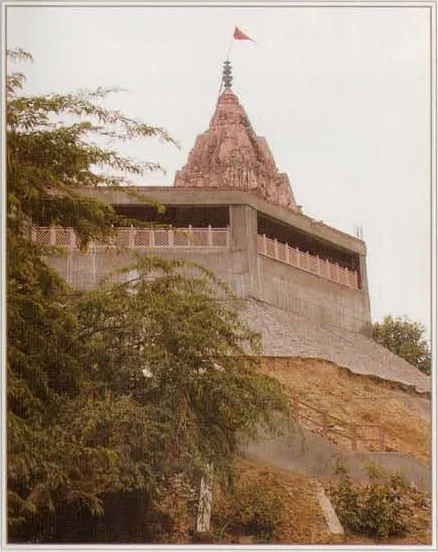
- What it is
- The Mahāvidyā-devī Mandira is a temple of the goddess on a hill in the west of Mathurā, reached by a long flight of steps.
- Visiting
- Śrī Vraja-maṇḍala Parikramā (2007) shows Mahāvidyā-devī on the ten-mile parikramā of Mathurā after Jñāna-vāpī, followed by Sarasvatī-kuṇḍa, Cāmuṇḍā-devī and Rajaka-badha-ṭīlā.
In short
The Mahāvidyā-devī Mandira is a temple of the goddess on a hill in the west of Mathurā, reached by a long flight of steps.[1 +5] The Caitanya-caritāmṛta names Mahāvidyā among the holy places of Mathurā that Śrī Caitanya Mahāprabhu saw.[7 +1] The Garga-saṁhitā calls the goddess Mahāvidyā the protector of Mathurā, and a verse of the Varāha Purāṇa, quoted by Śrīla Rūpa Gosvāmī, counts Mahāvidyeśvarī among the deities of Śrī Kṛṣṇa's family.[9 +3] The present shrine was built by the Peshwa towards the end of the eighteenth century, according to Growse (1883).[5 +1] The guidebooks connect the temple with two different pastimes; the sources differ (see below).
Key facts
| Kind | temple |
|---|---|
| Region · area | Mathurā |
| Also part of | Ambikāvana |
| Ācāryas | Śrī Caitanya Mahāprabhu, Śrīla Rūpa Gosvāmī, Śrīla Narahari Cakravartī Ṭhākura, Śrīla Rāghava Paṇḍita Gosvāmī of Govardhana, Śrīla Śrīnivāsa Ācārya |
Why it is glorified
In the Garga-saṁhitā Nārada tells King Bahulāśva who guards Mathurā: Caṇḍikā, the goddess Mahāvidyā, who rides a lion and removes …
In the Garga-saṁhitā Nārada tells King Bahulāśva who guards Mathurā: Caṇḍikā, the goddess Mahāvidyā, who rides a lion and removes distress, always protects the city.[9]
चण्डिका तु महाविद्या देवी दुर्गार्तिनाशिनी । सिंहारूढा सदा रक्षां मथुरायाः करोति हि ॥ 10 ॥
caṇḍikā tu mahāvidyā devī durgārtināśinī
siṁhārūḍhā sadā rakṣāṁ mathurāyāḥ karoti hi
A verse of the Varāha Purāṇa says that by seeing the goddess Ekānaṁśā, Yaśodā, Devakī and Mahāvidyeśvarī one is freed even from the sin of killing a brāhmaṇa. Śrīla Rūpa Gosvāmī quotes it in his Mathurā-māhātmya under the heading of Śrī Kṛṣṇa's family, and the Bhakti-ratnākara quotes it too (summarised here, not translated).[10 +2]
The Nārada Purāṇa names Mahāvidyā with Raṅgeśa, Bhūteśa and Bhairava: one who sees them and worships them properly gains the fruit of a pilgrimage.[13] Śrīla Nārāyaṇa Bhaṭṭa Gosvāmī's Vraja-bhakti-vilāsa says that the gods installed the goddess Mahāvidyā, dear to Devakī and slayer of demons, to protect Vraja-maṇḍala, and gives a prayer to her as the protector of the gopas and gopīs.[14]
In the Bhāgavatam Kṛṣṇa tells Yogamāyā that people will worship her under many names, Caṇḍikā and Ambikā among them. The verse names no place; the Garga-saṁhitā calls Mathurā's Mahāvidyā Caṇḍikā, and the guidebook Śrī Vraja-maṇḍala Parikramā (2007) calls her Ambikā-devī.[2 +2]
Divine pastimes
The guidebooks tell two different pastimes here, and the older texts tie neither to this hill. According to the local tradition recorded in Śrī Vraja-maṇḍala Parikramā (2007), this is the place where Kṛṣṇa freed Nanda Mahārāja from a python at Ambikāvana; the book says that the place is known as Mahāvidyā-devī. Śrīmad-Bhāgavatam (10.34) tells that the cowherd men went by bullock carts to the Ambikā forest on a pilgrimage for Lord Śiva, bathed in the Sarasvatī and worshipped Lord Paśupati and the goddess Ambikā, and that Kṛṣṇa freed Nanda from the python with the touch of His foot. It does not say where the forest was.[16 +2] The Canto 10 commentators place it either on the Sarasvatī to the west or north-west of Mathurā, with images of Śiva and Umā, or near Siddhapura in Gujarat (summarised here, not translated); none of them names Mahāvidyā.[19 +3] Śrīla Prabhupāda writes in his Kṛṣṇa book that Ambikāvana is somewhere in Gujarat and is said to be on the Sarasvatī.[18]
Vṛndāvana-Dhāma Ki Jaya! (c. 1986) tells here instead, without saying how it is connected with the temple, the story of the goddess who slipped from Kaṁsa's hands and became known by many names in many places, as Śrīla Prabhupāda tells it in his Kṛṣṇa book. The other guidebook places that goddess at the Kaṅkālī-devī Mandira.[23 +2]
The Gosvāmīs and ācāryas
- Śrī Caitanya Mahāprabhu: the Caitanya-caritāmṛta names Mahāvidyā among the holy places of Mathurā that He visited.[7 +1]
- According to the Bhakti-ratnākara, Śrīla Rāghava Paṇḍita Gosvāmī of Govardhana showed Śrīla Śrīnivāsa Ācārya Mahāvidyeśvarī as one of Kṛṣṇa's family. On a later round he brought him and Śrīla Narottama dāsa Ṭhākura to the Ambikā forest on the Kṛṣṇa-gaṅgā, where they saw Śrī Ambikā-devī and the Śiva called Gokarṇa; the book does not say that the two goddesses are one.[12 +1]
- Śrīla Sanātana Gosvāmī, Śrīla Jīva Gosvāmī and Śrīla Viśvanātha Cakravartī Ṭhākura discuss where the Ambikā forest lay, as told above.[19 +3]
Śrīla Prabhupāda
Śrīla Prabhupāda's translation of the Caitanya-caritāmṛta names Mahāvidyā among the holy places that Śrī Caitanya Mahāprabhu …
Śrīla Prabhupāda's translation of the Caitanya-caritāmṛta names Mahāvidyā among the holy places that Śrī Caitanya Mahāprabhu visited:[8]
Names this place“Śrī Caitanya Mahāprabhu visited all the holy places on the banks of the Yamunā, including Svayambhu, Viśrāma-ghāṭa, Dīrgha Viṣṇu, Bhūteśvara, Mahāvidyā and Gokarṇa.”
Śrīla Prabhupāda, Śrī Caitanya-caritāmṛta, Madhya-līlā 17.191, translation · vedabase.io
He does not speak of this temple. As a general teaching on how Vaiṣṇavas regard the goddess, he writes:[27]
General teaching (does not name the place)“Vaiṣṇavas, however, are śuddha-śāktas, or pure bhaktas, because the Hare Kṛṣṇa mahā-mantra indicates worship of the Supreme Lord’s energy, Harā. A Vaiṣṇava prays to the energy of the Lord for the opportunity to serve the Lord along with His spiritual energy.”
Śrīla Prabhupāda, Śrīmad-Bhāgavatam, 10.2.11-12, purport · vedabase.io
Visiting today
Śrī Vraja-maṇḍala Parikramā (2007) shows Mahāvidyā-devī on the ten-mile parikramā of Mathurā after Jñāna-vāpī, followed by Sarasvatī-kuṇḍa, Cāmuṇḍā-devī and Rajaka-badha-ṭīlā. Vṛndāvana-Dhāma Ki Jaya! (c. 1986) shows a white temple on the hilltop with a long stairway. Neither has been checked on the spot.[1 +3]
Nearby places
Jñāna-vāpī · Sarasvatī-kuṇḍa (Mathurā) · Ambikāvana
Pictures
1 pictures
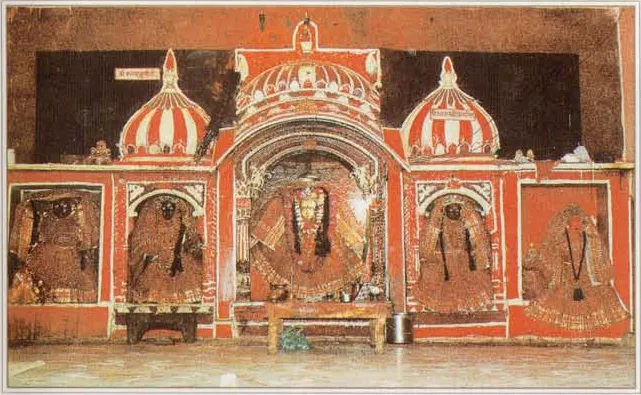
History
Growse (1883) and the district gazetteer of 1911 described the shrine as a tower-temple in a small courtyard on a hill, reached by thirty or forty masonry steps. They said that the Peshwa built it towards the end of the eighteenth century, and that two fairs were held there, on the eighth day of the bright fortnight of Caitra and of Āśvina.[5 +1] The historians differ on who served the temple and when its present image was installed (see below).
Where the sources differ
Who Mahāvidyā-devī is, and which pastime her temple recalls, according to the guidebooks and the older texts.
Who Mahāvidyā-devī is, and which pastime her temple recalls, according to the guidebooks and the older texts.[2 +3]
Accounts differ Who Mahāvidyā-devī is and which pastime her temple commemorates.
- Śrī Vraja-maṇḍala Parikramā (2007)Mahāvidyā-devī is Ambikā-devī; the place is famous for Kṛṣṇa's freeing Nanda from the python at Ambikāvana.
- Vṛndāvana-Dhāma Ki Jaya! (c. 1986)Tells the story of Yaśodā's daughter who escaped Kaṁsa.
- Garga-saṁhitā, Mathurā-khaṇḍa 25.10Caṇḍikā Mahāvidyā, riding a lion, protects Mathurā.
- Vraja-bhakti-vilāsa, printed p. 68The gods installed Mahāvidyā, dear to Devakī, to protect Vraja-maṇḍala; 'Mahāvidyā-Ambikā-sthala', where Kṛṣṇa studied under Sāndīpani.
Where Ambikāvana, the place of Nanda's rescue, was, the sources answer differently; their accounts are set out on the page of Ambikāvana.[16]
Which Mathurā temple, if any, belongs to the goddess who slipped from Kaṁsa's hands: the guidebooks name two different temples, and the older texts name none; the accounts are set side by side on the page of the Kaṅkālī-devī temple.[3 +2]
The Vraja-bhakti-vilāsa says that Kṛṣṇa studied under His guru Sāndīpani at this place, while the Bhāgavatam and Śrīla Prabhupāda say that Sāndīpani lived in Avantī.[14 +2]
Accounts differ Where Kṛṣṇa studied under Sāndīpani Muni.
- Vraja-bhakti-vilāsa, printed p. 68 (with its Hindi rendering)At the Mahāvidyā-Ambikā place in Mathurā.
- Śrīmad-Bhāgavatam 10.45.31Sāndīpani lived in the city of Avantī.
- Śrīla Prabhupāda, Kṛṣṇa ch. 45Sāndīpani Muni was a resident of Avantipura, in the district of Ujjain.
When the present temple and its image were set up.[31 +2]
Accounts differ When the present Mahāvidyā temple and its image were set up, and when the Tantric Samrāṭ Dīkṣit lived there.
- Growse (1883), printed p. 135, and the 1911 gazetteerThe present shrine was built by the Peshwa towards the end of the eighteenth century ('the end of last century').
- Entwistle (1987), p. 321 (historian)The present temple was built by the Marāṭhās in the latter half of the eighteenth century and placed in charge of a Tantric named Samrāṭ Dīkṣit; it was restored at the end of the nineteenth century; the central image was installed when the temple was built.
- Mītal (1966), first part, p. 156 (historian)A Tantric mahātmā named Samrāṭ Dīkṣit lived here in the seventeenth century; the present temple was built by the Marāṭhās; the Tantric scholar Śīlacandra installed the present image of the goddess in Saṁvat 1907.
References
35 references
- Śrī Vraja-maṇḍala Parikramā (2007), PDF p. 31
- Śrī Vraja-maṇḍala Parikramā (2007), PDF p. 50
- Vṛndāvana-Dhāma Ki Jaya! (c. 1986), by Dhruva Mahārāja dāsa, PDF p. 24
- Vṛndāvana-Dhāma Ki Jaya! (c. 1986), by Dhruva Mahārāja dāsa, PDF p. 99
- Mathurá (1883), F. S. Growse, B.C.S., M.A. Oxon., C.I.E. (as the title page gives him, p. 135
- Muttra (1911), D. L. Drake-Brockman, I.C.S. (edited and compiled), p. 298
- Śrīla Kṛṣṇadāsa Kavirāja Gosvāmī, Śrī Caitanya-caritāmṛta, Madhya-līlā 17.191, online edition · vedabase.io
- Śrīla Prabhupāda, Śrī Caitanya-caritāmṛta, Madhya-līlā 17.191, translation · vedabase.io
- Garga-saṁhitā, Mathurā-khaṇḍa (5) 25.10 ('śrī-mathurā-māhātmya-varṇana'), Sanskrit Wikisource
- Varāha Purāṇa, adhyāya 169, vv. 38-39, Sanskrit Wikisource
- Śrīla Rūpa Gosvāmī, Mathurā-māhātmya v.220, under the heading 'atha śrī-kṛṣṇa-parivārāṇām' (continuing the Ādi-varāha quotation of v.217)
- Śrīla Narahari Cakravartī, Bhakti-ratnākara, Fifth Wave (pañcama taraṅga), printed p. 169 (1912 ed.), 2nd ed., 1912
- Nārada Purāṇa, उत्तरार्धः/अध्यायः 79 v.79-51: Uttara-bhāga, chapter 79, verse 51
- Śrīla Nārāyaṇa Bhaṭṭa, Vraja-bhakti-vilāsa, Mathurā circuit, end of the verse numbered 50 and verse 51, 1st ed., publ. Bābā Kṛṣṇadāsa, Kusuma-sarovara, Saṁvat 2008
- Śrīmad-Bhāgavatam 10.2.11-12, GRETIL
- Śrīmad-Bhāgavatam 10.34.1-2, GRETIL
- Śrīmad-Bhāgavatam 10.34.8-9, GRETIL
- Śrīla Prabhupāda, Kṛṣṇa, the Supreme Personality of Godhead, Chapter 34 · vedabase.io
- Bṛhad-vaiṣṇava-toṣaṇī (Śrīla Sanātana Gosvāmī): commentary SB 10.34.1-2, Sanātana Gosvāmī's Bṛhad-vaiṣṇava-toṣaṇī, Bhagavata Vidya Pith edition, ed. Bhagavata Rishi and Krishna Shankar Shastri, 1996
- Laghu-vaiṣṇava-toṣaṇī (Śrīla Jīva Gosvāmī): commentary SB 10.34.1-2, Jīva Gosvāmī's Laghu-vaiṣṇava-toṣaṇī, Bhagavata Vidya Pith edition, ed. Bhagavata Rishi and Krishna Shankar Shastri, 1996
Show all 35 references
- Sārārtha-darśinī (Śrīla Viśvanātha Cakravartī Ṭhākura) on Śrīmad-Bhāgavatam: commentary on ŚB 10.34.1'), Bhagavata Vidya Pith edition, ed. Bhagavata Rishi and Krishna Shankar Shastri, 1996
- Krama-sandarbha (Śrīla Jīva Gosvāmī) on Śrīmad-Bhāgavatam: commentary on ŚB 10.34.1'), Bhagavata Vidya Pith edition, ed. Bhagavata Rishi and Krishna Shankar Shastri, 1996
- Śrīla Prabhupāda, Kṛṣṇa, the Supreme Personality of Godhead, chapter 4 ('Kaṁsa Begins His Persecutions') · vedabase.io
- Śrīmad-Bhāgavatam 10.4.13, GRETIL
- Śrīla Prabhupāda, Śrīmad-Bhāgavatam, 10.4.13, purport · vedabase.io
- Śrīla Narahari Cakravartī, Bhakti-ratnākara, Fifth Wave (pañcama taraṅga), printed p. 288 (1912 ed.), 2nd ed., 1912
- Śrīla Prabhupāda, Śrīmad-Bhāgavatam, 10.2.11-12, purport · vedabase.io
- Vṛndāvana-Dhāma Ki Jaya! (c. 1986), by Dhruva Mahārāja dāsa, PDF p. 25
- Śrīmad-Bhāgavatam 10.45.31, GRETIL
- Śrīla Prabhupāda, Kṛṣṇa, the Supreme Personality of Godhead, chapter 45 ('Kṛṣṇa Recovers the Son of His Teacher') · vedabase.io
- A. W. Entwistle, ch. 8 ('The pilgrimage itinerary'), §1.21 'Mahavidya Devi', printed p. 321, Egbert Forsten, Groningen, 1987
- Prabhudayāl Mītal, first part ('ब्रज-संस्कृति की भूमिका'), section 'Mathurā kī parikramā', entry 'Mahāvidyā mandir', printed p. 156
- A. W. Entwistle, ch. 4 §12 'Finds at other places along the circumambulation of Mathura', printed p. 126, Egbert Forsten, Groningen, 1987
- Śrī Vraja-maṇḍala Parikramā (2007), p. 74-75
- Vṛndāvana-Dhāma Ki Jaya! (c. 1986), by Dhruva Mahārāja dāsa, p. 6