Dāna-nivartana-kuṇḍa
दान-निवर्तन-कुण्ड Hindi name proposed
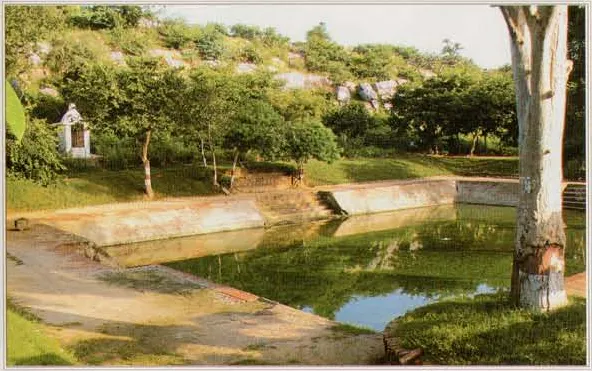
- What it is
- Dāna-nivartana-kuṇḍa is a lake (kuṇḍa) of Govardhana, some distance from Dāna-ghāṭī, where, according to the guidebook Govardhana Hill (2001), the stretch of the hill called Annakūṭa-kṣetra begins.
- Visiting
- Govardhana Hill (2001) says that the stretch of Govardhana from Dāna-nirvartana-kuṇḍa to the village of Aniyora is known as Annakūṭa-kṣetra.
- Parikramā
- Govardhana parikramā, station 22
In short
Dāna-nivartana-kuṇḍa is a lake (kuṇḍa) of Govardhana, some distance from Dāna-ghāṭī, where, according to the guidebook Govardhana Hill (2001), the stretch of the hill called Annakūṭa-kṣetra begins.[1 +2] Its name recalls how Kṛṣṇa's toll pastime with the gopīs, the cowherd girls, came to an end. Śrīla Raghunātha dāsa Gosvāmī says that the matter of the toll (dāna) was settled here in secret, and prays to live by this lake; in his poem Dāna-keli-cintāmaṇi the quarrel is settled with a promise that the toll will be paid here the next day, and the lake is named Dāna-nirvartana.[4 +2] The Bhakti-ratnākara calls it a very secret place.[5]
Key facts
| Kind | kuṇḍa |
|---|---|
| Region · area | Govardhana · Govardhana (town) |
| On the parikramā | Govardhana parikramā, station 22 · the route |
| Ācāryas | Śrīla Raghunātha dāsa Gosvāmī, Śrīla Viśvanātha Cakravartī Ṭhākura, Śrīla Śrīnivāsa Ācārya, Śrīla Narahari Cakravartī Ṭhākura |
Why it is glorified
Śrīla Raghunātha dāsa Gosvāmī explains the name in his Vraja-vilāsa-stava (verse 78): because the matter of the toll came to its …
Śrīla Raghunātha dāsa Gosvāmī explains the name in his Vraja-vilāsa-stava (verse 78): because the matter of the toll came to its settlement here in secret, the lake received this name among those who know the pastime. He prays to live at this lake, which is hidden from those who have no taste for rasa, the sweetness of loving exchange with Kṛṣṇa (summarised here, not translated). The verse does not say who paid whom.[1 +4]
A hymn of nine verses to the lake, the Dāna-nirvartana-kuṇḍāṣṭaka, tells that the young divine couple played a feigned quarrel over the toll at the foot of their beloved hill, beside this lake; it repeats the explanation of the name, and says that every day Kṛṣṇa, with His friends, waters the cows here and then drinks the lake's water Himself (summarised here, not translated).[7 +1] The Grantha Mandira edition of Śrīla Raghunātha dāsa Gosvāmī's hymns prints it among his works, while the Nandgram Dham song book credits it to Śrīla Viśvanātha Cakravartī Ṭhākura.[7 +1]
Śrīla Viśvanātha Cakravartī Ṭhākura names the kuṇḍa in his Vraja-rīti-cintāmaṇi (3.16) and says that the mere remembrance of it at once delights Śrī Rādhikā and Her beloved (summarised here, not translated).[9 +1]
Divine pastimes
How the toll quarrel was settled
The Bhāgavatam does not tell the toll pastime. It says that the boys sometimes played "imitating monarchs" (10.18.15), and the gopīs call Kṛṣṇa expert in the various activities of cowherds (10.35.14–15); neither verse speaks of a toll or names a place.[11 +3] Śrīla Viśvanātha Cakravartī Ṭhākura explains the first as the toll pastime, in which Kṛṣṇa, like a king, stopped the young women of Vraja at the toll place, and the purport by Śrīla Prabhupāda's disciples follows him and places the toll at a crossing of the Yamunā. The Bṛhat-krama-sandarbha, printed under Śrīla Jīva Gosvāmī's name, and Śrīla Śrīnātha Cakravartī read Kṛṣṇa's taking of a toll on milk products into the second (both summarised here, not translated). None of them names this kuṇḍa.[11 +3] In his Kṛṣṇa book Śrīla Prabhupāda tells the first verse as the boys playing like a king and his subjects.[13] Read more: Kṛṣṇa's toll pastime (dāna-līlā) at Govardhana and Varṣāṇā →
Śrīla Raghunātha dāsa Gosvāmī's Dāna-keli-cintāmaṇi tells how the quarrel ended (summarised here, not translated). Nāndīmukhī asked Kṛṣṇa to let the gopīs go on to the sacrifice with their pots of milk products, and promised that the next day they would all come to the grove of this lake, where she herself, standing surety, would see that His toll was paid. Because the toll was to be settled here, she said, this lake on the hill would be called Dāna-nirvartana. Kṛṣṇa laughed and let them go, and they went on happily to the sacrifice.[1 +4]
The guidebooks Govardhana Hill (2001) and Śrī Vraja-maṇḍala Parikramā (2007) send their readers to Śrīla Raghunātha dāsa Gosvāmī's poem, and the 2007 book also to Śrīla Rūpa Gosvāmī's Dāna-keli-kaumudī, for the pastime of this lake.[1 +3] Each of them, however, tells a different story behind the name.
The Annakūṭa festival
Śrīla Viśvanātha Cakravartī Ṭhākura's Vraja-rīti-cintāmaṇi (3.20) names this kuṇḍa and a Saṅkarṣaṇa-kuṇḍa together as the place where Nanda, the king of bliss who delights the young prince, holds the great Annakūṭa festival, the offering of a hill of food to Govardhana (summarised here, not translated; the verse is compressed). It names no village for the Saṅkarṣaṇa-kuṇḍa.[9 +1] Śrīmad-Bhāgavatam tells the first worship of the hill, at which Kṛṣṇa, in a huge form, said "I am the hill" and ate the offerings, but it names no kuṇḍa and no spot on the hill.[18 +3] Read more: The first Govardhana-pūjā and the Annakūṭa →
Traditional accounts
According to the Bhakti-ratnākara, Śrīla Śrīnivāsa Ācārya's guide showed him Dāna-nivartana-kuṇḍa as a very secret place that …
According to the Bhakti-ratnākara, Śrīla Śrīnivāsa Ācārya's guide showed him Dāna-nivartana-kuṇḍa as a very secret place that others do not know, and quoted Śrīla Raghunātha dāsa Gosvāmī's verse on its name.[5]
Visiting today
Govardhana Hill (2001) says that the stretch of Govardhana from Dāna-nirvartana-kuṇḍa to the village of Aniyora is known as Annakūṭa-kṣetra. Śrī Vraja-maṇḍala Parikramā (2007) places the kuṇḍa some distance from Dāna-ghāṭī and marks it at the south end of the road loop on its map of Govardhana town.[1 +2]
Location
| Where it is | Start of Annakūṭa-kṣetra[22] some distance from Dāna-ghāṭī (Town map: south end of the road loop)[23] |
|---|---|
| On the numbered Govardhana chart | 32 (printed as “Danivartan Kunda”)[24] |
Nearby places
Dāna-ghāṭī · Annakūṭa-kṣetra · Govardhana
Pictures
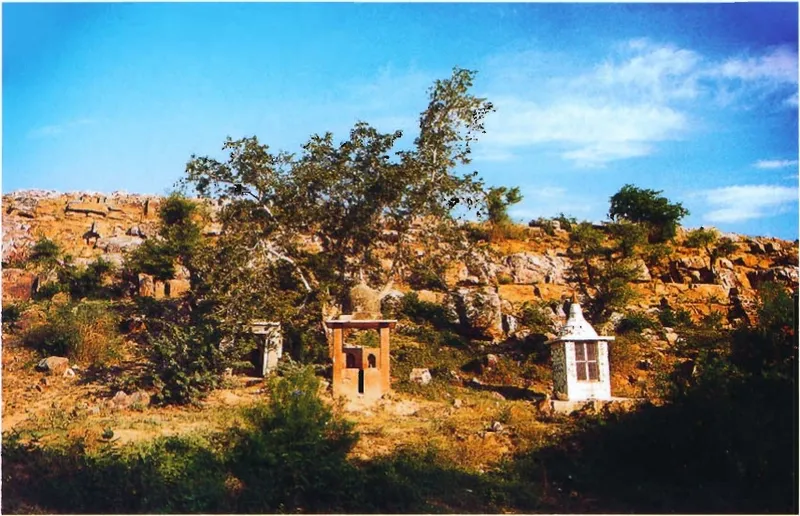
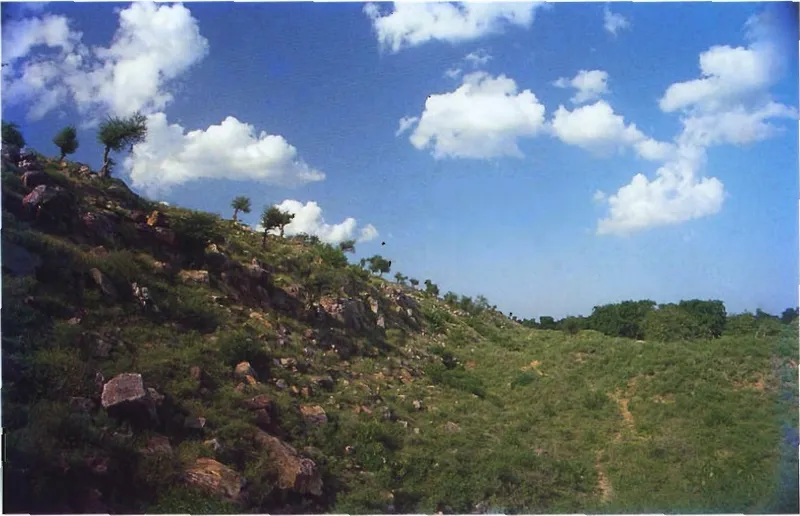
2 pictures
Where the sources differ
What the name Dāna-nivartana refers to: Śrīla Raghunātha dāsa Gosvāmī's two works and three guidebooks tell it in different ways.
Accounts differ What the name Dāna-nivartana / Dāna-nirvartana refers to
- Vraja-vilāsa-stava 78 (Śrīla Raghunātha dāsa Gosvāmī)the toll (dāna) matter came to its settlement (nirvṛti) here in secret, and so the place got its name (the verse does not say who paid)
- Govardhana Hill: India's Most Sacred Mountain (2001)the gopīs promised to return (nirvartana) the next day and pay the tax (dāna)
- Śrī Vraja-maṇḍala Parikramā (2007)the gopīs reclaimed their toll-tax from Kṛṣṇa here ('exchanged the toll-tax of prema')
- the undated parikramā notes Govardhanathe gopīs caught Kṛṣṇa, made Him pay for grazing in Rādhā's forest and bow to Her; the place where the tax was excused
Accounts differ Who composed the Dāna-nirvartana-kuṇḍāṣṭaka ("sva-dayita-giri-kacche …")
- Song book (Nandgram Dham Vaiṣṇava song book (nandgramdham.org/songs/) (2026)), /songs/dana-nirvartana-kundastakam/credited to Śrīla Viśvanātha Cakravartī Ṭhākura and listed under the Stavāmṛta-laharī
- Grantha Mandira Stavāvalī of Śrīla Raghunātha dāsa Gosvāmī, section (28) and its colophonprinted among Śrīla Raghunātha dāsa Gosvāmī's hymns: 'iti śrī-raghunātha-dāsa-gosvāmi-viracita-stavāvalyāṁ śrī-dāna-nivartana-kuṇḍāṣṭakaṁ sampūrṇam'
- Note printed after Dāna-keli-cintāmaṇi v.163 in the Grantha Mandira text (Dāna-keli-cintāmaṇi; the editor's note)quotes verse 6 as 'śrī-dāsa-gosvāmibhir dāna-nirvartana-kuṇḍāṣṭake', i.e. by Śrī Dāsa Gosvāmī
- Grantha Mandira Stavāmṛta-laharī of Śrīla Viśvanātha Cakravartī, the text's own contents listno Dāna-nirvartana-kuṇḍāṣṭaka among his hymns
Accounts differ Whether the Bhāgavatam's 'imitating monarchs' (ŚB 10.18.15) is the toll pastime, and where the toll was taken
- Śrīmad-Bhāgavatam 10.18.15 and 10.35.14–15the boys sometimes played 'imitating monarchs'; Kṛṣṇa is 'expert in the various activities of cowherds'; the verses speak of no toll and no place
- Śrīla Viśvanātha Cakravartī on ŚB 10.18.15 (Vaṁśīdhara the same)acting like a king at the toll-ghāṭ (dāna-ghaṭṭa): stopping the young women of Vraja to take toll; no particular place named
- vedabase purport on ŚB 10.18.15 (Śrīla Prabhupāda's disciples), explaining Viśvanāthaa place on the riverbank where those crossing the Yamunā paid a small tax; the cowherd boys stopped the young girls there to collect a customs duty
- Śrīla Śrīdhara Svāmī; Śrīla Jīva Gosvāmī's Laghu-vaiṣṇava-toṣaṇī and Śrīla Baladeva Vidyābhūṣaṇa on ŚB 10.18.15play as of kings (Śrīdhara); playing king with a throne of hill-stone, umbrellas of flowers and fans (Jīva, Baladeva); no toll
More on this place
Kṛṣṇa's toll pastime (dāna-līlā) at Govardhana and Varṣāṇā · The first Govardhana-pūjā and the Annakūṭa
References
24 references
- Govardhana Hill: India's Most Sacred Mountain (2001), Rajasekhara dasa Brahmacari, PDF p. 91
- Śrī Vraja-maṇḍala Parikramā (2007), PDF p. 111
- Śrī Vraja-maṇḍala Parikramā (2007), PDF p. 123
- Śrīla Raghunātha dāsa Gosvāmī, Vraja-vilāsa-stava, verse 78
- Śrīla Narahari Cakravartī, Bhakti-ratnākara, Fifth Wave, 1912 ed. p. 202, 2nd ed., 1912
- Śrīla Raghunātha dāsa Gosvāmī, Dāna-keli-cintāmaṇi vv.161-162
- Grantha Mandira Stavāvalī of Śrīla Raghunātha dāsa Gosvāmī, Dāna-nirvartana-kuṇḍāṣṭaka, Stavāvalī, section (28) 'śrī-dāna-nirvartana-kuṇḍāṣṭakam', vv.1-2
- Grantha Mandira Stavāvalī of Śrīla Raghunātha dāsa Gosvāmī, Dāna-nirvartana-kuṇḍāṣṭaka, Stavāvalī, section (28) 'śrī-dāna-nirvartana-kuṇḍāṣṭakam', v.8
- Śrīla Viśvanātha Cakravartī Ṭhākura, Vraja-rīti-cintāmaṇi 3.16
- Śrīla Viśvanātha Cakravartī Ṭhākura, Vraja-rīti-cintāmaṇi 3.20
- Śrīmad-Bhāgavatam 10.18.15, GRETIL
- Śrīmad-Bhāgavatam 10.35.14–15, GRETIL
- Śrīla Prabhupāda, Kṛṣṇa, the Supreme Personality of Godhead (Kṛṣṇa book), Chapter 18, 'Killing the Demon Pralambāsura' · vedabase.io
- Śrīla Prabhupāda, Kṛṣṇa, the Supreme Personality of Godhead (Kṛṣṇa book), Chapter 35, 'The Gopīs’ Feelings of Separation' · vedabase.io
- Śrīla Viśvanātha Cakravartī Ṭhākura: commentary on ŚB 10.18.15, Bhagavata Vidya Pith edition, ed. Bhagavata Rishi and Krishna Shankar Shastri, 1996
- Śrīla Jīva Gosvāmī: commentary on ŚB 10.35.14-15, Bhagavata Vidya Pith edition, ed. Bhagavata Rishi and Krishna Shankar Shastri, 1996
- Śrīla Rūpa Gosvāmī, Dāna-keli-kaumudī, prose before v.10 and v.10, after the undated edition published by Krishna Das of Kusum Sarovar
- Śrīmad-Bhāgavatam 10.24.25, GRETIL
- Śrīmad-Bhāgavatam 10.24.32–33, GRETIL
- Śrīmad-Bhāgavatam 10.24.35, GRETIL
- Śrīla Prabhupāda, Kṛṣṇa, the Supreme Personality of Godhead (Kṛṣṇa book), Chapter 24, Worshiping Govardhana Hill · vedabase.io
- Govardhana Hill: India's Most Sacred Mountain (2001), Rajasekhara dasa Brahmacari, p. 73
- Śrī Vraja-maṇḍala Parikramā (2007), p. 220-221
- Numbered list of the Govardhana sites (key of the Govardhana chart)