Mayūra-kuṭī
मयूर-कुटी
Also called Mor-kuṭir
- What it is
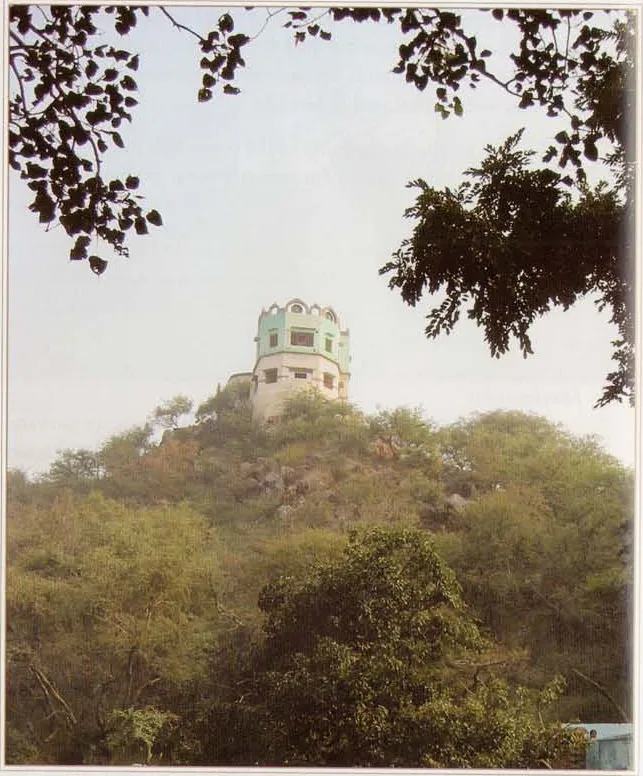
- Mayūra-kuṭī, the "peacock hut", stands on top of Brahma-parvata at Varṣāṇā.
- Visiting
- The guidebook Śrī Vraja-maṇḍala Parikramā (2007) places Mayūra-kuṭī on top of Brahma-parvata, which it calls Brahmācala-parvata, with the rāsa-maṇḍala of the peacock dance, and also says that it is …
- Places here
- Rāsa-maṇḍala (Mayūra-kuṭī)
In short
Mayūra-kuṭī, the "peacock hut", stands on top of Brahma-parvata at Varṣāṇā.[1 +1] The oldest text found that names it is Śrīla Nārāyaṇa Bhaṭṭa Gosvāmī's Vraja-bhakti-vilāsa, which places "the site of Mayūra-kuṭī" on Brahma-parvata and gives a prayer for it, with the rule of feeding the peacocks there.[3 +3] The guidebooks tell different stories of a peacock dance here; no older text found tells any of them.[7 +1]
Key facts
| Kind | pastime site |
|---|---|
| Region · area | Varṣāṇā · Brahma-parvata |
| Ācāryas | Śrīla Nārāyaṇa Bhaṭṭa Gosvāmī |
Divine pastimes
The peacock dance
Śrīmad-Bhāgavatam (10.15.11) tells of one peacock dance of Kṛṣṇa. On the forest path with Balarāma and the cowherd boys, He imitated a dancing peacock and made His friends laugh. The verse names no place, and it is a different occasion from the dance that the guidebooks set at Mayūra-kuṭī.[7 +1]
Sometimes He vigorously imitated the dancing of a peacock, making His cowherd boyfriends laugh.
Translation: Śrīla Prabhupāda's disciples (BBT)Śrīla Prabhupāda's Kṛṣṇa book tells the same moment:[8]
General teaching (does not name the place)“when they saw the peacocks dancing, they imitated them before Kṛṣṇa. Kṛṣṇa also moved His neck, imitating the dancing and making His friends laugh.”
Śrīla Prabhupāda, Kṛṣṇa, the Supreme Personality of Godhead, ch. 15 'The Killing of Dhenukāsura' · vedabase.io
The guidebooks tell three different stories of a peacock dance at this place, and no scripture or Gosvāmī text found so far tells any of them.[7 +1]
Accounts differ What happened at Mayūra-kuṭī (the occasion of the peacock dance).
- Śrī Vraja-maṇḍala Parikramā (2007)Rādhā and Kṛṣṇa, seeing the peacocks dance in a light rain, danced as a peacock and peahen among them while the sakhīs sang rāgas like malhāra.
- the undated parikramā notes VarṣāṇāAs Śrī Vraja-maṇḍala Parikramā (2007), and: Kṛṣṇa danced like a peacock to break Rādhā's māna, and She forgot it.
- Vṛndāvana-Dhāma Ki Jaya! (c. 1986)Rādhā complained that the forests had no peacocks; Kṛṣṇa appeared dressed as a peacock and danced for Her and Her friends.
- Vraja-bhakti-vilāsa ch. 4 v.57Only a prayer to the beloved of the peacocks and the great hut, abode of the peacocks feet', with the rule of feeding peacocks; no story.
The wording of these accounts is our summary of the sources, not a published translation.
Traditional accounts
The Vraja-bhakti-vilāsa (ch. 2, verse 47), in a description of Vṛṣabhānupura that it gives from the Padma Purāṇa, lists on …
In the Vraja-bhakti-vilāsa
The Vraja-bhakti-vilāsa (ch. 2, verse 47), in a description of Vṛṣabhānupura that it gives from the Padma Purāṇa, lists on Brahma-parvata the Dāna-mandira, the place of the swing, the site of Mayūra-kuṭī and a rāsa-maṇḍala, a circle for the rāsa dance.[3 +3]
Its prayer for the Mayūra-kuṭī site offers obeisances to the crowned Lord, dear to the peacocks, and to the delightful great hut where the peacocks walk. The pilgrim is to bow to the place seven times, stay there and feed the peacocks (summarised here, not translated).[4]
ततो मयूरकुटीस्थलप्रार्थनमन्त्रः— किरीटिने नमस्तुभ्यं मयूरप्रियवल्लभ ! । सुरम्यायै महाकुट्यै शिखण्डिपदवेश्मने ॥ इति मन्त्रं समुच्चार्य सप्तभिः प्रणमेत्स्थलं । यत्र स्थित्वा मयूरेभ्यो भोजनं विधिवच्चरेत् ॥ सुप्रियाभिः रमेन्नित्यं सर्वदानन्दवर्धनं ॥ ५७ ॥
tato mayūrakuṭīsthalaprārthanamantraḥ— kirīṭine namastubhyaṁ mayūrapriyavallabha !
suramyāyai mahākuṭyai śikhaṇḍipadaveśmane
iti mantraṁ samuccārya saptabhiḥ praṇametsthalaṁ
yatra sthitvā mayūrebhyo bhojanaṁ vidhivaccaret
supriyābhiḥ ramennityaṁ sarvadānandavardhanaṁ || 57 ||
A second prayer, which the book cites from the Ādi-varāha, is for the rāsa-maṇḍala at the Mayūra-kuṭī site; the rāsa-maṇḍala's page tells it.[5] The editor's introduction to the Hindi edition of the book lists Mayūra-kuṭī among the rāsa places where, it says, Śrīla Nārāyaṇa Bhaṭṭa Gosvāmī had rāsa-maṇḍalas made; this report is not certain.[6]
The same book also names a Mayūravana, a peacock forest, with a Mayūra-kuṇḍa, listed just before the forest of Brahma-parvata; there it speaks of a pond, not a hut.[11]
The painting
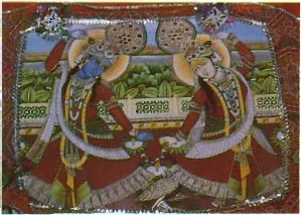
The guidebook Vṛndāvana-Dhāma Ki Jaya! (c. 1986) records a local tradition, which is not certain, that a blind saint had a vision of the peacock dance and made a painting of it, which is now on the walls of the small temple at Mor-kuṭīr, as the book calls the place.[12]
Visiting today
The guidebook Śrī Vraja-maṇḍala Parikramā (2007) places Mayūra-kuṭī on top of Brahma-parvata, which it calls Brahmācala-parvata, with the rāsa-maṇḍala of the peacock dance, and also says that it is on the right as one enters Gahvaravana.[1 +1] In 1987 the historian A. W. Entwistle described Mor Kuṭī as a small building with a shrine on the hill above Sāṅkarī-khor, cared for by ascetics of the Ṭaṭṭī Sthāna of Vṛndāvana.[13]
Location
| Where it is | on the top of Brahmācala-parvata; 'to the right when entering Gahvaravana'; map: on the ridge near the south end, a dotted path running south from it to 8[14] |
|---|
Places at Mayūra-kuṭī
1 places
Nearby places
Gahvaravana (Varṣāṇā) · Kṛṣṇa-kuṇḍa (Gahvaravana)
Pictures
1 pictures
Where the sources differ
Accounts differ The verse for Mayūra-kuṭī: one four-line verse from the Ādi-varāha, or two different prayers.
- Śrī Vraja-maṇḍala Parikramā (2007)Prints 'kirīṭine namas tubhyaṁ mayūra priya-vallabha / suramyāyai mahākuṭyai śikhaṇḍi padaveśmane / namaḥ sakhī sametāya rādhā-kṛṣṇāya te namaḥ / vimalotsava devāya vraja-maṅgala-hetave' as one verse, 'Ādi-varāha Purāṇa'.
- Vraja-bhakti-vilāsa ch. 4 vv.57 and 59Lines 1–2 are the prayer for the Mayūra-kuṭī site (v.57, no source named); lines 3–4 are the prayer for the rāsa-maṇḍala at the Mayūra-kuṭī site (v.59, introduced ādivārāhe); v.58 (a Brahma-yāmala rule on the pilgrimage) stands between them.
The wording of these accounts is our summary of the sources, not a published translation.
References
14 references
- Śrī Vraja-maṇḍala Parikramā (2007), PDF p. 175
- Śrī Vraja-maṇḍala Parikramā (2007), PDF p. 171
- Śrīla Nārāyaṇa Bhaṭṭa, Vraja-bhakti-vilāsa, ch. 2 v.47 ('ततो वृपभानुपुरलिंगानि', 'pādme'), printed p. 46, 1st ed., publ. Bābā Kṛṣṇadāsa, Kusuma-sarovara, Saṁvat 2008
- Śrīla Nārāyaṇa Bhaṭṭa, Vraja-bhakti-vilāsa, ch. 4 v.57 (prayer for the Mayūra-kuṭī site), printed p. 100, 1st ed., publ. Bābā Kṛṣṇadāsa, Kusuma-sarovara, Saṁvat 2008
- Śrīla Nārāyaṇa Bhaṭṭa, Vraja-bhakti-vilāsa, ch. 4 v.59 (prayer for the rāsa-maṇḍala at the Mayūra-kuṭī site), printed p. 101, 1st ed., publ. Bābā Kṛṣṇadāsa, Kusuma-sarovara, Saṁvat 2008
- Vraja-bhakti-vilāsa, introduction, 1st ed., publ. Bābā Kṛṣṇadāsa, Kusuma-sarovara, Saṁvat 2008
- Śrīmad-Bhāgavatam 10.15.12, Bhagavata Vidya Pith edition, ed. Bhagavata Rishi and Krishna Shankar Shastri, 1996
- Śrīla Prabhupāda, Kṛṣṇa, the Supreme Personality of Godhead, ch. 15 'The Killing of Dhenukāsura' · vedabase.io
- Śrīmad-Bhāgavatam 10.15.12, Bhagavata Vidya Pith edition, ed. Bhagavata Rishi and Krishna Shankar Shastri, 1996
- Śrīla Nārāyaṇa Bhaṭṭa, Vraja-bhakti-vilāsa, ch. 4 v.57 (prayer for the Mayūra-kuṭī site), printed p. 100, 1st ed., publ. Bābā Kṛṣṇadāsa, Kusuma-sarovara, Saṁvat 2008
- Śrīla Nārāyaṇa Bhaṭṭa, Vraja-bhakti-vilāsa, ch. 2 v.54, printed p. 51, 1st ed., publ. Bābā Kṛṣṇadāsa, Kusuma-sarovara, Saṁvat 2008
- Vṛndāvana-Dhāma Ki Jaya! (c. 1986), by Dhruva Mahārāja dāsa, PDF p. 48
- A. W. Entwistle, §37, item 5 'Mor Kuti', printed p. 372, Egbert Forsten, Groningen, 1987
- Śrī Vraja-maṇḍala Parikramā (2007), p. 324-325