Sāṅkarī-khor
साँकरी-खोर Hindi name proposed
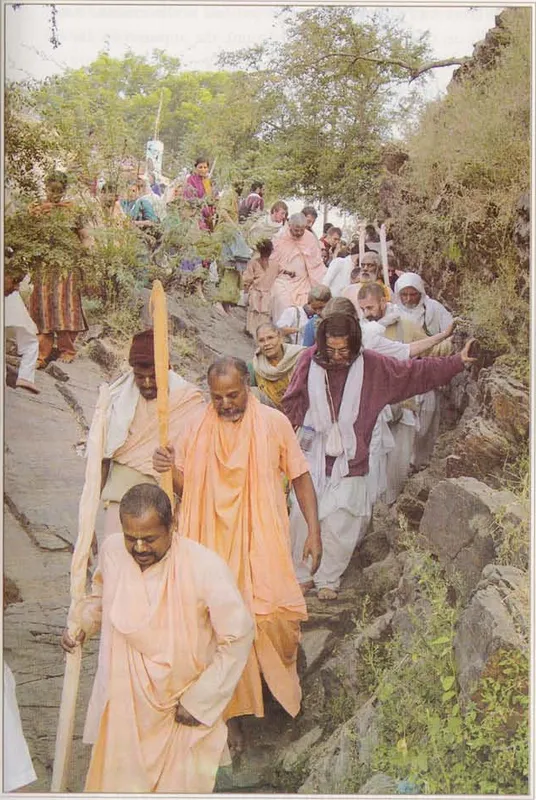
- What it is
- Sāṅkarī-khor, the narrow lane, is the rocky path between the two hills of Varṣāṇā, Brahma-parvata and Viṣṇu-parvata, on the way to Ciksaulī.
- Visiting
- Śrī Vraja-maṇḍala Parikramā (2007) puts Sāṅkarī-khor between Brahma-parvata and Viṣṇu-parvata, north of Ciksaulī; Vṛndāvana-Dhāma Ki Jaya! puts the narrow passage on the path between Varṣāṇā and …
In short
Sāṅkarī-khor, the narrow lane, is the rocky path between the two hills of Varṣāṇā, Brahma-parvata and Viṣṇu-parvata, on the way to Ciksaulī.[1 +3] The Bhakti-ratnākara gives the path this name and says that Śrī Rādhikā played here with Her friends.[5] Śrīla Nārāyaṇa Bhaṭṭa Gosvāmī's Vraja-bhakti-vilāsa remembers it as the place where Kṛṣṇa stopped the gopīs carrying pots of yoghurt on their heads.[6] The guidebooks tell Kṛṣṇa's toll pastime here, and every year a play of it is staged at the spot.[2 +5] The Bhāgavatam does not tell the toll pastime, and the sources set it in different places.[11 +5]
Key facts
| Kind | pass (narrow passage) |
|---|---|
| Region · area | Varṣāṇā |
| Ācāryas | Śrīla Nārāyaṇa Bhaṭṭa Gosvāmī, Śrīla Śrīnivāsa Ācārya, Śrīla Narahari Cakravartī Ṭhākura |
Divine pastimes
What the Bhāgavatam and its commentators say
Śrīmad-Bhāgavatam does not tell Kṛṣṇa's toll pastime, the dāna-līlā. Its commentators read a stopping of the gopīs into the boys' games of the Tenth Canto, without naming a place (summarised here, not translated): Śrīla Sanātana Gosvāmī speaks of the boys blocking the path of the gopīs and taking their yoghurt, Śrīla Viśvanātha Cakravartī Ṭhākura of the boys acting like a king at a toll crossing, and Śrīla Jīva Gosvāmī of a toll on milk products.[11 +5]
They would sometimes jump around like frogs, sometimes play various jokes, sometimes ride in swings and sometimes imitate monarchs.
Translation: Śrīla Prabhupāda's disciples (BBT)The toll on the hillside in the Garga-saṁhitā
The Garga-saṁhitā tells the pastime through Kṛṣṇa Himself, disguised as a woman. Speaking to Rādhā, the "goddess" says that Nanda's son stopped her in the narrow lanes on a hillside as she went to sell yoghurt, demanded a toll, broke her pot, drank the yoghurt and ran off towards Nandīśvara. The text does not name the place, and no source found identifies these lanes with Sāṅkarī-khor.[18 +3]
गोपदेवतोवाच - राधे व्रजन्सानुगिरेस्तटीषु संकोचवीथीषु मनोहरासु । यान्तीं स्वतो मां दधिविक्रयार्थं रुरोध मार्गे नवनन्दपुत्रः ॥ 14 ॥
gopadevatovāca - rādhe vrajansānugirestaṭīṣu saṁkocavīthīṣu manoharāsu
yāntīṁ svato māṁ dadhivikrayārthaṁ rurodha mārge navanandaputraḥ || 14 ||
The same work sets another toll pastime on Govardhana, at a place it calls Droṇa-tīrtha.[22] Read more: Kṛṣṇa's toll pastime (dāna-līlā) at Govardhana and Varṣāṇā →
Traditional accounts
In the Fifth Wave of the Bhakti-ratnākara, Śrīla Rāghava Paṇḍita Gosvāmī of Govardhana shows Śrīla Śrīnivāsa Ācārya the narrow …
The path between the two hills
In the Fifth Wave of the Bhakti-ratnākara, Śrīla Rāghava Paṇḍita Gosvāmī of Govardhana shows Śrīla Śrīnivāsa Ācārya the narrow path between the two hills and tells him (summarised here, not translated): no one can describe the fun that took place on this path; now everyone calls it Sāṁkarikhora. Dāna, Māna and Vilāsa are the three forts on the hills. Here Śrī Rādhikā played many games with Her friends in Her childhood, and at the age between childhood and youth.[5]
পর্ব্বতদ্বয়ের মধ্যে এ সঙ্কীর্ণ পথে। যে কৌতুক তাহা কেহ না পারে কহিতে ॥ এবে এ সাঁকরিখোর নাম সবে কয়। দান মান বিলাস পর্ব্বত গড় ত্রয় ॥ অহে শ্রীনিবাস শ্রীরাধিকা সখী সনে। বাল্যাবেশে নানা খেলা খেলিলা এখানে ॥ রাধিকার অপূর্ব্ব বয়স-সন্ধিকালে এথা মহা উল্লাসে বিলসে সখী মিলে ॥
parbbatadbaẏera madhye e saṅkīrṇa pathe| ye kautuka tāhā keha nā pāre kahite
ebe e sām̐karikhora nāma sabe kaẏa| dāna māna bilāsa parbbata gaṛa traẏa
ahe śrīnibāsa śrīrādhikā sakhī sane| bālyābeśe nānā khelā khelilā ekhāne
rādhikāra apūrbba baẏasa-sandhikāle ethā mahā ullāse bilase sakhī mile ||
The forts it names have their own pages: Dāna-garh, Māna-garh and Vilāsa-garh.[5]
In the Vraja-bhakti-vilāsa
Śrīla Nārāyaṇa Bhaṭṭa Gosvāmī's Vraja-bhakti-vilāsa, citing the Padma Purāṇa, describes the marks of Vṛṣabhānupura and places Sāṅkarī-khor between the two hills named Viṣṇu and Brahma; the passage has not been found in the Padma Purāṇa texts searched.[6 +2] The book then gives a prayer to say on seeing the dance circle and Sāṅkarī-khor (summarised here, not translated): these are the places where the gopīs, with pots of yoghurt on their heads, came and went and were stopped by Kṛṣṇa; one should always bow down to them.[6]
ततो लीलानृत्यमण्डलसांकरीखोरि दर्शन प्रार्थनमन्त्रः— दधिभाजनशीर्षाः स्ताः गोपिकाकृष्णरुन्धिवाः । वासां गमागमौ स्थानौ ताभ्यां नित्यं नमश्चरेत् ॥
tato līlānṛtyamaṇḍalasāṁkarīkhori darśana prārthanamantraḥ— dadhibhājanaśīrṣāḥ stāḥ gopikākṛṣṇarundhivāḥ
vāsāṁ gamāgamau sthānau tābhyāṁ nityaṁ namaścaret ||
The guidebooks' story
According to Śrī Vraja-maṇḍala Parikramā (2007) and the undated parikramā notes Varṣāṇā, Kṛṣṇa and His friends stopped the gopīs here to plunder or tax their milk products. In revenge the gopīs tied the boys' śikhās, their tufts of hair, to the branches of the trees, dressed Kṛṣṇa as a woman and broke a pot of yoghurt on His head with a stone. No older source has been found for the revenge.[2 +2] The guidebook Vṛndāvana-Dhāma Ki Jaya! (c. 1986) records a local tradition, which is not certain, that the stones here bear the marks of the pots that Kṛṣṇa broke.[3]
Śrīla Prabhupāda
Śrīla Prabhupāda's words found for this place are general.
Śrīla Prabhupāda's words found for this place are general. Explaining the toll pastime in the Caitanya-caritāmṛta, he sets it at the place where Rādhā crosses the Yamunā; the guidebook Vṛndāvana-Dhāma Ki Jaya! quotes this purport for Sāṅkarī-khor.[28 +1]
General teaching (does not name the place)“Being a cowherd girl, Śrīmatī Rādhārāṇī regularly carries milk in a container and often goes to sell the milk on the other side of the Yamunā. To cross the river, She has to pay the boatman, and the spot where the boatman collects his fares is called the dāna-ghāṭi.”
Śrīla Prabhupāda, Śrī Caitanya-caritāmṛta, Madhya-līlā 14.173, purport · vedabase.io
Visiting today
Śrī Vraja-maṇḍala Parikramā (2007) puts Sāṅkarī-khor between Brahma-parvata and Viṣṇu-parvata, north of Ciksaulī; Vṛndāvana-Dhāma Ki Jaya! puts the narrow passage on the path between Varṣāṇā and Ciksaulī.[1 +3] The būḍhī-līlā is staged here every year on the thirteenth day of the bright half of Bhādra, and today also on Rādhāṣṭamī, Śrī Rādhā's appearance day, according to the 2007 guidebook.[2 +4] In 1987 Entwistle found Holī, Rādhāṣṭamī and the būḍhī-līlā plays the best-attended festivals of Varṣāṇā.[30]
Location
| Where it is | between Brahma-parvata and Viṣṇu-parvata; north of Ciksaulī; map: at the west foot of Viṣṇu-parvata in the gap between the hills[32] on the path between Varṣāṇā and Citra[33] |
|---|
Nearby places
Brahma-parvata · Viṣṇu-parvata · Ciksaulī · Varṣāṇā
Pictures
2 pictures
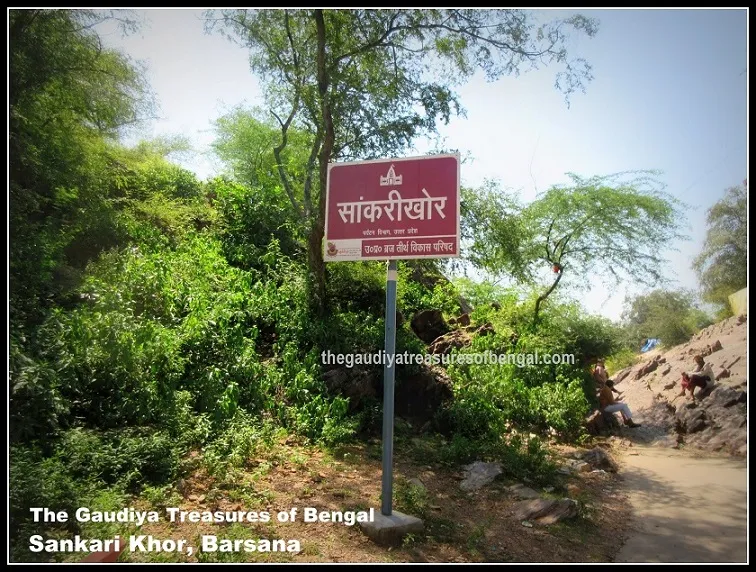
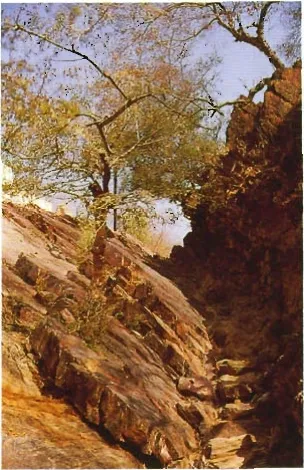
History
The historian A. W. Entwistle (1987) reports that a verse of Nehī Nāgarīdās, a poet of the Rādhāvallabha tradition who settled at Varṣāṇā in the late sixteenth century, already names Sāṅkarī-khor, with Gahvaravana, Vilāsa-garh and the hill-top temple of Rādhā. Entwistle knew the verse only from other books that quote it.[27]
The būḍhī-līlā, a yearly play of Kṛṣṇa's pastimes, is staged here. Śrī Vraja-maṇḍala Parikramā says that Śrīla Nārāyaṇa Bhaṭṭa Gosvāmī began it, and Entwistle (1987) described the yearly re-enactment of the toll pastime here and thought that Śrīla Nārāyaṇa Bhaṭṭa Gosvāmī probably began it.[2 +4] The modern introduction to the Hindi edition of the Vraja-bhakti-vilāsa counts Sāṅkarī-khor among the holy places of Varṣāṇā that Śrīla Nārāyaṇa Bhaṭṭa Gosvāmī brought to light; this is the editor's report of a tradition, and it is not certain.[25]
Where the sources differ
Where Kṛṣṇa stopped the gopīs for a toll: at Sāṅkarī-khor and on the hill of Varṣāṇā, according to the Bhakti-ratnākara, the …
Where Kṛṣṇa stopped the gopīs for a toll: at Sāṅkarī-khor and on the hill of Varṣāṇā, according to the Bhakti-ratnākara, the Vraja-bhakti-vilāsa and the 2007 guidebook; on Govardhana, according to the Garga-saṁhitā and the plays and poems of Śrīla Rūpa Gosvāmī and Śrīla Raghunātha dāsa Gosvāmī; or at a crossing of the Yamunā, as Śrīla Prabhupāda explains the Caitanya-caritāmṛta. The accounts are set out on the page of Dāna-garh.[6 +5]
More on this place
Kṛṣṇa's toll pastime (dāna-līlā) at Govardhana and Varṣāṇā
References
33 references
- Śrī Vraja-maṇḍala Parikramā (2007), PDF p. 171
- Śrī Vraja-maṇḍala Parikramā (2007), PDF p. 172
- Vṛndāvana-Dhāma Ki Jaya! (c. 1986), by Dhruva Mahārāja dāsa, PDF p. 48
- the undated parikramā notes Varṣāṇā, ¶15
- Śrīla Narahari Cakravartī, Bhakti-ratnākara, Fifth Wave, 1912 ed. p. 218; Grantha Mandira text v.893–896, 2nd ed., 1912
- Śrīla Nārāyaṇa Bhaṭṭa, Vraja-bhakti-vilāsa, ch. 4 v.60 (prayer on seeing the līlā-nṛtya-maṇḍala and Sāṅkarī-khor), printed p. 101, 1st ed., publ. Bābā Kṛṣṇadāsa, Kusuma-sarovara, Saṁvat 2008
- Śrī Vraja-maṇḍala Parikramā (2007), PDF p. 173
- Śrī Vraja-maṇḍala Parikramā (2007), PDF p. 188
- A. W. Entwistle, §37, item 3 'Sankari Khori', printed p. 372, Egbert Forsten, Groningen, 1987
- A. W. Entwistle, printed p. 167, Egbert Forsten, Groningen, 1987
- Śrīmad-Bhāgavatam 10.18.14, Bhagavata Vidya Pith edition, ed. Bhagavata Rishi and Krishna Shankar Shastri, 1996
- Śrīla Sanātana Gosvāmī: commentary v.10.18.14, sanātana-gosvāmī (bṛhad-vaiṣṇava-toṣaṇī), Bhagavata Vidya Pith edition, ed. Bhagavata Rishi and Krishna Shankar Shastri, 1996
- Śrīmad-Bhāgavatam 10.18.15, Bhagavata Vidya Pith edition, ed. Bhagavata Rishi and Krishna Shankar Shastri, 1996
- Śrīla Viśvanātha Cakravartī Ṭhākura: commentary on ŚB 10.18.15, Bhagavata Vidya Pith edition, ed. Bhagavata Rishi and Krishna Shankar Shastri, 1996
- Śrīmad-Bhāgavatam 10.35.14–15, Bhagavata Vidya Pith edition, ed. Bhagavata Rishi and Krishna Shankar Shastri, 1996
- Bṛhat-krama-sandarbha: commentary on ŚB 10.35.14–15, Bhagavata Vidya Pith edition, ed. Bhagavata Rishi and Krishna Shankar Shastri, 1996
- Śrīmad-Bhāgavatam 10.18.15, Bhagavata Vidya Pith edition, ed. Bhagavata Rishi and Krishna Shankar Shastri, 1996
- Garga-saṁhitā, Vṛndāvana-khaṇḍa (2) 18.14, Sanskrit Wikisource
- Garga-saṁhitā, Vṛndāvana-khaṇḍa (2) 18.15–16, Sanskrit Wikisource
- Garga-saṁhitā, Vṛndāvana-khaṇḍa (2) 18.17, Sanskrit Wikisource
Show all 33 references
- Garga-saṁhitā, Vṛndāvana-khaṇḍa (2) 18.1, Sanskrit Wikisource
- Garga-saṁhitā, Girirāja-khaṇḍa (3), adhyāya 7, verses 15-16, Sanskrit Wikisource
- Śrīla Narahari Cakravartī, Bhakti-ratnākara, Fifth Wave, 1912 ed. p. 218; Grantha Mandira text v.893–896, 2nd ed., 1912
- Śrīla Nārāyaṇa Bhaṭṭa, Vraja-bhakti-vilāsa, ch. 2 v.47 ('ततो वृपभानुपुरलिंगानि', 'pādme'), printed p. 46, 1st ed., publ. Bābā Kṛṣṇadāsa, Kusuma-sarovara, Saṁvat 2008
- Vraja-bhakti-vilāsa, introduction, 1st ed., publ. Bābā Kṛṣṇadāsa, Kusuma-sarovara, Saṁvat 2008
- Śrīla Nārāyaṇa Bhaṭṭa, Vraja-bhakti-vilāsa, ch. 4 v.60 (prayer on seeing the līlā-nṛtya-maṇḍala and Sāṅkarī-khor), printed p. 101, 1st ed., publ. Bābā Kṛṣṇadāsa, Kusuma-sarovara, Saṁvat 2008
- A. W. Entwistle, §37 'Barsana', printed p. 370, Egbert Forsten, Groningen, 1987
- Śrīla Prabhupāda, Śrī Caitanya-caritāmṛta, Madhya-līlā 14.171, translation · vedabase.io
- Śrīla Prabhupāda, Śrī Caitanya-caritāmṛta, Madhya-līlā 14.173, purport · vedabase.io
- A. W. Entwistle, §37 'Barsana', printed p. 371, Egbert Forsten, Groningen, 1987
- Śrīla Narahari Cakravartī, Bhakti-ratnākara, Fifth Wave, printed p. 218 (1912 edition), 2nd ed., 1912
- Śrī Vraja-maṇḍala Parikramā (2007), p. 318-319
- Vṛndāvana-Dhāma Ki Jaya! (c. 1986), by Dhruva Mahārāja dāsa, p. 30