The rāsa-maṇḍalas of Rādhā-kuṇḍa
रास-मण्डल (राधा-कुण्ड के दक्षिण में) Hindi name proposed
- What it is
- A rāsa-maṇḍala is a circle or platform that marks a place of the rāsa, Kṛṣṇa's dance with the gopīs, the cowherd girls.
- Visiting
- Śrī Vraja-maṇḍala Parikramā (2007) lists six rāsa-maṇḍalas of Rādhā-kuṇḍa and adds that Rāsavāḍī-ghāṭa is the location of a rāsa-maṇḍala too.
In short
A rāsa-maṇḍala is a circle or platform that marks a place of the rāsa, Kṛṣṇa's dance with the gopīs, the cowherd girls. The guidebook Śrī Vraja-maṇḍala Parikramā (2007) lists six rāsa-maṇḍalas at Rādhā-kuṇḍa and says that Rāsavāḍī-ghāṭa is the location of a rāsa-maṇḍala too, which no older source confirms, so it is not certain; this page describes all seven places, each under its own heading.[1 +1] The book gives no story for any of them, and no older text names these spots.[1 +4] The Canto 10 commentators tell of a rāsa at Govardhana on the night Kṛṣṇa killed the bull-demon Ariṣṭa, when the two kuṇḍas appeared, and the Caitanya-caritāmṛta speaks of a rāsa on the bank of Rādhā-kuṇḍa; none of them names a bank or a spot.[3 +4]
Key facts
| Kind | rāsa-sthalī |
|---|---|
| Region · area | Rādhā-kuṇḍa |
| Also part of | Rādhā-kuṇḍa (village) |
Divine pastimes
The rāsa of the Bhāgavatam
Śrīmad-Bhāgavatam (10.29–33) tells the rāsa dance of the autumn nights. Kṛṣṇa took the gopīs to the sandy bank of the Yamunā and began the dance there, the gopīs arrayed in a circle. The Bhāgavatam calls that circle the rāsa-maṇḍala, but it does not set this rāsa at Govardhana, at Rādhā-kuṇḍa or at Śyāma-kuṇḍa.[8 +6]
valayānāṃ nūpurāṇāṃ kiṅkiṇīnāṃ ca yoṣitām / sa-priyāṇām abhūc chabdas tumulo rāsa-maṇḍale
A tumultuous sound arose from the armlets, ankle bells and waist bells of the gopīs as they sported with their beloved Kṛṣṇa in the circle of the rāsa dance.
Translation: Śrīla Prabhupāda's disciples (BBT)About this place: Does not name the place. This is the Bhāgavatam's own use of the word rāsa-maṇḍala, 'the circle of the rāsa dance', for the dance on the Yamunā's bank.
Śrīla Prabhupāda retells the dance in his Kṛṣṇa book, on the bank of the Yamunā in the autumn moonlight:[8 +3]
General teaching (does not name the place)“After this, the Supreme Personality of Godhead began His rāsa dance. A dance in the midst of many girls is called a rāsa dance. … While strolling on the bank of the Yamunā, Kṛṣṇa recited various kinds of poetry. He thus enjoyed the company of the gopīs in the soothing moonlight of autumn.”
Śrīla Prabhupāda, Kṛṣṇa, the Supreme Personality of Godhead (Kṛṣṇa book), Chapter 33, 'Description of the Rāsa Dance' · vedabase.io
Closing the account (10.33.25), the Bhāgavatam says that Kṛṣṇa enjoyed all those moonlit nights. Śrīla Jīva Gosvāmī reads this to include the nights of the other seasons, sometimes with the rāsa, and Śrīla Viśvanātha Cakravartī Ṭhākura the nights of all twelve months in Vṛndāvana; neither names a place (summarised here, not translated).[13 +1]
The rāsa on the night of Ariṣṭa
Śrīmad-Bhāgavatam (10.36) tells how the bull-demon Ariṣṭa came to the cowherd village, tearing up the earth with his hooves, and how Kṛṣṇa seized him by the horns and killed him. Then Kṛṣṇa entered the village with Balarāma. The Bhāgavatam names no kuṇḍa and tells no rāsa that night.[16 +3]
Having thus killed the bull demon Ariṣṭa, He who is a festival for the gopīs’ eyes entered the cowherd village with Balarāma.
Translation: Śrīla Prabhupāda's disciples (BBT)Śrīla Prabhupāda's Kṛṣṇa book tells the same, here as a general retelling of the chapter:[16 +3]
General teaching (does not name the place)“Once a demon named Ariṣṭāsura entered the village in the form of a great bull with a gigantic body and huge horns, digging up the earth with his hooves. … after digging up the earth on the riverside, he entered the village proper. … With Balarāma, He triumphantly entered Vṛndāvana village”
Śrīla Prabhupāda, Kṛṣṇa, the Supreme Personality of Godhead (Kṛṣṇa book), Chapter 36, 'Kaṁsa Sends Akrūra for Kṛṣṇa' · vedabase.io
The Viṣṇu Purāṇa says that Ariṣṭa came at dusk, when Kṛṣṇa was intent on the rāsa.[20 +1] Following it and the Harivaṁśa, the Canto 10 commentators add more (summarised here, not translated). Śrīla Sanātana Gosvāmī says that water rose at the blow of Kṛṣṇa's heel and became Ariṣṭa-kuṇḍa, that Rādhā then made another kuṇḍa which the Lord named after Her, and, citing the Harivaṁśa, that a rāsa took place that night too.[3] Śrīla Jīva Gosvāmī says that Kṛṣṇa went out again for the rāsa with Śrī Rādhikā and the others and spoke with Her on the path of the rāsa, where Ariṣṭa had been killed, and that there Rādhā made Her kuṇḍa with the help of a hundred thousand sakhīs by clearing away the earth that his hooves had crushed; on the next verse he calls it the rāsa at Govardhana, in the middle of spring.[3 +7] The commentators also say that Ariṣṭa came at dusk, when Kṛṣṇa had set out for the rāsa, and Vaṁśīdhara says that Kṛṣṇa came to the frightened people from the place of the rāsa at Govardhana.[5 +1]
Śrīla Viśvanātha Cakravartī Ṭhākura sets down the story of the two kuṇḍas in twenty verses. In them Rādhā's friends find a ditch made by Ariṣṭa's hooves just west of Kṛṣṇa's kuṇḍa and dig out a lake there with their own hands; in the last verse Kṛṣṇa holds a rāsa festival there that night. The BBT edition, translated by Śrīla Prabhupāda's disciples, renders "there" as "at Rādhā-kuṇḍa"; the verse names no bank or spot.[3 +3]
‘I must create an even more beautiful pond. So go to work!’ Having heard these words, the gopīs saw that Ariṣṭāsura’s hooves had dug a shallow ditch just west of Śrī Kṛṣṇa’s pond. … At that nearby spot, all the gopīs began digging up lumps of soft mud with their hands, and in this way a divine pond manifested in the short span of an hour. Kṛṣṇa was astonished to see the lake they produced. … That night Lord Kṛṣṇa initiated a rāsa dance at Rādhā-kuṇḍa, generating a torrent of the greatest mood of splendorous pleasure.
Translation: Śrīla Prabhupāda's disciples (BBT)In his Gopāla-campū (Pūrva 31) Śrīla Jīva Gosvāmī tells of a spring rāsa at Govardhana on the night that ended the subduing of Ariṣṭa, with a rāsa circle shining with jewels. At the pond that Rādhā made the next morning, he says, Hari sports with Her sometimes in the water, sometimes on the bank, in a kuñja, and at times in the rāsa circle. He names no side of the kuṇḍa, no bank and no ghāṭa.[30 +2] Read more: The spring rāsa at Govardhana: Pārāsaulī, Candra-sarovara and Paiṭhā → “How Rādhā-kuṇḍa appeared: the accounts side by side”
A rāsa at Rādhā-kuṇḍa
In the Caitanya-caritāmṛta (Madhya 18.9), Śrī Caitanya Mahāprabhu prays to Rādhā-kuṇḍa, the lake where Kṛṣṇa and Rādhā sport in the water every day and dance the rāsa on its bank:[7]
General teaching (does not name the place)“In that lake, Lord Kṛṣṇa and Śrīmatī Rādhārāṇī used to sport daily in the water and have a rāsa dance on the bank.”
Śrīla Prabhupāda, Śrī Caitanya-caritāmṛta, Madhya-līlā 18.9, translation · vedabase.io
Śrīla Viśvanātha Cakravartī Ṭhākura's Kṛṣṇa-kuṇḍāṣṭaka, eight verses on Kṛṣṇa's kuṇḍa (Śyāma-kuṇḍa), prays in its sixth verse that our home may be there, and names what the youthful Pair do there with Their friends: swinging, the wonderful rāsa dance, singing and music, hide-and-seek and mock fights with flowers (summarised here, not translated). It speaks of the whole kuṇḍa and names no spot on its banks.[33 +1] The Bengali Kuñja-varṇana, ascribed to Śrīla Narottama dāsa Ṭhākura (the ascription is doubtful), says that kuñjas of mādhavī creepers stand at the four corners of the kuṇḍa, with many rāsa pavilions; it gives them no direction or name.[35]
In Śrīla Murāri Gupta's account of Śrī Caitanya's visit, in summary, His guide shows Him a pair of kuṇḍas east of Govardhana and a rāsa-maṇḍala, the place of Rādhā and Kṛṣṇa's rāsa, beside them. On which side it lay rests on wording that the only edition read does not make certain, so it is not certain that the verse concerns any of the rāsa-maṇḍalas of the guidebook, and it is not connected with them here.[36]
None of these texts names a bank, a direction, a ghāṭa, a temple or any of the seven places described below, so which rāsa, if any, each of them may recall is not certain.[1 +5]
Visiting today
Śrī Vraja-maṇḍala Parikramā (2007) lists six rāsa-maṇḍalas of Rādhā-kuṇḍa and adds that Rāsavāḍī-ghāṭa is the location of a rāsa-maṇḍala too. It gives no source and no story for any of them, and it does not say whether any two of them may be one place, so each is kept apart below, in the book's order.[1 +1]
South of Rādhā-kuṇḍa
The first, according to the book, is the place of an old rāsa-maṇḍala south of the kuṇḍa, where a pavilion now stands; the book gives no date or builder.[1]
Behind the Govindadeva Mandira
The second lies north-east of Rādhā-kuṇḍa, behind the temple of Śrī Govindadeva, Rādhā-Govinda Mandira (Rādhā-kuṇḍa), which the book's map puts on the north side of Śyāma-kuṇḍa.[1] The book gives only this position. It does not say whether its "Govindadeva temple" is the temple that other guides call Rādhā-Govinda, and no source describes what can be seen here today.[1]
South of Bhānukhora
The third lies in the northern part of the village of Rādhā-kuṇḍa, south of Bhānukhora; the book says nothing more about it.[1]
North of Rādhā-Vallabha-ghāṭa
The fourth is in the northern part of Śyāma-kuṇḍa, north of Rādhā-Vallabha-ghāṭa. The book gives no description, pastime or source for it.[1]
Rādhā-Vallabha-ghāṭa, the landmark the guidebook gives, is not in its own numbered list of the ghāṭas. Three dated works record a baiṭhaka (sitting place) of Śrī Hita Harivaṁśa at the kuṇḍas: the historian Prabhudayāl Mītal (1966) at a Rādhāvallabha-ghāṭa whose bank he does not give, A. W. Entwistle (1987) beside a Rādhāvallabha temple near Pañca-Pāṇḍava-ghāṭa, and Śrī Vraja-maṇḍala Parikramā (2007) at Madhumaṅgala-ghāṭa in the northern part of Śyāma-kuṇḍa. No source says which of these is the guidebook's Rādhā-Vallabha-ghāṭa, and none mentions a rāsa-maṇḍala.[1 +3]
In Nandinī-gherā
The fifth, the book says, is in Nandinī-gherā. It gives no position, description or pastime for it, and no other source found names Nandinī-gherā or a rāsa-maṇḍala there, so where it lies and which rāsa it may recall are not known.[1 +6]
In the Lalitā-bihārī Mandira
The sixth, the book says, is in the temple of Lalita-bihārījī. This is probably the Lalitā-bihārī Mandira of Rādhā-kuṇḍa village, though the list gives no location. That one line is all that is known of the rāsa-maṇḍala: no source describes it, dates it or says which rāsa it recalls.[1]
The temple is named after Lalitā, Śrī Rādhā's friend, and the commentators name her among the gopīs of the rāsa. Śrīla Viśvanātha Cakravartī Ṭhākura and Śrīla Jīva Gosvāmī identify Lalitā and Viśākhā as the two gopīs who sang with Kṛṣṇa and were praised by Him, and in one of his readings Śrīla Sanātana Gosvāmī places Lalitā and Śrī Rādhā at Kṛṣṇa's two sides in the middle of the circle. In the Bhāgavatam that rāsa is by the Yamunā, and no commentator links it with this temple.[40 +3]
Rāsavāḍī-ghāṭa
Rāsavāḍī-ghāṭa is a ghāṭa (bathing steps) in the southern part of Rādhā-kuṇḍa. Śrī Vraja-maṇḍala Parikramā (2007) places a rāsa-maṇḍala here; no older source confirms it, so it is not certain, and the book does not say whether this one and the old rāsa-maṇḍala south of the kuṇḍa may be the same place.[1 +1]
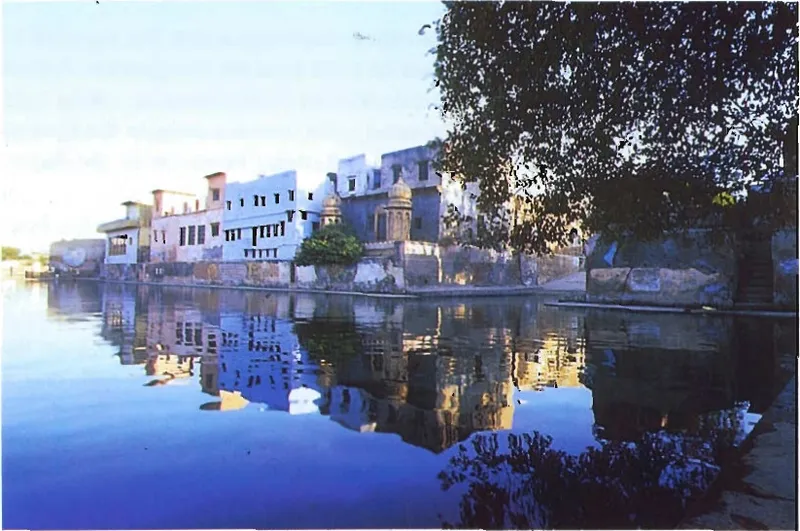
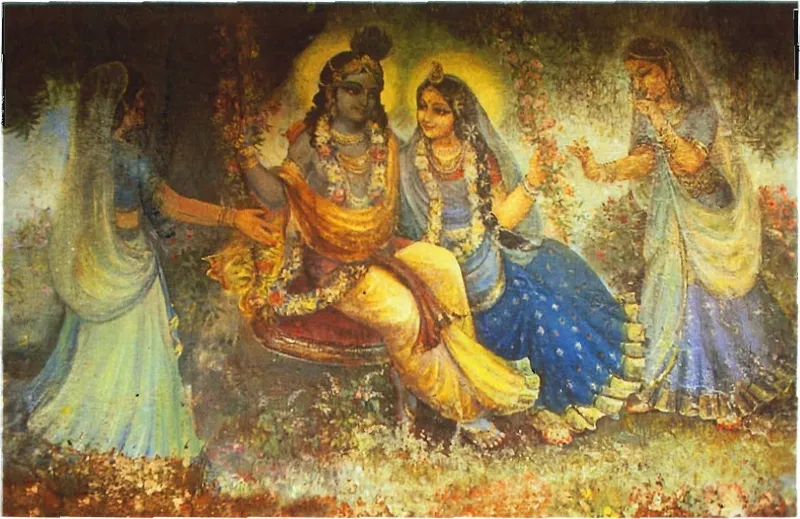
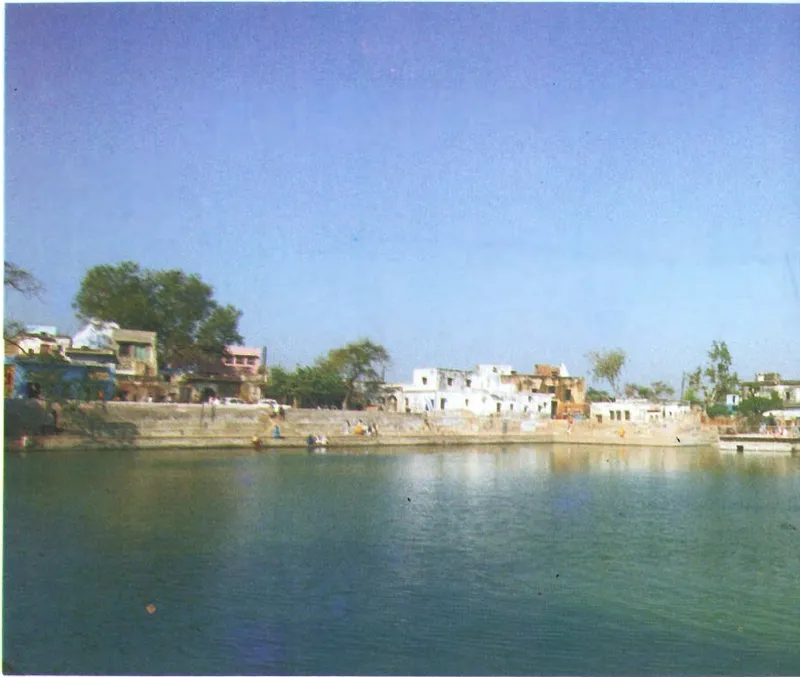
The Colour Guide to Rādhā-kuṇḍa (1999), which spells it Rasavari-ghāṭa, prints a view of Rādhā-kuṇḍa from the ghāṭa, a view of the ghāṭa itself and a painting of Rādhā and Kṛṣṇa "on the wall at Rasavari-ghāṭa". It gives the ghāṭa no story.[44 +2]
Location
Places at Rāsa-maṇḍala (south of Rādhā-kuṇḍa)
6 places
Also described on this page
- Rāsa-maṇḍala (Lalitā-bihārī Mandira, Rādhā-kuṇḍa) rāsa-sthalī
- Rāsa-maṇḍala (Nandinī-gherā) rāsa-sthalī
- Rāsa-maṇḍala (behind the Govindadeva Mandira, Rādhā-kuṇḍa) rāsa-sthalī
- Rāsa-maṇḍala (north of Rādhā-Vallabha-ghāṭa, Śyāma-kuṇḍa) rāsa-sthalī
- Rāsa-maṇḍala (south of Bhānukhora, Rādhā-kuṇḍa) rāsa-sthalī
- Rāsavāḍī-ghāṭa ghāṭa
Nearby places
Rādhā-kuṇḍa
Pictures
1 pictures
Where the sources differ
Which rāsa the rāsa-maṇḍalas of Rādhā-kuṇḍa recall, and where and when the sources set it. The critical edition of the Harivaṁśa reads the verse the commentators cite without the rāsa.[21]
Accounts differ Which rāsa the rāsa-maṇḍalas of Rādhā-kuṇḍa recall: where and when the Bhāgavatam, its Canto 10 commentators, other Vaiṣṇava texts and the guidebook set Kṛṣṇa's rāsa.
- Śrīmad-Bhāgavatam 10.29.1, 10.32.11–12, 10.33.2–5; Kṛṣṇa book ch. 32–33The rāsa dance of the autumn nights, on the sandy bank of the Kālindī (Yamunā); its circle is the rāsa-maṇḍala (10.33.5).
- Śrīmad-Bhāgavatam 10.33.25 with Śrīla Jīva Gosvāmī's and Śrīla Viśvanātha Cakravartī's commentsKṛṣṇa enjoyed all those moonlit nights. Jīva: in the manner of the rāsa every autumn, and in other seasons, on moonlit and dark nights, in secret, sometimes with the rāsa (or, in his second reading, the moonlit nights of spring and the other seasons as a rāsa); Viśvanātha: all the nights of the twelve months, in Śrī Vṛndāvana. …
- Śrīmad-Bhāgavatam 10.36.15; Kṛṣṇa book ch. 36After killing Ariṣṭa, Kṛṣṇa entered the cowherd village with Balarāma; no rāsa that night is told.
- Śrīla Sanātana Gosvāmī, Śrīla Jīva Gosvāmī and Vaṁśīdhara on ŚB 10.36.15 (Harivaṁśa read 'punar eva rarāma')A rāsa also took place on the night Ariṣṭa was killed; Jīva: Kṛṣṇa spoke to Rādhā on the rāsa path where Ariṣṭa had been killed (hatāriṣṭe rāsa-vartmani), where she made her kuṇḍa.
The same question was recorded separately for the places north of Rādhā-Vallabha-ghāṭa, in Nandinī-gherā, in the Lalitā-bihārī Mandira and at Rāsavāḍī-ghāṭa; those records give the same accounts as above, each with the guidebook's line for its place; no older source confirms those lines, so they are not certain.[1 +1]
Who composed the twenty verses on the origin of the two kuṇḍas is also told differently; those accounts are on the Śyāma-kuṇḍa page.[3 +3]
More on this place
The spring rāsa at Govardhana: Pārāsaulī, Candra-sarovara and Paiṭhā · How Rādhā-kuṇḍa appeared: the accounts side by side
References
46 references
- Śrī Vraja-maṇḍala Parikramā (2007), PDF p. 102
- Śrī Vraja-maṇḍala Parikramā (2007), PDF p. 100
- Śrīla Sanātana Gosvāmī: commentary on ŚB 10.36.15, Bhagavata Vidya Pith edition, ed. Bhagavata Rishi and Krishna Shankar Shastri, 1996
- Śrīla Jīva Gosvāmī: commentary on ŚB 10.36.16, Bhagavata Vidya Pith edition, ed. Bhagavata Rishi and Krishna Shankar Shastri, 1996
- Śrīla Sanātana Gosvāmī, Śrīla Jīva Gosvāmī: commentary on ŚB 10.36.1, Bhagavata Vidya Pith edition, ed. Bhagavata Rishi and Krishna Shankar Shastri, 1996
- Vaṁśīdhara (Bhāvārtha-dīpikā-prakāśa): commentary on ŚB 10.36.5–6: Vaṁśīdhara Śrīmad-Bhāgavatam canto 10, part 5, with ten commentaries, Sanātana 306070, Jīva 306071, Bhagavata Vidya Pith edition, ed. Bhagavata Rishi and Krishna Shankar Shastri, 1996
- Śrīla Prabhupāda, Śrī Caitanya-caritāmṛta, Madhya-līlā 18.9, translation · vedabase.io
- Śrīmad-Bhāgavatam 10.32.11-12, GRETIL
- Śrīmad-Bhāgavatam 10.33.2–3, GRETIL
- Śrīmad-Bhāgavatam 10.33.5, GRETIL
- Śrīla Prabhupāda, Kṛṣṇa, the Supreme Personality of Godhead (Kṛṣṇa book), Chapter 33, 'Description of the Rāsa Dance' · vedabase.io
- Śrīmad-Bhāgavatam 10.29.1, GRETIL
- Śrīmad-Bhāgavatam 10.33.25, GRETIL
- Śrīla Prabhupāda, Kṛṣṇa, the Supreme Personality of Godhead (Kṛṣṇa book), Chapter 29, 'The Rāsa Dance: Introduction' · vedabase.io
- Śrīla Jīva Gosvāmī: commentary on ŚB 10.33.25
- Śrīmad-Bhāgavatam 10.36.15, GRETIL
- Śrīla Prabhupāda, Kṛṣṇa, the Supreme Personality of Godhead (Kṛṣṇa book), Chapter 36, 'Kaṁsa Sends Akrūra for Kṛṣṇa' · vedabase.io
- Śrīmad-Bhāgavatam 10.36.1, GRETIL
- Śrīmad-Bhāgavatam 10.36.13, GRETIL
- Viṣṇu Purāṇa, 5.14.1, GRETIL
Show all 46 references
- Harivaṁśa, 64.23, GRETIL
- Varāha Purāṇa, adhyāya 164, verses 31-36, Sanskrit Wikisource
- Śrīla Viśvanātha Cakravartī Ṭhākura: commentary on ŚB 10.36.15, verse xx of the twenty verses, Bhagavata Vidya Pith edition, ed. Bhagavata Rishi and Krishna Shankar Shastri, 1996
- Śrīla Sanātana Gosvāmī: commentary on ŚB 10.36.15: Sanātana Śrīmad-Bhāgavatam canto 10, part 5, with ten commentaries, Jīva 306143, Bhagavata Vidya Pith edition, ed. Bhagavata Rishi and Krishna Shankar Shastri, 1996
- Śrīla Viśvanātha Cakravartī Ṭhākura: commentary on ŚB 10.36.15: the introduction and verse xx of the twenty verses in his comment, Bhagavata Vidya Pith edition, ed. Bhagavata Rishi and Krishna Shankar Shastri, 1996
- Vaṁśīdhara: commentary on the Grantha Mandira's v.10.36.6 = ŚB 10.36.5 (second half) and 10.36.6 (first half) on vedabase: Vaṁśīdhara Śrīmad-Bhāgavatam canto 10, part 5, with ten commentaries, with Jīva Gosvāmī's comment 306071, Bhagavata Vidya Pith edition, ed. Bhagavata Rishi and Krishna Shankar Shastri, 1996
- Verses quoted 'from the Purāṇas' by Śrīla Viśvanātha Cakravartī Ṭhākura, ŚB 10.36.16, purport: the 20th (last) of the verses quoted, online edition · vedabase.io
- Purāṇic verses quoted by Viśvanātha Cakravartī Ṭhākura, ŚB 10.36.16, purport, online edition · vedabase.io
- Śrīla Viśvanātha Cakravartī Ṭhākura: commentary on ŚB 10.36.15, Bhagavata Vidya Pith edition, ed. Bhagavata Rishi and Krishna Shankar Shastri, 1996
- Śrīla Jīva Gosvāmī, Gopāla-campū, Pūrva-campū, pūraṇa 31: verse 31.51, prose [80] with its verse and verse 31.53, GRETIL
- Śrīla Jīva Gosvāmī, Gopāla-campū, Pūrva-campū, pūraṇa 31: verse 31.56, prose [82] with verse 31.57, and verse 31.58, GRETIL
- Śrīla Jīva Gosvāmī, Gopāla-campū, Pūrva-campū, pūraṇa 31 ('nānā-rāga-vicitra-caritra-citram'), ¶[82] with v.57, and ¶[84] v.58
- Śrīla Viśvanātha Cakravartī Ṭhākura, Śrī Kṛṣṇa-kuṇḍāṣṭaka, verse 6 (the index counts the hymn as 'part 26' of the Stavāmṛta-laharī)
- Śrīla Viśvanātha Cakravartī Ṭhākura, Kṛṣṇa-kuṇḍāṣṭaka, verse 6
- Kuñja-varṇana, c.48, in the description of Śrī-kuṇḍa announced in c.35, after the Calcutta University edition, 1975
- Kṛṣṇa-caitanya-caritāmṛta of Murāri Gupta, prakrama 4, sarga 8, vv.8-9
- Prabhudayāl Mītal, 'Braj-yātrā', fourth halt (Rādhā-kuṇḍa and Kusuma-sarovara): 'Rādhā-kuṇḍa', printed p. 104
- A. W. Entwistle, ch. 8, gazetteer entry '12 Radhakund' (Govardhana area), printed p. 340, Egbert Forsten, Groningen, 1987
- Śrī Vraja-maṇḍala Parikramā (2007), PDF p. 97
- Śrīmad-Bhāgavatam 10.33.9, GRETIL
- Śrīla Viśvanātha Cakravartī Ṭhākura (Sārārtha-darśinī) and Baladeva Vidyābhūṣaṇa (Vaiṣṇavānandinī): commentary on ŚB 10.33.9: Viśvanātha Śrīmad-Bhāgavatam canto 10, part 4, with commentaries, Baladeva 305267
- Śrīla Jīva Gosvāmī: commentary on ŚB 10.33.10
- Śrīla Sanātana Gosvāmī: commentary on ŚB 10.33.13
- The Colour Guide to Rādhā-kuṇḍa (1999), Rājaśekhara dāsa Brahmacārī, PDF p. 30
- The Colour Guide to Rādhā-kuṇḍa (1999), Rājaśekhara dāsa Brahmacārī, PDF p. 107
- The Colour Guide to Rādhā-kuṇḍa (1999), Rājaśekhara dāsa Brahmacārī, PDF p. 108