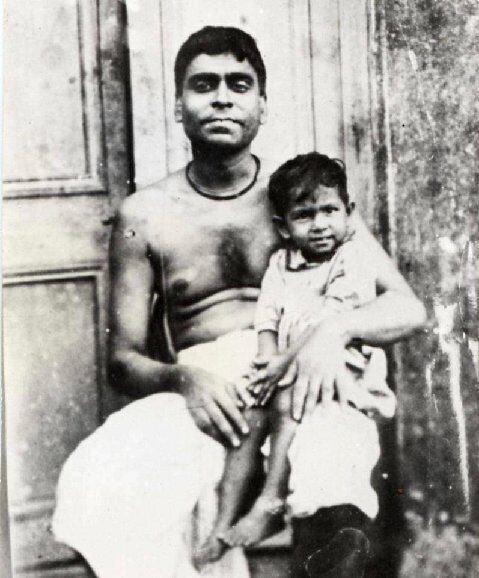
Bhaktivinoda Thakura's devotional and literary life unfolded, from beginning to end, inside a large and demanding household. He married twice and fathered fourteen children. He never withdrew from family responsibility, even as his writing and preaching expanded. Among his children was the son who would become Srila Bhaktisiddhanta Sarasvati Thakura, the next acharya in the line that leads to Srila Prabhupada and ISKCON.
| First wife | Shyamani Mitra of Ranaghat, married 1850, died 1861 |
| Second wife | Bhagavati Devi, daughter of Gangamoy Roy of Jakpore |
| Children | 14 total: 1 by Shyamani, 13 by Bhagavati Devi |
| Most noted son | Bimala Prasad (born 1874), later Bhaktisiddhanta Sarasvati Thakura |
| Family home | "Bhakti Bhavan," Maniktola Street, Calcutta |
Two Marriages #
As described on the first page of this section, Kedarnath's first marriage was arranged in the customary way in 1850, when he was twelve. His bride was five-year-old Shyamani Mitra of Ranaghat, daughter of Madhusudana Mitra. They had one son, Annada Prasad, born in 1860. Shyamani died the next year, and Kedarnath was left a widower at twenty-three. Soon after, he married again. His second wife was Bhagavati Devi, daughter of Gangamoy Roy of Jakpore. She became the mother of his other thirteen children, and his companion for the rest of his working and devotional life. She lived six years longer than her husband and died in 1920. Bhagavati Devi shared her husband's courage as well as the burdens of his household. During Bisakisen's trial the family was threatened. At that time she pleaded with Bhaktivinoda only because she feared for their children's safety. She never doubted that he was right to carry the case through to its end.
Fourteen Children #
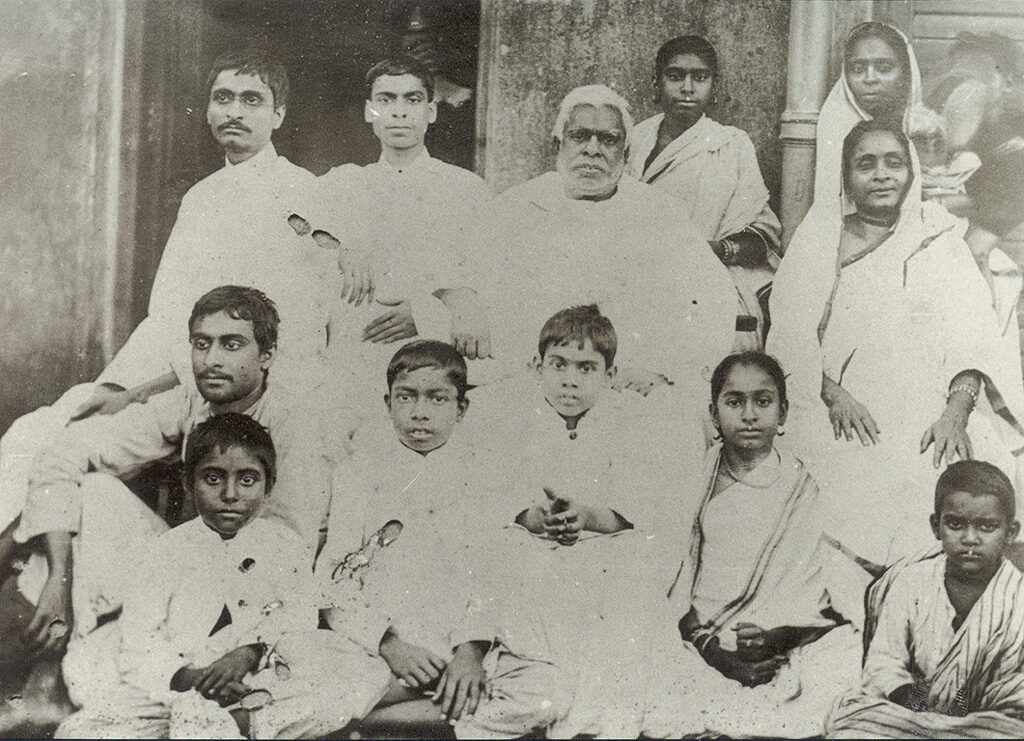
Between 1860 and 1891, Bhaktivinoda's household grew to fourteen children from his two marriages. Shyamani was the mother of Annada Prasad. Bhagavati Devi was the mother of Saudamani, Kadambini, a son who died in infancy, Radhika Prasad, Kamala Prasad, Bimala Prasad, Barada Prasad, Biraja Prasad, Lalita Prasad, Krishna Vinodini, Shyam Sarojini, Hari Pramodini, and Shailaja Prasad. A family photograph from around 1900 shows three generations gathered together. It was taken after Bhaktivinoda had settled his household at "Bhakti Bhavan" on Maniktola Street in Calcutta. It shows how large and settled the household had become in his later years, even as his devotional and literary work grew around it. During the years Bhaktivinoda was posted at Jagannatha Puri, the whole family lived together under one roof. He mentions this with clear satisfaction in his autobiography. His mother, his wife, and children including Annada, Radhika, Sadu and Kadu were all there. They received regular darshan of Lord Jagannatha as a normal part of daily life, not as a special pilgrimage. It was an unusually settled period in a career that was mostly marked by frequent transfers. Several of the sons went on to play their own roles in Gaudiya Vaishnava life. Bhaktivinoda wrote his autobiography, Svalikhita-jivani, in 1896 at the request of his son Lalita Prasad. After his father's passing, Lalita Prasad kept his own following, separate from the line that continued through his brother. But it was Bimala Prasad, the sixth child by Bhagavati Devi, who carried Bhaktivinoda's own work forward in the most lasting way, through an institution.
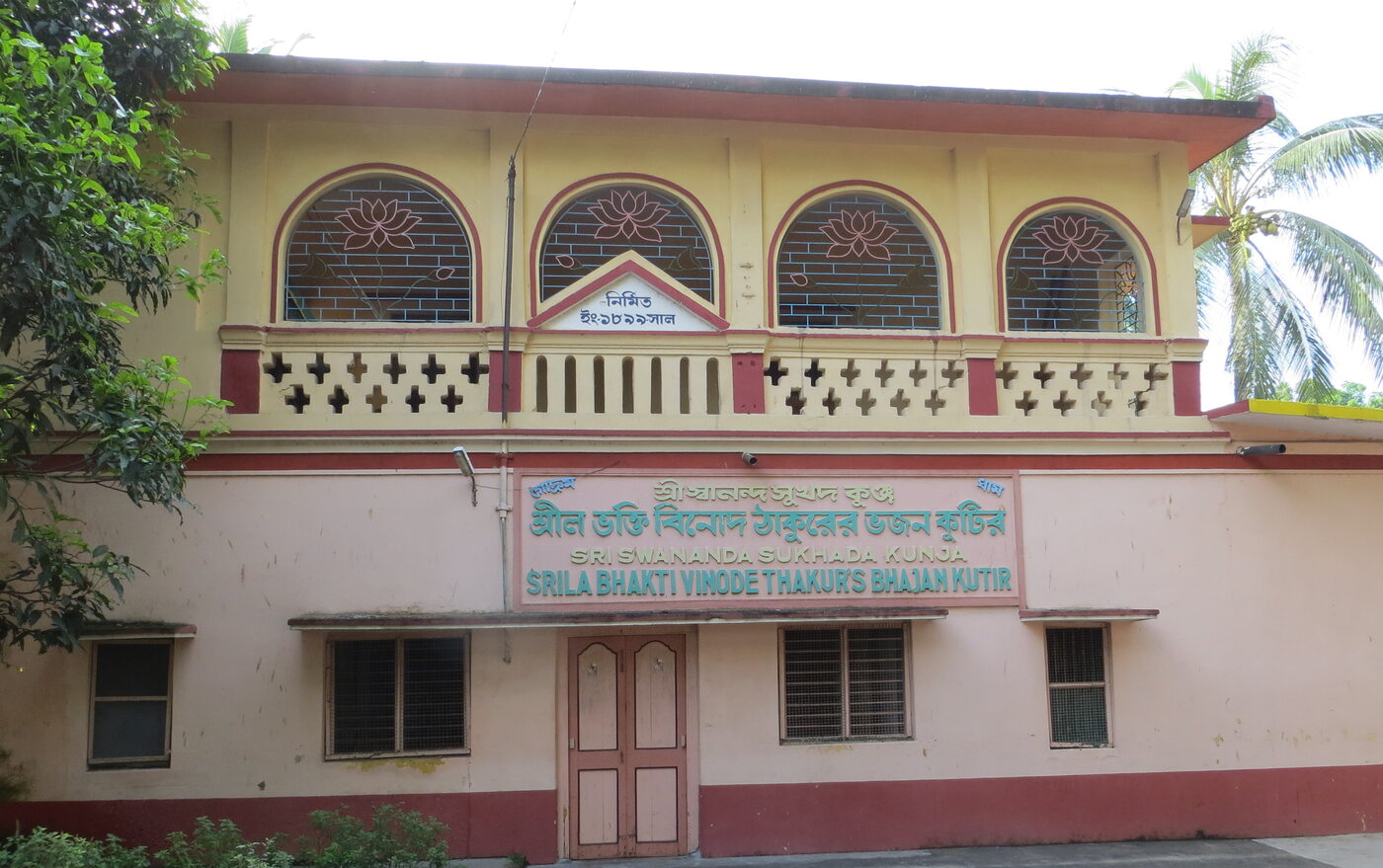
Bimala Prasad, the Seventh Child and Chosen Successor #
Bimala Prasad was born in February 1874 in Puri, during Bhaktivinoda's posting there as a magistrate. From childhood he showed the strong memory and discipline that his father's biographers speak of so much. By nine he had reportedly memorized the seven hundred verses of the Bhagavad-gita in Sanskrit. He kept an exceptional ability to recall texts, even decades after he had read them. Bhaktivinoda personally initiated him into chanting the Hare Krishna mantra, and taught him Sanskrit and the main Gaudiya philosophical texts. As the boy grew up, his father more and more treated him as the one who could carry on the work of restoring true Gaudiya Vaishnava teaching in the next generation. In 1911 there was a public theological debate in Balighai, Midnapore. The question was whether spiritual qualification came from caste birth or from initiation and practice. Bhaktivinoda did not go himself. He sent Bimala Prasad to represent the family's position. Bimala Prasad won the debate convincingly. He later took the name by which he is known today, Bhaktisiddhanta Sarasvati Thakura, and founded the Gaudiya Math. In time, this missionary institution sent out A.C. Bhaktivedanta Swami Prabhupada, the disciple who carried this teaching to the West.
A Householder's Discipline #
What is recorded of Bhaktivinoda's daily life shows a man who would not treat family duty, government service, and devotional writing as rivals for his time. Instead, he fitted all three into one very demanding daily schedule. According to later accounts of his household routine, he went to bed in the early evening and rose again around ten at night. He then wrote for about six hours. After that he took a short nap and rose before dawn to chant. His mornings were for letters, study, and visitors. The working day itself, often ten hours long, was spent in court as a magistrate. He raised his large family and met his duties as a government officer for twenty-eight years. Still, he produced all the writing described on the Literary Works page. In all his working life he never gave up his household or professional duties. In 1908, at the age of seventy, he had retired and his children were grown. Only then, at his house in Calcutta, did he formally take up the dress and practice of a babaji, a Vaishnava renunciant. He spent his final years absorbed in chanting, no longer in the duties of office and household that had filled most of his adult life.
