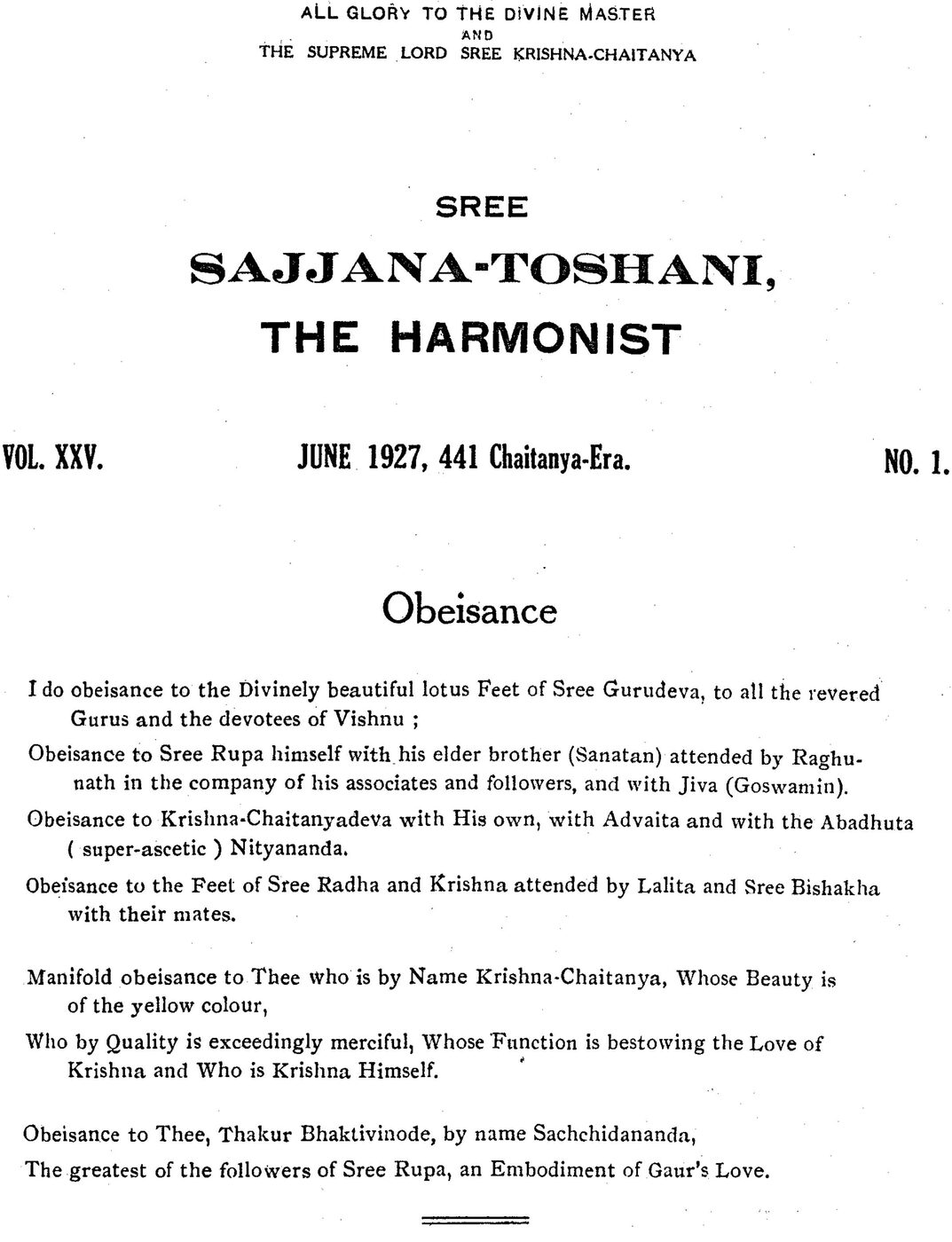
Across roughly four decades, Bhaktivinoda Thakura produced more than one hundred works, as his bibliographers count them. They include books of philosophy, commentaries on scripture, a novel that teaches theology, collections of devotional songs, and years of essays and serialized stories in a magazine he edited himself. Most of this writing was done in the hours before dawn, around a full-time career as a magistrate. What makes it different from most traditional Vaishnava writing of its time is not mainly its size. It is the readers it was written for. Much of it was written, deliberately, for readers who did not already believe.
| Total output | over 100 books, essays, translations, and song collections |
| Major theological treatise | Krishna-samhita (1879) |
| Novel-form treatise | Jaiva Dharma (1896) |
| Song collections | Kalyana-kalpataru (1881), Saranagati (1893), Gitavali (1893) |
| Monthly magazine | Sajjana-toshani, edited 1881-1909 |
An Output Without Precedent #
Bhaktivinoda wrote in Sanskrit, Bengali, and English, and he moved easily between different kinds of writing. He wrote formal philosophical argument, scriptural commentary, devotional poetry, and prose fiction built to carry theology inside a story. Many of his books first appeared in parts in Sajjana-toshani, the Bengali monthly he founded in 1881 and continued to edit until 1909. Only later were they gathered into single volumes. He also wrote long commentaries. One of them, the Amrita-pravaha-bhashya, is a Bengali commentary on the Chaitanya-caritamrita itself. He also wrote shorter works on the Chaitanya-upanishad and on the Siksastakam, Chaitanya Mahaprabhu's own eight verses of instruction. He could cover this wide range because of the way he worked for decades. After a full day's government duties, he wrote through the night, on whatever subject his preaching needed at the time. His very first Sanskrit composition was written years earlier, in 1874, while he was still posted at Jagannatha Puri. It was a 104-verse work on Vaishnava philosophy called Datta-kaustubha. This fairly small work shows how far his writing would grow over the following three decades.
Given the Name Bhaktivinoda #
He was named Kedaranatha at birth, after Lord Shiva. The world now remembers him by the title Bhaktivinoda, meaning "the pleasure of devotional service," and he received this title only later, during these same years of tireless preaching and publishing. A senior acharya of the tradition formally gave him the title in a Sanskrit letter. Kedarnath replied to him in the same way, and he accepted the title as a gift, not as something to boast about: "The masters had given the title Bhaktivinoda to me, and this was also the desire of Mahaprabhu." From then on his own writing appears under the name Srila Bhaktivinoda Thakura, the name used throughout the rest of this section.
Krishna-samhita: Answering the Skeptics #
His first major work, Krishna-samhita, was published in 1879. In it he spoke most directly to the educated world he had grown up in. British education and the criticism of Christian missionaries had changed Bengali bhadralok society. Many of them had come to see the Krishna of the Bhagavata Purana as a figure of doubtful morals, not fit for a rational age. Bhaktivinoda answered them with the kind of reasoning they themselves respected. He brought together the historical and archaeological arguments of his day with Vaishnava theology. With them he defended the truth that Krishna is a Person, and he showed that Krishna-worship is reasonable and consistent. He called this method adhunika-vada, "the contemporary approach." What he was defending was never a devotional decoration that could be bargained away. It is what Srimad-Bhagavatam itself states plainly, that every other incarnation is a portion of the Lord but "Lord Krishna is the original Personality of Godhead" (Srimad-Bhagavatam 1.3.28). Krishna-samhita was written to make exactly this conclusion believable to a generation trained to doubt it. The book found an audience beyond India almost immediately. In 1880 Bhaktivinoda sent copies to Western scholars, and received responses from both the London Sanskritist Reinhold Rost and the American writer Ralph Waldo Emerson, an episode taken up more fully on the page devoted to his final years.
Chaitanya-siksamrta and the Life of Chaitanya #
In 1886 Bhaktivinoda published Chaitanya-siksamrta, a systematic summary of Chaitanya Mahaprabhu's teachings together with his own social and theological commentary. It was meant for readers who wanted the main points of Gaudiya teaching without having to struggle through difficult medieval Sanskrit commentaries. His reputation as a defender of Krishna's full divinity reached even the literary world of Calcutta. The celebrated novelist Bankim Chandra Chattopadhyay had just finished his own book on Krishna, Krishna-charita, and he sought Bhaktivinoda out to review it. Krishna-charita was written very much in the rationalist style of the age. It portrayed Krishna as an admirable historical man, not as the Supreme Personality of Godhead. For four days, taking little food or rest, Bhaktivinoda argued the point from scripture. At last Bankim Chandra agreed to revise the passages that had gone furthest wrong. Scholars would later criticize Bankim Chandra for treating some Puranic material as literal history rather than legend. In its own way, Bhaktivinoda might have taken this criticism as a sign of success. His whole aim in those four days had been to convince Bankim Chandra that Krishna's transcendental pastimes were literal fact, not stories made up out of piety.
Recovering the Chaitanyopanishad #
Bhaktivinoda also spent years searching for the Chaitanyopanishad. It is a portion of the Atharva Veda that identifies Chaitanya Mahaprabhu as the Supreme Lord and yuga-avatara of the age. But it survived only in scattered old manuscripts. Word of his search eventually reached Madhusudan Das, a Vaishnava pandita who had an ancient manuscript of the Atharva Veda containing it. Madhusudan Das sent it to Bhaktivinoda directly. Finding and publishing texts like this was as much a part of his literary mission as composing his own arguments and writing books in his own name. After this he wrote a series of shorter works on doctrine, among them Amnaya-sutra, Vaishnava-siddhanta-mala, and Prema-pradipa. In 1896 he published an English account of Chaitanya's life and teaching, Sri Chaitanya Mahaprabhu: His Life and Precepts. He wrote it especially for foreign readers who were not Vaishnavas.
Jaiva Dharma: Theology in the Form of a Novel #
Perhaps his most unusual experiment in style came in 1896. This was Jaiva-dharma, a book-length work of Vaishnava theology written as a novel. Instead of presenting doctrine as a formal essay, Bhaktivinoda built it into the conversations and spiritual growth of his characters. This let readers take in Gaudiya philosophy through a story, not through a formal proof. The story form let him explain difficult and technical points in a way that readers with no formal training in Sanskrit philosophy could follow. These points include questions of the soul's constitutional nature, the stages of devotional practice, and the standards for true Vaishnava conduct. Jaiva-dharma has since been translated into many languages, and it is still one of his most widely read works.
A Society, and the Seed of the Gaudiya Math #
In 1886, alongside his literary work, Bhaktivinoda founded the Sri Vishva Vaishnava Sabha in Calcutta, a society through which many educated men of the city became his followers. Decades later his son Bhaktisiddhanta Sarasvati Thakura revived this same society in an expanded form, and it became known as the Gaudiya Math, the missionary institution that would eventually send Srila Prabhupada to the West.
Songs for Congregational Singing #
Alongside his prose, Bhaktivinoda composed a large body of devotional songs, or bhajans, mostly in Bengali and occasionally in Sanskrit. These were gathered into collections that remain in daily use in Gaudiya Vaishnava communities: Kalyana-kalpataru (1881), Saranagati (1893), and Gitavali (1893). Written in simpler language than his philosophical prose, these songs carried his teaching to people who would never read Krishna-samhita. They are still sung today in temples and homes wherever Gaudiya Vaishnavas gather for kirtan.
Writing for the Educated Reader #
Through all this varied writing, Bhaktivinoda deliberately kept one kind of reader in mind. He divided spiritual seekers into three broad types. The first were simple believers, moved by devotional stories. The second were rationalists, who needed argument before faith. He consciously aimed much of his writing at this second group. Beyond them, he also wrote for Western scholars. He counted them among a still rarer third type, people able to appreciate other traditions without losing their own footing. He chose to write in a style that a Western-educated Bengali or a foreign academic could take seriously as it stood, instead of dismissing it as mere pious ritual. In this choice he was decades ahead of the approach Srila Prabhupada would later take in building his own body of translated and annotated works for an English-speaking, largely non-Indian readership. Bhaktivinoda did not live to see that later mission succeed. But he had already worked out the method, first the argument and then the invitation, and he had put it into print.
