Long before anyone had reason to expect it, Bhaktivinoda Thakura believed that Chaitanya Mahaprabhu's teaching would one day be preached in the countries of the West. He acted on that belief, sending his own books across oceans to scholars and institutions who had no obvious reason to take a Bengali magistrate's theology seriously. He did not live to see the hope realized. He died on 23 June 1914, at seventy-five, more than half a century before a disciple of his son would carry Krishna consciousness to America in earnest.
| Retirement | 4 October 1894, age 56 |
| Books sent to the West | Krishna-samhita to Ralph Waldo Emerson and Reinhold Rost, 1880; Chaitanya Mahaprabhu: His Life and Precepts to Western academic libraries, 1896 |
| Adopted babaji life | 1908, at his residence in Calcutta |
| Disappeared | 23 June 1914, age 75, Calcutta |
Sending Krishna-samhita to Emerson and Rost #
In 1880, the year after it was published, Bhaktivinoda sent copies of his Sanskrit theological work Krishna-samhita to thinkers in Europe and America. He received replies from two respected men. One was Reinhold Rost, a Sanskrit scholar based in London. The other was Ralph Waldo Emerson, the American essayist, in the United States. Compared with later missionary work in the West, it was a small exchange. A book in Sanskrit could reach only a handful of Western readers. But it has since been described as, in effect, the introduction of Chaitanya's theology to the Western world. It also set a pattern that Bhaktivinoda would repeat.
A Book for Western Libraries #
In 1896 Bhaktivinoda published an English account of Chaitanya's teaching, Sri Chaitanya Mahaprabhu: His Life and Precepts. He wrote it especially to present Gaudiya Vaishnavism to readers with no Indian background. It described Chaitanya as a preacher of "equality of men" and "universal fraternity." He sent copies to academic addresses across the British Empire and beyond. They reached library shelves at McGill University in Montreal, the University of Sydney in Australia, and the Royal Asiatic Society in London. The book also reached the Oxford Sanskrit scholar Monier Monier-Williams, and it received a good review in the Journal of the Royal Asiatic Society. Some years earlier, he had already written about the hope behind all this in his own magazine, Sajjana-toshani: "When in England, France, Russia, Prussia, and America all fortunate persons by taking up kholas [drums] and karatalas [cymbals] will take the name of Chaitanya Mahaprabhu again and again in their own countries, and raise the waves of sankirtana, when will that day come!" That hope was fulfilled decades later. Bhaktisiddhanta Sarasvati's disciple Srila Prabhupada actually made the voyage to America. Bhaktivinoda had only been able to imagine it from his desk in Calcutta.
The Babaji's Final Years #
Bhaktivinoda retired from government service on 4 October 1894 and moved his family to Mayapur. He spent his remaining working years partly at Godrumadvipa and partly in Calcutta. He wrote, lectured, and looked after the institutions he had built around the birthsite temple and the nama-hatta preaching network. In 1897 he built a bhajana-kutira on the bank of the Sarasvati river at Godrumadvipa. He named the spot Svananda-sukhada-kunja. It was the very place from which Nityananda Prabhu had once begun His own preaching in Bengal. Bhaktivinoda's babaji vesha, the dress of a renunciant, did not come easily. For some time he kept going to Srila Gaura Kishora Dasa Babaji, by then an elderly renunciant at Godrumadvipa. Again and again he asked to be given the renounced order. Each time the babaji refused out of genuine humility. He insisted that he saw Bhaktivinoda as his own spiritual master, not the other way round. Once, sensing that Bhaktivinoda would ask yet again, Gaura Kishora Dasa Babaji hid for a day at the house of a woman of bad reputation near a Navadvipa marketplace. He reasoned that it was the one place his determined disciple would never think to look for him. He later laughed about having "outwitted" him. When Gaura Kishora Dasa Babaji finally agreed, he had Bhaktivinoda put on the old loincloth and begging-cloth of Srila Jagannatha Dasa Babaji, Bhaktivinoda's own departed siksha-guru. In this way Jagannatha Dasa Babaji's physical presence at the ceremony served as its witness. Then, in 1908, at the age of seventy, Bhaktivinoda took up the dress and life of a babaji at his house in Calcutta. He spent his last years mostly absorbed in chanting the Hare Krishna mantra. Even then, according to his disciples' accounts, his concern for preaching did not fully fade. During a serious illness in 1910 he was unable to walk. Even so, he reportedly asked to be carried from place to place so that he could continue teaching. Through these final years his son Bhaktisiddhanta Sarasvati stayed close to him. As late as 1913, a year before his father's passing, Bhaktisiddhanta Sarasvati was reading to him from his own commentary on the Chaitanya-caritamrita, which he was then still writing.
Disappearance, 23 June 1914 #
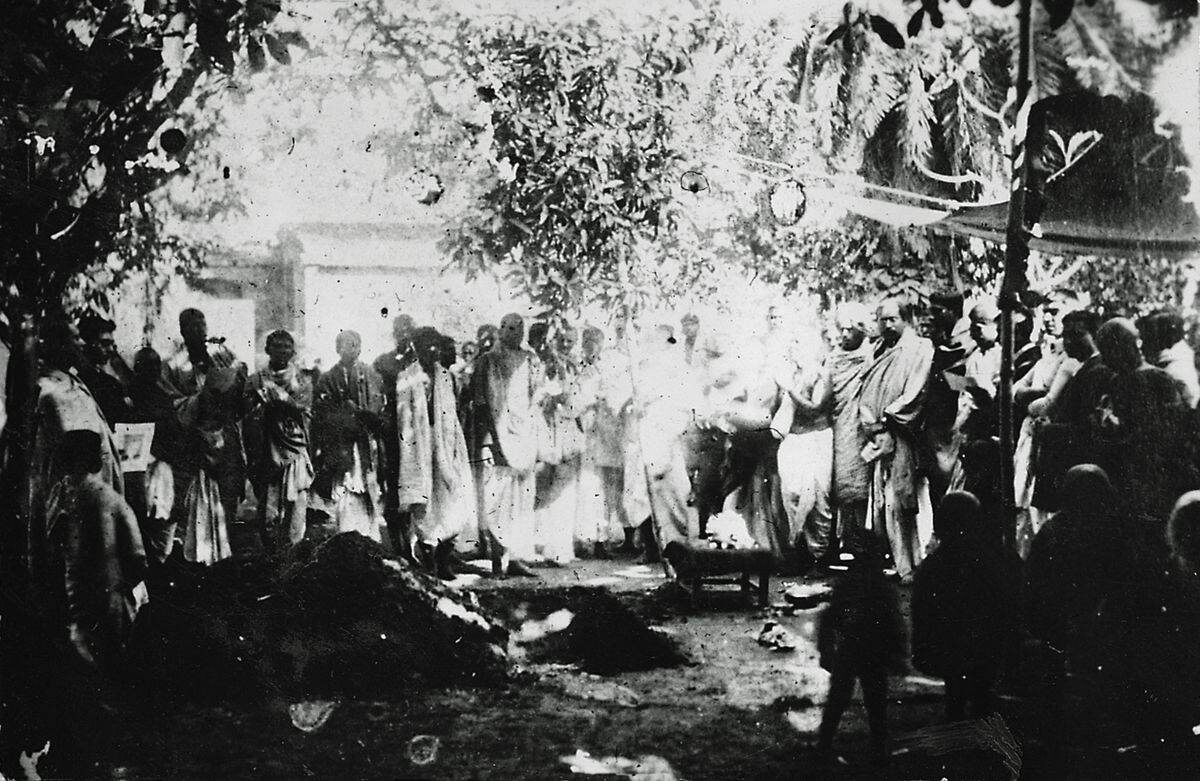
Srila Bhaktivinoda Thakura died at his house in Calcutta on 23 June 1914, at the age of seventy-five. Gaudiya Vaishnavas do not see that date as an ending, but as a return. The soul of a pure devotee is never really touched by death, as Krishna Himself declares: "For the soul there is neither birth nor death at any time. He has not come into being, does not come into being, and will not come into being. He is unborn, eternal, ever-existing and primeval. He is not slain when the body is slain" (Bhagavad-gita 2.20). So Bhaktivinoda Thakura's death marks his entry into eternal pastimes at Radha Kund. Gaudiya Vaishnavas observe it each year as his disappearance day. His remains were buried at Surabhi-kunj, the property he had obtained near Mayapur's birthsite temple decades earlier. One disciple from these final years, Krishna dasa Babaji, had served him faithfully since the Puri days and continued to do so to the end. After Bhaktivinoda's disappearance, Krishna dasa Babaji felt such intense separation that he gave up his own life within the year. His samadhi stands beside his master's at Godrumadvipa today.
The Seventh Goswami #
In Bhaktivinoda's own lifetime, the journalist Sisir Kumar Ghosh gave him the title "the seventh goswami," and so placed him alongside the original Six Goswamis of Vrindavan. The Six Goswamis had systematized Gaudiya theology in the sixteenth century. The title has stayed attached to his name ever since. It also became the title of the standard full-length English biography of him, The Seventh Goswami: A Biography of Srila Bhaktivinoda Thakura by Rupa Vilasa Dasa. That book is useful further reading for anyone who wants a fuller story than these seven pages can give. Bhaktivinoda did not live to see Krishna consciousness spread beyond India. For more than three decades he had hoped for this and written toward it. That work was left to his son and then, two generations later, to his son's disciple. But the direction had already been set by this magistrate, through Sanskrit letters mailed to Boston and London. His days as a colonial official left him no time to write, so he spent his nights writing.
Srila Prabhupada's Tribute #
Srila Prabhupada returned to this legacy often. Told once that Bhaktivinoda Thakura had said he was leaving the world with his work unfinished, he replied simply, "So let us finish it. We are descendants of Bhaktivinoda Thakura. It was kept unfinished so that we should get the chance to finish it. That's his mercy." In a Gaura Purnima lecture he went further: "The Chaitanya movement in its pure form, as it is, was restarted by Bhaktivinoda Thakura... Bhaktivinoda wrote about one hundred books, almost. Just imagine: he was a very responsible officer, a magistrate, and he was a grihastha; he also had many children... At the same time he served the Supreme Lord in so many ways. That is the beauty of his life." And in a 1971 lecture in London on Bhaktivinoda Thakura's appearance day, he told his own disciples plainly why they should honour him on that day: "So this Bhaktivinoda Ṭhākura's birthday, we should adore, we should worship, because in the modern age he reintroduced the disciplic succession... Ācārya-upāsanā: simply by the blessings of ācāryas we can make very rapid progress."
