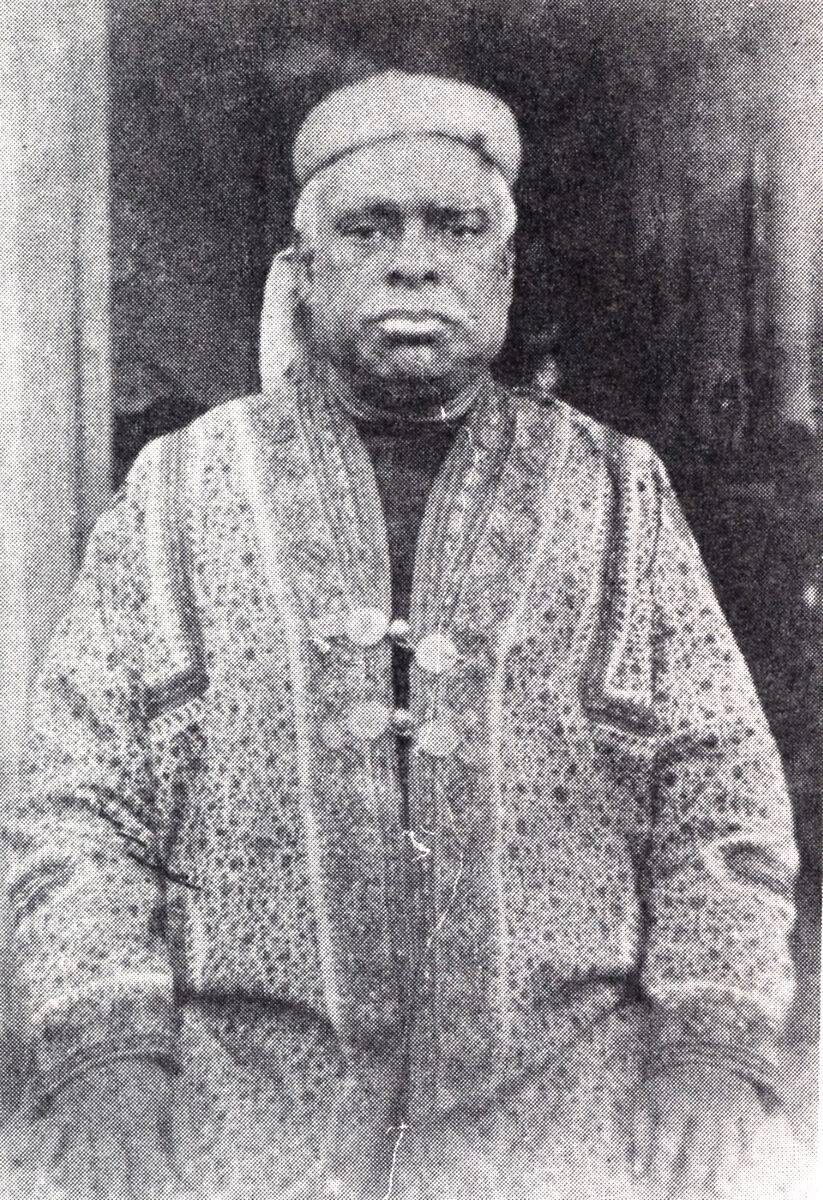
At eighteen, Kedarnath Datta began earning his living as a teacher in rural Bengal and Orissa. He moved through a string of village and English-medium schools, and in 1866 he entered the judicial service of the British Raj. Over the next twenty-eight years he rose from a junior grade to District Magistrate. Along the way, almost by accident, he found the manuscript that would fix the direction of the rest of his life.
| Teaching career | 1858-1866, village and English schools in Bengal and Orissa; headmaster, Bhadrak High School, 1862-1865 |
| Entered judicial service | February 1866, Special Deputy Registrar with powers of Deputy Magistrate, Chhapra, Bihar |
| Manuscript recovered | Chaitanya-charitamrita and a Bhagavata Purana translation, found in Calcutta in 1868 after an eight-year search |
| Posting at Jagannatha Puri | 1870-1875 (some accounts give 1869-1874), overseeing law, order, and temple administration |
| Retired | 4 October 1894, age 56, as District Magistrate |
Teacher in Bengal and Orissa #
Kedarnath's working life began modestly. In 1858, money troubles in his young family sent him to Chutimangal in Orissa. There he took a post as an English teacher, first at a village school. Then, after passing a qualifying examination, he taught at a school in Cuttack. From 1862 to 1865 he served as the first headmaster of Bhadrak High School. These years brought him a little financial stability, and with it time to write, lecture, and study. He began to be known locally as a thinker among the educated Bengalis of the district. But these years also brought grief. His first wife, Shyamani, died in 1861, and he was left a widower at twenty-three with an infant son, Annada Prasad. He soon remarried. His second wife, Bhagavati Devi, would become the mother of his thirteen other children and his companion through the decades that followed.
Into the Judicial Service #
In February 1866, with a friend's help, Kedarnath secured a government post as Special Deputy Registrar of Assurances, with the powers of a Deputy Magistrate and Deputy Collector, in Chhapra in Bihar's Saran district. For an educated Bengali of his generation, a job in the executive government service was one of the most sought-after positions. It offered financial security, social standing, and a pension, but it also meant long hours and frequent transfers. Over the following twenty-eight years his postings carried him and his growing family through some twenty locations across Bihar, Bengal, and Orissa. By the account of his own superiors, he proved to be a capable and completely honest officer. Along the way he taught himself Urdu and Persian for his official duties. He also learned Sanskrit for his devotional study, which was more and more becoming the main interest of his private life.
An Eight-Year Search for a Manuscript #
A posting to Dinajpur in 1868 brought a turning point in Kedarnath's devotional life. For some years he had been searching for a copy of the Chaitanya-charitamrita, Krishnadasa Kaviraja's sixteenth-century biography of Chaitanya Mahaprabhu, and for a Bengali translation of the Bhagavata Purana. These were the two texts most central to Gaudiya Vaishnava theology. In his later accounts he put the search at eight years. At last he found copies through his agent in Calcutta, Pratap Chandra Ray. Pratap Chandra Ray sent him a published Bengali translation of the Bhagavata Purana and the Chaitanya-charitamrita. Around the same time Kedarnath also bought a copy of Bhakta-mala. He later wrote that reading the Chaitanya-charitamrita first troubled him, and only then won him over: "On the second reading I understood that Caitanya was unequalled, but I doubted how such a good scholar with so high a level of prema could recommend the worship of Krishna, who had such a questionable character. I was amazed, and I thought about this in detail... From then on I believed that Caitanya was God." This passage clearly shows the struggle that would shape his life's work. He had an educated, questioning, Western-trained mind. He did not simply inherit the devotional teachings of his own tradition. He worked his way toward them, one argument at a time.
An Exorcism by the Bhagavatam at Champaran #
Soon after, a promotion carried Kedarnath to Champaran in 1869. There he found many people worshiping a powerful ghost, a brahma-daitya said to live in a banyan tree. Under its influence, even a local judge had begun ruling in favor of bandits who made offerings to please it. Kedarnath arranged for a wandering pandita to sit beneath the tree and recite the entire Srimad-Bhagavatam aloud. A month later, when the recitation was finished, the tree itself fell to the ground and the ghost departed. The bandits were furious, but many townspeople took the episode as proof of the Bhagavatam's own power, and they began to follow its message seriously.
Deputy Magistrate at Jagannatha Puri #
Kedarnath's next major posting, from 1870 to 1875, took him to Jagannatha Puri, Chaitanya's own residence for most of his adult life and the seat of the great Jagannatha temple. His official duties there were heavy. He was responsible for keeping order among the pilgrims who crowded the temple during festivals, arranging food, lodging, and medical care for them, and investigating threats to public order. In one well-known case, he built a legal file against Bishakishana, a man who called himself an avatar. Bishakishana claimed divine status and drew large crowds with displays of yogic power, and he had been accused of exploiting his followers. Kedarnath's investigation led to a conviction. According to Vaishnava biographers, it also led to the man's death soon after. The full story of that confrontation is told on the page devoted to the apasampradayas. Away from his official duties, Kedarnath's devotional and scholarly life truly deepened at Puri. He studied Sanskrit intensively under local pandits, and worked through core Gaudiya philosophical texts such as Jiva Goswami's Sat Sandarbhas and Baladeva Vidyabhushana's Govinda Bhashya. He also founded a discussion circle, the Bhagavat Samsad, where he lectured on the Bhagavata Purana to an audience of local bhadralok. This drew criticism from some pandits connected with the temple's Mukti Mandapa. They objected that he lectured on Vaishnava scripture without having taken formal initiation. But it also marked the beginning of his public teaching of Vaishnava scripture. His seventh child, Bimala Prasad, was also born in Puri, in February 1874. This son would later be known as Bhaktisiddhanta Sarasvati Thakura.
Devotees and Trials at Puri #
Puri also brought Kedarnath into contact with realized souls who shaped him as much as his own study did. He held his Bhagavat Samsad discussions in the Jagannatha-vallabha gardens, once the very bhajana site of Ramananda Raya, Chaitanya Mahaprabhu's great associate. Kedarnath had not yet taken formal diksha, so he wore no tilaka or tulasi neck-beads. For this reason a saintly renunciant named Raghunatha dasa Babaji at first refused to attend his lectures, and he warned other Vaishnavas to keep away from him as well. Soon after, the babaji fell dangerously ill, and in a dream Lord Jagannatha told him his only relief lay in seeking Kedarnath's mercy. He hurried to Kedarnath's home and begged forgiveness. Kedarnath simply explained that no diksha-guru had yet given him the right to wear tilaka or beads, and he would not take that right upon himself. He arranged medicine for the sick babaji and won his lasting respect. Kedarnath also sought out Svarupa dasa Babaji, a blind renunciant who lived near the samadhi of Srila Haridasa Thakura. Though this babaji could not see, he slipped away alone each midnight to bathe in the ocean, rather than let anyone serve him unseen. From him Kedarnath received one instruction he treasured: krishna-nama bhulibe na, never forget the name of Krishna. In 1874 the king of Puri was found to have wrongly taken eighty thousand rupees from the Jagannatha temple. By then Kedarnath had been given charge of supervising temple affairs. He forced the king to make costly offerings again and again as a penance. The enraged king reportedly organized a secret sacrifice intended to kill Kedarnath by mystic means. But on the final day of the rite, it was the king's own son who died in the palace instead.
Diksha and a Guiding Siksha-Guru #
Kedarnath had long felt the need of a qualified guru. While he was posted at Narail, his prayers were answered. Vipina-vihari Gosvami came and gave him Vaishnava diksha. Vipina-vihari Gosvami was a family descendant of Vamshi Vadanananda Thakura, an associate of Chaitanya Mahaprabhu. Not long after, in 1880, Kedarnath set out again for Vrindavan. There he met Srila Jagannatha Dasa Babaji for the first time. Jagannatha Dasa Babaji divided his years between Vrindavan and Mayapur, and he was revered as the spiritual leader of the Gaudiya Vaishnava community of Navadvipa. The babaji became Kedarnath's most important siksha-guru. This relationship was so important that, when Bhaktivinoda later listed his guru-parampara, he gave this instructing relationship first place, above his formal diksha from Vipina-vihari Gosvami. This follows exactly the priority that Gaudiya Vaishnava tradition gives to siksha over the ceremony of initiation alone. Thirteen years later, in 1893, this same Jagannatha Dasa Babaji gave the final and decisive confirmation of the Mayapur birthsite Bhaktivinoda had discovered, an episode told in full on the next page.
The Officer and the Devotee #
For the rest of his working life, Kedarnath followed a routine that joined his two callings, as an officer and as a devotee, instead of choosing between them. By later accounts of his household routine, he would go to bed at half past seven or eight and rise at ten at night. Then he wrote for six hours through the night, took a short nap, and rose again before dawn to chant. Mornings were given to correspondence, study, and visitors. The working day itself, from ten until five, was spent in court, where he might hear as many as fifty cases and write a judgment for each. He wore his court uniform with six strands of large tulasi beads showing at his neck. He shaved his head every month and did not care how it looked to others. Other magistrates took half an hour over a case, but he settled such cases in a matter of minutes, with the judgment written. Every evening after the court closed, he dictated a Sanskrit translation to a secretary. Then he had an evening meal of a little rice, two chapatis, and milk. He kept up this routine for nearly three more decades. He retired from government service on 4 October 1894, at the age of fifty-six. By then his private writing and preaching had already produced most of the works described on the next page, Literary Works.
