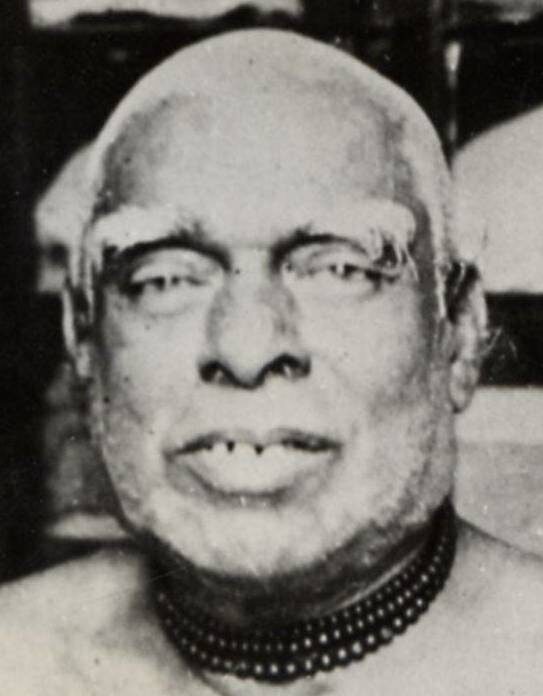
Srila Bhaktivinoda Thakura
The Seventh Goswami
The complete life, on one page: The main biography and every pastime page, in order, in one place
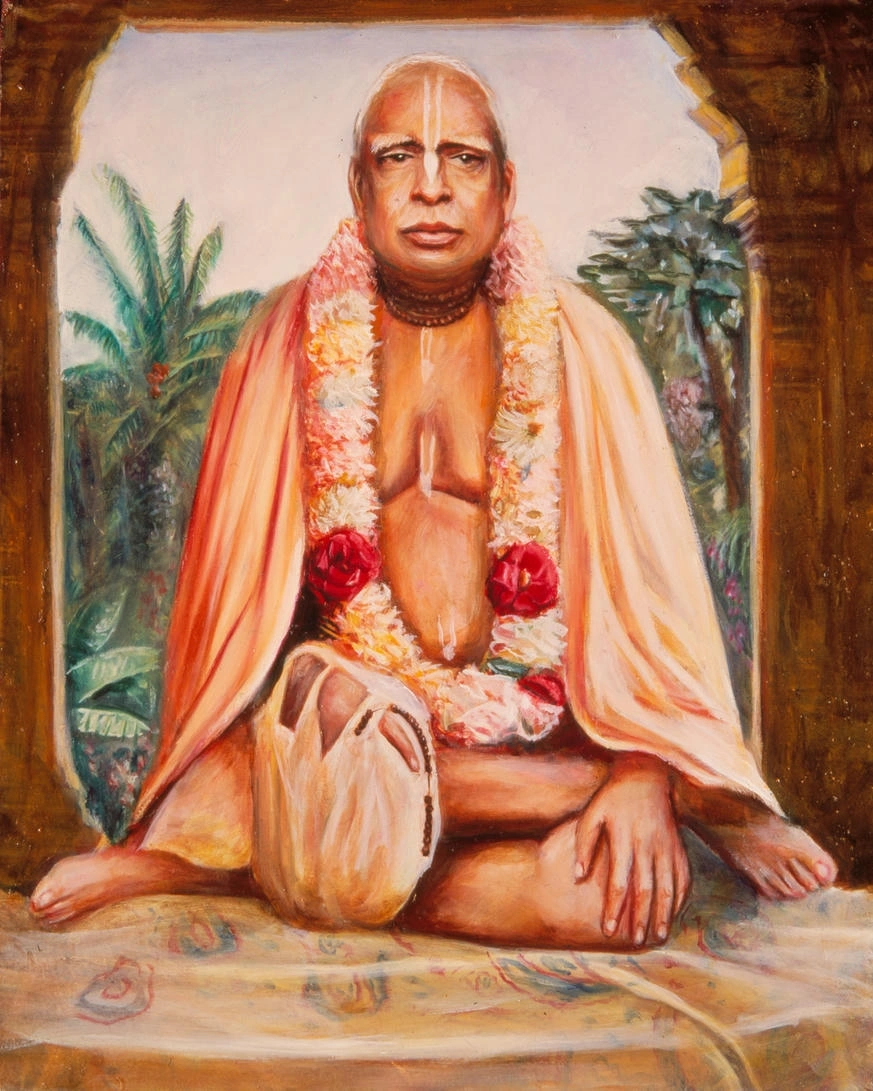
Introduction
namo bhaktivinodāya sac-cid-ānanda-nāmine
gaura-śakti-svarūpāya rūpānuga-varāya te
"I offer my respectful obeisances unto Sri Saccidananda Bhaktivinoda Thakura, who is the personified transcendental energy of Sri Chaitanya Mahaprabhu. He is a devoted follower of Srila Rupa Gosvami and the Gosvamis who follow him."
Srila Bhaktivinoda Thakura (1838-1914) rescued this Gaudiya Vaishnava line from three centuries of decline. This line is the very teaching of Sri Chaitanya Mahaprabhu. He put it on a path that would carry it to the entire world within two generations. He was born Kedarnath Datta in the Bengali village of Ula. For most of his working life he served as a respected magistrate in British India's judicial service. Alongside that career he wrote more than one hundred books, essays and songs, and together they reconstructed Gaudiya Vaishnava theology for the modern age. Without Bhaktivinoda Thakura there would have been no Gaudiya Math for his son Bhaktisiddhanta Sarasvati Thakura to found. And without the Gaudiya Math there would have been no ISKCON for Srila Prabhupada to carry to the West. The guru-parampara page here traces that direct line.
Chapter 1
Birth and Early Life
How Kedarnath Datta, born into a cholera-struck kayastha family in 1838, came of age in the Bengal Renaissance
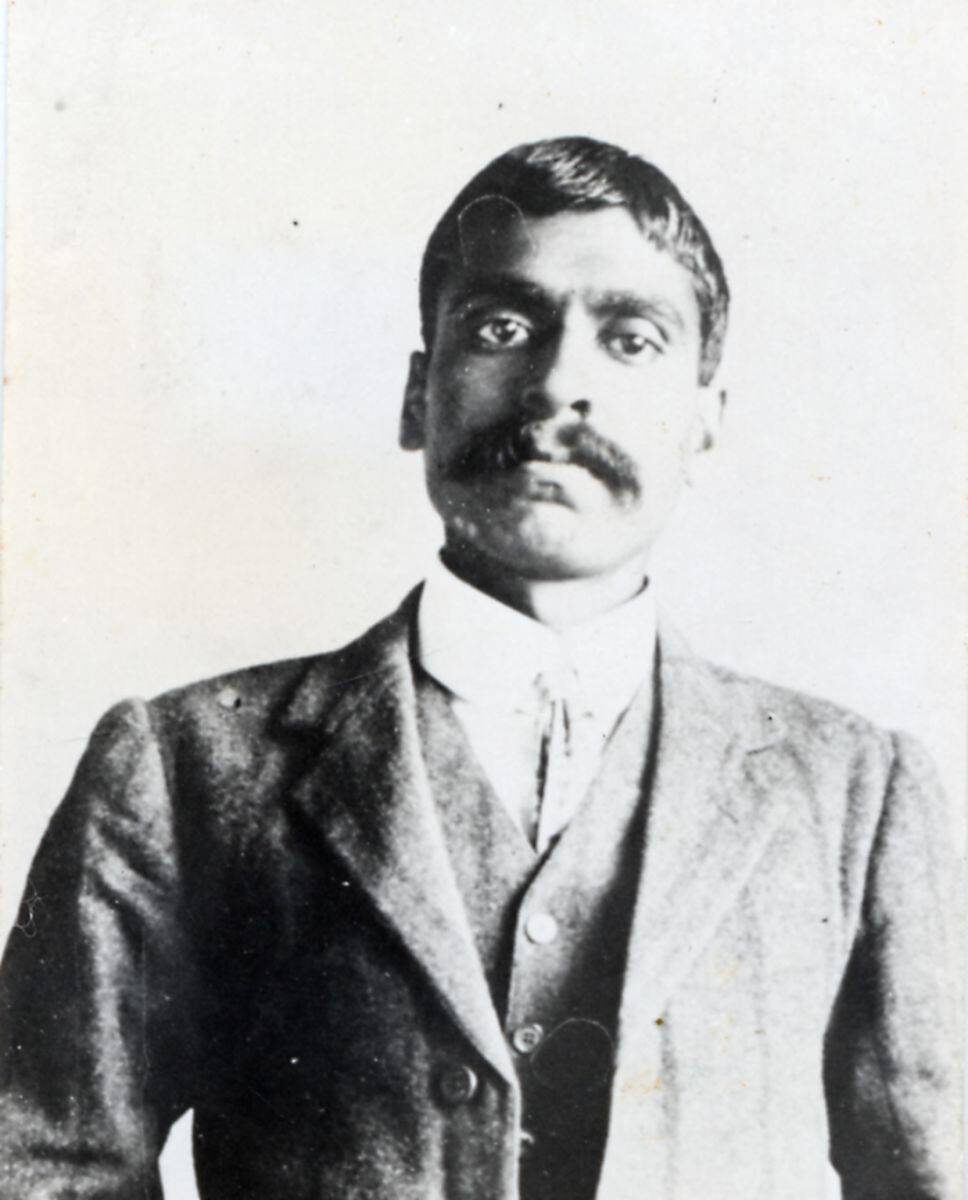
Kedarnath Datta, the man the world would come to know as Srila Bhaktivinoda Thakura, was born on 2 September 1838. His birthplace was the village of Ula, in the Nadia district of Bengal, a place known today as Birnagar. He was not born in his father's house but in his maternal grandfather's. His parents had taken shelter there after financial troubles pushed them out of Calcutta. At his birth there was no sign of the reformer he would become. To all outward appearance, the boy was born into an ordinary Bengali kayastha household. The family was dealing with debt and caste custom. It also faced a colonial economy that was already changing the idea of what a respectable Bengali gentleman should be.
| Birth name | Kedarnath Datta |
| Born | 2 September 1838, Ula (now Birnagar), Nadia district, Bengal |
| Parents | Ananda Chandra Datta and Jagat Mohini Devi |
| Family lineage | Datta kayastha family; paternal line traced to Krishnananda Datta, an associate of Nityananda Prabhu |
| First marriage | 1850, at age 12, to five-year-old Shyamani Mitra of Ranaghat |
| Education | Village school in Ula; Hindu Charitable Institution and Hindu College, Calcutta |
A Kayastha Family in Ula #
Kedarnath's father, Ananda Chandra Datta, came from a Datta family. Vaishnava tradition connects this family to Krishnananda Datta, who lived at the same time as Nityananda Prabhu and was his associate. Nityananda Prabhu was Chaitanya Mahaprabhu's closest companion. The exact family line is unclear, but later biographers thought the connection important enough to mention. By the family's own account, it had come into contact with Gaudiya Vaishnavism generations before Bhaktivinoda Thakura gave his life to it. In his autobiography, Svalikhita-jivani, Kedarnath describes his father as "a straightforward, clean, religious man." His mother, Jagat Mohini Devi, came from the Mitra family. She was a descendant of an eighteenth-century zamindar, Rameshwar Mitra, and Kedarnath calls her "a sober woman possessed of many unique qualities." His maternal grandfather, Ishwar Chandra Mustaufi, was a landowner in Ula known for his generosity. Kedarnath was born, and spent his early childhood, in that house.
A Child Who Spoke to Crows #
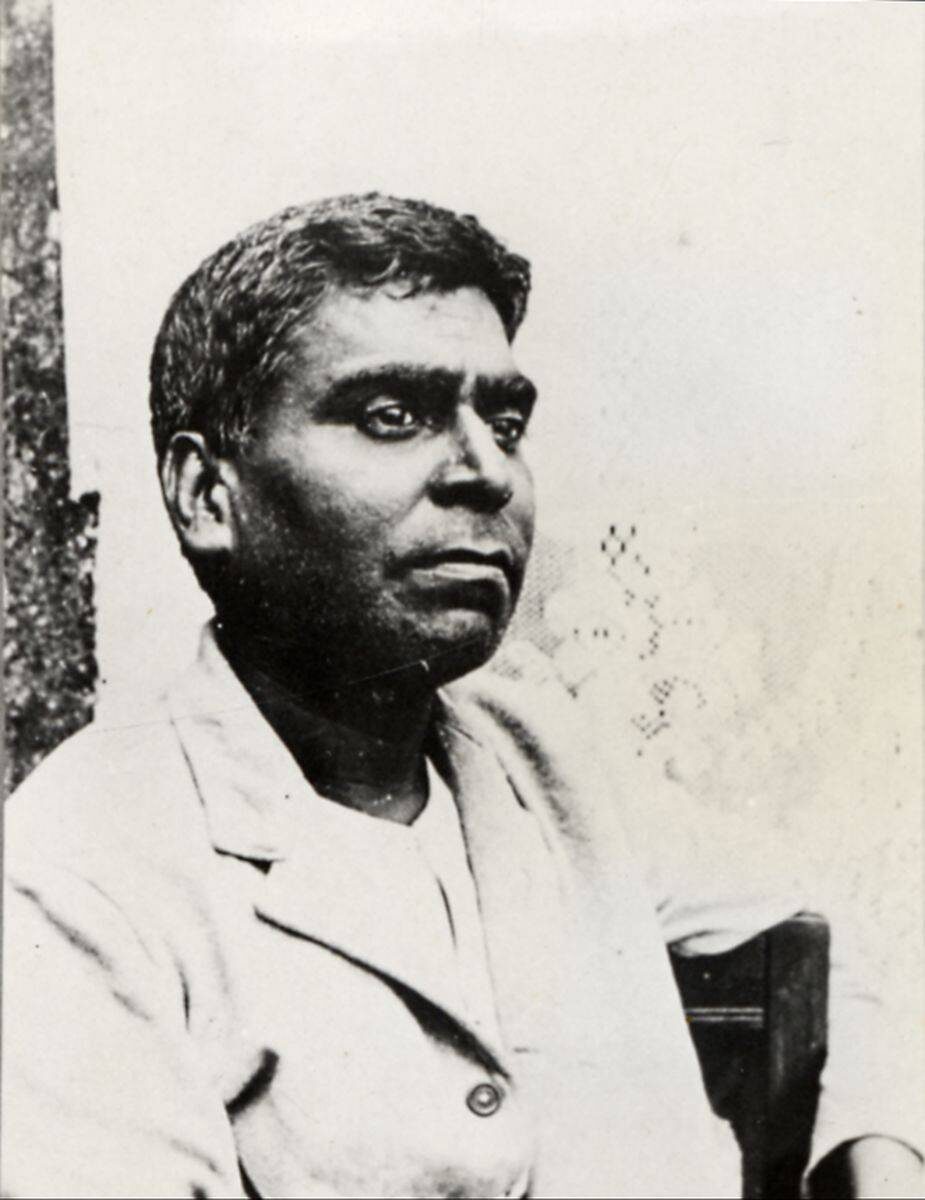
Even before he could properly speak, those around Kedarnath sensed something unusual in him. Not yet two years old, he composed a simple rhyme to a crow perched near the house: "O crow, Kala, flower of the jhinga squash, father comes, sit aside." As he spoke it, the crow actually moved, and those nearby took it as a sign. A few days later his father did arrive home from Orissa, just as the rhyme seemed to predict. His first schooling began around age three, on the veranda of his maternal grandfather's puja hall, where the village boys gathered under a stern teacher named Karttika Sarkara. Bhaktivinoda Thakura recalled him decades later without much fondness: "I have some recollection of going to a school run by Karttika Sarkara when I was three years old. Even now it comes to mind, that cane he used to show."
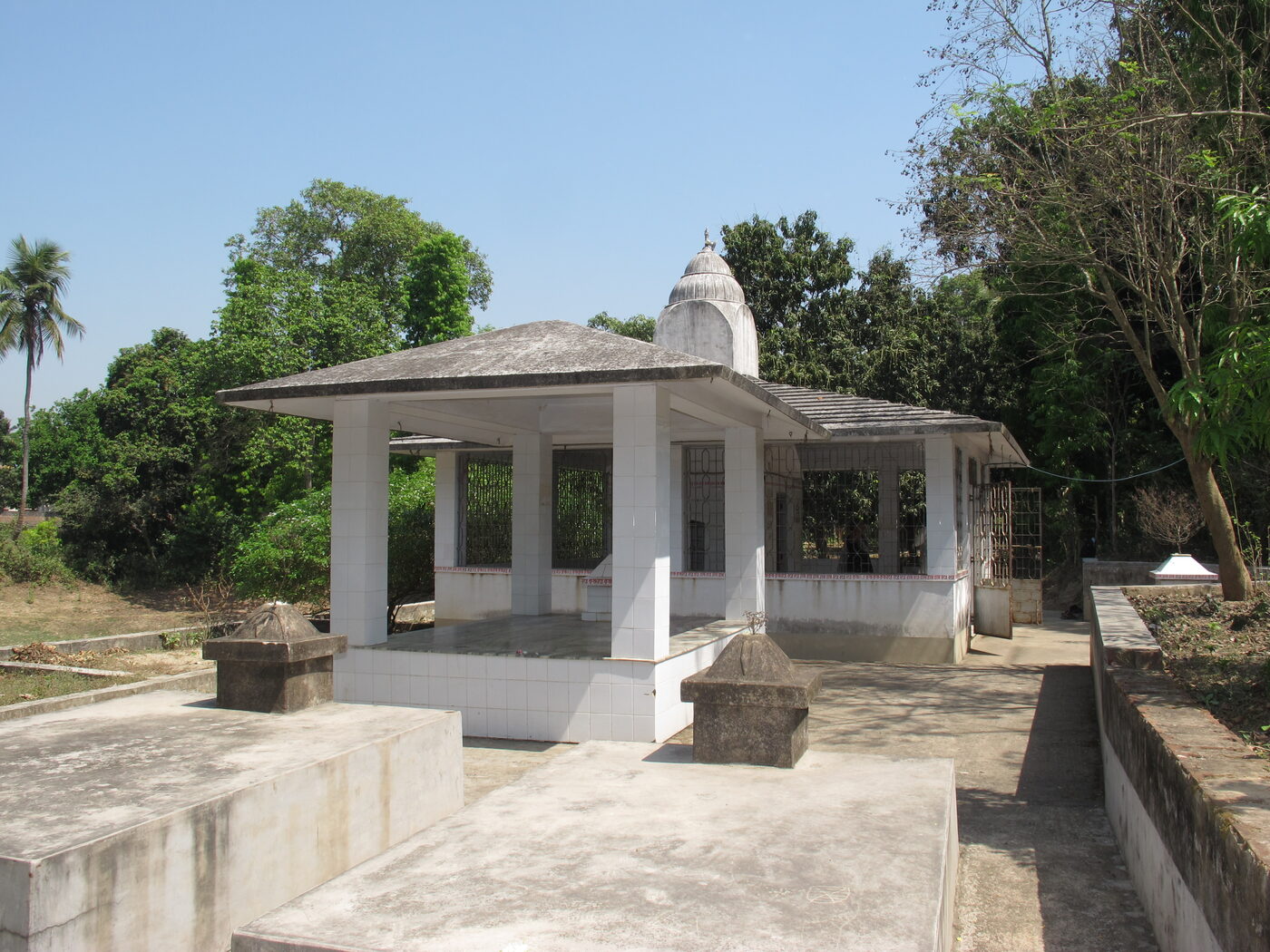
Cholera and a Widow's House #
The family that welcomed Kedarnath was already marked by loss, and more was coming. He was the third of six children. All four of his brothers died young. The eldest, Abhayakali, had died before Kedarnath was even born. In the years after his birth, cholera swept through the family. Then Kaliprasanna fell ill with cholera at seven while travelling home from school in Krishnanagar, and he died within a day of reaching Ula. Then two more infant brothers, Haridas and Gauridas, died in that same season. Three years later, when Kedarnath was eleven, his father Ananda Chandra also died. He died of a high fever, not of cholera itself. But the family's fortunes never recovered from the earlier losses. Jagat Mohini was left a widow with young children to raise. Around the same time, her own father's finances collapsed, ruined in large part by the pressures of the Permanent Settlement land-revenue system. Kedarnath later recalled the strain plainly: "Everybody thought that my mother had a lot of money and jewelry, so no one would help. All her wealth was lost except for a few properties. There was so much debt and I was full of anxiety." Several years later, a further cholera outbreak killed his sister Hemlata and ended what was left of the family's place in Ula. After that, his mother left the village for Calcutta for good.
A Boy in Search of Truth #
Even as a child Kedarnath was drawn to serious questions. At nine he studied astrology under a local teacher, Jagat Bhattacharya, taking careful notes and learning by heart what he was taught. By ten, he later wrote, "I began to become a little thoughtful. What is this world? Who are we? These two questions were in my mind." He read whatever Bengali manuscripts of the Ramayana, Mahabharata and other epics he could find. He discussed them with anyone learned enough to talk with him about them. His biographers have compared this searching, restless mood to that of Maharaja Parikshit. After his birth, Parikshit examined everything around him, searching for the Krishna he had seen in the womb. Around this time Kedarnath was frightened one day by an orchard that was said to be haunted. He learned that chanting the name of Rama removed his fear completely. From then on he chanted it constantly whenever he had to go out after dark. When Kedarnath was eleven his father Ananda Chandra died of a high fever. For a short time this loss drove the boy to avoid school in any way he could. Even so, he kept writing. In this period he composed a poem called Ula-chandi-mahatmya about the deity of his village. By his own account, this work no longer survives.
Married at Twelve #
This run of misfortune did not stop the ordinary customs of the period. In 1850, following the custom of upper-class Bengali Hindus at the time, Jagat Mohini arranged for her twelve-year-old son to marry five-year-old Shyamani Mitra of nearby Ranaghat. She hoped a new set of in-laws might bring the family better fortune than its own recent history had. Decades later, Kedarnath spoke of it plainly, without any sentiment: "It was just like a doll's play-marriage." By his own account he did not question the custom at the time. Later, though, he would become a strong critic of the rigid rules of caste and custom in Bengali Vaishnava society. Shyamani died young, not many years into the marriage, after bearing him a son.
Calcutta, Hindu College, and the Bengal Renaissance #
In 1852 Kedarnath moved to Calcutta to continue his education, at the invitation of his maternal uncle Kashiprasad Ghosh, a well-known poet and newspaper editor. He studied first at the Hindu Charitable Institution, then from 1856 at Hindu College. There he studied under Ishwar Chandra Vidyasagar, the reformer and educationist who became his lifelong friend and mentor. He also moved among a circle that included Bankim Chandra Chattopadhyay, the journalist Sisir Kumar Ghosh, and classmates such as the elder brothers of Rabindranath Tagore. This was the world of the Bengal Renaissance and its bhadralok class. These educated Bengalis were trying to bring the religion they had inherited into agreement with Western learning. Kedarnath threw himself into this world. He studied English literature and rhetoric, took public-speaking lessons from the British abolitionist George Thompson, and in 1857 published a two-volume English poem, The Poriade, that earned him an early reputation as a writer. He also read seriously across many traditions and compared them. He worked through Kant, Hegel, Hume, and Schopenhauer alongside the Bible, the Quran, and Unitarian theology. An American Unitarian minister posted in Calcutta guided him in this. By a longer route, this path eventually led him back to the Vaishnava scripture of his own family's tradition. That road is taken up on the next page, The Magistrate and the Manuscript.
Chapter 2
The Magistrate and the Manuscript
How a British Raj magistrate's eight-year search for a lost manuscript and his posting to Jagannatha Puri reshaped his life
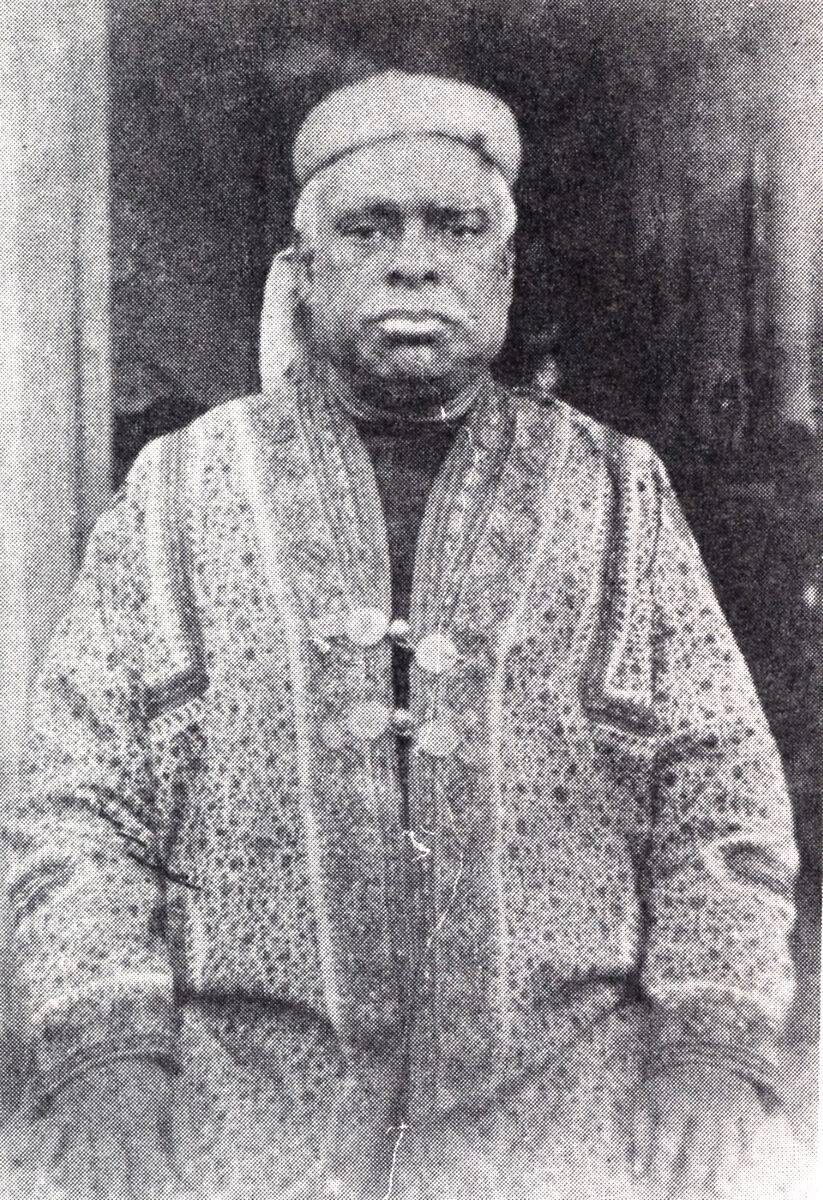
At eighteen, Kedarnath Datta began earning his living as a teacher in rural Bengal and Orissa. He moved through a string of village and English-medium schools, and in 1866 he entered the judicial service of the British Raj. Over the next twenty-eight years he rose from a junior grade to District Magistrate. Along the way, almost by accident, he found the manuscript that would fix the direction of the rest of his life.
| Teaching career | 1858-1866, village and English schools in Bengal and Orissa; headmaster, Bhadrak High School, 1862-1865 |
| Entered judicial service | February 1866, Special Deputy Registrar with powers of Deputy Magistrate, Chhapra, Bihar |
| Manuscript recovered | Chaitanya-charitamrita and a Bhagavata Purana translation, found in Calcutta in 1868 after an eight-year search |
| Posting at Jagannatha Puri | 1870-1875 (some accounts give 1869-1874), overseeing law, order, and temple administration |
| Retired | 4 October 1894, age 56, as District Magistrate |
Teacher in Bengal and Orissa #
Kedarnath's working life began modestly. In 1858, money troubles in his young family sent him to Chutimangal in Orissa. There he took a post as an English teacher, first at a village school. Then, after passing a qualifying examination, he taught at a school in Cuttack. From 1862 to 1865 he served as the first headmaster of Bhadrak High School. These years brought him a little financial stability, and with it time to write, lecture, and study. He began to be known locally as a thinker among the educated Bengalis of the district. But these years also brought grief. His first wife, Shyamani, died in 1861, and he was left a widower at twenty-three with an infant son, Annada Prasad. He soon remarried. His second wife, Bhagavati Devi, would become the mother of his thirteen other children and his companion through the decades that followed.
Into the Judicial Service #
In February 1866, with a friend's help, Kedarnath secured a government post as Special Deputy Registrar of Assurances, with the powers of a Deputy Magistrate and Deputy Collector, in Chhapra in Bihar's Saran district. For an educated Bengali of his generation, a job in the executive government service was one of the most sought-after positions. It offered financial security, social standing, and a pension, but it also meant long hours and frequent transfers. Over the following twenty-eight years his postings carried him and his growing family through some twenty locations across Bihar, Bengal, and Orissa. By the account of his own superiors, he proved to be a capable and completely honest officer. Along the way he taught himself Urdu and Persian for his official duties. He also learned Sanskrit for his devotional study, which was more and more becoming the main interest of his private life.
An Eight-Year Search for a Manuscript #
A posting to Dinajpur in 1868 brought a turning point in Kedarnath's devotional life. For some years he had been searching for a copy of the Chaitanya-charitamrita, Krishnadasa Kaviraja's sixteenth-century biography of Chaitanya Mahaprabhu, and for a Bengali translation of the Bhagavata Purana. These were the two texts most central to Gaudiya Vaishnava theology. In his later accounts he put the search at eight years. At last he found copies through his agent in Calcutta, Pratap Chandra Ray. Pratap Chandra Ray sent him a published Bengali translation of the Bhagavata Purana and the Chaitanya-charitamrita. Around the same time Kedarnath also bought a copy of Bhakta-mala. He later wrote that reading the Chaitanya-charitamrita first troubled him, and only then won him over: "On the second reading I understood that Caitanya was unequalled, but I doubted how such a good scholar with so high a level of prema could recommend the worship of Krishna, who had such a questionable character. I was amazed, and I thought about this in detail... From then on I believed that Caitanya was God." This passage clearly shows the struggle that would shape his life's work. He had an educated, questioning, Western-trained mind. He did not simply inherit the devotional teachings of his own tradition. He worked his way toward them, one argument at a time.
An Exorcism by the Bhagavatam at Champaran #
Soon after, a promotion carried Kedarnath to Champaran in 1869. There he found many people worshiping a powerful ghost, a brahma-daitya said to live in a banyan tree. Under its influence, even a local judge had begun ruling in favor of bandits who made offerings to please it. Kedarnath arranged for a wandering pandita to sit beneath the tree and recite the entire Srimad-Bhagavatam aloud. A month later, when the recitation was finished, the tree itself fell to the ground and the ghost departed. The bandits were furious, but many townspeople took the episode as proof of the Bhagavatam's own power, and they began to follow its message seriously.
Deputy Magistrate at Jagannatha Puri #
Kedarnath's next major posting, from 1870 to 1875, took him to Jagannatha Puri, Chaitanya's own residence for most of his adult life and the seat of the great Jagannatha temple. His official duties there were heavy. He was responsible for keeping order among the pilgrims who crowded the temple during festivals, arranging food, lodging, and medical care for them, and investigating threats to public order. In one well-known case, he built a legal file against Bishakishana, a man who called himself an avatar. Bishakishana claimed divine status and drew large crowds with displays of yogic power, and he had been accused of exploiting his followers. Kedarnath's investigation led to a conviction. According to Vaishnava biographers, it also led to the man's death soon after. The full story of that confrontation is told on the page devoted to the apasampradayas. Away from his official duties, Kedarnath's devotional and scholarly life truly deepened at Puri. He studied Sanskrit intensively under local pandits, and worked through core Gaudiya philosophical texts such as Jiva Goswami's Sat Sandarbhas and Baladeva Vidyabhushana's Govinda Bhashya. He also founded a discussion circle, the Bhagavat Samsad, where he lectured on the Bhagavata Purana to an audience of local bhadralok. This drew criticism from some pandits connected with the temple's Mukti Mandapa. They objected that he lectured on Vaishnava scripture without having taken formal initiation. But it also marked the beginning of his public teaching of Vaishnava scripture. His seventh child, Bimala Prasad, was also born in Puri, in February 1874. This son would later be known as Bhaktisiddhanta Sarasvati Thakura.
Devotees and Trials at Puri #
Puri also brought Kedarnath into contact with realized souls who shaped him as much as his own study did. He held his Bhagavat Samsad discussions in the Jagannatha-vallabha gardens, once the very bhajana site of Ramananda Raya, Chaitanya Mahaprabhu's great associate. Kedarnath had not yet taken formal diksha, so he wore no tilaka or tulasi neck-beads. For this reason a saintly renunciant named Raghunatha dasa Babaji at first refused to attend his lectures, and he warned other Vaishnavas to keep away from him as well. Soon after, the babaji fell dangerously ill, and in a dream Lord Jagannatha told him his only relief lay in seeking Kedarnath's mercy. He hurried to Kedarnath's home and begged forgiveness. Kedarnath simply explained that no diksha-guru had yet given him the right to wear tilaka or beads, and he would not take that right upon himself. He arranged medicine for the sick babaji and won his lasting respect. Kedarnath also sought out Svarupa dasa Babaji, a blind renunciant who lived near the samadhi of Srila Haridasa Thakura. Though this babaji could not see, he slipped away alone each midnight to bathe in the ocean, rather than let anyone serve him unseen. From him Kedarnath received one instruction he treasured: krishna-nama bhulibe na, never forget the name of Krishna. In 1874 the king of Puri was found to have wrongly taken eighty thousand rupees from the Jagannatha temple. By then Kedarnath had been given charge of supervising temple affairs. He forced the king to make costly offerings again and again as a penance. The enraged king reportedly organized a secret sacrifice intended to kill Kedarnath by mystic means. But on the final day of the rite, it was the king's own son who died in the palace instead.
Diksha and a Guiding Siksha-Guru #
Kedarnath had long felt the need of a qualified guru. While he was posted at Narail, his prayers were answered. Vipina-vihari Gosvami came and gave him Vaishnava diksha. Vipina-vihari Gosvami was a family descendant of Vamshi Vadanananda Thakura, an associate of Chaitanya Mahaprabhu. Not long after, in 1880, Kedarnath set out again for Vrindavan. There he met Srila Jagannatha Dasa Babaji for the first time. Jagannatha Dasa Babaji divided his years between Vrindavan and Mayapur, and he was revered as the spiritual leader of the Gaudiya Vaishnava community of Navadvipa. The babaji became Kedarnath's most important siksha-guru. This relationship was so important that, when Bhaktivinoda later listed his guru-parampara, he gave this instructing relationship first place, above his formal diksha from Vipina-vihari Gosvami. This follows exactly the priority that Gaudiya Vaishnava tradition gives to siksha over the ceremony of initiation alone. Thirteen years later, in 1893, this same Jagannatha Dasa Babaji gave the final and decisive confirmation of the Mayapur birthsite Bhaktivinoda had discovered, an episode told in full on the next page.
The Officer and the Devotee #
For the rest of his working life, Kedarnath followed a routine that joined his two callings, as an officer and as a devotee, instead of choosing between them. By later accounts of his household routine, he would go to bed at half past seven or eight and rise at ten at night. Then he wrote for six hours through the night, took a short nap, and rose again before dawn to chant. Mornings were given to correspondence, study, and visitors. The working day itself, from ten until five, was spent in court, where he might hear as many as fifty cases and write a judgment for each. He wore his court uniform with six strands of large tulasi beads showing at his neck. He shaved his head every month and did not care how it looked to others. Other magistrates took half an hour over a case, but he settled such cases in a matter of minutes, with the judgment written. Every evening after the court closed, he dictated a Sanskrit translation to a secretary. Then he had an evening meal of a little rice, two chapatis, and milk. He kept up this routine for nearly three more decades. He retired from government service on 4 October 1894, at the age of fifty-six. By then his private writing and preaching had already produced most of the works described on the next page, Literary Works.
Chapter 3
Literary Works
A hundred-plus books, essays, and songs, written to reach educated skeptics as much as traditional Vaishnavas
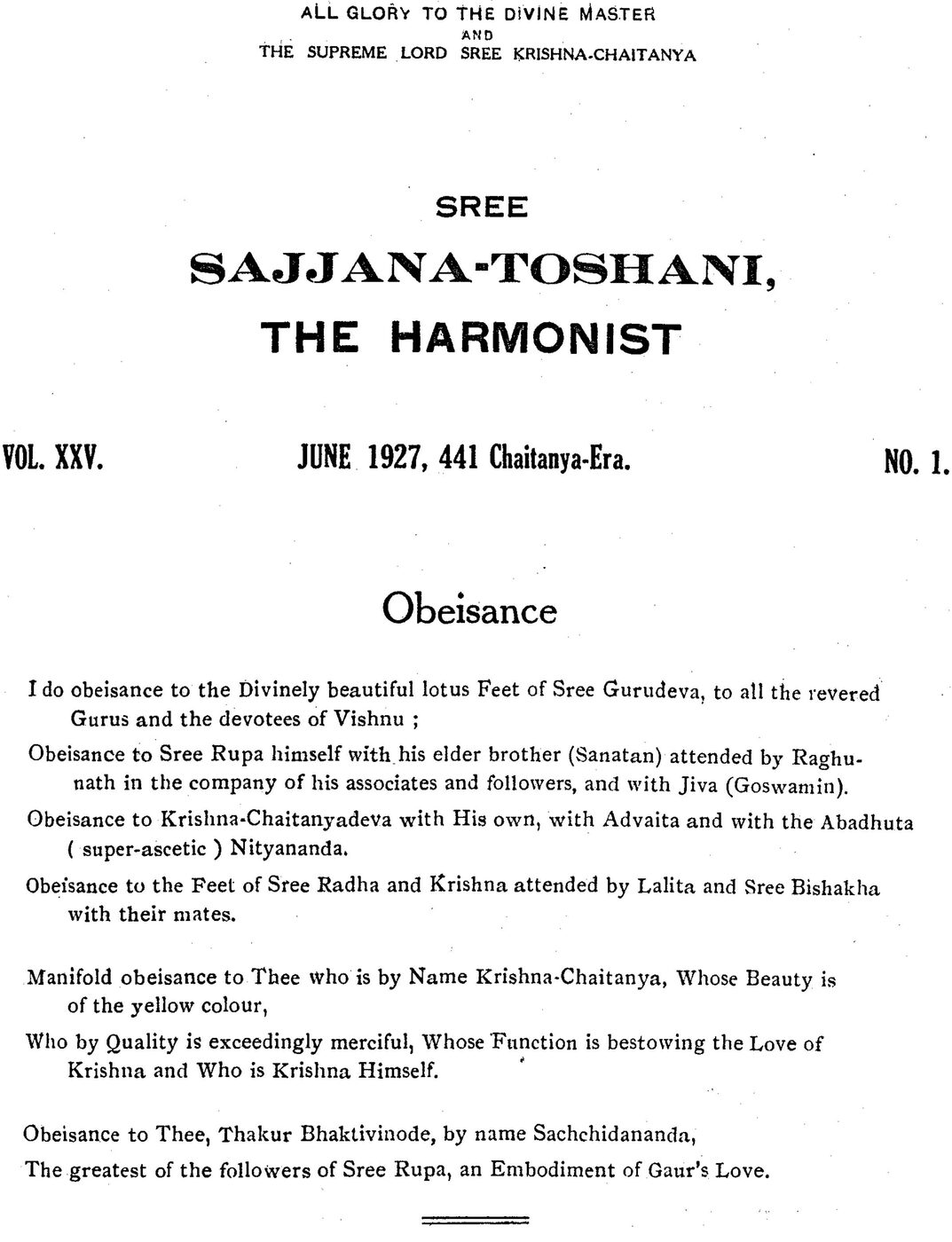
Across roughly four decades, Bhaktivinoda Thakura produced more than one hundred works, as his bibliographers count them. They include books of philosophy, commentaries on scripture, a novel that teaches theology, collections of devotional songs, and years of essays and serialized stories in a magazine he edited himself. Most of this writing was done in the hours before dawn, around a full-time career as a magistrate. What makes it different from most traditional Vaishnava writing of its time is not mainly its size. It is the readers it was written for. Much of it was written, deliberately, for readers who did not already believe.
| Total output | over 100 books, essays, translations, and song collections |
| Major theological treatise | Krishna-samhita (1879) |
| Novel-form treatise | Jaiva Dharma (1896) |
| Song collections | Kalyana-kalpataru (1881), Saranagati (1893), Gitavali (1893) |
| Monthly magazine | Sajjana-toshani, edited 1881-1909 |
An Output Without Precedent #
Bhaktivinoda wrote in Sanskrit, Bengali, and English, and he moved easily between different kinds of writing. He wrote formal philosophical argument, scriptural commentary, devotional poetry, and prose fiction built to carry theology inside a story. Many of his books first appeared in parts in Sajjana-toshani, the Bengali monthly he founded in 1881 and continued to edit until 1909. Only later were they gathered into single volumes. He also wrote long commentaries. One of them, the Amrita-pravaha-bhashya, is a Bengali commentary on the Chaitanya-caritamrita itself. He also wrote shorter works on the Chaitanya-upanishad and on the Siksastakam, Chaitanya Mahaprabhu's own eight verses of instruction. He could cover this wide range because of the way he worked for decades. After a full day's government duties, he wrote through the night, on whatever subject his preaching needed at the time. His very first Sanskrit composition was written years earlier, in 1874, while he was still posted at Jagannatha Puri. It was a 104-verse work on Vaishnava philosophy called Datta-kaustubha. This fairly small work shows how far his writing would grow over the following three decades.
Given the Name Bhaktivinoda #
He was named Kedaranatha at birth, after Lord Shiva. The world now remembers him by the title Bhaktivinoda, meaning "the pleasure of devotional service," and he received this title only later, during these same years of tireless preaching and publishing. A senior acharya of the tradition formally gave him the title in a Sanskrit letter. Kedarnath replied to him in the same way, and he accepted the title as a gift, not as something to boast about: "The masters had given the title Bhaktivinoda to me, and this was also the desire of Mahaprabhu." From then on his own writing appears under the name Srila Bhaktivinoda Thakura, the name used throughout the rest of this section.
Krishna-samhita: Answering the Skeptics #
His first major work, Krishna-samhita, was published in 1879. In it he spoke most directly to the educated world he had grown up in. British education and the criticism of Christian missionaries had changed Bengali bhadralok society. Many of them had come to see the Krishna of the Bhagavata Purana as a figure of doubtful morals, not fit for a rational age. Bhaktivinoda answered them with the kind of reasoning they themselves respected. He brought together the historical and archaeological arguments of his day with Vaishnava theology. With them he defended the truth that Krishna is a Person, and he showed that Krishna-worship is reasonable and consistent. He called this method adhunika-vada, "the contemporary approach." What he was defending was never a devotional decoration that could be bargained away. It is what Srimad-Bhagavatam itself states plainly, that every other incarnation is a portion of the Lord but "Lord Krishna is the original Personality of Godhead" (Srimad-Bhagavatam 1.3.28). Krishna-samhita was written to make exactly this conclusion believable to a generation trained to doubt it. The book found an audience beyond India almost immediately. In 1880 Bhaktivinoda sent copies to Western scholars, and received responses from both the London Sanskritist Reinhold Rost and the American writer Ralph Waldo Emerson, an episode taken up more fully on the page devoted to his final years.
Chaitanya-siksamrta and the Life of Chaitanya #
In 1886 Bhaktivinoda published Chaitanya-siksamrta, a systematic summary of Chaitanya Mahaprabhu's teachings together with his own social and theological commentary. It was meant for readers who wanted the main points of Gaudiya teaching without having to struggle through difficult medieval Sanskrit commentaries. His reputation as a defender of Krishna's full divinity reached even the literary world of Calcutta. The celebrated novelist Bankim Chandra Chattopadhyay had just finished his own book on Krishna, Krishna-charita, and he sought Bhaktivinoda out to review it. Krishna-charita was written very much in the rationalist style of the age. It portrayed Krishna as an admirable historical man, not as the Supreme Personality of Godhead. For four days, taking little food or rest, Bhaktivinoda argued the point from scripture. At last Bankim Chandra agreed to revise the passages that had gone furthest wrong. Scholars would later criticize Bankim Chandra for treating some Puranic material as literal history rather than legend. In its own way, Bhaktivinoda might have taken this criticism as a sign of success. His whole aim in those four days had been to convince Bankim Chandra that Krishna's transcendental pastimes were literal fact, not stories made up out of piety.
Recovering the Chaitanyopanishad #
Bhaktivinoda also spent years searching for the Chaitanyopanishad. It is a portion of the Atharva Veda that identifies Chaitanya Mahaprabhu as the Supreme Lord and yuga-avatara of the age. But it survived only in scattered old manuscripts. Word of his search eventually reached Madhusudan Das, a Vaishnava pandita who had an ancient manuscript of the Atharva Veda containing it. Madhusudan Das sent it to Bhaktivinoda directly. Finding and publishing texts like this was as much a part of his literary mission as composing his own arguments and writing books in his own name. After this he wrote a series of shorter works on doctrine, among them Amnaya-sutra, Vaishnava-siddhanta-mala, and Prema-pradipa. In 1896 he published an English account of Chaitanya's life and teaching, Sri Chaitanya Mahaprabhu: His Life and Precepts. He wrote it especially for foreign readers who were not Vaishnavas.
Jaiva Dharma: Theology in the Form of a Novel #
Perhaps his most unusual experiment in style came in 1896. This was Jaiva-dharma, a book-length work of Vaishnava theology written as a novel. Instead of presenting doctrine as a formal essay, Bhaktivinoda built it into the conversations and spiritual growth of his characters. This let readers take in Gaudiya philosophy through a story, not through a formal proof. The story form let him explain difficult and technical points in a way that readers with no formal training in Sanskrit philosophy could follow. These points include questions of the soul's constitutional nature, the stages of devotional practice, and the standards for true Vaishnava conduct. Jaiva-dharma has since been translated into many languages, and it is still one of his most widely read works.
A Society, and the Seed of the Gaudiya Math #
In 1886, alongside his literary work, Bhaktivinoda founded the Sri Vishva Vaishnava Sabha in Calcutta, a society through which many educated men of the city became his followers. Decades later his son Bhaktisiddhanta Sarasvati Thakura revived this same society in an expanded form, and it became known as the Gaudiya Math, the missionary institution that would eventually send Srila Prabhupada to the West.
Songs for Congregational Singing #
Alongside his prose, Bhaktivinoda composed a large body of devotional songs, or bhajans, mostly in Bengali and occasionally in Sanskrit. These were gathered into collections that remain in daily use in Gaudiya Vaishnava communities: Kalyana-kalpataru (1881), Saranagati (1893), and Gitavali (1893). Written in simpler language than his philosophical prose, these songs carried his teaching to people who would never read Krishna-samhita. They are still sung today in temples and homes wherever Gaudiya Vaishnavas gather for kirtan.
Writing for the Educated Reader #
Through all this varied writing, Bhaktivinoda deliberately kept one kind of reader in mind. He divided spiritual seekers into three broad types. The first were simple believers, moved by devotional stories. The second were rationalists, who needed argument before faith. He consciously aimed much of his writing at this second group. Beyond them, he also wrote for Western scholars. He counted them among a still rarer third type, people able to appreciate other traditions without losing their own footing. He chose to write in a style that a Western-educated Bengali or a foreign academic could take seriously as it stood, instead of dismissing it as mere pious ritual. In this choice he was decades ahead of the approach Srila Prabhupada would later take in building his own body of translated and annotated works for an English-speaking, largely non-Indian readership. Bhaktivinoda did not live to see that later mission succeed. But he had already worked out the method, first the argument and then the invitation, and he had put it into print.
Scriptural evidence for this chapter (1)
ete cāṁśa-kalāḥ puṁsaḥ
kṛṣṇas tu bhagavān svayam
indrāri-vyākulaṁ lokaṁ
mṛḍayanti yuge yuge
Word for word
ete: all these; ca: and; aṁśa: plenary portions; kalāḥ: portions of the plenary portions; puṁsaḥ: of the Supreme; kṛṣṇaḥ: Lord Krishna; tu: but; bhagavān: the Personality of Godhead; svayam: in person; indra-ari: the enemies of Indra; vyākulam: disturbed; lokam: all the planets; mṛḍayanti: gives protection; yuge yuge: in different ages.
All of the above-mentioned incarnations are either plenary portions or portions of the plenary portions of the Lord, but Lord Sri Krishna is the original Personality of Godhead. All of them appear on planets whenever there is a disturbance created by the atheists. The Lord incarnates to protect the theists.
Supports the Literary Works page's statement that Bhaktivinoda's Krishna-samhita was defending Krishna's actual personhood as Bhagavan, not a devotional preference. Already verified and in use on the krishna/the-bhagavatams-direct-statement page; reused here rather than re-verified from scratch, since it is the same acharya's-tradition citation supporting the same underlying claim.
Chapter 4
Mayapur and the Nama-hatta
Identifying Chaitanya's birthplace at Mayapur in 1887, and organizing a caste-free preaching movement across rural Bengal
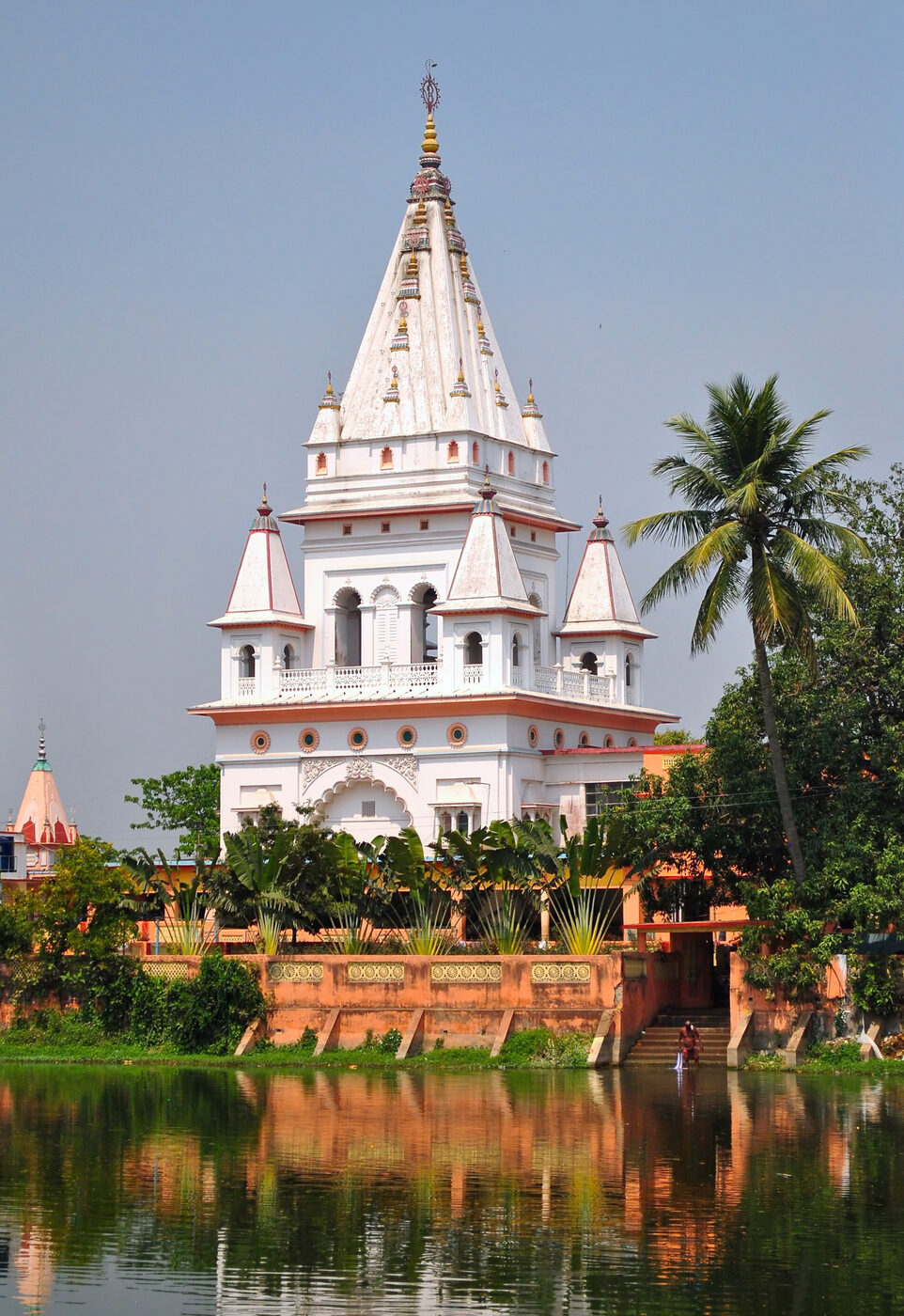
In 1887, while working as a magistrate stationed in Krishnanagar, Bhaktivinoda Thakura identified a site near Navadwip called Ballaladighi as the actual birthplace of Chaitanya Mahaprabhu. This set in motion the work that made Mayapur into the place it is today: a major center of pilgrimage and, in the twentieth century, the international headquarters of ISKCON. In the same decades he organized a very different kind of project, the nama-hatta. This was a traveling preaching movement that carried Chaitanya's teaching into the Bengali countryside. He deliberately kept it out of the hands of priests who held their office by birth.
| Claimed discovery | 1887, birthsite identified at Ballaladighi, near Navadwip |
| Key evidence | old maps, the Bhakti-ratnakara text, local testimony, and a reported vision |
| Temple established | Deities of Gaura and Vishnupriya installed at the Yogapith, 21 March 1894 |
| Nama-hatta preaching | organized on a circuit-court model; over 500 centers by the early twentieth century |
Called Back from Vrindavan #
By 1886 Bhaktivinoda had hoped to retire from government service and settle in Vrindavan, the heartland of Krishna's pastimes, to devote himself fully to devotional life. Vaishnava biographers record that he instead had a dream in which Chaitanya directed him to Navadwip, not Vrindavan, telling him there was unfinished work nearer home. However one views this account, its practical result is recorded. Bhaktivinoda asked for and received a transfer to Krishnanagar, a district town some twenty-five kilometers from Navadwip. Navadwip was traditionally revered as Chaitanya's birthplace. There he began making regular visits to research the area.
A Vision Across the Ganges #
Despite poor health, Bhaktivinoda kept searching for the exact site of Chaitanya's birth. He was not satisfied with the place usually shown to pilgrims in the town of Navadwip itself. Vaishnava biographers record that one night, standing on the roof of a guesthouse and looking across the Ganges, he saw a large building shining in golden light. By daylight, only a group of palm trees stood in that spot. His young son, who was with him, reported seeing the same thing. Bhaktivinoda made inquiries and learned that the spot was the site of a ruined fort known locally as Ballaladighi. He took this as a clue, not as a conclusion, and turned to more ordinary methods. He compared old maps with written and spoken accounts. He concluded that Ballaladighi was the same as a place called Mayapur, which the older text Bhakti-ratnakara names as Chaitanya's birthplace. Reading further in the Bhakti-ratnakara, he found the verse that put the matter beyond doubt for him:
navadvīpa madhye māyāpura nāme sthāna
yathāya janmilena gauracandra bhagavān
"In the midst of Navadvipa there is a place called Mayapura. There the Supreme Lord, Gauracandra, took His birth."
Confirming the Site Against Navadwip's Claim #
The claim was not accepted quietly. For a long time the town of Navadwip had welcomed pilgrims because of its own claim to be Chaitanya's birthplace. So its residents rejected Bhaktivinoda's identification. Even today, some historians still debate which site is the more ancient. Still, Bhaktivinoda pursued the matter with the same careful attention to records that he brought to his other historical and theological work. He raised funds through Sajjana-toshani, special festivals, and his own wide circle of friends and contacts, in order to secure the site and build on it. Within Gaudiya Vaishnavism his identification has since become the settled and accepted one. The movement's institutions, ISKCON's included, have built their central temples at Mayapur, not in the town of Navadwip itself. Pilgrims and devotees now travel there by the hundreds of thousands each year for the annual Gaura Purnima festival, which marks Chaitanya's birth.
A Temple at the Birthsite #
Bhaktivinoda acquired property at Surabhi-kunj near the identified site. He worked through a body called the Nabadwip Pracarini Sabha. Through it he organized the making and installation of deities of Gaura and Vishnupriya at what became known as the Yogapith, the birthsite temple. This took place on 21 March 1894, during a lunar eclipse. Over the course of these years the journalist Sisir Kumar Ghosh had come to regard Bhaktivinoda as something close to a guru. He praised him for the discovery by calling him "the seventh goswami," which refers to the Six Goswamis of Vrindavan. These sixteenth-century Gaudiya Vaishnava ascetics had arranged the school's theology into a clear system, and generations earlier they had identified the sites of Krishna's pastimes around Vrindavan. The title stuck, and it later gave a full-length biography of Bhaktivinoda its name, as discussed on the final page of this section. While the temple's foundation was being dug, workers found a Deity of Adhokshaja Vishnu. After consulting Gaudiya Vaishnava scripture, Bhaktivinoda identified it as the very Deity once worshiped by Jagannatha Mishra, Chaitanya Mahaprabhu's own father. This find from the ground was a further confirmation of the site, alongside the evidence of the texts and of local testimony. Thousands attended the installation. Those present compared its size to the Kheturi festival, which Narottama Dasa Thakura had organized about three centuries earlier to unite Chaitanya Mahaprabhu's scattered followers.
The Nama-hatta: A Marketplace of the Holy Name #
Alongside the work at Mayapur, Bhaktivinoda organized what he called the nama-hatta, literally "the marketplace of the [holy] name." This was a traveling preaching program built on the model of a circuit court, a court that travels from town to town. It moved from village to village across Bengal and Orissa. Nama-hatta groups combined kirtan, or congregational chanting, with the distribution of prasada and lectures on Gaudiya Vaishnava teaching. Bhaktivinoda described how this preaching network was structured in his own essay, Sri Sri Godruma-kalpatavi. He saw in it the very same spirit as the order Chaitanya Mahaprabhu had given to Nityananda Prabhu three centuries earlier: "O hear Me, hear Me Nityananda! Hear Me Haridasa! Simply disseminate My order everywhere. Go from house to house and beg the residents: speak about Krishna, worship Krishna, and teach others about Krishna" (Chaitanya-bhagavata, Madhya-lila 13.8-9). By the early twentieth century Bhaktivinoda had established more than five hundred nama-hatta centers.
Preaching Outside the Priestly Monopoly #
The nama-hatta was important because of how far it reached. It was also important because of the way it was organized. Bhaktivinoda deliberately ran it outside the control of the hereditary caste goswamis and the brahmana family lines that gave initiation. By the late nineteenth century, these lineages had come to treat the right to give initiation and interpret scripture as their birthright, not as a matter of spiritual qualification. He argued in print that a person's fitness for devotional life, and even for spiritual authority, should rest on conduct and practice, not on birth. This is exactly what scripture itself teaches: "If one shows the symptoms of being a brahmana, kshatriya, vaishya or shudra, as described above, even if he has appeared in a different class, he should be accepted according to those symptoms of classification" (Srimad-Bhagavatam 7.11.35). Birth shows only where a soul happened to take its last body. It does not show what that soul has actually become. He organized his own preaching network to put that principle into practice, not to leave it as an argument on paper. He held that caste or family birth should not keep anyone away from Krishna consciousness. His son Bhaktisiddhanta Sarasvati Thakura would carry this same idea further through the Gaudiya Math. It would eventually shape the open, non-hereditary structure of ISKCON itself. The guru-parampara that carried this teaching forward is set out in full on the site's sampradaya chart.
The identification of the birthsite was not his alone. In 1893, in extreme old age, Srila Jagannatha Dasa Babaji was carried to the site. He was too weak to walk without help, yet he is said to have leapt from his carrying-basket and danced in ecstasy when he arrived there. The wider Gaudiya Vaishnava community took this as his personal confirmation, and for them it settled the question. That visit is told in full here.
Chapter 5
Opposing the Apasampradayas
How a magistrate, using only his pen and the printing press, showed the difference between Gaudiya Vaishnavism and its false imitations
Sri Chaitanya Mahaprabhu had started His movement in Bengal three hundred years earlier. By the second half of the nineteenth century, educated society looked down on it, and it had almost completely lost its good name. There was no single, clearly written body of Gaudiya Vaishnava teaching that could say with authority what a Vaishnava was and was not. Into this empty space a confusing mix of sects had grown up. They dressed like Vaishnavas and used Vaishnava words. But in Bhaktivinoda Thakura's judgement, they had almost nothing to do with what Chaitanya Mahaprabhu had actually taught. Saving the tradition from this confusion became one of the main works of his life. He did it in print, not by using any official authority.
Thirteen Named Deviations #
Vaishnava tradition, following a verse of Totarama Dasa Babaji, counts thirteen such false branches by name: aula, baula, kartabhaja, neda (or neria), daravesha, sani, sahajiya, sakhibheki, smarta, jata-gosani, ativadi, curadhari and gauranga-nagari. Wikipedia's separate account of Bhaktivinoda's writing also names several of the same groups, including aul, baul, saina, darvesa and sahajiya. This confirms that the traditional list of thirteen is the same set of groups he was writing about. Some were orders of wandering holy men who lived by begging, and who had slowly moved into practices that had nothing to do with Krishna bhakti. Others taught that ordinary men and women could literally copy, in their own conduct, the erotic relationship between Krishna and the gopis described in scripture. In this way they treated sexual license as a spiritual practice. The most notorious of these were the sahajiyas and sakhibhekis. Bhaktivinoda criticised this last group more sharply, and for longer, than any other.
The Method Was the Printing Press, Not the Courtroom #
We should be clear about what Bhaktivinoda Thakura actually did about this. People sometimes remember his campaign as something bigger than it was, almost as if he formally expelled these groups. He held no official religious post. He led no organisation that had the power to put anyone out of the faith. What he had was his own pen and his magazine, Sajjana-tosani, which he had founded and edited. In a long series of articles there, he wrote about the qualifications for initiation, the correct meaning of scripture, and the theology of devotional practice. Argument by argument, he built up a public account of true Gaudiya Vaishnava teaching, and it gained more and more authority. The apasampradayas could be compared with this standard, and they fell short. His literary works more broadly are described here. He named the deviant groups. Using scripture, he explained exactly where each one had left Chaitanya Mahaprabhu's teaching. Then he trusted educated public opinion, once it was properly informed, to do the rest. At that time no Gaudiya Vaishnava institution existed that could enforce the limits of correct teaching. So, in practice, this was the only tool he had. And it proved to be a very effective one.
The Chastisement of Bisakisen: An Exception That Proves the Rule #
There was one clear exception to this rule of persuading people, not forcing them. It did not come from any claim of religious authority. It came from Kedarnath's ordinary duty as a serving magistrate. A man named Bisakisen claimed to be an incarnation of Maha-Vishnu. He belonged to the ativadi lineage. That lineage was founded by a follower of Haridasa Thakura who had gone astray, and whom Chaitanya Mahaprabhu himself had rejected. Bisakisen had gathered a large following in the jungle near Sharadaipur in Orissa. He claimed that he would soon destroy every European in India, and he showed feats of what seemed to be yogic power. Most seriously, he had taken sexual liberties with the wives of leading citizens of a nearby town, using the promise of a rasa dance as a cover. When the wronged husbands brought their complaint to the government, the case came to Kedarnath. He personally led the party that arrested Bisakisen. The yogi made flames shoot from his own hair and eyes to frighten the police, but Kedarnath was not moved. The trial lasted eighteen days. During it Bisakisen fasted completely and threatened Kedarnath's family with ruin. For a time he even seemed to cause unexplained pain in Kedarnath's own body. But Kedarnath did not waver. He told his anxious wife, "Yes, let us all die, but this rascal must be punished." He convicted Bisakisen of conspiracy against the government and sentenced him to eighteen months of hard labor. The yogi was said to store his mystic power in his matted locks. The moment a court doctor cut them off, Bisakisen collapsed, powerless, and at that same instant Kedarnath's own pain vanished. Bisakisen took poison and died in prison in 1873. This was different from the writing campaign described above. It was a magistrate's judgment on a charge of stirring up rebellion against the government and of abusing the public. It was not a religious verdict, and Kedarnath had no personal authority to give one. But it shows that when the law itself gave him the power to act, he did not hesitate to use it. He used it against exactly the kind of false devotion that his pen spent decades exposing in print.
Refuting the Sahajiya Interpretation #
His sharpest argument was against the way the sahajiyas understood raganuga-bhakti. Raganuga-bhakti is a high form of devotion in which a devotee develops the spontaneous loving moods of Krishna's eternal associates in Vrindavana. The sahajiyas took the erotic language about Krishna and the gopis as permission to act it out literally in sexual behaviour. Bhaktivinoda argued at length that this was the crudest kind of mistake. It wilfully confused a transcendental, spiritual feeling with something material that only looks like it on the surface. Srimad-Bhagavatam itself draws the same line. After describing the rasa dance, Shukadeva Goswami gives this warning: "One who is not a great controller should never imitate the behavior of ruling personalities, even mentally. If out of foolishness an ordinary person does imitate such behavior, he will simply destroy himself, just as a person who is not Rudra would destroy himself if he tried to drink an ocean of poison" (Srimad-Bhagavatam 10.33.30). Krishna's dealings with the gopis are the Lord's own transcendental pastime. They do not give anyone else permission to act in the same way. Bhaktivinoda said that the sahajiya teaching was not an advanced or secret teaching at all. It was simply "non-Vaishnava," dressed in Vaishnava clothing. And it did lasting damage to the good name of Chaitanya Vaishnavism among the very educated Bengalis he most wanted to reach.
Caste, Qualification and the Jati-Gosanis #
In the same campaign, Bhaktivinoda also worked against the jati-gosanis (hereditary caste goswamis) and smarta brahmanas. This work was quieter, but just as determined. These groups claimed that only they, by birth, had the right to initiate disciples into Gaudiya Vaishnavism. They denied that right to devotees who were not born into a brahmana family. Bhaktivinoda used Vaishnava scripture to show that such gurus failed in the very duty that their claim by birth was supposed to justify. They did not care whether their own disciples actually practised what they preached. He held that spiritual qualification could never be a simple accident of birth. Vaishnava scripture itself settles the point: "If one shows the symptoms of being a brahmana, kshatriya, vaishya or shudra, as described above, even if he has appeared in a different class, he should be accepted according to those symptoms of classification" (Srimad-Bhagavatam 7.11.35). Birth only shows where a soul entered this life. It is not proof of what that soul has actually developed. He even proposed that a village committee should judge a child's varna early in life by examining the child's nature and abilities. The decision would then be reviewed again after a two-year trial. In this way the varna would not simply be assumed from the parents' caste.
The historical record is clear that Bhaktivinoda did not push this position into any direct public fight during his own lifetime. Historians give two reasons for this restraint. One was his position as a serving government magistrate and a family householder. The other was where he chose to focus his own spiritual practice. He had prepared the theological ground, but the public confrontation itself was left to his son. In 1911 he was no longer able to attend in person. So he sent Bhaktisiddhanta Sarasvati, who was not yet a sannyasi, to represent him at a public debate at Balighai, in Midnapore district. The debate was on caste and Vaishnava qualification. There, the arguments that Bhaktivinoda had spent decades developing in print were finally tested in open debate. That debate, and the rest of Bhaktisiddhanta Sarasvati's own confrontations over caste and doctrinal deviation, are told in full here.
What the Campaign Achieved #
By the time of his disappearance, Bhaktivinoda Thakura had not removed the apasampradayas. Sects of exactly this kind still survive on the edges of Bengali religious life today. But he had done something that may well last longer. For the first time in generations, he had given the wider Gaudiya Vaishnava tradition a clear standard. It was based on scripture and set out openly in public. By this standard, genuine Chaitanya Vaishnavism could be told apart from its false imitations. His son inherited that standard and built an institution to defend it. Through Srila Bhaktisiddhanta Sarasvati, and after him Srila Prabhupada, that standard still shapes how the guru-parampara account given here describes the difference between genuine and deviant Gaudiya Vaishnava practice today.
Scriptural evidence for this chapter (2)
Quoted in the text above:
- SB 10.33.30 Srimad-Bhagavatam
- SB 7.11.35 Srimad-Bhagavatam
Chapter 6
Family and Household Life
Two marriages, fourteen children, and the son who became Srila Bhaktisiddhanta Sarasvati Thakura
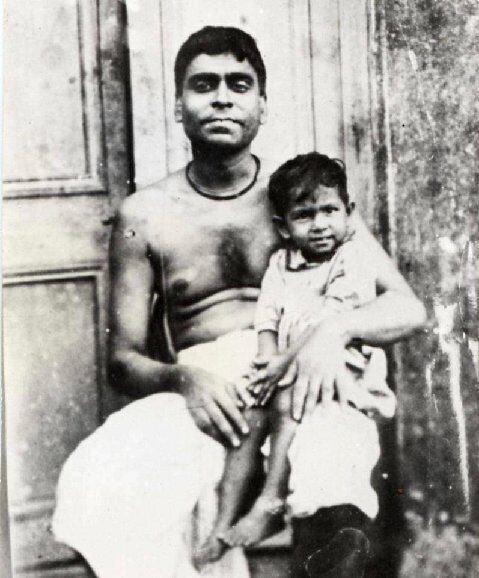
Bhaktivinoda Thakura's devotional and literary life unfolded, from beginning to end, inside a large and demanding household. He married twice and fathered fourteen children. He never withdrew from family responsibility, even as his writing and preaching expanded. Among his children was the son who would become Srila Bhaktisiddhanta Sarasvati Thakura, the next acharya in the line that leads to Srila Prabhupada and ISKCON.
| First wife | Shyamani Mitra of Ranaghat, married 1850, died 1861 |
| Second wife | Bhagavati Devi, daughter of Gangamoy Roy of Jakpore |
| Children | 14 total: 1 by Shyamani, 13 by Bhagavati Devi |
| Most noted son | Bimala Prasad (born 1874), later Bhaktisiddhanta Sarasvati Thakura |
| Family home | "Bhakti Bhavan," Maniktola Street, Calcutta |
Two Marriages #
As described on the first page of this section, Kedarnath's first marriage was arranged in the customary way in 1850, when he was twelve. His bride was five-year-old Shyamani Mitra of Ranaghat, daughter of Madhusudana Mitra. They had one son, Annada Prasad, born in 1860. Shyamani died the next year, and Kedarnath was left a widower at twenty-three. Soon after, he married again. His second wife was Bhagavati Devi, daughter of Gangamoy Roy of Jakpore. She became the mother of his other thirteen children, and his companion for the rest of his working and devotional life. She lived six years longer than her husband and died in 1920. Bhagavati Devi shared her husband's courage as well as the burdens of his household. During Bisakisen's trial the family was threatened. At that time she pleaded with Bhaktivinoda only because she feared for their children's safety. She never doubted that he was right to carry the case through to its end.
Fourteen Children #
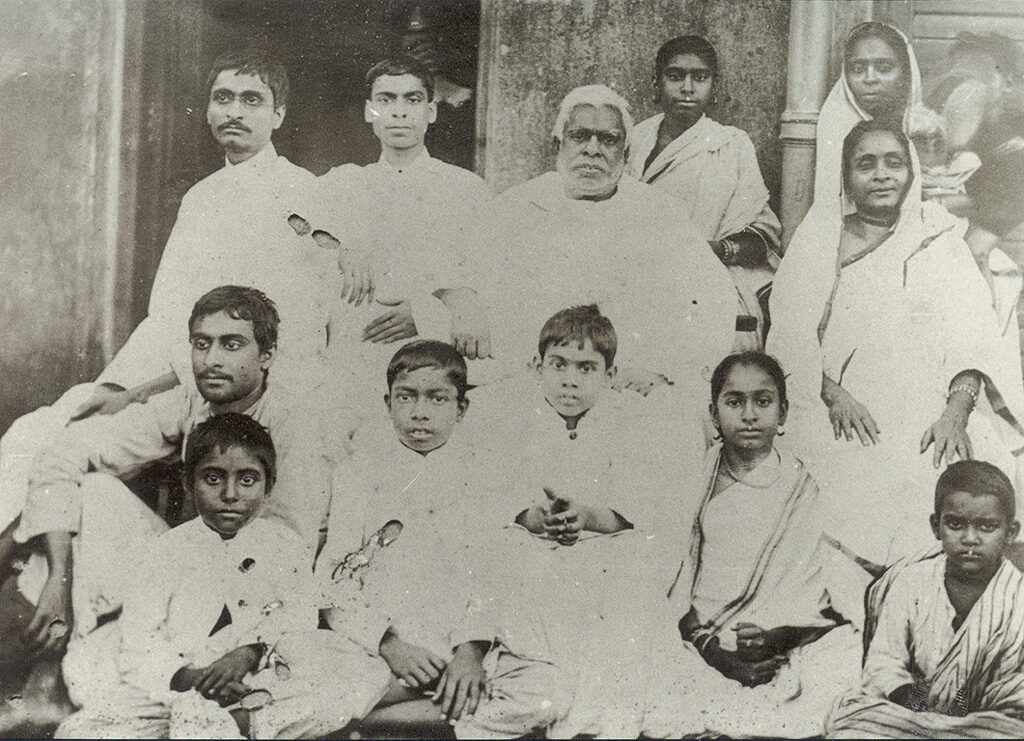
Between 1860 and 1891, Bhaktivinoda's household grew to fourteen children from his two marriages. Shyamani was the mother of Annada Prasad. Bhagavati Devi was the mother of Saudamani, Kadambini, a son who died in infancy, Radhika Prasad, Kamala Prasad, Bimala Prasad, Barada Prasad, Biraja Prasad, Lalita Prasad, Krishna Vinodini, Shyam Sarojini, Hari Pramodini, and Shailaja Prasad. A family photograph from around 1900 shows three generations gathered together. It was taken after Bhaktivinoda had settled his household at "Bhakti Bhavan" on Maniktola Street in Calcutta. It shows how large and settled the household had become in his later years, even as his devotional and literary work grew around it. During the years Bhaktivinoda was posted at Jagannatha Puri, the whole family lived together under one roof. He mentions this with clear satisfaction in his autobiography. His mother, his wife, and children including Annada, Radhika, Sadu and Kadu were all there. They received regular darshan of Lord Jagannatha as a normal part of daily life, not as a special pilgrimage. It was an unusually settled period in a career that was mostly marked by frequent transfers. Several of the sons went on to play their own roles in Gaudiya Vaishnava life. Bhaktivinoda wrote his autobiography, Svalikhita-jivani, in 1896 at the request of his son Lalita Prasad. After his father's passing, Lalita Prasad kept his own following, separate from the line that continued through his brother. But it was Bimala Prasad, the sixth child by Bhagavati Devi, who carried Bhaktivinoda's own work forward in the most lasting way, through an institution.
Bimala Prasad, the Seventh Child and Chosen Successor #
Bimala Prasad was born in February 1874 in Puri, during Bhaktivinoda's posting there as a magistrate. From childhood he showed the strong memory and discipline that his father's biographers speak of so much. By nine he had reportedly memorized the seven hundred verses of the Bhagavad-gita in Sanskrit. He kept an exceptional ability to recall texts, even decades after he had read them. Bhaktivinoda personally initiated him into chanting the Hare Krishna mantra, and taught him Sanskrit and the main Gaudiya philosophical texts. As the boy grew up, his father more and more treated him as the one who could carry on the work of restoring true Gaudiya Vaishnava teaching in the next generation. In 1911 there was a public theological debate in Balighai, Midnapore. The question was whether spiritual qualification came from caste birth or from initiation and practice. Bhaktivinoda did not go himself. He sent Bimala Prasad to represent the family's position. Bimala Prasad won the debate convincingly. He later took the name by which he is known today, Bhaktisiddhanta Sarasvati Thakura, and founded the Gaudiya Math. In time, this missionary institution sent out A.C. Bhaktivedanta Swami Prabhupada, the disciple who carried this teaching to the West.
A Householder's Discipline #
What is recorded of Bhaktivinoda's daily life shows a man who would not treat family duty, government service, and devotional writing as rivals for his time. Instead, he fitted all three into one very demanding daily schedule. According to later accounts of his household routine, he went to bed in the early evening and rose again around ten at night. He then wrote for about six hours. After that he took a short nap and rose before dawn to chant. His mornings were for letters, study, and visitors. The working day itself, often ten hours long, was spent in court as a magistrate. He raised his large family and met his duties as a government officer for twenty-eight years. Still, he produced all the writing described on the Literary Works page. In all his working life he never gave up his household or professional duties. In 1908, at the age of seventy, he had retired and his children were grown. Only then, at his house in Calcutta, did he formally take up the dress and practice of a babaji, a Vaishnava renunciant. He spent his final years absorbed in chanting, no longer in the duties of office and household that had filled most of his adult life.
Chapter 7
Final Years and Disappearance
His correspondence with Western scholars, his last years as a babaji, and his death on 23 June 1914
Long before anyone had reason to expect it, Bhaktivinoda Thakura believed that Chaitanya Mahaprabhu's teaching would one day be preached in the countries of the West. He acted on that belief, sending his own books across oceans to scholars and institutions who had no obvious reason to take a Bengali magistrate's theology seriously. He did not live to see the hope realized. He died on 23 June 1914, at seventy-five, more than half a century before a disciple of his son would carry Krishna consciousness to America in earnest.
| Retirement | 4 October 1894, age 56 |
| Books sent to the West | Krishna-samhita to Ralph Waldo Emerson and Reinhold Rost, 1880; Chaitanya Mahaprabhu: His Life and Precepts to Western academic libraries, 1896 |
| Adopted babaji life | 1908, at his residence in Calcutta |
| Disappeared | 23 June 1914, age 75, Calcutta |
Sending Krishna-samhita to Emerson and Rost #
In 1880, the year after it was published, Bhaktivinoda sent copies of his Sanskrit theological work Krishna-samhita to thinkers in Europe and America. He received replies from two respected men. One was Reinhold Rost, a Sanskrit scholar based in London. The other was Ralph Waldo Emerson, the American essayist, in the United States. Compared with later missionary work in the West, it was a small exchange. A book in Sanskrit could reach only a handful of Western readers. But it has since been described as, in effect, the introduction of Chaitanya's theology to the Western world. It also set a pattern that Bhaktivinoda would repeat.
A Book for Western Libraries #
In 1896 Bhaktivinoda published an English account of Chaitanya's teaching, Sri Chaitanya Mahaprabhu: His Life and Precepts. He wrote it especially to present Gaudiya Vaishnavism to readers with no Indian background. It described Chaitanya as a preacher of "equality of men" and "universal fraternity." He sent copies to academic addresses across the British Empire and beyond. They reached library shelves at McGill University in Montreal, the University of Sydney in Australia, and the Royal Asiatic Society in London. The book also reached the Oxford Sanskrit scholar Monier Monier-Williams, and it received a good review in the Journal of the Royal Asiatic Society. Some years earlier, he had already written about the hope behind all this in his own magazine, Sajjana-toshani: "When in England, France, Russia, Prussia, and America all fortunate persons by taking up kholas [drums] and karatalas [cymbals] will take the name of Chaitanya Mahaprabhu again and again in their own countries, and raise the waves of sankirtana, when will that day come!" That hope was fulfilled decades later. Bhaktisiddhanta Sarasvati's disciple Srila Prabhupada actually made the voyage to America. Bhaktivinoda had only been able to imagine it from his desk in Calcutta.
The Babaji's Final Years #
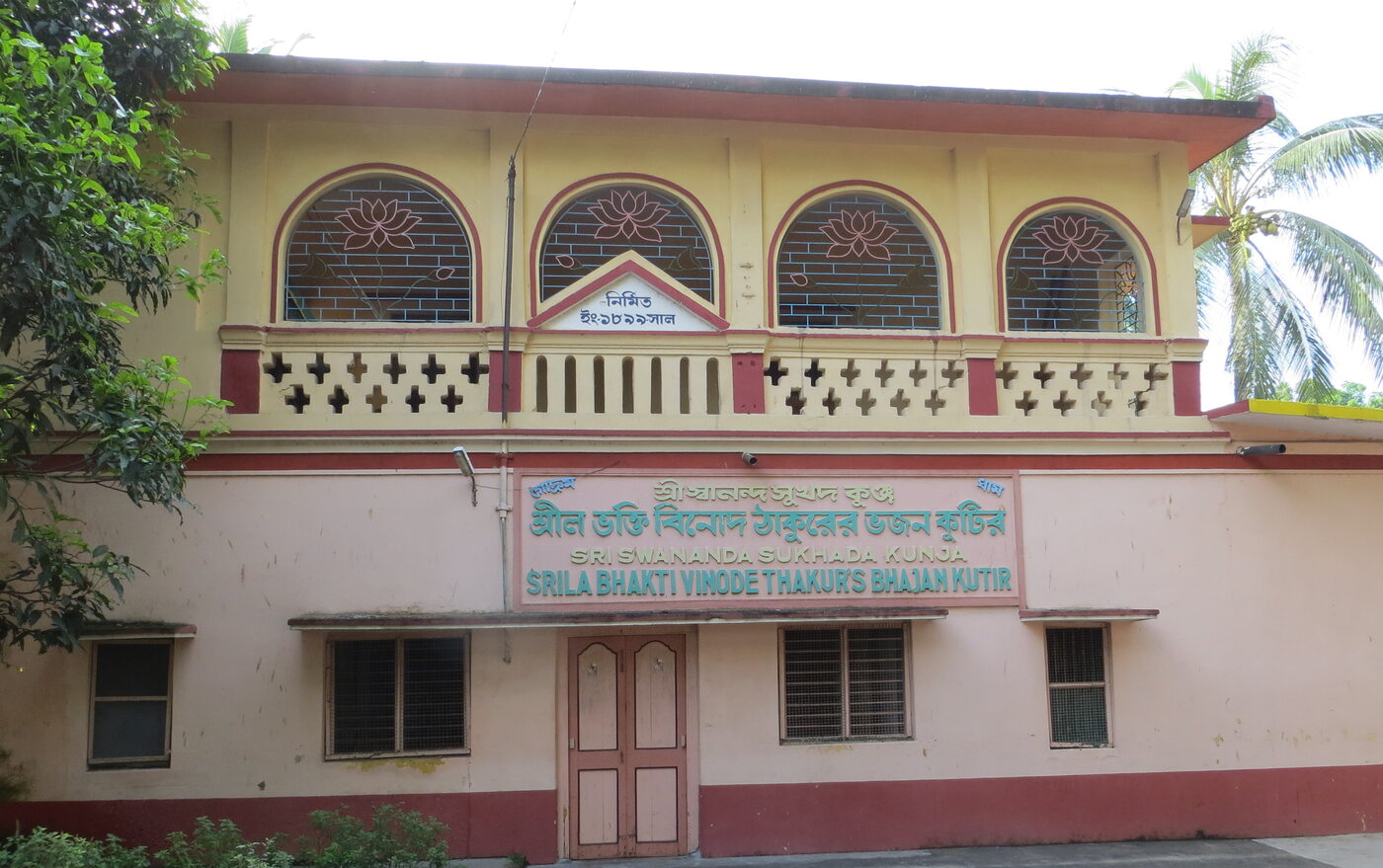
Bhaktivinoda retired from government service on 4 October 1894 and moved his family to Mayapur. He spent his remaining working years partly at Godrumadvipa and partly in Calcutta. He wrote, lectured, and looked after the institutions he had built around the birthsite temple and the nama-hatta preaching network. In 1897 he built a bhajana-kutira on the bank of the Sarasvati river at Godrumadvipa. He named the spot Svananda-sukhada-kunja. It was the very place from which Nityananda Prabhu had once begun His own preaching in Bengal. Bhaktivinoda's babaji vesha, the dress of a renunciant, did not come easily. For some time he kept going to Srila Gaura Kishora Dasa Babaji, by then an elderly renunciant at Godrumadvipa. Again and again he asked to be given the renounced order. Each time the babaji refused out of genuine humility. He insisted that he saw Bhaktivinoda as his own spiritual master, not the other way round. Once, sensing that Bhaktivinoda would ask yet again, Gaura Kishora Dasa Babaji hid for a day at the house of a woman of bad reputation near a Navadvipa marketplace. He reasoned that it was the one place his determined disciple would never think to look for him. He later laughed about having "outwitted" him. When Gaura Kishora Dasa Babaji finally agreed, he had Bhaktivinoda put on the old loincloth and begging-cloth of Srila Jagannatha Dasa Babaji, Bhaktivinoda's own departed siksha-guru. In this way Jagannatha Dasa Babaji's physical presence at the ceremony served as its witness. Then, in 1908, at the age of seventy, Bhaktivinoda took up the dress and life of a babaji at his house in Calcutta. He spent his last years mostly absorbed in chanting the Hare Krishna mantra. Even then, according to his disciples' accounts, his concern for preaching did not fully fade. During a serious illness in 1910 he was unable to walk. Even so, he reportedly asked to be carried from place to place so that he could continue teaching. Through these final years his son Bhaktisiddhanta Sarasvati stayed close to him. As late as 1913, a year before his father's passing, Bhaktisiddhanta Sarasvati was reading to him from his own commentary on the Chaitanya-caritamrita, which he was then still writing.
Disappearance, 23 June 1914 #
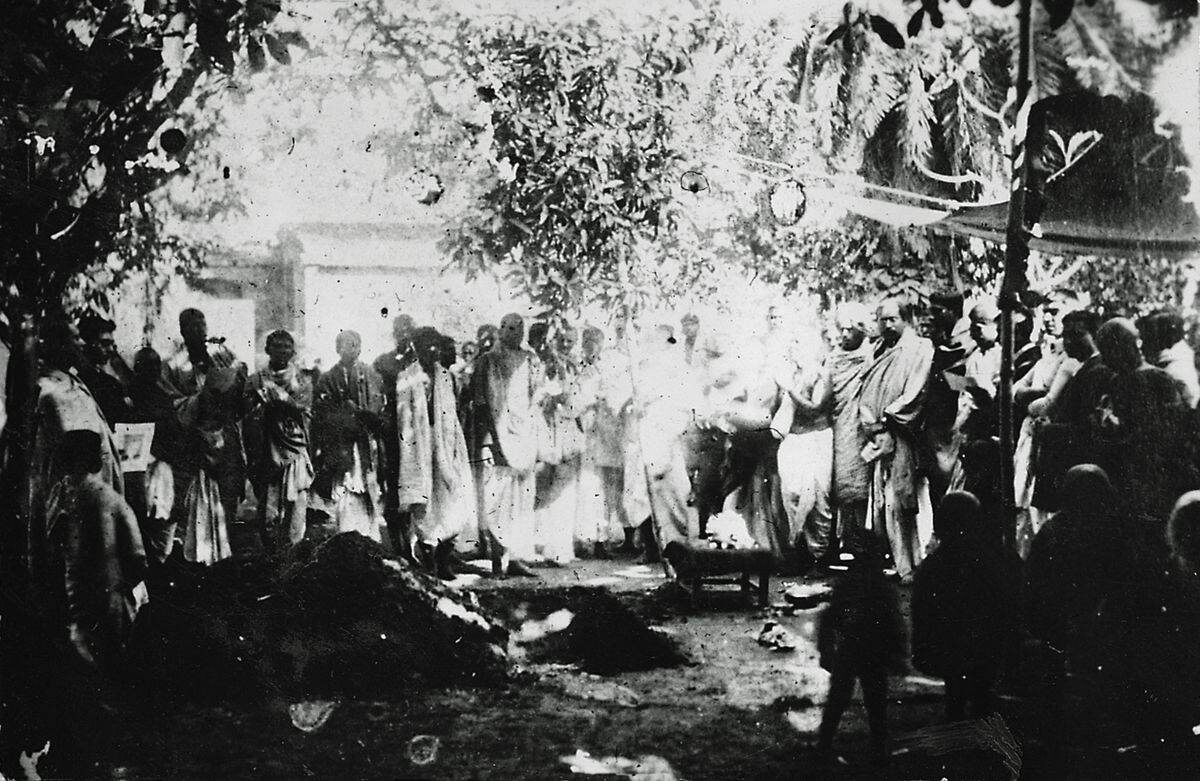
Srila Bhaktivinoda Thakura died at his house in Calcutta on 23 June 1914, at the age of seventy-five. Gaudiya Vaishnavas do not see that date as an ending, but as a return. The soul of a pure devotee is never really touched by death, as Krishna Himself declares: "For the soul there is neither birth nor death at any time. He has not come into being, does not come into being, and will not come into being. He is unborn, eternal, ever-existing and primeval. He is not slain when the body is slain" (Bhagavad-gita 2.20). So Bhaktivinoda Thakura's death marks his entry into eternal pastimes at Radha Kund. Gaudiya Vaishnavas observe it each year as his disappearance day. His remains were buried at Surabhi-kunj, the property he had obtained near Mayapur's birthsite temple decades earlier. One disciple from these final years, Krishna dasa Babaji, had served him faithfully since the Puri days and continued to do so to the end. After Bhaktivinoda's disappearance, Krishna dasa Babaji felt such intense separation that he gave up his own life within the year. His samadhi stands beside his master's at Godrumadvipa today.
The Seventh Goswami #
In Bhaktivinoda's own lifetime, the journalist Sisir Kumar Ghosh gave him the title "the seventh goswami," and so placed him alongside the original Six Goswamis of Vrindavan. The Six Goswamis had systematized Gaudiya theology in the sixteenth century. The title has stayed attached to his name ever since. It also became the title of the standard full-length English biography of him, The Seventh Goswami: A Biography of Srila Bhaktivinoda Thakura by Rupa Vilasa Dasa. That book is useful further reading for anyone who wants a fuller story than these seven pages can give. Bhaktivinoda did not live to see Krishna consciousness spread beyond India. For more than three decades he had hoped for this and written toward it. That work was left to his son and then, two generations later, to his son's disciple. But the direction had already been set by this magistrate, through Sanskrit letters mailed to Boston and London. His days as a colonial official left him no time to write, so he spent his nights writing.
Srila Prabhupada's Tribute #
Srila Prabhupada returned to this legacy often. Told once that Bhaktivinoda Thakura had said he was leaving the world with his work unfinished, he replied simply, "So let us finish it. We are descendants of Bhaktivinoda Thakura. It was kept unfinished so that we should get the chance to finish it. That's his mercy." In a Gaura Purnima lecture he went further: "The Chaitanya movement in its pure form, as it is, was restarted by Bhaktivinoda Thakura... Bhaktivinoda wrote about one hundred books, almost. Just imagine: he was a very responsible officer, a magistrate, and he was a grihastha; he also had many children... At the same time he served the Supreme Lord in so many ways. That is the beauty of his life." And in a 1971 lecture in London on Bhaktivinoda Thakura's appearance day, he told his own disciples plainly why they should honour him on that day: "So this Bhaktivinoda Ṭhākura's birthday, we should adore, we should worship, because in the modern age he reintroduced the disciplic succession... Ācārya-upāsanā: simply by the blessings of ācāryas we can make very rapid progress."
Closing
Songs in the Vaishnava Song Book #
The Vaishnava Song Book here carries 283 songs attributed to Srila Bhaktivinoda Thakura. See the full author page here.